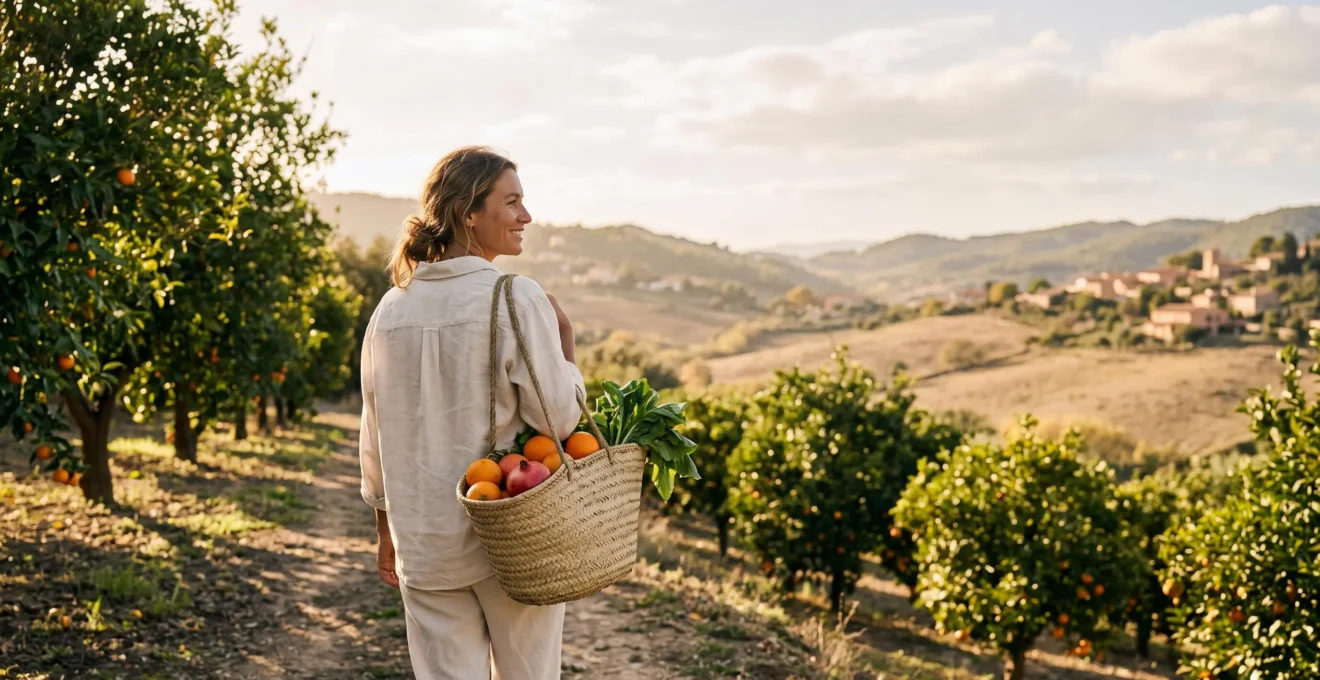
True culinary travel isn’t about visiting during a generic ‘harvest season,’ but timing your trip to a specific ingredient’s narrow biological peak for unparalleled flavor.
- Peak flavor is a result of terroir-specific breeding and fleeting ripeness, not just a date on a calendar.
- Authentic food festivals (sagre) celebrate the live harvest, unlike many commercial showcases designed for tourists.
Recommendation: Reverse-engineer your itinerary from the ingredient, not the destination, by identifying overlapping “micro-seasons” to experience multiple foods at their absolute best.
There is a universal experience for any traveler who truly loves food: biting into a sun-warmed tomato in August Sicily, a mango in a Thai market, or an oyster pulled from the water moments before. The flavor is electric, a completely different category of food from its supermarket counterpart. You try to recapture that magic back home, buying the same ingredient, but the experience is a pale imitation. The common advice for chasing this flavor is to travel during “harvest season,” a vague term that often leads to crowded, generic trips to well-known regions like Tuscany or Napa.
But what if the key wasn’t the region, but the timing? And what if “harvest season” is a misleading concept? The truth is that the peak flavor of an ingredient exists in a very narrow biological window, a fleeting moment when sugars, acids, and aromatic compounds are in perfect harmony. This moment is often disconnected from the broader, months-long period we call a harvest. The most rewarding culinary journeys are not planned around destinations, but are reverse-engineered from these precise moments of peak quality.
This guide moves beyond the simplistic advice. We will dismantle the difference between a true harvest and a commercial festival, teach you how to identify an ingredient’s peak biological window, and provide a framework for planning trips that let you experience multiple signature ingredients at their absolute zenith. It’s about shifting your mindset from a tourist to a seasonal strategist, ensuring every bite is as memorable as that first one.
To help you navigate this new approach, this article is structured to build your expertise step by step. Below, you’ll find a summary of the key topics we’ll explore, from understanding the science of flavor to mastering the logistics of planning.
Summary: How to Plan Food-Focused Trips Around Peak Harvest Seasons?
- Why Do Tomatoes in August Sicily Taste Nothing Like November Supermarket Versions?
- How to Plan Food-Focused Trips Around Peak Harvest Seasons?
- What Food Festivals Celebrate Peak Harvest Seasons in Different Regions?
- The Seasonal Timing Mistake That Means Missing Signature Ingredients Entirely
- How to Visit Regions When Multiple Signature Ingredients Overlap Peak Seasons?
- When Should You Visit Markets and Restaurants to Experience Local Food Culture?
- When Should You Cruise the Mediterranean to Avoid Heat and Crowds?
- How to Experience a City’s Food Culture Beyond Tourist Restaurant Traps?
Why Do Tomatoes in August Sicily Taste Nothing Like November Supermarket Versions?
The profound difference between a tomato picked at its peak in Sicily and one from a winter supermarket shelf is not just about sunshine; it’s a lesson in terroir and genetics. The iconic Pachino tomato, for example, is not a simple heirloom. It’s a product of careful science designed to thrive in a specific, challenging environment. Its exceptional flavor comes from terroir-specific breeding, where agronomists developed a variety that could withstand the region’s salty groundwater and intense summer heat.
As one analysis on the celebrated Pachino tomato explains, this is a product of deliberate innovation, not just inheritance. An article on its development notes that agronomists worked to develop a tomato able to withstand Pachino’s poor, salt-laden groundwater, which is precisely why the same seed planted elsewhere fails to replicate that signature intense, sweet-salty taste. This is the core principle: peak flavor is often a result of an ingredient perfectly adapted to its unique micro-environment, harvested at the precise moment of ripeness.
This concept of a “peak biological window” is what separates good from transcendent. Supermarket produce is bred for durability and shelf life, picked under-ripe to survive long-distance shipping. A tomato from Pachino, however, is harvested for immediate consumption when its sugar and acid levels are at their apex. It’s a fleeting state that cannot be replicated by artificial ripening, making the timing of your visit not just important, but everything.
How to Plan Food-Focused Trips Around Peak Harvest Seasons?
Planning a trip around an ingredient’s true peak requires a shift in strategy. Instead of picking a destination and then looking for “what’s in season,” you must reverse-engineer the process. Start with the ingredient and its narrow biological window, and let that dictate your timing and location. This requires more granular research than a standard guidebook provides, often involving direct contact with producers.
This hands-on approach is becoming more common among discerning travelers. In fact, data on U.S. culinary tourism shows that direct booking is the leading channel, surpassing third-party platforms. This trend reflects a desire for more authentic, tailored experiences, which is exactly what harvest-focused travel demands. Contacting a small farm or an agriturismo directly not only secures your booking but opens a dialogue about the exact timing of the harvest, which can shift by a week or two each year based on weather.
A structured timeline is essential. Roughly three months out, identify broad regional overlaps—for instance, where grape and olive harvests might coincide. At two months, narrow down to a specific micro-region and book key accommodations, as the best small-scale lodgings fill up fast. One month before your trip, contact producers to confirm tour availability, as the busiest harvest weeks can sometimes mean less access for visitors. Finally, in the week or two leading up to your departure, monitor regional agricultural updates and farm social media accounts to make any last-minute adjustments.
What Food Festivals Celebrate Peak Harvest Seasons in Different Regions?
The term “food festival” can be misleading. Many are large-scale commercial events that celebrate a processed product long after the harvest is over. A true harvest festival, or a local sagra in Italy, is an entirely different experience. It’s an event that exists because the raw ingredient is being pulled from the earth or picked from the tree that very week. The key is to distinguish between a genuine celebration of harvest and a staged commercial showcase.
The Alba White Truffle Fair is a perfect model of a “true” harvest festival. Held from October to December, it coincides directly with the live harvest of the prized tuber. The entire event is built around the freshly unearthed truffles being weighed, graded, and sold. The stakes are high; according to a report from Italy Segreta, prices reached up to €4,500 per kilogram in 2024, a figure that reflects the ingredient’s freshness and rarity. This direct link between the festival and the live harvest is the hallmark of an authentic culinary event.
To help you distinguish between these events, consider the following breakdown:
| Event Type | Relation to Harvest | Typical Scale | Example |
|---|---|---|---|
| Local Sagra | Held during the actual harvest window, celebrating the raw ingredient | Small village-level, often free entry | Village asparagus or chestnut sagre |
| Regional Fair | Timed to peak harvest, but with wider regional draw and commercial stalls | Tens of thousands of visitors | Alba White Truffle Fair (Oct-Nov) |
| Commercial Showcase | Celebrates a finished or processed product, sometimes staged well after harvest | 200,000+ visitors, imported raw materials common | Menton Lemon Festival, where festival fruit is largely imported from Spain |
Seeking out a local sagra over a massive, well-publicized festival often leads to a more intimate and authentic experience. These small-scale events are where you’ll find communities celebrating their agricultural heritage with genuine passion, offering a true taste of the season.
The Seasonal Timing Mistake That Means Missing Signature Ingredients Entirely
One of the most common errors in culinary travel is thinking of a “season” as one long, monolithic block of time. In reality, most ingredient seasons are composed of several distinct micro-seasons for different varieties. Arriving with the general idea of “truffle season” or “citrus season” can mean you miss the specific variety you came for by a matter of weeks, or even days.
The truffle calendar is a perfect illustration of this principle. The broader “truffle season” in Italy spans from late autumn through spring, but this period encompasses entirely different products. The prized white truffle (Tuber magnatum pico) has a very narrow peak in autumn. In contrast, the less aromatic but still delicious Bianchetto truffle runs from late January to early April. A trip planned for February to “hunt truffles” will yield a completely different experience—and flavor—than one in November. Mistiming your visit within that larger window can be the difference between abundance and absence.
This work is demanding and subject to the whims of nature, a reality often lost in romanticized travel narratives. As one veteran Piedmontese truffle hunter, or trifulau, shared in an interview with Italy Segreta, the reality is far from a gentle stroll in the woods:
It’s physically demanding. It’s tiring. The cold and humidity cause a lot of aches.
– Sergio, veteran Piedmontese truffle hunter (trifulau), Italy Segreta
This underscores why the harvest is so precious and its timing so critical. It is the culmination of immense effort and deep local knowledge. To truly honor it, the traveler must do their homework, researching the specific micro-season of their target ingredient and planning with precision.
How to Visit Regions When Multiple Signature Ingredients Overlap Peak Seasons?
The ultimate achievement for a culinary traveler is to plan a trip that aligns with the peak seasons of multiple signature ingredients. This requires a “harvest overlap” strategy, where you identify a region that becomes a temporary hub of agricultural abundance. This is best accomplished with a hub-and-spoke itinerary, where you establish a base in a central location and take day trips to surrounding micro-regions to experience different harvests.
Emilia-Romagna in autumn is a prime example of this strategy in action. The area around Bologna becomes a nexus of peak flavors. The first three weekends of November host the Savigno International White Truffle Festival. This period also coincides with the late stages of Parmigiano-Reggiano cheese production and the finishing of traditional balsamic vinegar in nearby Modena. By basing yourself in a city like Bologna, you can take day trips to a truffle hunt, a cheese dairy, and an acetaia, all within a few days, experiencing each product at a crucial moment in its creation.
Building this type of itinerary requires careful mapping and research, moving from a country-level view down to the specific valley or village. The goal is to find a genuine geographic cluster of overlapping seasons, rather than assuming a whole country is “in season” at once.
Your Action Plan: Building a Hub-and-Spoke Harvest Itinerary
- Identify & List: Make a list of every signature ingredient you want to experience. Research and note its typical peak harvest month and specific growing region.
- Map & Cluster: Plot these regions on a map to visually identify geographic clusters where two or more peak harvests genuinely overlap in time and proximity.
- Select a Hub: Choose a central town or small city within that cluster to serve as your home base, prioritizing one with good road connections to the surrounding areas.
- Plan Spokes: Design a series of day-trip “spokes” from your hub. Alternate between different harvest experiences—a winery one day, an olive press the next—to maximize variety.
- Verify & Book: Contact individual producers to confirm harvest timing and visitor access. Secure your accommodation in the hub well in advance, as these areas are popular with local and international food lovers.
When Should You Visit Markets and Restaurants to Experience Local Food Culture?
While farm visits and harvest festivals are primary goals, restaurants and local markets are where you witness the daily life of a food culture. Timing your visits to these venues is just as important. For restaurants, in particular, being there when the kitchen receives its freshest supply can transform a meal. In fact, the economic data underscores their central role; a recent market analysis shows that restaurant dining alone accounts for 44.1% of total consumer expenditure in culinary tourism.
To make the most of your time, it’s helpful to prioritize activities based on how travelers consistently rank them. Arriving early in the week (Tuesday or Wednesday) often means you’ll see the most exciting “specials” on a restaurant’s menu, reflecting the freshest deliveries from weekend markets. Local markets themselves are best experienced on their busiest days, typically Saturdays, when the widest variety of vendors and shoppers are present. The energy is higher, and the product selection is at its peak.
Based on traveler preferences and local rhythms, you can build a highly effective weekly schedule:
- Prioritize Local Restaurants First: Surveys show this is the single favorite culinary activity for travelers. Plan your key dinner reservations for early-to-mid week to catch chefs at their most creative with fresh produce.
- Visit the Main Market on a Weekend Morning: This is when you’ll see the community in action and find the best selection. Go early to experience the initial rush and energy.
- Use Food Tours Strategically: Book a local food tour early in your trip. It’s a fantastic shortcut to discovering hidden gems and building relationships with vendors that would otherwise take weeks.
- Reserve Tastings for the Afternoon: Activities like wine or olive oil tastings are generally less time-sensitive and are perfect for afternoons after the morning market rush has subsided.
When Should You Cruise the Mediterranean to Avoid Heat and Crowds?
The conventional wisdom for Mediterranean cruises is to travel in the peak summer months of July and August. However, for a food-focused traveler, this is often a mistake. The intense heat can be draining, and the crowds in port cities can make authentic experiences difficult to find. The “shoulder seasons” of spring (April-May) and autumn (September-October) offer a far better alternative, with pleasant weather, fewer people, and, most importantly, unique harvest opportunities.
Europe’s dominance in the culinary travel sector, where Europe alone captured an estimated 32.2% of global market revenue in 2025, is largely built on these rich, seasonal experiences that extend far beyond summer. A cruise in October, for example, could put you in proximity to the olive harvest in Greece or the grape harvest in Italy. A winter cruise offers even more unique possibilities.
Consider the port of Nice, France. While most tourists flock to the old town, a savvy traveler on a winter cruise can find a remarkable harvest just a short drive away. In the nearby town of Menton, the celebrated lemons are harvested by hand directly from the tree between January and March. This offers a rare, intimate agricultural experience at a time of year most people don’t associate with fresh produce. By pre-booking a visit to a lemon grove, a cruise passenger can turn a standard port day into an unforgettable encounter with a peak-season ingredient, completely avoiding the summer crowds.
Key Takeaways
- Focus on the “peak biological window” of an ingredient, not the generic, months-long harvest season, for the best flavor.
- Learn to differentiate between authentic local festivals (sagre), which celebrate the live harvest, and large commercial showcases, which may use out-of-season or imported products.
- Use a “hub-and-spoke” travel model to base yourself in a central location and take day trips to experience multiple, overlapping micro-seasons for different ingredients.
How to Experience a City’s Food Culture Beyond Tourist Restaurant Traps?
In any major city, the most famous restaurants are often clustered in the tourist center, serving reliable but rarely groundbreaking food. The true heart of a city’s food culture beats in its residential neighborhoods, where locals eat, shop, and socialize. Finding these places requires moving beyond top-ten lists and looking for neighborhood-level culinary ecosystems. While social media is a powerful tool, shaping an estimated 82% of food tourism decisions, its algorithms often amplify already-popular spots, creating echo chambers.
A more effective strategy is to identify a city’s historically immigrant or working-class neighborhoods. These areas are often where the most vibrant and authentic food scenes thrive, away from the high rents and tourist-driven menus of the city center. A perfect example of this is the Ironbound neighborhood in Newark, New Jersey. While many visitors to the New York area never venture into Newark, the Ironbound is a celebrated hub for Portuguese, Brazilian, and Spanish cuisine.
Case Study: Newark’s Ironbound Neighborhood
As a report on culinary travel trends highlights, Newark’s Ironbound neighborhood is known for its top-rated Portuguese, Brazilian, and Spanish restaurants. It’s even home to a designated food trail. This illustrates a key strategy: the most authentic food is often concentrated in a single residential area outside the main tourist core, discoverable through curated local guides rather than generic travel advice.
To find these neighborhoods, look for local food blogs, university newspapers, or cultural center websites rather than major travel publications. Once you’ve identified a promising area, spend an afternoon just walking around. Visit the local butcher, the bakery, and the small produce markets. This is where you’ll find the true pulse of a city’s food culture, building an experience that is deeply personal and far more memorable than any tourist trap.
Start planning your next culinary journey not by choosing a destination, but by choosing an ingredient at its absolute peak. Apply these principles to seek out the small farms, authentic festivals, and neighborhood restaurants that honor the seasons. Your palate will thank you for it.