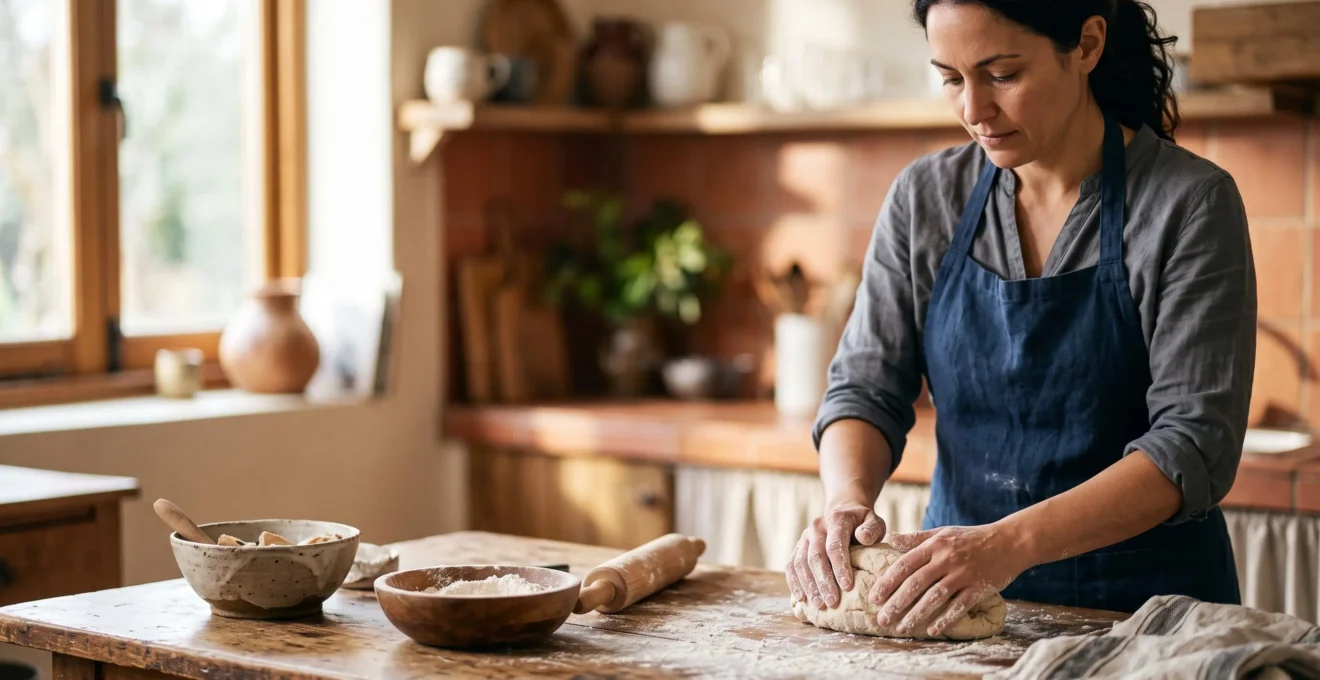
A great travel cooking class is measured by the skills you use back home, not the photos you take on vacation.
- Focus on workshops that teach transferable techniques, not just follow-along recipes.
- The best learning happens in environments that allow for real-time, individual feedback and correction, not just group observation.
Recommendation: Before booking, ask specific questions about student participation and the instructor’s teaching philosophy to separate genuine education from simple entertainment.
For any food-loving traveller, the dream is to bring a piece of the destination back home. You have a transcendent meal—a perfectly spiced tagine in Marrakech, a complex mole in Oaxaca—and you sign up for a local cooking class, eager to capture that magic. Yet, weeks later, the printed recipes gather dust. The experience was fun, but the skills didn’t stick. The common advice—”find a hands-on class” or “look for a market tour”—is often too simplistic. It fails to address the core reason for this disconnect.
The problem isn’t a lack of effort, but a misunderstanding of the goal. Many workshops are designed for entertainment, a fun afternoon activity that results in a great meal and a good photo. They are not, however, designed for effective skill transfer. The real challenge is learning to distinguish between a culinary photo-op and a genuine educational experience. The secret lies not in the dish being cooked, but in the pedagogical design of the workshop itself.
This guide provides a new framework for evaluating cooking workshops. We will move beyond superficial labels to analyse the structure, format, and venue of a class to determine its true value. By focusing on how skills are taught and retained, you can ensure your next culinary adventure provides a return on investment that lasts long after your suitcase is unpacked: the confidence and ability to recreate authentic dishes in your own kitchen.
To help you become a discerning student of global cuisine, this article breaks down the essential factors. We will explore the fundamental differences in teaching methods, provide tools for vetting potential classes, and offer strategies for making what you learn a permanent part of your culinary repertoire.
Summary: A Guide to Choosing Skill-Building Cooking Workshops
- Why Do Hands-On Workshops Teach More Than Chef Demonstration Classes?
- How to Choose Cooking Workshops That Teach Usable Skills for Home?
- Cooking School vs Home Kitchen vs Restaurant: Which Workshop Venue for Learning?
- The Workshop Format That Delivers Photos but Zero Usable Skills
- How to Retain Cooking Workshop Skills After Returning Home?
- Food Tour vs Independent Exploration vs Cooking Class: Which for Cultural Depth?
- How to Identify Genuinely Educational Activities From Basic Childminding?
- How to Find Cooking Experiences That Teach Disappearing Traditional Techniques?
Why Do Hands-On Workshops Teach More Than Chef Demonstration Classes?
The term “hands-on” is often misused. A truly effective hands-on workshop is fundamentally different from a demonstration class because it engages a different mode of learning. Demonstrations rely on passive observation and note-taking. You watch a chef perform a task, and you try to remember the sequence. However, this method completely bypasses the development of muscle memory, which is the cornerstone of any practical skill, from playing an instrument to mastering knife cuts.
True learning in a kitchen happens through tactile experience and immediate correction. A chef instructor, in a proper hands-on setting, can provide real-time feedback that a video or demonstration never can. They notice you’re “holding your knife at the wrong angle, when your pan isn’t hot enough, or when you’re over-mixing dough,” and correct you before the mistake becomes a habit. This interactive feedback loop is what transforms a recipe from a set of instructions into an internalized technique.
Ultimately, the goal is not just to replicate one dish, but to understand the principles behind it so you can apply them to other ingredients and contexts. This deeper understanding is almost exclusively built through active participation, trial, and guided error. The following table, based on common culinary education distinctions, clarifies the core differences.
| Feature | Demonstration Class | Hands-On Class |
|---|---|---|
| Student Role | Observe and take notes while the instructor cooks | Actively perform each step of the recipe |
| Feedback Loop | Minimal to none, questions only after the fact | Real-time correction from the instructor as you work |
| Skill Retention | Lower, based on passive viewing | Higher, based on repeated physical practice |
| Best For | Social evenings, entertainment-first formats | Building transferable techniques for home cooking |
How to Choose Cooking Workshops That Teach Usable Skills for Home?
Vetting a cooking workshop before you book is crucial to avoid disappointment. The key is to look for signs that the class is designed for learning, not just for show. A major red flag is an overemphasis on perfectly manicured presentation. If all the promotional photos show pristine, pre-chopped ingredients in tiny bowls (a practice called *mise en place*), be wary. True learning is often messy; it involves you, the student, doing the chopping, peeling, and mixing.
The image above perfectly illustrates the dichotomy. The left side represents the “photo-op” workshop, where everything is prepared for you. The right side represents genuine learning—the flour, the uneven cuts, the process itself. You must become a detective, looking for clues in the class description, photos, and reviews. Ask yourself: does this look like a kitchen where people are working and learning, or a stage set for a food magazine?
To help you in this process, arm yourself with specific questions to ask the school before you pay. A school focused on education will welcome these questions, while one focused on entertainment may be evasive. Your goal is to confirm that you will be an active participant, not just an audience member, and that the skills taught are adaptable to a standard home environment. Inquire about ingredient substitutions and the availability of recipes adapted for home equipment. These details signal an instructor who understands the challenge of skill transfer.
Cooking School vs Home Kitchen vs Restaurant: Which Workshop Venue for Learning?
The location of a cooking workshop significantly influences the type of skills you will learn and their transferability to your own kitchen. Each venue—a formal cooking school, a professional restaurant, or an intimate home kitchen—has distinct advantages and disadvantages. Your choice should align with your primary goal: are you seeking structured curriculum, professional efficiency, or real-world adaptability?
A professional restaurant kitchen offers a tantalizing glimpse into the world of high-speed, high-pressure cooking. You’ll learn about efficiency and organization, but the specialized equipment (like salamanders and industrial-grade mixers) and frantic pace are rarely replicable at home. A formal cooking school provides a structured, progressive curriculum, which is excellent for building foundational skills from the ground up. However, these environments can sometimes feel sterile and less connected to the local culture.
For acquiring genuinely usable skills, the home kitchen setting is often superior. Learning from individuals or families, as some experts suggest by prioritizing “classes that are run by an individual or families as opposed to hotels or culinary schools,” offers a unique advantage. In this setting, you are forced to work with standard equipment and common ingredients, learning the art of resourcefulness and adaptation. This is where you learn how to make a dish work without a gadget, a crucial skill for any home cook. The cultural intimacy of sharing a family kitchen provides a depth of experience that a commercial setting can rarely match.
The following comparison helps clarify which venue best suits your learning objectives, as highlighted in analyses by resources like the Reluctant Gourmet on culinary class types.
| Venue | Primary Strength | Best Goal | Trade-off |
|---|---|---|---|
| Cooking School | Structured curriculum, progressive skill-building | Structured Curriculum | Can be less spontaneous or intimate |
| Restaurant Kitchen | Professional speed, efficiency, specialized equipment | Professional Efficiency | Tools and pace rarely translate to home cooking |
| Home Kitchen | Adaptability, resourcefulness, cultural intimacy | Real-World Adaptability & Usable Skills | Less standardized, more variable structure |
The Workshop Format That Delivers Photos but Zero Usable Skills
One of the most common and deceptive workshop formats is the “one task per person” assembly line. In this setup, a group of participants works together to create several dishes, but each person is only responsible for one or two steps of the entire process. One person chops the onions for all five dishes, another sautés the garlic, and a third plates the final product. While efficient for producing a meal, this format is an educational disaster. It completely prevents skill acquisition because no single participant experiences the full arc of creating a dish from start to finish.
A traveller recounted a classic example of this failure in a large group class where “each person only made one dish from start to finish,” even though the group collectively produced a large feast. You may watch eighteen dishes being prepared, but if you only perform the actions for one, you have only learned one. The repetition and integration of steps that build competence are entirely absent. This format is designed for group entertainment and logistics, not individual learning. It prioritizes the “ta-da” moment of a beautiful final spread over the gritty, repetitive work of actual practice.
True technique is built through repetition and feel. It’s the act of kneading dough until the texture changes under your hands, of learning to chop vegetables to a uniform size through practice, of controlling the heat of a pan by sight and sound. These are sensory, physical skills. A workshop that denies you this full-process experience is offering a simulation of cooking, not a lesson in it.
How to Retain Cooking Workshop Skills After Returning Home?
The cooking class is only the beginning. The most critical phase for skill retention happens in the days and weeks after you return home. The sensory details of the workshop—the smell of spices, the feel of the dough, the instructor’s voice—are fresh in your mind, but this memory is fleeting. To convert this short-term experience into long-term ability, you must engage in a deliberate process of practice and reinforcement.
The first step is to bridge the gap between the holiday environment and your everyday kitchen. Don’t wait. The longer you delay, the more the details will fade. Recreate the meal as soon as possible, ideally within 48 hours. This immediate repetition helps lock in the motor skills and procedural steps. During the class, it’s also wise to take your own notes. As one experienced traveller mentions, “I’ll take a notebook and write things down as I go,” capturing the small tips and sensory cues that don’t make it into the official recipe handout.
Beyond simply repeating the recipe, the key to true skill transfer is to isolate and practice the core techniques you learned. If the class taught you how to make a perfect emulsion for a vinaigrette, don’t just remake that one salad. Practice the emulsification technique with different oils and acids. This decontextualization is what transforms a single recipe into a versatile, foundational skill in your culinary arsenal.
Your Action Plan: Cementing Workshop Skills at Home
- Recreate the full workshop meal within the first 24 to 48 hours of returning home while the sensory memory is fresh.
- Source at least one signature ingredient from the destination to anchor the dish in authentic flavor.
- Repeat the recipe a second time within a week, then a third time within a month to move the technique into long-term memory.
- Isolate one core technique from the class and practice it with different ingredients rather than only repeating the same recipe.
- Before booking, ask if recipes are adapted for standard home kitchen equipment and common ingredient substitutions.
Food Tour vs Independent Exploration vs Cooking Class: Which for Cultural Depth?
When seeking to understand a culture through its food, travellers have several paths. Independent exploration allows for serendipity but can lack context. Food tours provide curated access and storytelling, making them incredibly popular. In fact, a recent report shows that activities like food festivals (46%), local food tours (41%), and wine tastings (39%) rank as top culinary activities for luxury travellers. These are fantastic ways to sample a wide variety of what a destination has to offer.
However, these methods position you as a consumer, an observer. You are tasting the final product, but you are not engaging with the process of its creation. A cooking class, by contrast, offers a different, arguably deeper, level of cultural immersion. It shifts your role from passive taster to active participant. You are not just eating the food; you are learning the ‘how’ and ‘why’ behind it. You are touching the ingredients, learning the history of a dish, and understanding the techniques passed down through generations.
This active engagement provides a unique lens into the local culture. The choice of spices, the method of preparation, the rituals surrounding a meal—all of these are cultural artifacts. As the World Food Travel Association puts it, the goal is “travelling for a taste of place to get a sense of place.” While a food tour lets you taste the place, a cooking class lets you get your hands dirty in it, providing a tangible, sensory connection that mere consumption cannot replicate. The skill you bring home is not just a recipe; it’s a small, living piece of that culture.
How to Identify Genuinely Educational Activities From Basic Childminding?
Not all “hands-on” activities are created equal. There is a crucial distinction between experiences that are genuinely educational and those that are essentially a form of adult “childminding”—activities designed to keep participants occupied and entertained without any real learning objective. As one culinary instructor notes, while some settings are for fun, in “there are other settings where the goal is really to teach people some key learning outcomes.” The challenge is spotting the difference.
A genuinely educational experience is built on a principle called scaffolding. An instructor provides just enough support to help a student complete a task they couldn’t do on their own, then gradually removes that support as the student’s competence grows. They allow for mistakes because mistakes are learning opportunities. They explain the ‘why’ behind each step, building a conceptual framework.
“Childminding,” in contrast, involves hand-holding. The instructor simplifies the task to the point of being foolproof, or even completes it for the participant to ensure a perfect outcome. Mistakes are silently fixed or prevented entirely. The focus is on the flawless final product, not the learning process. This approach may feel supportive and pleasant, but it builds dependency, not skill. To assess an instructor’s approach, you can draw from concepts used in evaluating educational programs.
| Signal | Scaffolding (Real Education) | Hand-Holding (Childminding) |
|---|---|---|
| Error Correction | Instructor corrects technique in real time before habits form | Mistakes are silently fixed or prevented entirely by staff |
| Task Ownership | Participant performs the full task with guidance | Task is simplified or completed for the participant |
| Explanation | The ‘why’ behind each step is taught | Only the ‘what to do next’ is given |
Key Takeaways
- True hands-on learning involves individual work and real-time correction, not just group observation.
- The best venue for learning usable skills is often a home kitchen, as it mirrors your own environment and teaches adaptability.
- Retaining skills requires immediate practice and repetition upon returning home; the learning doesn’t end with the class.
How to Find Cooking Experiences That Teach Disappearing Traditional Techniques?
For the truly dedicated food traveller, the ultimate experience goes beyond learning popular national dishes. It involves seeking out and helping to preserve disappearing culinary traditions. Around the world, industrial agriculture and globalization are threatening the existence of unique local ingredients and time-honoured techniques. Finding workshops that teach these skills requires looking beyond mainstream tourism platforms and connecting with grassroots organizations dedicated to culinary heritage.
A prime example is the Slow Food movement. Their Presidia project is a global initiative aimed at protecting and relaunching “local and traditional agriculture at risk of extinction.” These Presidia are communities of producers committed to passing on traditional methods. Seeking out experiences within these communities is a direct way to learn from masters and support the preservation of their craft. This network is vast, with a global community dedicated to this mission.
Finding these experiences often means connecting with local food advocacy groups, agricultural cooperatives, or organizations like Slow Food, which boasts a network of more than 100,000 members and branches in over 150 countries. It involves a shift in mindset—from looking for a “class” to seeking an “apprenticeship,” however brief. This is not about a quick, polished lesson. It is about witnessing, participating in, and valuing a living piece of cultural history, often in a simple, unadorned setting.
Armed with this evaluative framework, your next culinary travel experience can be more than just a memorable meal—it can be a lasting investment in your skills and a deeper connection to the culture you’re exploring. Start evaluating your next workshop not just as a tourist, but as a dedicated home cook seeking to learn, grow, and preserve. Your future dinner guests will thank you.