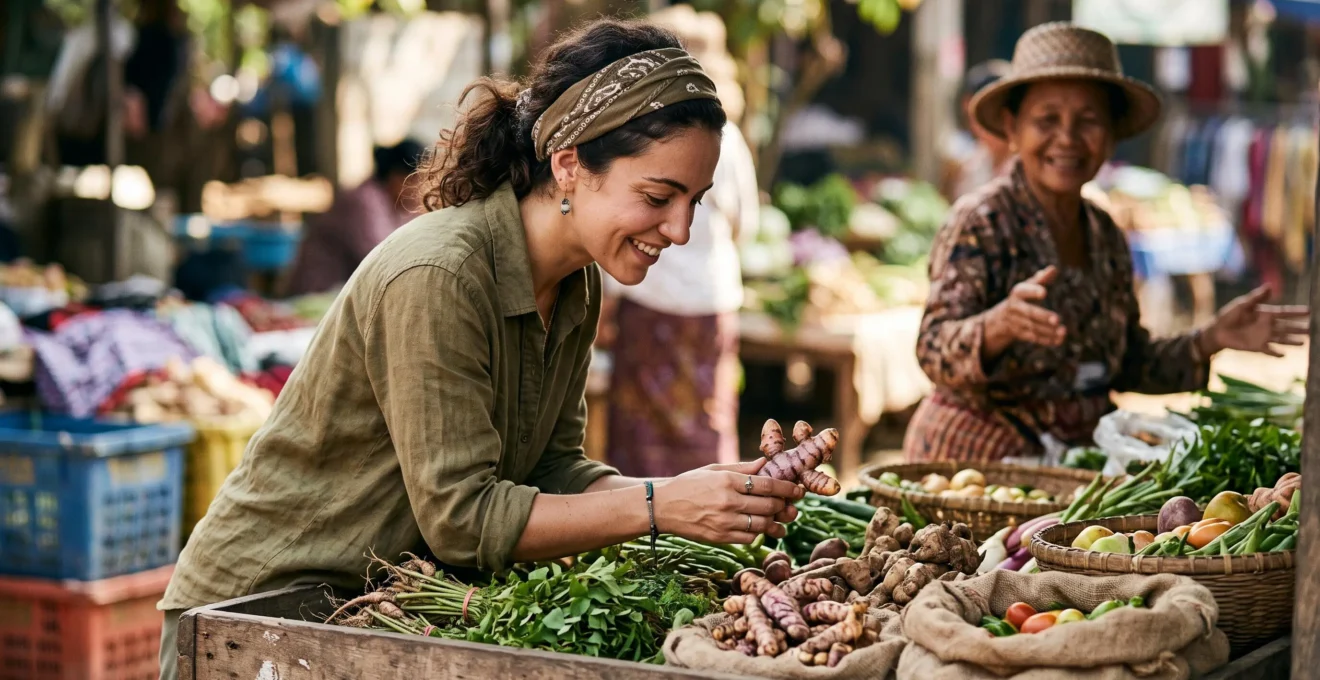
True culinary appreciation isn’t about finding the best restaurant; it’s about decoding the specific ingredients that give a local cuisine its soul.
- An authentic regional ingredient is a historical and ecological document, carrying the story of its specific place, climate, and culture.
- Official labels like PDO or AOC protect the entire origin story—genetics, terroir, and process—not just a recipe, creating an irreplaceable product.
- Substituting even one key ingredient can break the “authenticity chain,” transforming a unique regional dish into a generic copy.
Recommendation: On your next trip, learn to “read” the ecological layers of a place—its soil, climate, and seasonal calendar—to truly understand what makes its food special.
For the food-conscious traveller, a trip is a quest for flavour. We arrive in a new place with a list of dishes to try, markets to visit, and restaurants to book. We diligently follow advice to “eat like a local,” believing that authentic experience is found on the plate. But this approach often misses the most crucial element, the very foundation of a region’s culinary identity. We focus so much on the finished recipe that we overlook the story told by the ingredients themselves.
The common wisdom is to visit a bustling food market. While a vital first step, it often remains a surface-level interaction—a colourful photo opportunity rather than a deep learning experience. True understanding doesn’t come from just tasting the final product. It comes from questioning what makes that product possible in the first place. What if the real secret to appreciating local food wasn’t in learning recipes, but in learning to read a landscape? What if we treated a single, unique regional ingredient not as a component, but as a complete historical and ecological document?
This guide proposes a shift in perspective. Instead of focusing on what chefs do with ingredients, we will explore the ingredients themselves—as products of a specific terroir, genetic heritage, and cultural history. We will delve into why a single, protected ingredient can be more important than any cooking technique, how to decipher quality labels, and why substituting one component can erase a dish’s entire identity. By learning to see the story in the soil, the calendar, and the supply chain, you will unlock a far deeper and more meaningful appreciation for every local cuisine you encounter.
This article provides a complete framework for shifting your focus from the plate to the source. You will find a structured path to building profound ingredient knowledge, transforming your travels from simple culinary tours into rich cultural and ecological explorations.
Summary: How to Identify and Truly Appreciate the Regional Ingredients That Define a Cuisine
- Why Do Regional Ingredients Matter More Than Cooking Techniques for Cuisine Identity?
- How to Identify and Appreciate Regional Ingredients That Define Local Cuisines?
- What Do PDO, PGI, and AOC Labels Mean for Regional Food Ingredients?
- The Ingredient Substitution That Transforms Regional Dishes Into Generic Versions
- When Are Regional Ingredients at Peak Quality and Market Availability?
- Why Do Local Food Markets Reveal Social Structures Better Than Any Museum?
- Why Does Local Gastronomy Reveal More About Cultures Than Museums?
- How to Navigate Local Food Markets as a Cultural Learning Experience?
Why Do Regional Ingredients Matter More Than Cooking Techniques for Cuisine Identity?
In the world of gastronomy, technique is often glorified. We celebrate complex sauces, intricate knife work, and innovative cooking methods. Yet, for the most iconic regional cuisines, the identity of a dish is cemented long before a chef ever touches it. The true author of flavour is often the terroir—the unique combination of soil, climate, and geography—and the specific genetic heritage of the ingredient it produces. The Bresse chicken from France serves as the ultimate example of this principle.
This isn’t just any chicken. In 1957, it became the only living creature to be granted France’s prestigious Appellation d’Origine Contrôlée (AOC). This protection doesn’t safeguard a recipe; it safeguards a specific genetic bloodline (the white Bresse Gauloise) raised on a strictly defined patch of earth, under exacting conditions. The flavour is considered inseparable from its origin. As the famous epicure Jean Anthelme Brillat-Savarin declared, it is “the queen of poultry, the poultry of kings.”
This protection creates extreme rarity and value. Data on the protected breed shows that with an annual production of about 1.2 million birds, it represents a tiny fraction—around 0.1%—of total French poultry output. This isn’t a matter of simple scarcity; it’s a testament to the belief that no amount of culinary skill can replicate the taste derived from this unique combination of genetics and place. You can use the most advanced cooking technique in the world on a generic industrial chicken, but you will never create the flavour of a Bresse chicken. Here, the ingredient is not a component; it is the dish.
This idea extends to countless other products, from San Marzano tomatoes grown in the volcanic soil near Mount Vesuvius to Istrian olive oil whose taste is shaped by the Adriatic winds. In these cases, the cooking is often simple by design, intended to showcase, not mask, the inherent quality of the ingredient. The most important work was done by farmers, breeders, and nature itself, decades or even centuries before the dish was conceived.
How to Identify and Appreciate Regional Ingredients That Define Local Cuisines?
Moving beyond simply tasting to truly understanding requires a method. Instead of a random walk through a market, you need a framework for “reading” the landscape and its produce. The ‘Ecological Layers’ framework offers a practical way to deconstruct a cuisine’s ingredient identity. It’s a repeatable method that helps you look past the restaurant menu and toward the land itself, turning you into a culinary detective.
The process starts with the most fundamental layer: the micro-climate and soil. The first question to ask is: “What grows or lives here that does not grow just 50 kilometres away?” This question forces you to identify the hyper-local specialties—the specific olive cultivar that thrives only on this side of the mountain, the heritage pig breed adapted to a particular forest, or the wild herb that appears only in these coastal fields. This is the foundation of terroir.
Next, you consider the seasonal calendar. This goes beyond the four broad seasons. You must look for micro-seasons and the food cycles they govern. When is the short, three-week window for wild asparagus? When are the local figs at their absolute peak of sweetness? Understanding this rhythm reveals why certain dishes only appear on menus for a fleeting moment. It connects you to the community’s alignment with the land’s natural clock, a stark contrast to the year-round availability of a globalised supermarket.
By applying this lens, you begin to see ingredients not as commodities but as outcomes. A gnarled, flavourful heirloom tomato is a direct result of a specific seed, soil composition, and sun exposure. You learn to appreciate its value not just for its taste, but for the entire ecological and agricultural story it represents. It’s an intellectual and sensory exercise that transforms how you travel and eat.
Action Plan: How to Decode Regional Ingredients
- Pre-Trip Research: Before traveling, identify two or three dishes or food traditions unique to the specific region. Research their key ingredients and their history so you know what to look for.
- Ecological Inquiry: Upon arrival, ask locals or a guide about the land itself. Use questions like, “What makes your olive oil different from the next valley’s?” or “Why does this cheese taste this way?” to get past surface-level answers.
- Guided Orientation: Book a structured food tour or a cooking class early in your stay. Use this opportunity to learn local names for ingredients, ordering etiquette, and the cultural context behind the food.
- Visit a Production Site: Seek out small, working food sites—a local dairy, a small-batch olive press, a family-run salumeria—rather than just consumption sites. Seeing the process provides invaluable context.
- Market Cross-Reference: After visiting a production site or taking a tour, return to a local market. You’ll now see the stalls with an educated eye, able to identify specific producers and understand the value behind different price points.
Ultimately, this framework trains your palate and your mind. You begin to recognise the subtle notes in an olive oil that speak of the nearby sea, or the dense texture in a loaf of bread that comes from a low-yield ancient grain. It’s the difference between hearing a song and reading the sheet music.
What Do PDO, PGI, and AOC Labels Mean for Regional Food Ingredients?
As you explore regional foods, you’ll encounter a dizzying array of acronyms on packaging: PDO, PGI, AOC, TSG. These are not mere marketing stickers; they are legally binding geographical indications (GIs) that function as a guarantee of authenticity. Understanding them is crucial to decoding an ingredient’s story, as they certify the link between a product and its specific place of origin. For a food-conscious traveller, they are signposts pointing to true regional character.
The European Union has a particularly robust system. The most stringent is PDO (Protected Designation of Origin). For a product to bear the PDO label, every single step—from production of raw materials to processing and preparation—must occur within the defined geographical area, using recognised local know-how. It’s an ironclad guarantee of provenance.
Slightly more flexible is PGI (Protected Geographical Indication). This label requires that at least one stage of production, processing, or preparation takes place in the designated region. This allows for some raw materials to come from elsewhere, while still ensuring the product’s character is linked to the area. Finally, TSG (Traditional Speciality Guaranteed) protects a traditional recipe or production method, not a geographical location.
This table breaks down the key differences, using data synthesized from official EU explanations of its quality schemes.
| Scheme | What It Requires | Example |
|---|---|---|
| PDO (Protected Designation of Origin) | Every part of production, processing and preparation must take place in the specific region, using recognized local know-how | Kalamata olive oil, entirely produced in the Kalamata region of Greece |
| PGI (Protected Geographical Indication) | At least one stage of production, processing or preparation must occur in the defined area; raw materials can partly come from elsewhere | Many regional fruits, vegetables and meats registered across EU member states |
| TSG (Traditional Speciality Guaranteed) | No geographic link required; the recipe, raw materials or processing method must be traditional, i.e. used for at least 30 years | Recipes recognized for their traditional character rather than their origin |
However, these systems are not without their complexities. Despite the rigour of certification, official EU data reveals that only 20% of surveyed consumers recognised the PGI logo, suggesting a significant gap between regulatory effort and public awareness. Furthermore, some academic studies on the EU’s GI system highlight a “dark side,” where the framework can entrench the power of established landowners, making it difficult for smaller or newer producers to gain the same protections. This adds a layer of socio-economic context to the simple logo on a package.
For the traveller, these labels are a powerful tool. They offer a shortcut to identifying products that are deeply rooted in a place’s history and environment. While not a perfect system, a PDO or AOC label is a strong indicator that you are holding an ingredient that is, by law and by nature, irreplaceable.
The Ingredient Substitution That Transforms Regional Dishes Into Generic Versions
A regional dish is a fragile ecosystem, a chain of authenticity where each link is a specific, place-based ingredient. The magic of the dish relies on the integrity of this chain. When one link is replaced—a standard industrial tomato for a sun-dried Puglian one, a generic olive oil for a peppery Tuscan variety, or factory-made pasta for a hand-rolled local shape—the chain breaks. The dish may still be edible, even enjoyable, but its soul, its unique regional identity, is lost. It becomes a generic version of itself.
This process of substitution is often driven by the economics of scale and the pressures of tourism. A case study of a Chinese restaurant group famous for its Shanxi handmade noodles illustrates this perfectly. As the chain expanded, some outlets began using industrially manufactured noodles and concentrated soup bases to speed up service and reduce costs. While commercially “acceptable” to many customers, each substitution hollowed out the dish’s identity, severing its connection to the craft and tradition of hand-pulled dough and long-simmered broths.
This phenomenon, where traditional dishes are altered to meet tourist expectations or business demands, is known as the commodification of authenticity. The visual language of a dish might remain—it still *looks* like the authentic version—but its flavour profile, texture, and cultural resonance are fundamentally diluted. The discerning traveller must learn to detect these subtle but critical differences.
Recognizing the integrity of the authenticity chain means paying attention to details. Does the Neapolitan pizza have the slightly chewy, blistered crust that can only come from ’00’ flour and a screaming-hot wood-fired oven? Does the pesto have the vibrant, non-astringent bite of true Ligurian basil and pine nuts, or is it a flat-tasting version made with cheaper cashews? These are not questions of snobbery; they are questions of respect for the culinary ecosystem that created the dish. Appreciating this difference is key to seeking out and supporting the artisans who keep these traditions alive.
The lesson for the traveller is to become an advocate for the entire chain. When you choose a restaurant that proudly names its olive oil producer or a shop that sells cheese from a single, named farm, you are voting for authenticity. You are rewarding the preservation of the entire system, ensuring that these unique culinary documents are not replaced by generic, mass-produced copies.
When Are Regional Ingredients at Peak Quality and Market Availability?
The global food system has conditioned us to expect everything, everywhere, all the time. But the foundation of regional cuisine is the exact opposite: it is the celebration of something, somewhere, for a very specific and often fleeting time. Understanding an ingredient’s peak is not just about finding it “in season”; it’s about understanding its hyper-seasonal calendar and the precise moment of its highest quality.
The generic advice to “seek out local markets for seasonal ingredients” is a starting point, but it lacks the necessary precision. A whole season, like “summer,” is too broad a category. Within that season are numerous micro-seasons. The first pale strawberries of early June are a different ingredient from the deep, jammy berries of late July. The young, tender garlic of spring bears little resemblance to the pungent, cured heads of autumn. A true appreciation of regional food requires this level of temporal granularity.
Revisiting the ‘Ecological Layers’ framework, the ‘seasonal calendar’ layer must be isolated and examined in detail. It’s about asking not just “What’s in season?” but “What’s at its absolute peak *this week*?” This is the knowledge that local cooks and discerning chefs operate on. They know the two-week window when the local chanterelle mushrooms are perfect, or the exact moment the wild sea bass have the highest fat content before spawning. This rhythm dictates the daily specials and the ever-changing market stalls.
Connecting with this rhythm as a traveller requires active listening and observation. Pay attention to what dominates the market stalls. Is there a mountain of a single vegetable? That’s likely what’s at its peak. Listen to the specials recited by the waiter in a small, family-run trattoria; they are often a direct reflection of that day’s best market finds. This is how a community’s food cycle aligns with the land’s pulse.
By shifting your thinking from broad seasons to these narrow harvest windows, you move from being a passive consumer to an active participant in the region’s agricultural life. You begin to understand that a dish’s excellence is not just a matter of skill, but of timing. You are tasting not just an ingredient, but a specific moment in time, captured at its most perfect.
Why Do Local Food Markets Reveal Social Structures Better Than Any Museum?
A museum presents a curated, past-tense version of a culture. It displays artifacts behind glass, neatly organised and explained. A local food market, by contrast, is a living, breathing museum of the present. It’s a chaotic, dynamic space where a region’s economy, social hierarchies, and community ties are performed and revealed in real time. To understand a place, look not just at what is being sold, but at who is selling, who is buying, and how they interact.
Many local markets are a visible manifestation of the informal economy. According to ILO estimates compiled by WIEGO, this sector includes nearly 2 billion people, or close to 60% of the world’s workers. These are the small-scale farmers, the home-based artisans, and the individual vendors who may not be part of the formal, taxed, and regulated economy but are its vital backbone. A market stall run by a grandmother selling a handful of herbs from her garden tells you more about local household economics than any official statistic.
Furthermore, markets act as a bridge between the formal and informal sectors. A study of farmers’ markets in New York identified distinct vendor categories—full-time professional growers, part-time growers, and non-grower artisans—demonstrating how the market functions as an intermediate social structure. It’s a space where different scales of production and different lifestyles converge and coexist.
Beyond economics, markets serve as essential social hubs, providing a range of documented community benefits.
| Social Function | Observed Impact |
|---|---|
| Bridging divides | Markets build community ties by facilitating social interactions and bridging economic, ethnic, and political divides |
| Multipurpose public space | Markets host music, nutrition instruction, culinary demonstrations, seasonal produce tastings, and community outreach |
| Economic catalyst | Markets serve as a catalyst for local economic development and business revitalization |
When you walk through a market, you are observing these structures in action. Notice the bartering, the established relationships between long-time vendors and customers, the way information is exchanged. This is where you see a culture’s unwritten rules of commerce and community in play. It’s a living diorama of the social fabric, far more vibrant and revealing than any static museum exhibit.
Why Does Local Gastronomy Reveal More About Cultures Than Museums?
Museums preserve artifacts; gastronomy preserves life. While a museum displays the tools, clothing, and art of a culture, local food offers a direct, visceral, and participatory connection to its very soul. As the late Anthony Bourdain famously said, food is an all-encompassing expression of identity.
Food is everything we are. It’s an extension of nationalist feeling, ethnic feeling, your personal history, your province, your region, your tribe, your grandma.
– Anthony Bourdain, Quoted in Spotlyts
This sentiment is reflected in traveller behaviour. The pursuit of authentic food is not a niche interest; it’s a primary motivation for travel. According to a 2023 survey referenced by food culture writers, for 72% of global travellers, local cuisine is a defining element of their travel experience. They intuitively understand that a recipe carries more living history than a relic in a display case.
The key distinction is between static artifacts and living heritage. UNESCO recognizes locally rooted cuisine as a form of intangible cultural heritage, a body of knowledge and skill passed down through generations. A recipe for a specific regional bread, for example, contains generations of knowledge about local grains, wild yeasts, and climate-specific fermentation times. It’s a living science, not a dead object.
The story of New Nordic cuisine provides a powerful example. The movement, celebrated for its modern innovation, is built upon centuries-old preservation methods from rural Norway—techniques for smoking, curing, and fermenting that were born from necessity. This demonstrates how gastronomy is a continuously retold story, a living history that adapts and evolves while remaining rooted in the past. Each meal is a performance of cultural memory.
When you eat a truly local dish, you are not just consuming calories; you are partaking in an act of cultural transmission. You are tasting the climate, the soil, the history of migration and trade, the agricultural ingenuity, and the collective memory of a people. It’s the most profound and accessible museum exhibit you will ever experience.
Key takeaways
- True culinary identity comes from terroir and ingredient genetics, often mattering more than the cooking technique applied.
- Official labels like PDO and AOC are legal guarantees of an ingredient’s origin story, protecting the entire production process, not just a recipe.
- A local food market is a living social map, revealing a community’s economic and social structures more effectively than a static museum display.
How to Navigate Local Food Markets as a Cultural Learning Experience?
Armed with this new perspective, your approach to a local food market can be transformed. It ceases to be a simple shopping trip and becomes an act of cultural immersion and active learning. The goal is no longer just to find something delicious to eat, but to understand the context that produced it. This requires a strategy that goes beyond aimless wandering.
The experience of a guided tapas tour in Seville serves as a useful model. Following a local expert through the city’s winding alleyways, participants learn not just what to eat, but how to order, when to dine, and how each small dish reflects a piece of Andalusian life. The guide acts as a cultural translator, turning a simple food crawl into a genuine lesson in history and social customs. You can replicate this guided experience for yourself by being more intentional in your navigation.
Start by observing the market’s layout and flow. Where are the wholesale vendors selling in bulk to restaurants? Where are the individual producers? Where do locals congregate to chat? These zones reveal the market’s internal logic. Instead of being drawn to the most photogenic stall, seek out the one with the longest queue of locals—it’s often a sign of quality and trust built over years.
Engage with vendors using more than just transactional language. Instead of asking “How much is this?”, try asking “How do you prepare this?” or “Is this from your own farm?” Even with a language barrier, a genuine interest is often understood and appreciated. This shifts the interaction from a simple purchase to an exchange of knowledge. By applying a deliberate strategy, you move from being a tourist to being a student of the market.
The ultimate goal is to see the market not as a collection of things to buy, but as a web of relationships and stories. Each ingredient, each vendor, and each transaction is a data point that, when pieced together, creates a rich and nuanced portrait of the local culture. The next time you travel, don’t just ask where to eat. Start by asking what grows there, why it grows there, and who brings it to the table. That is where the real story begins.