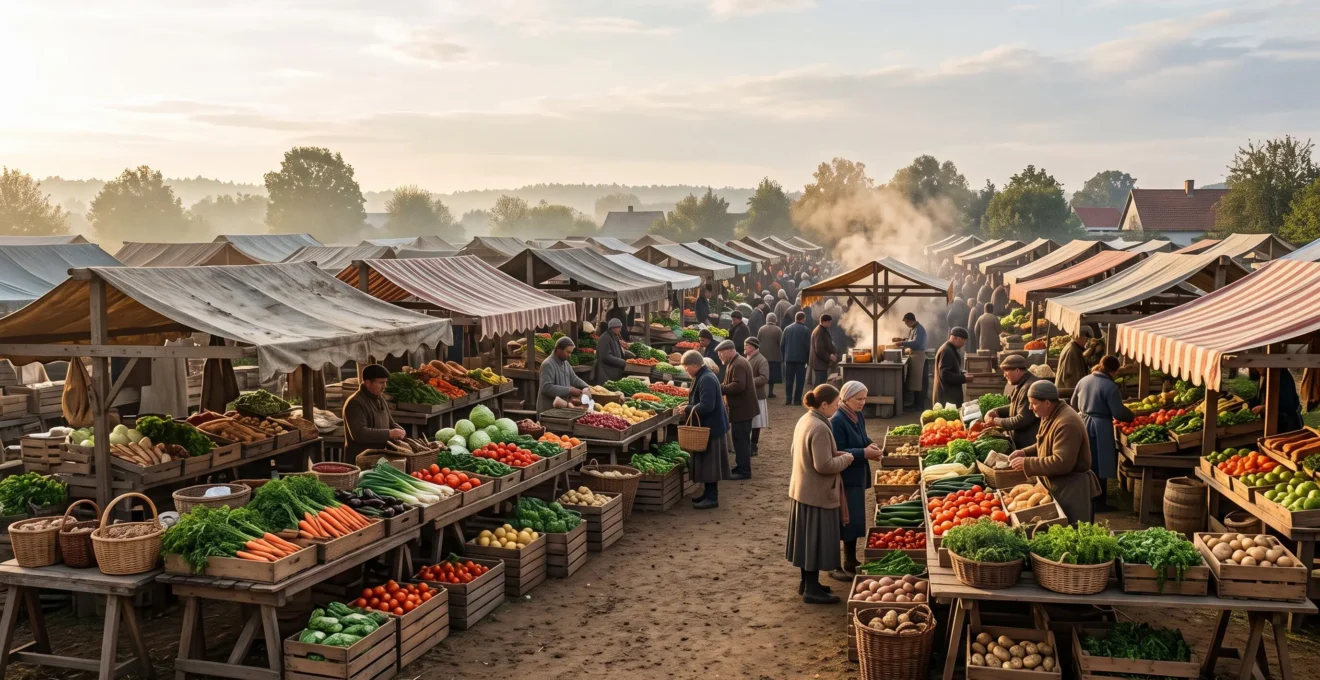
Visiting a local market isn’t about what you buy; it’s about learning to see the intricate social system operating in plain sight.
- Markets reveal a culture’s social hierarchy and gender roles more effectively than a museum.
- Respectful engagement, like buying before photographing, is key to unlocking authentic interactions.
Recommendation: Shift your mindset from a consumer to a cultural observer to transform your next market visit.
You’ve seen it in every travel guide: “Visit the local market!” You arrive, camera in hand, ready for a vibrant, authentic experience. You wander past stalls piled high with strange and wonderful produce, inhale unfamiliar spices, and navigate the bustling crowds. Yet, as you leave, you might feel a lingering sense that you’ve only skimmed the surface. You’ve walked through the space, but you haven’t truly understood it. You were a spectator, not a participant.
Many travellers believe the key to a good market visit is to go early, haggle well, or be brave enough to try a fried insect. While these tips have their place, they miss the fundamental point. They treat the market as a simple commercial venue, a place for transactions and photo opportunities. But what if the real secret wasn’t about navigating the market as a shopper, but learning to read it as a cultural text? What if every stall layout, every interaction between vendor and customer, and every ingredient for sale told a deeper story about the society you’re visiting?
This guide offers a different approach. We will move beyond the superficial and equip you with the tools to decode the hidden language of local food markets. By shifting your perspective from a passive tourist to an active cultural observer, you’ll learn how to see the market not as a place to buy things, but as a living museum—a dynamic map of a community’s social structure, values, and daily life. We’ll explore how to interpret its layout, engage with respect, and use all your senses to unlock a level of understanding that most travellers never reach.
This article provides a complete framework for transforming your market visits. Below, the table of contents outlines the key steps to becoming a more observant and engaged traveller, ready to uncover the rich stories hidden within these vibrant community hubs.
Contents: A Guide to Reading a Local Market
- Why Do Local Food Markets Reveal Social Structures Better Than Any Museum?
- How to Navigate Local Food Markets as a Cultural Learning Experience?
- Wholesale Markets vs Retail Markets: Which Offer More Authentic Local Experiences?
- The Market Photography Behaviour That Offends Vendors in 70% of Countries
- What Should You Research About Markets Before Visiting New Destinations?
- Why Do Slow Travellers Report Higher Satisfaction Than Fast-Paced Tourists?
- How to Interact Respectfully With Himalayan Communities During Treks?
- How to Spend One Week in a City Like a Temporary Local?
Why Do Local Food Markets Reveal Social Structures Better Than Any Museum?
Museums preserve artefacts behind glass, offering a static glimpse into a culture’s past. A local food market, however, is a living, breathing exhibition of a culture’s present. It’s where social hierarchies, economic realities, and community bonds are performed daily, out in the open. As the Drift Travel Editorial Team notes, “Markets are not simply shopping areas, they function as social centers where local identity remains alive.” To the observant traveller, a market is a masterclass in social cartography, revealing the unspoken rules and roles that govern a community.
The very layout of the market is a map of social values. Notice the spatial arrangement: are the butchers, with their traditionally male-dominated trade, located in a prime central spot, while female vendors selling foraged greens are on the periphery? This isn’t an accident; it’s a physical representation of social and economic hierarchies. The market is a dynamic space where you can witness the culture in action, far more effectively than reading a placard in a gallery.
As this visual of a market’s layered structure suggests, every zone has its purpose and place within the whole. Observing the human element within this structure provides even deeper clues. Paying attention to these details transforms a simple walk into an insightful analysis of the community’s fabric. Instead of just seeing people buying and selling, you begin to understand the complex web of relationships that make the market the true heart of the city.
To start decoding this social fabric on your next visit, actively look for these key indicators:
- Gendered Labour Roles: Notice who is doing the cooking and who is managing the money. Are certain products sold exclusively by men or women?
- Family and Economic Structures: Observe if small children are present with the vendors, which can speak to family work dynamics and economic necessity.
- Social Status Markers: Pay attention to the everyday clothing of both sellers and shoppers; it often serves as a subtle indicator of social standing.
- Movement and Space: Identify who else occupies the market—not just shoppers, but couriers, cleaners, or loiterers—and observe how they move through the space. Do they cluster in certain areas? Their presence and patterns add another layer to the market’s social ecosystem.
How to Navigate Local Food Markets as a Cultural Learning Experience?
The desire to connect with a culture through its food is nearly universal. In fact, research shows that food is a primary travel motivator; almost 80% of travelers research food and drink options before even starting their trip. Yet, this research often focuses on *what* to eat, not *how* to discover it. To truly turn a market visit into a learning experience, you must move beyond a checklist of foods to try and adopt a mindset of active, sensory discovery. It requires developing a kind of “sensory literacy”—using more than just your eyes to read the environment.
Start by letting your senses guide you, rather than a map or a list. Instead of hunting for a specific stall, allow your eyes to be drawn to the most vibrant, fresh-looking produce. What is piled highest? What seems to be the most popular? This is a direct visual cue to what is in season and locally prized. Follow your nose toward the stalls with the most potent aromas, whether it’s freshly baked bread, pungent cheeses, or fragrant herbs. These scents are the market’s vocabulary, telling you where the freshest and most authentic goods are located.
When language is a barrier, your hands can become a tool for communication and learning. Observing how locals test for ripeness—tapping a melon, gently squeezing a fruit—and then politely mimicking the gesture is a form of non-verbal dialogue. This tactile engagement shows respect and a genuine interest in the product. Finally, your ears can provide one of the most valuable clues. Seek out the vendors with the longest and most energetic lines of local shoppers. A queue is a public endorsement, a clear sign of quality, trustworthiness, and fair pricing that no travel guide can replicate. By tuning into this sensory data, you begin to navigate the market like a local, making decisions based on the immediate, authentic information all around you.
Wholesale Markets vs Retail Markets: Which Offer More Authentic Local Experiences?
The question of “authenticity” is complex, but when it comes to markets, the answer often lies in understanding a market’s core purpose and its unique rhythm. Not all markets are created equal. A sprawling wholesale market operating before dawn serves a completely different function—and offers a different kind of authentic experience—than a curated weekly farmers’ market. The key is to match the market type with the experience you seek, as different venues cater to different aspects of local life.
Wholesale markets are the engine rooms of a city’s food supply. They are chaotic, functional, and often overwhelming. Here, authenticity is raw and unfiltered; it’s the domain of chefs, restaurateurs, and other vendors buying in bulk. For a traveller, this is a place for pure observation of commerce on a grand scale, not for casual shopping. In contrast, retail or farmers’ markets are community-centric. This is where locals do their daily or weekly shopping, where you can interact directly with the people who grew or made the food. The authenticity here is social and relational.
Finally, specialty and evening markets offer yet another flavour of authenticity. A specialty market focused on organic produce or regional crafts provides an insight into modern values and niche economies, while an evening food market is all about social gathering, celebration, and convenience. Each has its own “rhythm of authenticity.”
The following table, based on an analysis of European markets, breaks down these rhythms to help you align your visit with your travel goals.
| Market Type | Typical Timing | Best Suited For | Nature of Authenticity |
|---|---|---|---|
| Farmers’ / Produce Market | Early morning | Cultural observers, home cooks | Community daily-life authenticity |
| Specialty / Organic Market | Set weekly schedule | Focused ingredient hunters | Regional-produce authenticity |
| Evening / Festival Market | Late afternoon to night | Social atmosphere seekers | Festive, social authenticity |
Ultimately, there is no single “most authentic” type. The most rewarding experience comes from understanding these differences and choosing the market that aligns with your goal, whether it’s to witness the city’s commercial heartbeat at dawn or to participate in its community life mid-morning.
The Market Photography Behaviour That Offends Vendors in 70% of Countries
For many travellers, a camera is an essential tool for capturing the vibrant scenes of a local market. The colourful produce, the character-filled faces of vendors, the bustling energy—it all seems to beg to be photographed. However, there is a fine line between documenting and disrespecting, and one specific behaviour is almost universally considered offensive: treating a vendor’s stall and their person as a public spectacle for your lens without any form of engagement.
A vendor’s stall is their place of business, their livelihood, and in many cultures, an extension of their personal space. Pointing a large camera lens at someone without permission can feel intrusive, objectifying, or even aggressive. As the editorial team at Blind Magazine points out in their guide on photographic ethics, ” In some cultures, even pointing a camera at someone without permission is considered deeply disrespectful.” This act transforms a human being into a mere object in your travel photo, ignoring their agency and dignity. It creates a power imbalance: you are taking something (an image) without offering anything in return, not even the courtesy of a conversation.
The solution lies in shifting your mindset from taking a photo to making a connection. This is the principle of “transactional respect.” The goal is to enter into a respectful exchange before you ever raise your camera. The most effective way to do this is to become a customer first. By making a small purchase, you are no longer just a tourist; you are a patron participating in the market’s ecosystem. This simple act of commerce completely changes the dynamic, building rapport and turning an anonymous encounter into a personal interaction. Once you’ve established this connection, asking for a photo is far more likely to be met with a warm smile than a cold shoulder.
Your Action Plan: The ‘Buy First, Shoot Second’ Photography Rule
- Approach the vendor, smile, and express interest in their products before even thinking about your camera.
- Make a small purchase to establish a positive connection and show you value their work. This is the most effective way to build rapport.
- After the transaction, politely ask for permission to take a photograph. Use hand gestures if there is a language barrier.
- If permission is granted, take your shots quickly and efficiently, then express your thanks.
- If a vendor declines, respect their decision immediately and without question. Smile, thank them anyway, and move on.
What Should You Research About Markets Before Visiting New Destinations?
While spontaneous discovery is one of the joys of travel, a small amount of targeted research before visiting a new market can be the difference between a frustrating, overwhelming experience and a deeply rewarding one. Arriving with a bit of context allows you to navigate with confidence, engage more meaningfully, and understand the nuances of what you are seeing. Your research shouldn’t be about creating a rigid itinerary, but about building a foundational knowledge that enhances your observations on the ground.
The most crucial pieces of information to find are the market’s logistics. First, identify the primary market day and operating hours. Showing up on the wrong day is a common and easily avoidable mistake. Next, learn the local customs around pricing. Is haggling an expected part of the interaction, or is it considered rude? Generally, bargaining is more common at flea markets or with non-food items, while prices at food stalls are often fixed. Knowing this etiquette prevents awkward encounters and shows respect for the vendors.
Beyond logistics, a little historical context can profoundly enrich your visit. Understanding a market’s history—why it’s located where it is, how it has evolved, or significant events that have shaped it—adds a layer of meaning to your experience. A guided tour can be an excellent way to gain this insight, offering curated knowledge from a local expert who can share stories you would never discover on your own.
Case Study: Bazurto Market, Cartagena
The chaotic, maze-like Bazurto Market in Cartagena, Colombia, can be intimidating for first-time visitors. However, as an insight from Amiho Experience highlights, knowing its history transforms the visit. The market relocated to its current site after a fire in 1965, with many original vendors and their families moving with it. Understanding this backstory and the value of hiring a local guide to navigate its complex layout turns a potentially overwhelming walk into a focused mission of discovery, connecting you to the resilience and loyalty of its community.
This example shows that research isn’t about spoiling the surprise; it’s about giving you the keys to unlock a deeper level of appreciation for the culture you are exploring.
Why Do Slow Travellers Report Higher Satisfaction Than Fast-Paced Tourists?
In a world obsessed with efficiency and “seeing it all,” a counter-movement is gaining momentum: slow travel. This philosophy champions depth over breadth, connection over checklists. It’s not about moving at a snail’s pace, but about adopting a more intentional and immersive mindset. The results are telling; a 2024 survey found that over 60% of US travelers are now planning “slowcations” specifically to unwind and connect more deeply with a single place. This approach is particularly transformative when applied to experiences like visiting a local market.
A fast-paced tourist “does” a market in an hour, snapping photos and grabbing a quick bite. They see the market as an attraction to be consumed. A slow traveller, however, *experiences* the market. They understand that to read the cultural text of a market, you cannot rush. You need time to observe the subtle rhythms of daily life: the morning rush of locals, the mid-day lull, the shifting conversations between vendors, and the changing light as the day progresses. These are the details that reveal the true character of a place, and they are invisible to those in a hurry.
Higher satisfaction among slow travellers stems from this very shift in perspective. Instead of the stress of a packed itinerary, there is the joy of serendipitous discovery. Instead of a collection of superficial snapshots, there are genuine memories of human connection—a shared laugh with a vendor, a recommendation for a local cafe, the taste of a fruit you’ve never seen before. Slow travel allows you to move from being an outsider looking in to becoming, even for a short time, a part of the local fabric. By allocating an entire morning, rather than a single hour, to a market, you give yourself the gift of time—the essential ingredient for any meaningful cultural exchange.
How to Interact Respectfully With Himalayan Communities During Treks?
While the towering peaks of the Himalayas may seem a world away from a bustling city market, the core principles of respectful cultural interaction are universal. Whether you are navigating a narrow mountain path or a crowded market aisle, your role as a visitor is to be a humble and observant guest. The satisfaction derived from your experience is directly proportional to the respect you show to the local community and their customs. Just as in a market, meaningful connection in the Himalayas is built on a foundation of humility, curiosity, and awareness.
The first step is always learning and using basic greetings. In a Nepali market, a smile and a “Namaste” can transform a transaction into an interaction. On a trek, the same word offered to a passing local or a teahouse owner creates an immediate bridge of goodwill. It signals that you see them not as part of the scenery, but as a fellow human being. Similarly, an awareness of appropriate dress is crucial. In a market in a conservative country, covering shoulders and knees shows respect; in the Himalayas, the same modesty is expected, especially when entering villages or sacred sites like temples and monasteries.
The concept of sacred space is another powerful parallel. In a market, a vendor’s stall is their private domain. In the Himalayas, monasteries, stupas, and mani walls are sacred. Approaching these sites with reverence—speaking quietly, removing your shoes before entering a temple, and always asking permission before taking photographs of people or religious ceremonies—demonstrates your understanding that you are a guest in a place with deep spiritual significance. As the Explore Himalaya team suggests, “You will feel the warmth and hospitality of Nepal most when you approach its people with humility and openness.” This wisdom applies equally whether you are at 12,000 feet or sea level.
Key Takeaways
- See, Don’t Just Look: A market is a social map. Observe the layout, vendor demographics, and customer interactions to understand the community’s structure.
- Engage with Transactional Respect: Your camera is not a passport. Become a patron before you become a photographer by making a small purchase to build rapport.
- Match the Market’s Rhythm: Embrace a slower pace. True understanding comes from observing the market’s natural flow, not rushing through it.
How to Spend One Week in a City Like a Temporary Local?
The ultimate goal for many curious travellers is to shed the “tourist” label and experience a city as a “temporary local.” This isn’t about finding a hidden, secret spot, but about integrating into the daily rhythms of a place. The single most effective gateway to this experience is the local food market. By making the market your anchor point for the week, you can build a routine, foster familiarity, and unlock a side of the city that remains invisible to those hopping between major landmarks.
Your strategy is simple: become a regular. Instead of visiting a different market each day, choose one that feels right and return to it. Buy your morning fruit from the same vendor. Get your bread from the same baker. This repetition is powerful. On the first day, you are an anonymous tourist. By the third day, you might be greeted with a nod of recognition. By the fifth, a smile. This familiarity is the currency of local life, and it opens doors to genuine connection. As the Travel And Tour World team states, “Food is no longer just a necessity; it’s become a gateway to understanding a destination’s culture, history, and community.”
Use the vendors as your local information hub. After you’ve built a small rapport, don’t be shy. Ask for recommendations: Where do they get their morning coffee? What is a simple, delicious lunch spot nearby that isn’t for tourists? These are the questions that lead you away from the beaten path and into the authentic fabric of the neighborhood. By pairing your market visits with these local-approved detours—a nearby park, a small museum, a quiet backstreet—you start to weave your own map of the city, one based on personal connections rather than a guidebook’s checklist. You are no longer just visiting; you are temporarily living there.
On your next journey, step into a local market not as a tourist, but as a student of culture. Apply these principles of observation, respect, and slow engagement. Discover the stories, forge the connections, and experience the profound satisfaction of seeing a place not just for what it has, but for who its people are.