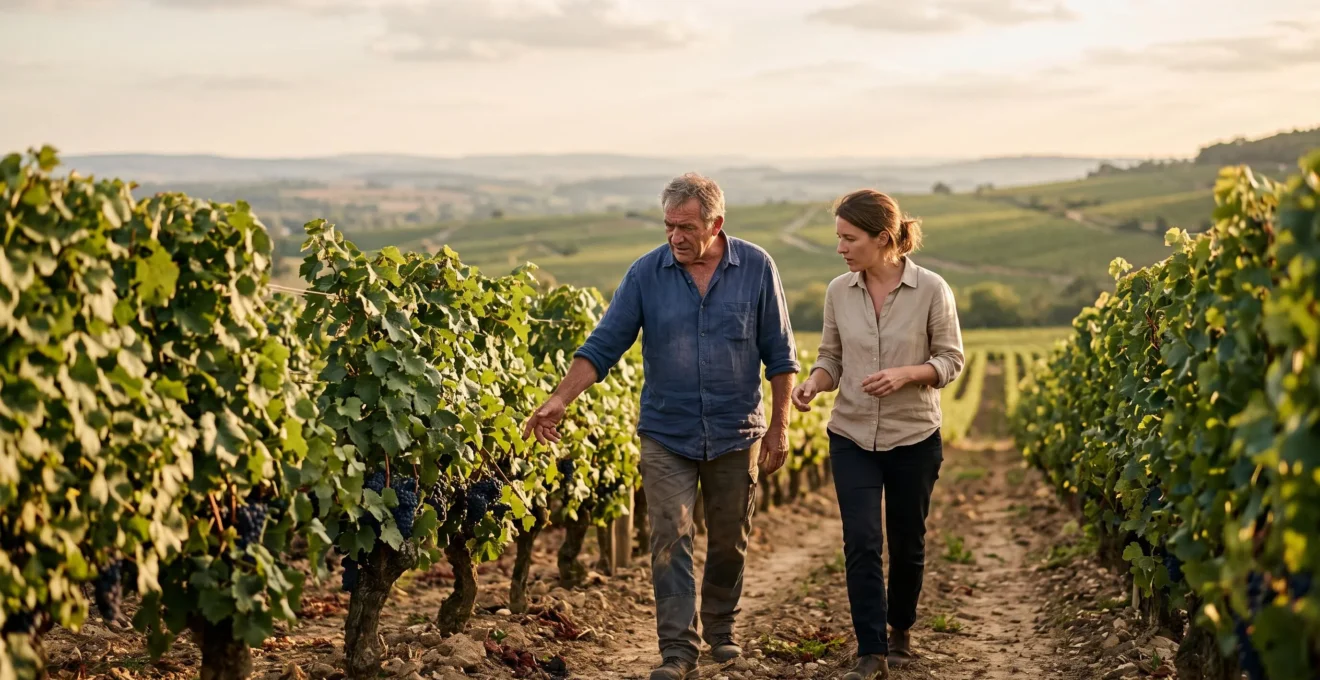
The most rewarding wine tours are not about the number of glasses you taste, but the depth of context you gain from the place itself.
- Genuine learning happens at small, owner-operated wineries where direct interaction and vineyard walks are the norm.
- True educational value comes from understanding terroir—the soil, climate, and landscape—not from polished tasting rooms.
Recommendation: To build lasting knowledge, intentionally seek out tours that frame the vineyard as a classroom and the winemaker as a teacher, rather than simply chasing a long list of tastings.
You return from a wine country vacation, your car laden with bottles, your camera full of scenic vineyard photos. Yet, when a friend asks what you learned, the answer feels disappointingly vague. You can recall the taste of a specific Chardonnay, but not why it tasted that way. This is a common experience for aspiring wine learners: a trip that provides consumption but not comprehension. Many tours are designed as efficient tasting circuits, shuttling visitors between large, commercial estates for a standardized presentation and a quick pour.
These “tasting-only” tours are the platitudes of wine travel. They promise an experience of wine country but deliver a superficial skim of the surface, leaving you with a fleeting buzz rather than foundational knowledge. But what if the true objective of a wine tour wasn’t just to taste, but to understand? What if we shifted the focus from the wine in the glass to the ground it came from? The key to transforming a simple vacation into a genuine educational journey lies in a strategic shift in perspective: seeking out an educational pedagogy over a simple itinerary.
This guide offers a new framework for selecting wine region tours. We will move beyond the generic advice and explore why small producers are often the best teachers and why “slow travel” is essential for comprehension. We’ll deconstruct what classic regions like Bordeaux, Burgundy, and Barolo can uniquely teach you, and provide a clear methodology for finding experiences that offer real participation and leave you with knowledge that lasts long after the last bottle is finished.
To help you navigate this new approach to wine travel, this article is structured to build your expertise step-by-step. The following sections provide a complete curriculum for choosing your next, and most educational, wine journey.
Contents: A Curriculum for the Curious Wine Traveller
- Why Do Small Producer Visits Teach More Than Large Estate Tours?
- How to Choose Wine Region Tours That Educate Rather Than Just Pour?
- Bordeaux vs Burgundy vs Barolo: Which Wine Region for Learning Fundamentals?
- The Tasting-Only Tour That Leaves You With a Headache but No Knowledge
- When Should You Visit Vineyards to See Harvest or Winemaking in Action?
- Why Do Slow Travellers Report Higher Satisfaction Than Fast-Paced Tourists?
- Why Do Research Station Visits Transform Antarctic Expeditions From Scenic to Substantive?
- How to Join Harvest Experiences That Offer Real Winemaking Participation?
Why Do Small Producer Visits Teach More Than Large Estate Tours?
The secret to a truly educational wine tour often lies in a simple economic reality: small wineries depend on building direct relationships. Unlike large estates that rely on distributors and mass-market branding, smaller producers thrive on connection. Their tasting room is not just a profit center; it’s their primary stage for storytelling, education, and creating brand evangelists. When you visit a small, family-run domaine, you are more likely to be greeted by the winemaker or a family member—the very person whose hands have touched the vines and guided the fermentation.
This direct access is invaluable. Instead of a scripted speech from a summer intern, you get a conversation rooted in years of personal experience. You can ask about the specific challenges of the last vintage, the decision to plant a particular clone, or the philosophy behind their blending choices. This economic model, centered on direct-to-consumer (DTC) sales, forces them to be better educators. In fact, a 2025 industry report found that wineries doing over 60% of sales via DTC were profitable, while those under 40% were not, highlighting the critical importance of these personal, educational interactions.
Large estates, by contrast, are built for scale and efficiency. Their tours are designed to handle large groups, leading to a more passive, observational experience. The tour follows a set path, the information is generalized, and the tasting is often pre-poured. While impressive, these visits are more akin to a museum tour than a hands-on lab session. For the dedicated learner, the choice is clear: seek out the small producers whose business model is fundamentally aligned with providing a deep, personal, and educational experience.
How to Choose Wine Region Tours That Educate Rather Than Just Pour?
Shifting from a passive taster to an active learner requires a deliberate strategy. The first step is to look for tours that explicitly prioritize education and context. Scrutinize tour descriptions for keywords like “terroir-focused,” “vineyard walk,” “soil analysis,” “winemaker-led,” or “cellar masterclass.” These phrases signal an intent to teach, not just to entertain. Conversely, be wary of itineraries that emphasize “unlimited tastings,” “party bus atmospheres,” or visits to four or more wineries in a single day, as these are hallmarks of a consumption-focused experience.
A powerful tactic is to seek out experiences you can book directly. The rise of personalized wine tourism means you are no longer limited to third-party tour operators. Indeed, market data shows that direct bookings accounted for over 38% of wine tourism revenue share in 2023, indicating a clear trend of travelers seeking more authentic, tailored visits. Contacting a winery in advance to request a private, education-focused tour with a vineyard walk often yields incredible results. Many small producers are thrilled to share their passion with an engaged and curious visitor.
Ultimately, the goal is to get out of the tasting room and into the vineyard. An educational tour should spend as much time among the vines as it does at the bar. It is in the field, with soil in your hands and the slope under your feet, that the abstract concept of terroir becomes tangible. This is where true learning happens, transforming the wine in your glass from a simple beverage into a complex expression of a specific place and time.
Bordeaux vs Burgundy vs Barolo: Which Wine Region for Learning Fundamentals?
Not all wine regions offer the same lesson plan. For the dedicated student of wine, choosing a region is like choosing a university major. Each classic European region has a specialized curriculum, offering a masterclass in a specific aspect of the wine world. Understanding what each region teaches best allows you to tailor your travels to your learning objectives, making your trip exponentially more valuable.
Burgundy, for instance, is the ultimate terroir laboratory. With its single-varietal focus on Pinot Noir and Chardonnay, it strips away the variable of blending to reveal the microscopic impact of soil, slope, and aspect. Here, you learn why a wine from a Grand Cru vineyard, sometimes just meters away from a Premier Cru, commands a different price and profile. Bordeaux, in contrast, is a masterclass in blending and branding. It teaches the art of assemblage—how Cabernet Sauvignon, Merlot, and other grapes are combined to create a harmonious whole—and the enduring power of historical classification systems.
This comparative approach allows you to build a comprehensive understanding of wine. Instead of seeing a collection of disconnected facts, you begin to see a system of interconnected principles. The following table, based on insights from sources like Into The Vineyard’s expert itineraries, breaks down the core educational focus of several key regions.
| Region | Core Educational Lens | What It Teaches |
|---|---|---|
| Burgundy | Terroir Laboratory | Micro-impact of soil, slope and aspect on a single grape across tiny, hierarchically classified plots (village, Premier Cru, Grand Cru) |
| Bordeaux | Blending & Branding Masterclass | Assemblage logic and the power of historic classification systems on perceived quality and price |
| Barolo | Structure & Evolution Deep Dive | How a single grape, Nebbiolo, teaches tannin, acidity and long-term cellar aging potential |
| New World (Napa, Barossa) | School of Winemaking Technique | Overt, hands-on impact of winemaker choices such as oak regime, irrigation and acid adjustment |
The Tasting-Only Tour That Leaves You With a Headache but No Knowledge
The siren song of the “tasting-only” tour is seductive: a promise of variety and volume, hopping from one winery to the next to sample an extensive list. Yet, this approach is the very antithesis of an educational experience. The human palate is a sensitive and finite instrument. After a certain point, it simply cannot process more information. This phenomenon, known as sensory fatigue or palate blowout, is the biggest enemy of the wine learner. Your ability to discern subtle aromas, textures, and flavors diminishes with each glass, until all wines begin to taste vaguely the same.
This isn’t just anecdotal; it’s backed by science. While a professional taster might evaluate dozens of wines in a day by spitting, for the average person trying to learn, the limit is much lower. In fact, sensory science research indicates that rarely more than 12 wines are tasted in controlled studies before palate fatigue significantly impairs judgment. A tour that offers 20, 30, or more tastings in a day is not designed for learning; it’s designed for intoxication. You leave with a headache and a muddled memory, not a clear understanding of the region’s character.
Experienced sommeliers understand this challenge well and treat extensive tastings with the seriousness of an athletic event. As one industry professional cited by Wine Enthusiast aptly put it:
Remember, this, in many ways, is like a marathon.
– Wine Enthusiast contributor citing an industry sommelier, ‘Taste Like a Pro: How to Prevent Palate Blowout During Wine Tastings’
The solution is to prioritize context over consumption. A truly valuable tour will feature fewer wines but provide more information about each one. One hour spent walking a single vineyard and tasting its two wines with the person who made them is infinitely more educational than a frantic hour tasting twelve wines in a crowded tasting room.
When Should You Visit Vineyards to See Harvest or Winemaking in Action?
To witness a vineyard at its peak of energy and purpose, you must visit during harvest. This period, known as the *vendange* in France or *vendemmia* in Italy, is a whirlwind of activity, transforming the vineyard from a tranquil agricultural landscape into a dynamic, 24/7 production hub. It is the one time of year when all the abstract concepts of viticulture and winemaking become intensely real and visible. As the team at Wine Travel Guides notes, the experience is unparalleled.
No other moment in the winemaking year matches harvest for sheer energy.
– Wine Travel Guides editorial team, ‘Grape Picking at a Winery: When to Go & How to Book’
Visiting during this time provides a unique educational window. You can see the grapes being picked, sorted, and brought into the cellar. You can smell the intoxicating aroma of fermenting grape juice and feel the hum of the press. This is not a simulation; it is the raw, unedited process of turning fruit into wine. For those seeking hands-on learning, some wineries offer harvest participation experiences, allowing you to be part of the action, even for a day. This kind of active involvement cements learning in a way that passive observation never can, as one participant in a Bordeaux harvest described:
We started early in the morning and learned rather quickly which grapes to cut and which to leave… after we had harvested enough grapes to fill the press, we helped in the cellar and learned about the next steps in the wine making process, guided directly by the winemaker.
– First-hand account, Aquitaine Travel Guide
Timing is everything, of course. Harvest dates vary dramatically by hemisphere, region, and even by the specific grape. A general rule is late August to October in the Northern Hemisphere and February to April in the Southern Hemisphere. Planning a trip around this period requires flexibility, as the final decision to pick is often made just days in advance, but the educational reward is well worth the effort.
Why Do Slow Travellers Report Higher Satisfaction Than Fast-Paced Tourists?
In the world of wine tourism, there is a pervasive pressure to “do it all.” Tourists often treat regions like a checklist, rushing from one famous name to the next in an effort to maximize the number of wineries visited. This “region-ticking” mentality is particularly prevalent in high-density areas. For example, a Napa Valley economic impact report found that visitors to the region visit about three wineries on average per trip, often in a single day. While this might seem efficient, it actively works against deep learning and true satisfaction.
Slow travel offers a powerful antidote. Instead of visiting three wineries in one afternoon, the slow traveler might spend the entire afternoon at a single estate. This deliberate pacing allows for a different kind of experience—one that moves beyond the tasting room and into the fabric of the place. It creates time for a long walk through the vineyard, an extended conversation with the cellar master, or simply a quiet moment to sit and observe the rhythm of the winery. It is in these unhurried moments that the most profound insights are found.
This approach allows you to appreciate the very nuances that make a region special. In a place like Burgundy, where the character of a wine can change dramatically from one small plot of land to the next, speed is the enemy of understanding. As one guide beautifully states, “Their transparency is the point: each village, slope and soil type marks the wine with its own character.” You cannot perceive these subtle marks when you are rushing to your next appointment. By slowing down, you give yourself the time and mental space to truly connect with the terroir as a curriculum, leading to a more substantial, memorable, and ultimately more satisfying educational journey.
Why Do Research Station Visits Transform Antarctic Expeditions From Scenic to Substantive?
Consider an expedition to Antarctica. One traveler might see it as a purely scenic trip: a journey to witness majestic icebergs and penguin colonies. Another might seek to visit a scientific research station, engaging with climatologists to understand the data being collected about the ice shelf. Both travelers visit the same continent, but their experiences are worlds apart. One is scenic; the other is substantive. This metaphor holds the key to transformative wine travel. The “tasting-only” tour is the scenic trip, focused on the pretty surface. The educational tour is the research station visit, focused on the substance beneath.
The “research station” of the wine world is the vineyard itself, and the “scientists” are the winemakers who have dedicated their lives to understanding it. The goal of the serious wine learner is to gain access to this level of substance. It’s about moving past the generic “this wine has notes of cherry” and getting to the “why”—the specific clay content in the soil, the morning sun exposure on the slope, the choice of yeast strain in the cellar. This is the information that turns tasting notes into true knowledge.
This desire for substance is what separates a tourist from a student. The legendary wine expert Jasper Morris, describing his formative experiences, perfectly captured this distinction. It wasn’t just about tasting; it was about being shown the evidence in the field. He recalls:
It was only here in Burgundy that people were taking me out into vineyards, showing me the differences in soil between one place and another, talking about how they make the individual wines.
– Jasper Morris, Roadside Terroir
To transform your wine travel from scenic to substantive, you must actively seek out these “research station” opportunities. It means choosing the tour that prioritizes a muddy-boots walk through the vines over a comfortable seat in a polished tasting room. It is a choice for depth over breadth, for education over mere entertainment.
Key Takeaways
- The most educational wine tours prioritize context and conversation over the quantity of wine served.
- Focus on small, owner-operated wineries, as their business model often depends on providing a superior, direct-to-consumer educational experience.
- Choose your destination strategically; regions like Burgundy are ideal for learning about terroir, while Bordeaux offers a masterclass in blending.
How to Join Harvest Experiences That Offer Real Winemaking Participation?
For the truly dedicated learner, the ultimate experience is to move from observer to participant. Joining a harvest, even for a short time, offers an unparalleled immersion into the winemaking process. This is not tourism; it is a brief but intense entry into the agricultural and social life of a winery during its most critical period. As one guide puts it, this is an “immersion — in the rhythm of agricultural labour, in the social fabric of a wine estate.”
Finding these opportunities requires a different approach than booking a standard tour. Start by researching smaller, family-owned wineries in your region of interest, especially those known for organic or biodynamic practices, which often rely more on manual labor. Contact them well in advance, expressing your genuine interest in learning and your willingness to work. Frame your request not as a tourist seeking entertainment, but as a student seeking knowledge through participation. Many programs also exist, from formal “vendanges” contracts in France to volunteer networks that connect willing hands with wineries in need.
To make this happen, you need to vet the opportunity to ensure it’s a genuine learning experience. The following checklist can help you distinguish a real participatory role from a staged photo-op.
Action Plan: Vetting a Truly Educational Harvest Experience
- Assess the interaction: Does the offer include direct work and conversation with the core winemaking team or owner, or is it a large group event managed by tour staff?
- Clarify the tasks: Will you be involved in key decisions like sorting grapes, or just a single, repetitive task? Inquire about exposure to both vineyard and cellar work.
- Understand the scale: Is this an intimate part of the actual harvest team, or a separate, large-scale “tourist harvest” event? Smaller is almost always better for learning.
- Inquire about the “why”: Ask if the experience includes explanations of why tasks are done a certain way (e.g., why some grape clusters are discarded, the purpose of a cold soak).
- Confirm the “end-to-end” view: Does the experience follow the grapes from the vine to the press or fermentation tank, providing a complete view of the process?
Planning is key. Harvest times vary significantly, so researching the typical windows for your target region is the first step. Below is a general guide:
- Champagne: Typically late September to early October
- Bordeaux: September to mid-October
- Burgundy: Mid-September to early October
- German Riesling regions: October, sometimes into November for late-harvest wines
- Argentina (Mendoza): February to March
- Australia (Barossa): February
- New Zealand (Marlborough): March to April
Participating in a harvest is demanding, but it offers a level of understanding that simply cannot be gained from a tasting glass. It connects you to the wine, the land, and the people in a profound and unforgettable way.
By applying this framework, you transform yourself from a passive consumer into an active, engaged student of wine. The next time you plan a trip, don’t just ask where you can taste good wine; ask where you can find the best teachers. Your palate, your notebook, and your long-term knowledge will thank you for it.