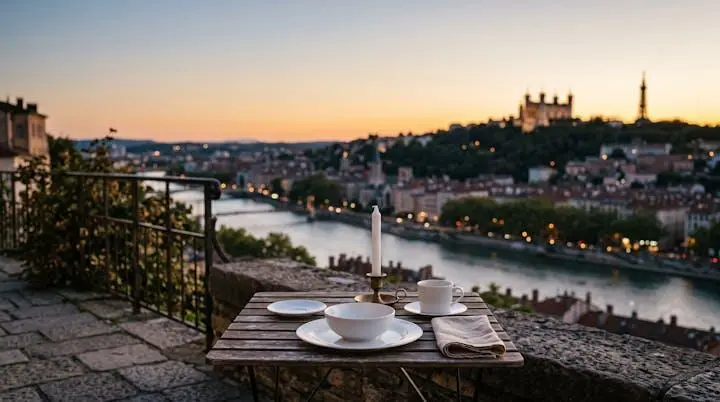
Experiencing Lyon’s elite dining on a moderate budget is achieved not by cutting corners, but by building a strategic ‘gastronomic portfolio’.
- Balance high-end splurges (one-star dinners) with high-value experiences (Bib Gourmand, authentic bouchon lunches).
- Prioritise culinary innovation (one-star) over performance theatre (two-star) for better value and leverage lunch menus strategically.
Recommendation: Plan your meals like an investment portfolio, diversifying across different price points and experiences to maximise your culinary return on investment.
Lyon, the undisputed gastronomic heart of France, presents a delicious dilemma for the discerning food enthusiast. The city whispers promises of life-changing meals from kitchens helmed by world-class chefs. Yet, this dream often collides with the reality of tasting menus that climb into the hundreds of euros. The common advice—”go for lunch,” “book ahead”—scratches the surface but misses the fundamental opportunity Lyon offers.
Many guides will point you towards the well-trodden path of famous brasseries or the most affordable options, but this often means compromising on the very excellence you came to experience. The real challenge isn’t just finding a cheaper meal; it’s about accessing haute cuisine intelligently. It’s about understanding the subtle differences between a one-star and a two-star restaurant, knowing how to identify an authentic bouchon from a tourist trap, and even leveraging the city’s famed market as part of your culinary journey.
But what if the key wasn’t about saving money, but about investing it wisely? This guide introduces a new perspective: treating your meals in Lyon as a ‘gastronomic portfolio’. This strategic approach moves beyond simple cost-cutting to focus on maximising your culinary return on investment. It’s a method for balancing a show-stopping Michelin-starred splurge with deeply authentic, high-value local experiences, ensuring every euro spent contributes to an unforgettable gastronomic adventure.
This article will guide you through building this portfolio, from understanding Lyon’s unique culinary landscape to the specific tactics you need to secure the best tables and experiences. We will deconstruct the city’s dining scene, providing a clear framework for making a series of smart choices that, together, create a perfectly balanced and budget-respecting journey through the capital of French cuisine.
Summary: A Strategic Guide to Lyon’s Haute Cuisine on a Budget
- Why Is Lyon Called France’s Gastronomic Capital Over Paris?
- How to Dine at Lyon’s Michelin-Starred Restaurants on a Moderate Budget?
- One-Star vs Two-Star Lyon Restaurants: Which Offers Better Value for First-Timers?
- The Reservation Timing Mistake That Leaves Lyon’s Best Tables Fully Booked
- Should You Prioritise Michelin Stars or Traditional Bouchons in Lyon?
- How to Identify Genuinely Local Restaurants in Tourist-Heavy Cities?
- Why Can All-Inclusive Resorts Save Families £800+ Compared to Half-Board Options?
- How to Experience a City’s Food Culture Beyond Tourist Restaurant Traps?
Why Is Lyon Called France’s Gastronomic Capital Over Paris?
While Paris boasts more Michelin stars in absolute numbers, Lyon’s claim to being France’s gastronomic capital is rooted in something deeper: density, history, and a unique culinary identity. The city has more restaurants per capita than any other in France, creating a fiercely competitive and innovative environment. This includes an impressive collection of 18 Michelin-starred restaurants, a remarkable concentration for a city of its size. This density is the bedrock of our ‘gastronomic portfolio’ approach; it provides a wealth of diverse options to choose from.
The city’s culinary heritage is built upon two pillars: the “Mères Lyonnaises” (the Mothers of Lyon), female chefs who established the city’s reputation for hearty, soulful cuisine in the 19th century, and legendary figures like Paul Bocuse, who propelled it onto the global stage. This history has cultivated a food culture that values both high-end gastronomy and rustic, product-focused cooking. It is this duality that makes Lyon so compelling for a food enthusiast.
As Anthony Bonnet, head chef of the Michelin-starred Les Loges, noted in National Geographic Traveller, this range is the city’s greatest asset.
Lyon’s food scene is so exciting because of its diversity.
– Anthony Bonnet, National Geographic Traveller
This diversity is the key. A successful gastronomic portfolio in Lyon isn’t just about Michelin stars; it’s about embracing the entire spectrum, from the humble bouchon to the innovative starred kitchen. The city’s identity is not defined by a single type of restaurant but by the rich interplay between them, offering a far more varied and accessible culinary landscape than the capital.
How to Dine at Lyon’s Michelin-Starred Restaurants on a Moderate Budget?
The first strategic assets to add to your gastronomic portfolio are high-value, low-cost entries. This is where two key Michelin-endorsed tactics come into play: the Bib Gourmand selection and the strategic lunch menu. These are not just “cheap options”; they are smart investments that deliver exceptional culinary ROI without depleting your budget for a bigger splurge later in the week.
The Bib Gourmand is a distinction awarded by the Michelin Guide to restaurants offering “carefully prepared cuisine at moderate prices.” These are often the proving grounds for future starred chefs and offer some of the best value in the city. For a strategic diner, they are a non-negotiable part of the plan. According to an analysis by Visiter Lyon, you can expect a full menu to cost between €25 and €38 at a Bib Gourmand establishment, providing a near-Michelin experience for a fraction of the price.
The second tactic is leveraging the ‘menu du jour’ (lunch menu). Many of Lyon’s most prestigious and expensive restaurants offer a significantly reduced-price menu at lunchtime, often featuring two or three courses for around €30. This isn’t just about eating your main meal midday; it’s about strategically evaluating which lunch offering gives you the best taste of a chef’s talent. A generic menu might not be worth it, but one that showcases seasonal, market-driven creativity is an incredible opportunity.
Action Plan: The Strategic Lunch-Menu Evaluation
- Check the restaurant’s website the night before for the published lunch ‘menu du jour’. Look for seasonal, market-specific wording rather than generic dish names which signals higher quality.
- Consider shifting your main meal of the day from dinner to lunch. Many of Lyon’s pricier eateries offer a very reasonable lunch menu, with three courses for about €30 or so.
- Be aware that most restaurants have very limited hours, with lunch service typically running only from noon to 2 pm. A reservation is still highly recommended to secure your spot.
- Assess the complexity and ingredients. Does the lunch menu offer a glimpse into the techniques and quality found on the pricier evening menu?
- Compare the lunch menu price to the restaurant’s Bib Gourmand neighbours. Sometimes, a top-tier Bib Gourmand offers better overall value than a stripped-down lunch at a one-star.
One-Star vs Two-Star Lyon Restaurants: Which Offers Better Value for First-Timers?
When allocating a significant portion of your budget for a “splurge” night, the choice between a one-star and a two-star restaurant is a critical portfolio decision. For the first-time, budget-conscious enthusiast, the answer often lies in understanding what you are paying for: pure culinary innovation or a more holistic, theatrical experience. In Lyon, the one-star restaurants frequently offer a superior culinary ROI.
A one-star rating signifies “high-quality cooking, worth a stop.” Here, the focus is almost entirely on what is on the plate: creativity, precision, and exceptional ingredients. A two-star rating, for “excellent cooking, worth a detour,” begins to incorporate more of the overall experience: the perfection of the service, the luxury of the setting, and the ‘performance’ of the meal. This added layer of theatre and service inevitably drives up the price, often without a proportional increase in food quality.
As the matrix below shows, while two-star restaurants offer an elevated performance, one-star establishments are the sweet spot for diners prioritising the culinary craft itself. For a first-timer, the leap in food quality from a Bib Gourmand to a one-star is often more dramatic and rewarding than the leap from a one-star to a two-star.
This table, based on an analysis of Lyon’s dining scene, breaks down the value proposition of each tier, helping you decide where to make your “blue-chip” investment.
| Criteria | One-Star Restaurants | Two-Star Restaurants |
|---|---|---|
| Number in Lyon | Fifteen restaurants | Five restaurants |
| Primary value driver | Culinary innovation per euro | Service theatre & ambiance |
| Typical tasting menu example | 10 courses for around €130 | Higher entry price, often more inclusive |
| Best suited for | Diners prioritising ‘the plate’ | Diners prioritising ‘the performance’ |
Furthermore, two-star experiences can sometimes come with a “supplement trap,” where extras like wine pairings or a cheese course can dramatically inflate the final bill, an issue highlighted by diners. One visitor noted the frustration of hidden costs:
Pricing for extras aside from the dinner (wine, cheese, etc) felt too high and I would have liked to see those somewhere ahead of time so I could make an imformed decision about buying them.
– Lyon Diner, Wanderlog
The Reservation Timing Mistake That Leaves Lyon’s Best Tables Fully Booked
Building the perfect gastronomic portfolio is pointless if you can’t secure a table. The most common mistake visitors make is not the failure to book in advance, but the failure to use the right booking method at the right time. In Lyon, a city that runs on tradition, there’s a distinct etiquette and a digital-versus-analogue protocol that can make all the difference between securing a dream reservation and being left out in the cold.
The default for most travellers is to rely solely on online booking systems or emails. While this works for standard requests made weeks in advance, it lacks the nuance required for more specific or last-minute needs. An email sent on a Friday afternoon is likely to be buried until Monday. For more immediate requests, or to inquire about a specific table or dietary need, a polite, well-timed phone call is infinitely more effective. The golden window for calling is typically between the end of the lunch rush (around 2:30 PM) and the start of dinner prep (around 5:00 PM), when staff are more relaxed and receptive.
Your timing during the week also matters. Targeting a Tuesday or Wednesday service, especially for lunch, can dramatically increase your chances. These are typically quieter services, and kitchens are often more accommodating. This “off-peak” approach can even open doors at the most sought-after institutions that appear fully booked online.
Case Study: The Off-Peak Advantage at Le Garet
Le Garet, a classic twelve-table bouchon in the Presqu’île district, is a prime example of this strategy. It is considered an institution with one of the best quenelles in central Lyon. While dinner reservations are essential and hard to come by, the restaurant explicitly notes that walk-ins are possible for lunch. This confirms that by shifting your desired visit to a weekday lunch service, you dramatically increase the odds of securing a spontaneous table, even at an in-demand address that would otherwise require weeks of planning.
In short, don’t just book ahead; book smarter. Use email for long-range planning, but reserve the personal touch of a phone call for specific needs, and leverage the quiet power of the weekday lunch service to your advantage.
Should You Prioritise Michelin Stars or Traditional Bouchons in Lyon?
The question of whether to prioritise a Michelin-starred restaurant or a traditional bouchon is a false dichotomy. For a well-balanced gastronomic portfolio, the answer is not “either/or” but “both, in strategic proportion.” Bouchons are not a consolation prize; they are a fundamental and essential asset class in your Lyon culinary experience, offering a different, yet equally vital, form of value.
A traditional bouchon provides a deep dive into the soul of Lyonnaise cuisine: rich, rustic, and generous. It’s where you’ll find foundational dishes like saucisson de Lyon, quenelle de brochet, and tarte à la praline. A meal here is an investment in authenticity and history. To balance your portfolio, you should plan to offset a high-cost, high-innovation Michelin dinner with a lower-cost, high-tradition bouchon lunch. The price differential makes this strategy highly effective; a classic, multi-course menu at a traditional bouchon will typically cost between €25 and €40 per person.
However, not all bouchons are created equal. The rise of “bouchons bourgeois” has introduced a new, hybrid category. These establishments, often run by highly-trained chefs, elevate traditional recipes with superior ingredients and technique while retaining the convivial bouchon atmosphere. They represent a sort of “blue-chip” investment within the bouchon category.
Portfolio Play: The ‘Bouchon Bourgeois’ of Daniel et Denise
Run by acclaimed Chef Joseph Viola (a Meilleur Ouvrier de France), Daniel et Denise is the quintessential ‘bouchon bourgeois’. While more expensive than a traditional bouchon, with menus ranging from €40 to €60, the quality is consistently top-notch and rivals that of many more formal restaurants. Securing a table here (reservations are essential) provides a guaranteed high-quality experience grounded in authentic Lyonnaise tradition. It’s the perfect “blue-chip” addition to a gastronomic portfolio, elegantly balancing a more experimental Michelin-starred meal with an impeccably executed taste of tradition.
By including both a one-star restaurant and a top-tier bouchon in your itinerary, you experience the full spectrum of Lyon’s culinary genius: the future and the past, innovation and tradition. This is the essence of building a truly satisfying and intelligent dining plan.
How to Identify Genuinely Local Restaurants in Tourist-Heavy Cities?
In a city as popular as Lyon, particularly in areas like Vieux Lyon (the Old Town), the line between an authentic bouchon and a tourist trap can be perilously thin. The term “bouchon” itself is not a protected trademark, meaning any restaurant can use it. To protect your portfolio from a “bad investment,” you need a reliable method for identifying genuine establishments. Fortunately, Lyon’s culinary community has created one: the “Les Bouchons Lyonnais” certification.
This association awards an official plaque to restaurants that adhere to a strict set of criteria, guaranteeing the quality of the products, the authenticity of the cuisine, and the warmth of the welcome. Looking for this official sticker—a plaque featuring the marionette Gnafron, a symbol of Lyon—is the single most effective way to ensure you’re getting the real deal. As reported by ThisisLyon.fr, this certification was specifically introduced to offer official support regarding quality and transparency for diners.
Beyond the official plaque, you can use other sensory clues to vet a restaurant. True local eateries often share common characteristics that are hard for tourist-focused businesses to fake. A key strategy is simply to walk one street back from the main tourist arteries. The restaurants on a street like Rue Saint-Jean might be bustling, but the hidden gems are often found on the quieter parallel streets, with fairer prices and a more local clientele.
To arm yourself against tourist traps, use this simple checklist:
- The Official Plaque: Look for the “Les Bouchons Lyonnais” certification sticker near the entrance. It’s your primary guarantee.
- The Location: Be wary of restaurants on the most crowded tourist squares. Explore the side streets just one block away.
- The Menu: A genuine bouchon will have a short, focused menu, often written on a chalkboard. It will be exclusively in French and prominently feature a ‘plat du jour’ (dish of the day). A long, laminated, multi-language menu is a major red flag.
- The Ambiance: Authentic bouchons are often small, cramped, and noisy, with red-and-white checked tablecloths. It’s a sign of conviviality, not poor quality.
Why Can All-Inclusive Resorts Save Families £800+ Compared to Half-Board Options?
It may seem counterintuitive to discuss all-inclusive resorts in a guide to Lyon’s fine dining. However, the core financial logic that makes them appealing—cost certainty and bundled value—can be surprisingly applied to the world of Michelin tasting menus. For the strategic diner, a tasting menu functions as a kind of ‘all-inclusive’ experience for the evening, protecting your budget from unforeseen costs.
When you choose a tasting menu, or ‘menu dégustation’, you are buying a complete, multi-course package at a fixed price. A great example from a Lyon one-star restaurant is a 10-course prix fixe for €130. This provides tremendous value, but more importantly, it provides predictability. You know the total cost of your food upfront, allowing you to manage your overall ‘portfolio’ budget with precision. This contrasts sharply with à la carte dining in a high-end setting, where the cost of individual dishes, side orders, and desserts can quickly escalate, leading to a much higher-than-expected final bill.
The Michelin Guide itself implicitly supports this value proposition. When awarding stars, one of the key criteria inspectors consider is “value for money.” This doesn’t mean “cheap.” It means that the price is justified by the overall quality of the experience. The criteria include the quality of produce, the creativity of the cuisine, the talent of the chefs, and the consistency of that quality. A tasting menu is the chef’s ultimate expression of this value, a curated journey designed to showcase their best work at a price point they believe is fair for the experience delivered.
By embracing the tasting menu, you are not just ordering dinner; you are buying a curated, risk-managed experience. You are entrusting the chef to deliver a complete gastronomic narrative for a single, known price. For a budget-conscious enthusiast, this removal of financial uncertainty is a powerful tool, allowing you to enjoy a world-class meal without the lingering anxiety of a runaway bill.
Key Takeaways
- Treat your Lyon trip as a ‘gastronomic portfolio’: balance high-end splurges with high-value local gems.
- Prioritise one-star innovation over two-star theatre for a better culinary return on investment (ROI).
- Leverage Bib Gourmand and strategic lunch menus as the foundational, high-value assets of your portfolio.
How to Experience a City’s Food Culture Beyond Tourist Restaurant Traps?
A truly successful gastronomic portfolio extends beyond the restaurant table. To fully experience Lyon’s food culture, you must go to the source: the market. Les Halles Paul Bocuse, the city’s legendary indoor market, is not just a place to buy food; it’s a living museum of French culinary excellence and an essential “diversification” strategy for your itinerary. Here, you can taste the very products that supply the city’s greatest kitchens.
With around 60 or so merchants under one roof, Les Halles can be overwhelming. The key is to approach it not as a tourist, but as a chef on a shopping trip. Instead of wandering aimlessly, have a targeted plan. This allows you to interact with iconic producers, sample world-class products, and assemble a five-star picnic for a fraction of the cost of a formal meal. It’s the ultimate high-value, high-authenticity experience.
Follow this self-guided itinerary to connect with the market’s most storied vendors:
- Stop 1 – Cheese at Fromagerie Renée Richard: This is a pilgrimage site. The late Madame Richard was Paul Bocuse’s exclusive supplier of Saint-Marcellin cheese. Buying cheese here is tasting a piece of culinary history.
- Stop 2 – Charcuterie at Sibilia: This stall, easily recognisable by its long queues, is another institution with ties to Bocuse. Sample the rosette de Lyon or saucisson à cuire to understand the city’s charcuterie heritage.
- Stop 3 – Oysters at Merle: Finish your market tour like a true Lyonnais. Stand at the counter of Écailleria Merle, order a plate of fresh oysters and a glass of crisp white wine. It’s a simple, perfect, and affordable luxury.
- Insider Tip: The most important step is the first. Greet each vendor with a polite “Bonjour, monsieur/madame” before you say anything else. This simple sign of respect will transform your entire interaction.
This market immersion provides context for every other meal you’ll have. When you see a Sibilia sausage on a restaurant menu, you’ll understand its pedigree. It deepens your appreciation and enriches your entire culinary journey far beyond what a restaurant meal alone can offer.
Now that you have the complete framework for building a strategic gastronomic portfolio, the next step is to start planning. Begin by researching the one-star restaurants and certified bouchons that pique your interest, and lay out a balanced itinerary that combines a major splurge, high-value lunches, and a hands-on market experience to create your own perfect, budget-respecting culinary adventure in Lyon.