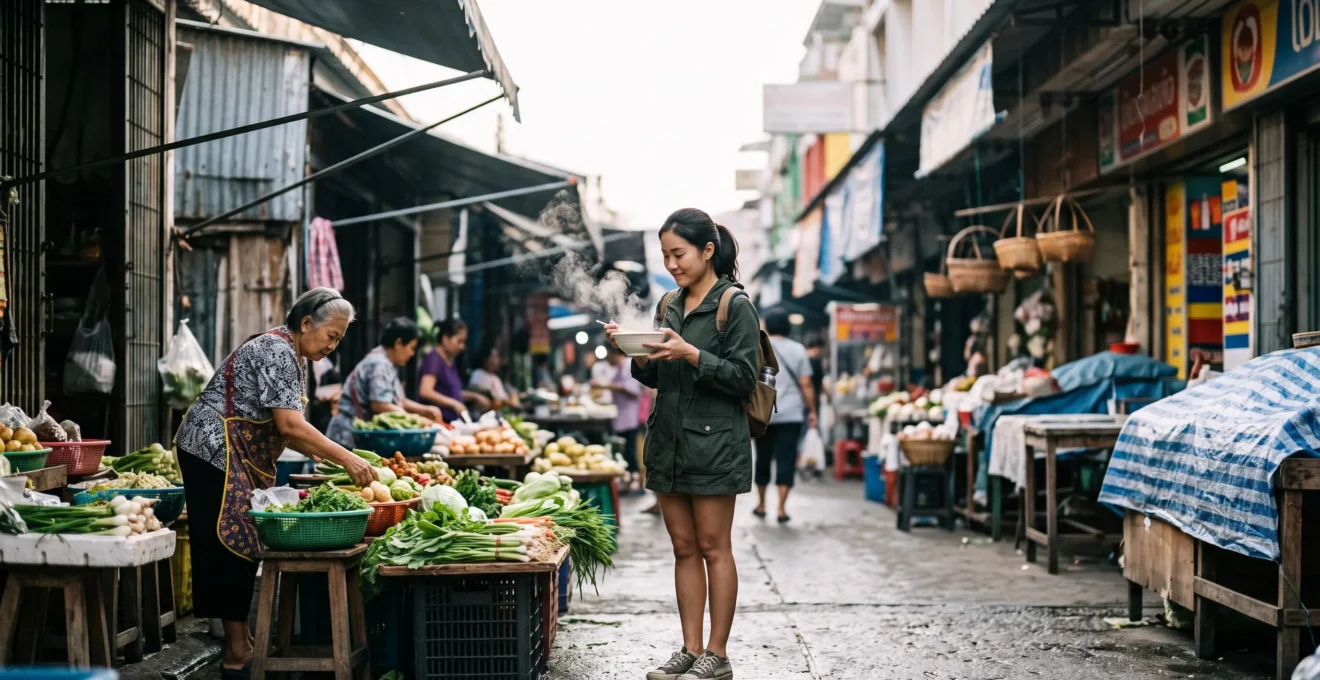
The frustration of an overpriced, inauthentic tourist meal is universal, but finding genuine food culture is a skill, not a matter of luck.
- Authentic dining is revealed by decoding a city’s “culinary rhythms”—understanding *when* and *where* locals eat, not just *what* they eat.
- Moving beyond simple red flags to a systematic approach of vetting eateries, comparing experience types, and embracing a “temporary local” mindset is key.
Recommendation: Instead of just searching for restaurants, start by exploring a local food market at dawn to understand the foundational ingredients and flow of the city’s food system.
There is a specific, sinking feeling every curious traveller knows: the moment you realise the charming little restaurant you chose is a perfectly staged tourist trap. The menu is a glossy, multi-language booklet, the prices are inflated, and the food, while edible, lacks any soul. You’re not tasting the city; you’re consuming a generic, manufactured version of it. This experience leaves you feeling not just out of pocket, but culturally disconnected, as if you’ve looked through a window without ever being invited inside.
The common advice—”avoid places near attractions,” “look for handwritten menus”—is a starting point, but it’s fundamentally reactive. It teaches you what to run from, not what to run towards. True culinary exploration goes deeper. It involves understanding that a city’s gastronomy is its most dynamic, living archive. It tells stories of migration, agriculture, economy, and celebration that a museum exhibit can only hint at. Accessing this archive requires more than a checklist of red flags; it demands a proactive mindset and a systematic approach.
What if the key wasn’t simply avoiding traps, but actively decoding a city’s unique food system? This guide is built on that premise. We will move beyond the platitudes to provide a framework for becoming a “temporary local.” You will learn to read the subtle authenticity signals, understand the city’s culinary rhythms, and triangulate experiences to build a rich, genuine understanding of its culture, one plate at a time. This is your strategy for turning every meal into a meaningful discovery.
This article will guide you through a complete system for authentic culinary exploration. We’ll start by establishing why food is such a powerful cultural key and then provide actionable strategies for identifying genuine restaurants, choosing the right type of experience, and adopting the mindset of a local. Let’s dive in.
Summary: How to Find Authentic Food Culture Beyond Tourist Traps
- Why Does Local Gastronomy Reveal More About Cultures Than Museums?
- How to Identify Genuinely Local Restaurants in Tourist-Heavy Cities?
- Food Tour vs Independent Exploration vs Cooking Class: Which for Cultural Depth?
- The “Local” Restaurant District That Actually Serves Globalised Tourist Food
- When Should You Visit Markets and Restaurants to Experience Local Food Culture?
- Why Do Slow Travellers Report Higher Satisfaction Than Fast-Paced Tourists?
- How to Vet Local Tour Operators for Safety and Authenticity?
- How to Spend One Week in a City Like a Temporary Local?
Why Does Local Gastronomy Reveal More About Cultures Than Museums?
Museums preserve the past in glass cases, offering a static, curated glimpse into history. Gastronomy, on the other hand, is a living, breathing archive of culture that you can interact with and participate in. Every dish tells a story of agriculture, trade routes, migration, and celebration. As the World Food Travel Association defines it, food tourism is about “travelling for a taste of place to get a sense of place.” It’s an active, sensory experience that engages you far more deeply than observing an artifact. In fact, a 2024 Hilton study found that for over 50% of surveyed travellers, exploring local food and drink is a top priority.
This image perfectly captures the difference. One side represents the static, preserved object of a museum, while the other shows the vibrant, tactile reality of fresh ingredients—the building blocks of a culture’s daily life. A local recipe is history made edible. It’s a tradition passed down through generations, adapted with each new wave of influence, and served fresh every day. When you eat a truly local dish, you are not just a spectator; you are the final link in a long cultural chain. This participatory connection is what makes food a more profound gateway to understanding a place than almost any other activity.
How to Identify Genuinely Local Restaurants in Tourist-Heavy Cities?
In a crowded city center, every restaurant seems to be vying for your attention with bright signs and persuasive hosts. The key to seeing past this noise is to shift your focus from marketing to signals—the subtle clues that indicate a place serves its community, not just visitors. A genuinely local restaurant doesn’t need to shout about its authenticity; its existence is proof of it. As Hector Santiago, chef-owner of The Alden, puts it, the proof is in the clientele: “When I’m eating at a tapas restaurant in Spain, I want to hear the table next to me speaking Spanish. I look for where the locals are.”
When I’m eating at a tapas restaurant in Spain, I want to hear the table next to me speaking Spanish. I look for where the locals are.
– Hector Santiago, HuffPost Life
This requires developing an eye for what can be called “authenticity signals.” These include a short, focused menu written primarily in the local language, a nondescript location a few blocks away from a major landmark, and a crowd that peaks at local mealtimes, not tourist schedules. It’s about looking for signs of an established local following rather than transient appeal. This systematic vetting process dramatically increases your chances of having a memorable meal; research suggests travellers who adopt these habits are significantly more satisfied with their dining choices.
Your Checklist for Vetting Authentic Eateries
- Diner Demographics: Observe the customers. Is the chatter in the local language? Are there families, workers, and regulars, or just other tourists?
- Menu Analysis: Scrutinize the menu. Is it short, seasonal, and in the local language (perhaps with a simple translation)? Avoid glossy, multi-language photo albums.
- Location Triangulation: Use a map. Is the restaurant directly facing a major monument, or is it tucked away on a side street one or two blocks over?
- Marketing Tactics: Note how they attract customers. Do they rely on a quiet reputation, or are there aggressive hosts on the sidewalk trying to lure you in?
- Review Scrutiny: When checking online reviews, filter for those written by locals or in the local language. Question sources like TripAdvisor, which are heavily skewed towards tourist opinions.
Food Tour vs Independent Exploration vs Cooking Class: Which for Cultural Depth?
Once you’re ready to explore, you face a choice of method: the curated path of a food tour, the self-guided adventure of independent exploration, or the hands-on lesson of a cooking class. Each offers a different kind of cultural insight, and the best choice depends on your goals. The growing demand for these activities is clear; surveys show that over 65% of travellers are interested in food-centric experiences like cooking classes and tours, indicating a desire for deeper engagement.
| Criteria | Food Tour | Independent Exploration | Cooking Class |
|---|---|---|---|
| Access to Local Stories | High (guide-curated) | Variable (self-sourced) | Medium-High (instructor-led) |
| Understanding of Food Systems | Medium | Low-Medium | High |
| Skill Acquisition | Low | None | High |
| Authenticity of Interaction | Medium (can be staged) | High (if well-researched) | Medium-High |
As the table shows, a cooking class often provides the deepest understanding of a food system. By handling the ingredients and learning the techniques firsthand, you gain an appreciation for the *process* behind the plate. A food tour offers unparalleled access to curated stories and hidden spots, but the interactions can sometimes feel staged. Independent exploration offers the highest potential for authentic, serendipitous discovery, but it also carries the highest risk of failure if poorly researched. The ideal strategy is often a form of “culinary triangulation”: start with a cooking class or market tour to get your bearings, then use that knowledge to explore independently with more confidence and context.
The “Local” Restaurant District That Actually Serves Globalised Tourist Food
Every major city has one: an area famed for its “authentic” restaurants that, upon closer inspection, has become an “Authenticity Performance Zone.” It’s a district where the aesthetics of local culture—cobblestone streets, rustic decor, traditional music—are maintained, but the substance has been replaced by globalised tourist fare. These zones are often located adjacent to major attractions and are masters of mimicry. They adopt the superficial markers of authenticity, like chalk-board menus, but a closer look reveals they are all serving the same five “safe” dishes to an exclusively tourist clientele.
The solution is almost always to walk one street over. As this image illustrates, the difference between the crowded, uniform main drag and the quiet, authentic side street can be just a few steps. To escape these performance zones, you must be willing to venture just beyond the epicenter of tourism. Look for areas where restaurants are smaller, less flashy, and integrated into a real neighborhood with homes, workshops, and other local businesses. The best meal is often found in a place that isn’t trying to sell you an experience, but is simply serving its community.
Key red flags of an Authenticity Performance Zone include:
- Aggressive Touts: Staff standing outside with menus, trying to lure you in. Authentic places rely on their reputation.
- Multilingual Menus: Menus printed in three or more languages are a clear sign they cater primarily to tourists.
- Extensive Menus: A menu with dozens of items from different cuisines suggests a kitchen that does nothing particularly well, likely relying on frozen ingredients.
- Proximity to Attractions: If you can see the city’s number one landmark from your table, you are likely paying a “view tax” in both price and authenticity.
When Should You Visit Markets and Restaurants to Experience Local Food Culture?
Understanding *what* to eat is only half the battle; understanding *when* to eat is just as crucial for tapping into a city’s culture. The culinary rhythm of a place—its daily and weekly schedule of meals, market hours, and social gatherings around food—is a powerful cultural indicator. Aligning your schedule with this rhythm is a fundamental step toward experiencing a city like a temporary local. This goes beyond just finding a meal; it’s about participating in the city’s daily flow. According to one survey, this desire for authentic timing is growing, with more travellers planning trips around specific food experiences.
For food markets, the best time to visit is almost always at dawn or in the very early morning. This is when you’ll see chefs and savvy locals selecting the best produce, fish, and meat for the day. The market is a workplace at this hour, not a tourist attraction. The air is filled with the energy of commerce, the smells are at their freshest, and you can observe the foundational ingredients of the local cuisine before they are transformed in the kitchen. Visiting a market mid-day, by contrast, often means navigating crowds of other tourists and seeing picked-over stalls.
For restaurants, observing local mealtimes is key. In Spain, for example, lunch is the main meal of the day, often starting around 2 PM, while dinner doesn’t begin until 9 PM or later. Arriving at a restaurant at 6:30 PM and finding it empty or filled only with other foreigners is a clear sign you are out of sync with the local rhythm. To find the right time, simply observe. Walk through a residential neighborhood and see when the local eateries start to fill up. Eating on local time not only ensures a more vibrant atmosphere but also often means you’re getting the freshest food, served as the kitchen hits its stride.
Why Do Slow Travellers Report Higher Satisfaction Than Fast-Paced Tourists?
The pressure to see and do everything in a new city often leads to a frantic, checklist-driven style of travel. This “fast travel” approach can leave you with a collection of photos but little genuine connection. Slow travel offers a powerful antidote. It’s a mindset that prioritizes depth over breadth, connection over consumption. Instead of rushing between five cities in a week, a slow traveller might spend that entire week in one neighborhood, building familiarity and allowing for serendipitous discoveries. This approach is particularly transformative for culinary exploration, as it gives you the time to become a regular at a café, build a rapport with a market vendor, or return to a restaurant to try another dish.
The benefits are not just anecdotal. A study published in the Journal of Sustainable Tourism highlights that travellers who engage in slow travel report higher levels of satisfaction, cultural appreciation, and personal growth. By slowing down, you move from being a mere observer to a participant. You start to notice the subtle details: the way locals greet each other, the daily specials at the corner bistro, the rhythm of the delivery trucks in the morning. These are the textures of daily life that fast travel completely misses.
Fast travel gives you memories. Slow travel gives you meaning.
This shift in pace fundamentally changes your relationship with a place. You are no longer just extracting experiences; you are allowing the place to reveal itself to you on its own terms. For the food-focused traveller, this means having the time to follow a recommendation from a shopkeeper, take a detour to a rumored-to-be-excellent bakery, or simply sit at a bar and chat with the person next to you. It’s in these unhurried moments that the most meaningful and authentic connections are made.
How to Vet Local Tour Operators for Safety and Authenticity?
While independent exploration is rewarding, sometimes the expertise of a local guide is invaluable, especially when exploring complex food scenes. A great food tour or cooking class can provide context and access that would be impossible to achieve on your own. However, not all operators are created equal. Vetting them for both authenticity and responsible practices is crucial to ensure your money supports the local community and that you receive a genuinely insightful experience, not a canned performance.
The first step is to look for signs of a deep, genuine connection to the local food community. Does the operator highlight the names of their partner chefs, vendors, and artisans? Or do they use vague, generic language? True experts are proud of their network. As Adrienne Lee of the Planeterra Foundation notes, responsible operators are “crucial in connecting travellers to business owners that are creating opportunities for many at the grassroots level.” Look for operators who are transparent about how they support the community. With some community-focused services, as much as 70% of the money spent by travellers directly supports locals, a figure far higher than the industry average.
Beyond that, use this checklist to assess an operator’s commitment to quality and responsibility:
- Third-Party Certification: Look for accreditations from respected bodies like the Global Sustainable Tourism Council (GSTC), which is the gold standard for environmental and social practices.
- Small Group Sizes: Responsible tours prioritize a low-impact experience. A maximum group size of 10-12 people is a good sign that they value quality interaction over volume.
- Local Reinvestment: Does the company talk about its local hiring practices or how it reinvests profits into the community? Ethical firms focus on long-term benefits.
- Authentic Itineraries: Do their tours go to the same five famous spots as everyone else, or do they feature unique, lesser-known locations that suggest real local knowledge?
Key Takeaways
- Authentic food culture is a dynamic, “living archive” that reveals more about a place than static museum exhibits.
- Finding genuine eateries requires a systematic approach of decoding “authenticity signals,” not just avoiding tourist traps.
- The most profound culinary understanding often comes from a “triangulation” of experiences: combining a hands-on cooking class, a market visit, and informed independent exploration.
How to Spend One Week in a City Like a Temporary Local?
Spending a full week in a single city allows you to move beyond the surface-level highlights and adopt the rhythm of a “temporary local.” This is the culmination of all the strategies we’ve discussed: it’s about applying a systematic approach to food discovery within the unhurried framework of slow travel. The goal is to build a routine, establish favorite spots, and create a sense of belonging, however fleeting. This is becoming an increasingly popular travel style, with some reports showing that nearly one in five dedicated travellers now plan their entire trip around specific restaurants.
Your first day should be about orientation. Start at a central food market to understand the local terroir and seasonal ingredients. This is your “tasting map” for the week. On day two, take a cooking class or a niche food tour to gain hands-on skills and insider knowledge. Use the rest of the week to explore independently, armed with this new context. Instead of aiming to eat at a different place for every meal, try returning to a spot you enjoyed. Become a “regular” for a day or two at a local coffee shop. The staff will start to recognize you, and these small points of human connection are what transform a trip from a series of transactions into a collection of meaningful experiences.
Throughout the week, make it a habit to ask for recommendations from industry insiders—the bartender at your hotel, the barista at your morning coffee spot, the cheesemonger at the market. Ask them where *they* go to eat on their day off. Their answers will be infinitely more valuable than any online list. By crowdsourcing information from the people who power the city’s food scene, you tap directly into the local network. This is the ultimate hack for eating like a local: trust the people, not just the pixels.
By shifting your mindset from that of a tourist to that of a temporary resident, you unlock a completely different and far more rewarding way to travel. Your goal is no longer to just see the city, but to understand its pulse. Start planning your next trip not as a checklist of sights, but as an opportunity to truly inhabit a new place, one authentic meal at a time.