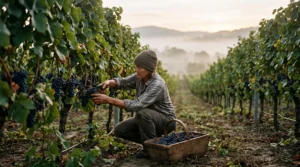
A genuine harvest experience is not about finding a beautiful vineyard; it’s about earning your place on a working team, and the most rewarding ones are never advertised as simple tours.
- Most “harvest experiences” are tourist theatre—brief, staged photo opportunities designed for social media, not for genuine participation.
- Real harvest work is a physically demanding agricultural job that requires commitment, stamina, and a willingness to get your hands dirty for hours, not minutes.
Recommendation: Shift your search from “tours” to “work opportunities.” Investigate volunteer platforms, contact small family-run wineries directly, and learn to spot the signals of authenticity before you book.
For the dedicated wine enthusiast, the journey from casual sipper to true connoisseur is marked by a desire for deeper understanding. You’ve attended countless tastings, you can distinguish a Merlot from a Malbec, and you might even have a favorite appellation. Yet, a gap remains between the glass and the ground. The common advice—to visit a winery during harvest—often leads to a polished, passive experience. You might see the action from a safe distance, but you won’t feel the sun on your back, the sticky grape juice on your hands, or the camaraderie of a team working against the clock.
The travel industry is saturated with what can only be described as “tourist theatre”: carefully curated, 30-minute photo-ops where you pose with a basket and a pair of secateurs before being whisked away to a standard tasting. These experiences promise participation but deliver a pantomime. But what if the true key to unlocking a profound appreciation for wine isn’t about tasting more, but about contributing to its creation? What if the goal wasn’t just to see the harvest, but to become part of it?
This guide is for those who seek that authentic connection. We will reject the tourist-theatre model and provide a framework for finding and vetting genuine harvest experiences. We will explore the different paths to participation, the real physical commitments involved, and the tell-tale signs that separate an authentic day of labor from a staged event. It’s time to trade the tasting room for the vineyard row and discover the story of wine from the inside out.
To navigate this journey from enthusiast to participant, this guide breaks down the essential steps and considerations. Here is a look at the topics we will cover to help you find an experience that truly educates and engages.
Summary: Finding Authentic Wine Harvest Participation
- Why Does Harvest Participation Transform Wine Appreciation More Than 100 Tastings?
- How to Join Harvest Experiences That Offer Real Winemaking Participation?
- What Physical Fitness and Time Commitment Do Wine Harvests Actually Require?
- The “Harvest Experience” That’s Actually 30 Minutes of Photo Opportunities
- How to Extend Harvest Experiences Into Fermentation and Cellar Work?
- Why Do Hands-On Workshops Teach More Than Chef Demonstration Classes?
- How to Find Cooking Experiences That Teach Disappearing Traditional Techniques?
- How to Choose Wine Region Tours That Educate Rather Than Just Pour?
Why Does Harvest Participation Transform Wine Appreciation More Than 100 Tastings?
A wine tasting can teach you to identify notes of blackberry or hints of oak, but it can never fully convey the context of their origin. True appreciation is born from understanding the labor, decisions, and challenges that precede the bottle. Participating in a harvest bridges this gap, transforming wine from a simple beverage into a story you helped write. The market is slowly recognizing this; a recent analysis shows that nearly 38.7% of the wine tourism market is now driven by immersive, educational winery experiences, a clear shift away from passive consumption.
This transformation is rooted in a physical and emotional connection to the process. When you’ve spent a morning with aching back muscles, carefully selecting which grape bunches to cut and which to leave, you gain an intimate respect for the terroir and the vigneron’s skill. You understand the urgency of a harvest crew trying to bring in the crop before a forecasted rain. The abstract concepts of “vintage variation” and “yield management” become tangible realities. It’s the difference between admiring a painting in a gallery and spending a day in the artist’s studio, smelling the paint and seeing the brushstrokes form.
This hands-on effort fosters a profound sense of respect for the agricultural reality of winemaking. As one participant reflected after their first harvest, the simple act of picking grapes instills a deep appreciation for the immense work involved. This direct experience connects you to every person in the chain of production, from the farmer to the cellar hand. The glass of wine you enjoy at the end of the day is no longer just a product; it’s a reward, an emblem of a shared effort, and a memory of the vineyard you can taste.
How to Join Harvest Experiences That Offer Real Winemaking Participation?
Finding an authentic harvest experience requires looking beyond the glossy brochures of large-scale tour operators. The most genuine opportunities are often less advertised and fall into a few distinct categories, each with its own “labor contract” defining your role, commitment, and compensation. Understanding this spectrum is the first step in finding the right fit for your goals and legal status, especially when traveling abroad.
For the truly committed, platforms like WWOOF (World Wide Opportunities on Organic Farms) or HelpX offer a clear path. These programs are built on a work-exchange model: you provide 4-6 hours of labor per day in exchange for accommodation and meals. This is not a tour; you are part of the team. For non-EU citizens, this often provides a convenient way to participate without navigating complex work permit regulations. On the other end of the spectrum are paid harvest positions, which require a full workday and legal eligibility to work, but offer financial compensation. This is a real job, and expectations are set accordingly.
For those with less time, the key is to seek out small, structured programs organized by winemaker unions or individual family estates. These are designed for enthusiasts who want more than a photo-op but can’t commit to a full season. A great example comes from Alsace, France.
Case Study: The Union-Organized Harvest in Alsace
The Independent Winemakers of France union organizes a “Grape Harvest Experience” that allows participants to join a real picking team for a half-day. This isn’t a separate tour group; you are integrated into the existing crew, many of whom return year after year, fostering a strong sense of community. This model illustrates a perfect middle ground, offering deep immersion within a manageable timeframe and ensuring visitors are treated as temporary colleagues, not customers.
The choice between these models depends entirely on your goals. To make an informed decision, it’s crucial to understand the practical differences in commitment and compensation.
This comparative table, based on information from guides for aspiring harvest volunteers, clarifies the most common arrangements.
| Model | Compensation | Daily Hours | Legal Notes |
|---|---|---|---|
| Volunteer (WWOOF/HelpX) | No cash; accommodation and meals in exchange for work | 4-6 hours/day | Common workaround for non-EU citizens avoiding work-permit paperwork |
| Paid harvest position (France) | €8-12 per hour (minimum wage applies) | Full workday | Technically requires a work permit for non-EU citizens; EU citizens can work freely |
What Physical Fitness and Time Commitment Do Wine Harvests Actually Require?
The romantic image of a gentle stroll through sun-dappled vines, snipping a few photogenic grape bunches, is the biggest deception of wine tourism. A real harvest is a demanding agricultural job. It’s repetitive, it’s physically taxing, and it operates on a strict schedule dictated by weather and grape ripeness. Arriving unprepared is not only a disservice to yourself but also to the crew you’re joining. The work involves hours of bending, lifting, and carrying, often on uneven terrain. It’s crucial to be honest about your physical capabilities before committing.
The primary physical challenge is the strain on the back and legs. The picking posture—a constant stoop or crouch—engages muscles rarely used in a typical fitness routine. The data doesn’t lie; research on vineyard ergonomics shows that sprains and strains account for about 42% of non-fatal injuries, with back injuries making up a significant portion of those. This isn’t meant to deter you, but to underscore the importance of preparation. Strengthening your core, lower back, and hip flexors is more important than pure cardiovascular fitness.
Beyond strength, endurance is key. A harvest day is not a one-hour workout. You will be on your feet for the better part of the day, performing the same motions over and over. You should also be prepared for the elements—sun, wind, and sometimes cold morning temperatures. Proper gear is not an afterthought: sturdy, closed-toe boots with good support are non-negotiable, as are layered clothing, a hat, and sunscreen. Many experienced pickers also use padded gloves to prevent blisters and protect from cuts.
Action Plan: Pre-Harvest Physical Preparation
- Build Endurance: Start a routine of daily walks of 5–8km with a loaded pack one month before harvest to simulate carrying equipment or baskets.
- Condition Core Muscles: Add hip flexor and lower back stretches to your daily routine, as the stooped picking posture is different from regular exercise.
- Test Your Stamina: Recognize that harvest is not the time to discover you’ve never worked on your feet for eight hours. Practice long periods of standing or light activity.
- Mimic the Motions: Practice controlled squats and use grip-strength trainers to prepare for the repetitive cutting and lifting motions of picking.
- Invest in Gear: Obtain and break in your gear beforehand, especially your footwear. A blister on day one can ruin the entire experience.
The “Harvest Experience” That’s Actually 30 Minutes of Photo Opportunities
This is the heart of the matter for any authenticity-seeking traveler: how to spot the “tourist theatre” before you’ve paid for the ticket. These experiences are expertly packaged to look like the real thing, but they are fundamentally different in purpose. A genuine harvest is about efficiently and carefully bringing in a crop; a staged experience is about creating a memorable, and highly shareable, customer moment. Learning to distinguish the two requires a cynical eye for detail.
The first and most obvious signal is duration and timing. A real harvest day starts early and lasts for hours. An “experience” that begins at 11 a.m. and lasts for 90 minutes, including the tasting, is a performance. Be wary of any program that fits neatly into a tourist’s afternoon schedule. The second signal is the price and what it includes. While counterintuitive, a very low price for a short “harvest package” can be a red flag. Data on average visitor spending in Italy shows a trip cost of €400, with just €46 allocated to harvest experiences, indicating these are often short, low-cost add-ons rather than the main event. A real, immersive day will likely have a more substantial cost reflecting a full day’s worth of food, guidance, and wine.
The language used in the description is another crucial clue. Look for verbs. Does the description talk about “learning,” “joining the team,” and “working alongside the crew”? Or does it focus on “picturesque views,” “creating memories,” and “tasting our finest”? The latter suggests a focus on passive enjoyment, not active participation. A full day of work is a clear differentiator.
Case Study: The Full-Day Harvest Workshop in the Loire Valley
A family winery in Vouvray offers a “Harvest Workshop” that serves as a benchmark for authenticity. The day starts at 9:00 a.m. and finishes around 4:30 p.m. Participants are not just handed shears for a photo; they are involved in the hand harvest, the pressing of the grapes, tasting the fresh juice (must), and sharing a lunch with the winemakers and crew. This structure, a full working day, is the clearest possible distinction from a brief, curated photo-op designed for tourists.
How to Extend Harvest Experiences Into Fermentation and Cellar Work?
Picking the grapes is only the first act in the drama of winemaking. For those who want to understand the full story, the journey from vine to bottle continues in the cellar. A truly comprehensive experience doesn’t end when the last crate of grapes is brought in from the field. It follows the fruit to the sorting table, the crusher-destemmer, and the fermentation tank. This is where the magic of transformation begins, and participating in this stage offers a completely different, yet equally valuable, set of lessons.
Seeking out these extended experiences requires an even more discerning approach. Many wineries are hesitant to allow visitors into the cellar during the hectic harvest season due to safety and hygiene concerns. Therefore, experiences that explicitly include cellar work are a strong signal of a winery’s commitment to genuine education. Look for programs that mention activities like grape sorting, monitoring fermentation, or performing a “punch-down” (the manual process of pushing the solid cap of grape skins back down into the fermenting juice).
The wine tourism sector is slowly adapting, with more wineries seeing the value in these deeper educational offerings. They are building programs that bridge the gap between the vineyard and the cellar. A prime example can be found in one of Burgundy’s most esteemed domains, demonstrating how a single session can be structured to cover the entire process.
Case Study: The Terroir-to-Cellar Journey at Château de Pommard
At Château de Pommard’s prestigious Clos Marey-Monge, the winery offers a three-hour session specifically designed to take participants through the entire process. This experience intentionally moves beyond just picking, guiding visitors through the critical steps involved in taking the grape from the terroir to the cellar, and ultimately, to the bottle and glass. This model shows how even a shorter, curated experience can be designed for deep learning, focusing on the crucial transition from agriculture to alchemy rather than stopping at the vineyard gate.
Why Do Hands-On Workshops Teach More Than Chef Demonstration Classes?
To understand the profound difference between a real harvest and a tourist photo-op, consider a parallel from the culinary world: the cooking class. There are two fundamental models. In one, you sit in an auditorium and watch a famous chef prepare a complex dish on stage. It’s entertaining and inspiring, but when you get home, you realize you haven’t learned the feel of the dough or the smell of the onions just before they burn. This is the chef demonstration class—the equivalent of watching a harvest from the tasting room patio.
In the second model, you are given an apron, a knife, and a workstation. You chop the vegetables, you knead the dough, you make the mistakes, and a guide corrects your technique in real-time. This is the hands-on workshop. It may be less glamorous, but your hands, your muscles, and your mind are engaged. You build muscle memory. You learn not just the “what” but the “how” and the “why.” You understand the rhythm and flow of a kitchen. This is the model of a genuine harvest experience.
The value is not in the final product but in the process. Watching a chef doesn’t make you a cook, and watching a harvest doesn’t make you a winemaker. It is the act of doing—the physical engagement and problem-solving—that encodes the lesson deep in your memory. A passive demonstration appeals to the intellect, but a hands-on workshop engages the whole person. This is why, after a real day in the vineyard, the wine tastes different. You are not just a spectator to its story; you are a minor character in it.
How to Find Cooking Experiences That Teach Disappearing Traditional Techniques?
Extending the culinary analogy, the most sought-after cooking classes are often those that teach something unique and endangered—the art of making a rare regional pasta, the secrets of a grandmother’s fermentation process. These are techniques that don’t scale, that resist industrialization, and that are kept alive by a few dedicated custodians of tradition. The same principle applies to finding the most authentic and rewarding wine experiences. The goal isn’t just to find a harvest, but to find one that connects you to a specific winemaking philosophy and tradition.
Instead of targeting large, famous estates whose processes are often highly mechanized and streamlined for volume, shift your focus. Look for the small, family-run wineries that are celebrated for preserving ancestral grape varietals or for using traditional, non-interventionist methods. These are often the places where you will find biodynamic farming practices, foot-stomping of grapes, or aging in ancient clay amphorae instead of new oak barrels. These are the “disappearing techniques” of the wine world.
Finding these wineries requires more research. They are less likely to have a large marketing budget or a flashy tourism program. Your search should involve reading blogs by niche wine writers, exploring the portfolios of specialist wine importers, or looking for producers who are members of alternative winemaker associations (like natural or biodynamic wine guilds). When you contact them, express your interest not just in “helping with harvest,” but in learning about their specific, traditional methods. This shows respect and a genuine desire to learn, making them far more likely to welcome you into their very small, and very real, operation.
Key Takeaways
- Vet all “experiences” by asking about duration, group size, and specific tasks. A real harvest is a full day of work, not a 90-minute tour.
- Be brutally honest about your physical fitness. Authentic harvest is a demanding agricultural job that requires stamina, a strong back, and a willingness to perform repetitive tasks for hours.
- Prioritize opportunities that integrate you with the actual crew, whether through volunteer platforms like WWOOF, paid seasonal work, or structured workshops at small, family-run wineries.
How to Choose Wine Region Tours That Educate Rather Than Just Pour?
The principles used to vet a harvest experience can be applied to all forms of wine tourism. The industry is vast, and as tastings and tours make up over 57% of wine tourism revenue, the default model is often built for high-volume, low-depth encounters. The challenge is to find the tours that educate rather than just pour. This requires a final shift in mindset: you are not looking for a driver, but for a curator; not a tasting, but a lesson.
An educational tour prioritizes access and expertise over volume and variety. Instead of a bus tour that stops at four different wineries for a standard flight of three wines at each, a high-value tour might spend an entire half-day at a single estate with the winemaker themselves. The goal is depth over breadth. You learn about one place intimately rather than seeing many places superficially. The best tours are often private or in very small groups, allowing for real conversation and tailored questions.
When evaluating a tour, look for these signals of educational intent. A truly valuable experience will often include these elements:
- Winemaker-Hosted Access: The tour is led by the winemaker or a senior vineyard manager, not a generic tour guide. Access is often restricted to private groups.
- In-Depth Vineyard Walks: The tour includes a significant amount of time in the vineyard, discussing specific rows, soil types, and the decisions that were made during the growing season for that specific vintage.
- Hands-On Sorting Table Participation: If it’s harvest, a great tour might allow you to spend time at the sorting table alongside the permanent crew, learning firsthand how quality control is performed.
- Barrel Tastings and Unfinished Wines: The tasting goes beyond the standard polished offerings. It includes tasting wine directly from the barrel, comparing different vintages, or sampling unfinished wine to understand its development.
Ultimately, choosing an educational tour is about investing in knowledge. By applying the same discerning criteria you’d use to find a real harvest, you can ensure that every trip to a wine region leaves you not just with a few bottles, but with a richer, more profound understanding of the world of wine.
Your journey to authentic participation begins with this shift in perspective. Move beyond the mindset of a tourist and adopt that of an apprentice. Seek out the small, the traditional, and the labor-intensive. By asking the right questions and managing your own expectations, you can find an experience that offers more than a photo—it offers a genuine connection to the land, the labor, and the art of winemaking.