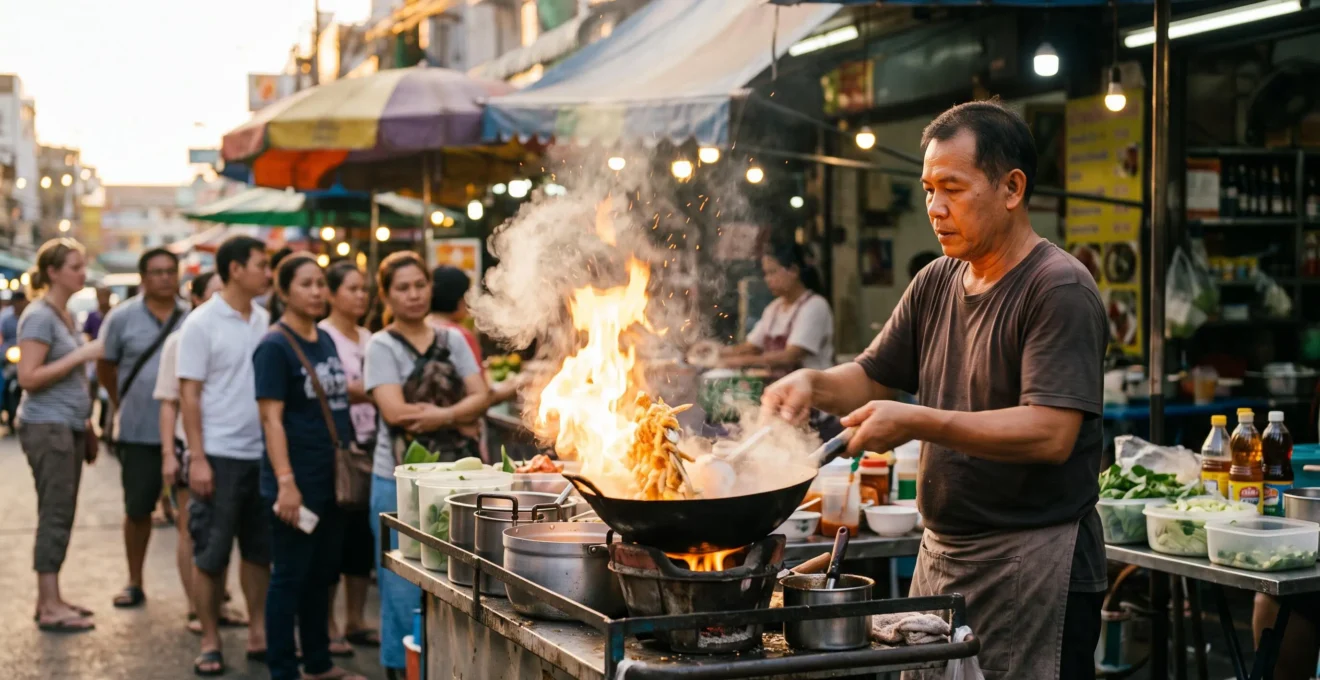
The secret to safely eating incredible Bangkok street food isn’t avoiding stalls, but learning to read the hidden “quality signals” that locals trust every day.
- High turnover is key: A long queue of locals means ingredients are fresh and food is cooked at temperatures that prevent bacterial growth.
- Specialization equals quality: Vendors who have mastered a single dish over decades, known as “one-dish masters,” offer an unparalleled taste and reliability.
- Location dictates experience: Different areas like Yaowarat, Or Tor Kor, and Khao San Road are not “better” or “worse”—they are built for different types of foodies and experiences.
Recommendation: Start by trusting the visual cue of a busy stall with high customer traffic, then graduate to seeking out specialists and exploring market rhythms beyond the main tourist paths.
The sizzle of a hot wok, the fragrant steam of lemongrass and chili, the kaleidoscope of colours from fresh produce—Bangkok’s street food scene is a sensory explosion. For first-time visitors, it represents both the ultimate culinary adventure and a source of deep-seated anxiety. The excitement of trying authentic Pad Thai from a cart is often tempered by a nagging fear: “Will this make me sick?” This worry can lead to a trip of missed opportunities, sticking to tourist-trap restaurants instead of diving into the city’s true culinary heart.
The common advice—”only eat what’s hot,” “avoid the ice”—is a starting point, but it’s outdated and misses the intricate dance of the city’s food culture. It fails to explain why one vendor thrives for decades while another disappears in a week. The real key to unlocking Bangkok’s street food safely isn’t about a list of things to avoid; it’s about learning to see the city’s food ecosystem as the locals do. It’s about understanding the unwritten rules and quality signals that have governed this world long before Michelin stars and food bloggers arrived.
This guide moves beyond the generic tips. We’ll deconstruct the logic behind a busy stall, explore the different foodie “personalities” of Bangkok’s most famous food districts, and teach you how to spot a “one-dish master” from a block away. We will equip you not with rules, but with knowledge, turning your anxiety into confident curiosity. By understanding the system, you won’t just eat safely; you’ll eat better, more authentically, and with the thrill of a true insider.
To help you navigate this delicious world with confidence, this article breaks down the essential strategies. The following summary outlines the key areas we will cover, from understanding the science of safe food to the art of cultural immersion.
Summary: A Strategic Approach to Bangkok’s Culinary Streets
- Why Do Busy Street Food Stalls With Queues Cause Fewer Illnesses?
- What Are the 10 Essential Bangkok Street Food Dishes First-Timers Must Try?
- Khao San Road vs Yaowarat vs Or Tor Kor: Which Bangkok Food Area for Quality?
- The Street Food Pricing Scam Targeting Tourists Near Major Attractions
- When Are Bangkok Street Food Vendors at Their Freshest and Most Vibrant?
- How to Identify Genuinely Local Restaurants in Tourist-Heavy Cities?
- How to Vet Local Tour Operators for Safety and Authenticity?
- How to Navigate Local Food Markets as a Cultural Learning Experience?
Why Do Busy Street Food Stalls With Queues Cause Fewer Illnesses?
The most common piece of advice for eating street food is to “choose a stall that’s busy with locals,” but few explain the powerful science and economics behind this rule. It’s not just social proof; it’s a visible indicator of food safety. The core principle is turnover velocity. A stall with a constant queue is continuously cooking fresh batches of food. This means ingredients don’t sit around, and the food you receive is likely only minutes old, prepared at a high, sterilizing heat.
This high heat is crucial. The food is kept well outside the ‘Danger Zone’—the temperature range of 40°F to 140°F (4°C to 60°C) where bacteria multiply rapidly. A sizzling wok or a bubbling pot is your best friend. Conversely, food sitting in lukewarm trays at an empty stall is a red flag. Furthermore, this high turnover creates what is essentially a self-policing system. As one analysis points out, Bangkok’s street food scene operates as an informal self-regulating ecosystem where vendors rely on daily repeat customers. If quality or hygiene slips, their local customer base disappears overnight—a far more immediate and effective deterrent than any official inspection. A queue isn’t just a line; it’s a vote of confidence and a living safety certificate.
What Are the 10 Essential Bangkok Street Food Dishes First-Timers Must Try?
With thousands of vendors, knowing where to start can be overwhelming. The key is to think in terms of flavour profiles and cooking styles. Aim to try a dish from each major category: noodles, salads, grilled meats, soups, and sweets. This approach gives you a comprehensive taste of Thai cuisine. While personal preferences vary, a well-rounded introductory list includes dishes that are both iconic and consistently delicious when prepared by a skilled vendor.
Here are 10 essential dishes that serve as a perfect introduction:
- Pad Thai (ผัดไทย): The world-famous stir-fried noodle dish. Look for vendors who cook it to order in a hot wok.
- Som Tum (ส้มตำ): A spicy green papaya salad that perfectly balances sweet, sour, salty, and spicy flavours.
- Moo Ping (หมูปิ้ง): Grilled pork skewers marinated in a sweet and savoury sauce, often eaten with sticky rice (Khao Niao).
- Guay Teow (ก๋วยเตี๋ยว): Noodle soup, with countless variations of broth, noodles, and toppings like beef, pork, or fish balls.
- Khao Pad (ข้าวผัด): Thai-style fried rice, a simple yet satisfying staple that showcases the quality of the wok cooking.
- Pad Krapow Moo (ผัดกระเพราหมู): Minced pork stir-fried with holy basil and chili, served over rice with a fried egg on top. A local favourite.
- Gai Tod (ไก่ทอด): Crispy, juicy fried chicken, often seasoned with garlic and pepper.
- Sai Krok Isan (ไส้กรอกอีสาน): Fermented sausage from the Northeastern region, grilled and served with fresh cabbage and chilies.
- Mango Sticky Rice (ข้าวเหนียวมะม่วง): A classic dessert of sweet sticky rice, fresh mango, and a drizzle of coconut cream.
- Roti (โรตี): A sweet, pan-fried bread, often filled with banana and egg, then drizzled with condensed milk.
_
Don’t be afraid to venture beyond the basics. The world of street food includes everything from humble, affordable Bib Gourmand spots to true gourmet experiences. As a pricing analysis notes, you can find Bib Gourmand meals for $2–$5, while a Michelin-starred street food dish can exceed $30. This is exemplified by Raan Jay Fai, whose 2018 Michelin star proved that street-side stalls can achieve world-class quality through decades of focused mastery.
Khao San Road vs Yaowarat vs Or Tor Kor: Which Bangkok Food Area for Quality?
Not all food areas in Bangkok are created equal. Where you go should depend on what you’re looking for: a party atmosphere, a deep culinary dive, or a pristine market experience. Understanding the “personality” of each major hub helps you match your expectations and find the quality you seek. Think of yourself as a specific Foodie Archetype and choose your destination accordingly.
To make the choice clearer, here is a breakdown based on a comparative analysis of Bangkok’s food hubs. It helps frame the ideal use case for each location.
| Area | Ideal For | Peak Time | Atmosphere |
|---|---|---|---|
| Khao San Road | The Social Snacker | Evening / Late-night | Convenient, lively, party atmosphere |
| Yaowarat (Chinatown) | The Hardcore Foodie | After 6 PM | Chaotic, high-energy, specialized stalls |
| Or Tor Kor Market | The Quality-Controlled Explorer | Daytime / Lunch | Clean, market-fresh, calmer pace |
Khao San Road is perfect for the Social Snacker who wants convenience and variety while soaking up a vibrant, party-like energy. The food is geared towards tourists (think Pad Thai and fried scorpions) but is easily accessible. Yaowarat, Bangkok’s Chinatown, is for the Hardcore Foodie. The energy is frenetic, the crowds are dense, and the focus is on specialized stalls that have perfected one or two dishes. The experience is intense but incredibly rewarding. Finally, Or Tor Kor Market is for the Quality-Controlled Explorer. It’s a clean, almost clinical fresh market with a high-end food court. Here, you can sample premium-quality fruits, seafood, and prepared dishes in a calm, orderly environment.
The Street Food Pricing Scam Targeting Tourists Near Major Attractions
One of the few downsides to Bangkok’s otherwise welcoming street food scene is the risk of overpaying, especially in areas packed with tourists. While not rampant, a dual-pricing system can exist where foreigners are charged significantly more than locals. This “scam” relies on the tourist’s unfamiliarity with local prices. As a Bangkok street food pricing breakdown documents, a dish that a local pays ฿40–฿70 for might be quoted at ฿100–฿180 near a major temple or on a main tourist drag.
The most common culprits are mobile carts or stalls without clearly displayed prices that strategically position themselves near the exits of major attractions like the Grand Palace or Wat Arun. They bank on you being tired, hungry, and less likely to question a price. The key to avoiding this is a combination of awareness and proactive communication. Being armed with a few simple verification techniques removes the guesswork and ensures you pay a fair price, just like a local.
Action Plan: How to Avoid Street Food Overcharging
- Observe the vendor: Only order from stalls that have visible price lists or menus written in Thai script (often with numbers you can read).
- Confirm before cooking: Politely ask for the price (“Tao Rai?”) before the vendor starts preparing your food. A clear, upfront confirmation prevents any “surprises” later.
- Compare prices: If you’re unsure, take a moment to walk 50 meters down the street and see what similar stalls are charging. The price difference can be significant.
- Be skeptical of tourist bait: Exercise caution with stalls that have glossy, multi-language photo menus, especially if they are the only food source right outside a major landmark.
- Watch the locals: Observe what others are paying. If you see a local hand over a ฿50 note and get change for a dish, you know the fair price is under that amount.
By following these simple steps, you can confidently navigate any area, ensuring that the only thing you’re focused on is the delicious food, not the bill. This knowledge empowers you to explore with peace of mind.
When Are Bangkok Street Food Vendors at Their Freshest and Most Vibrant?
In Bangkok, *when* you eat is almost as important as *where* you eat. The city’s food scene operates on a distinct rhythm, and timing your visit to a stall or market correctly can dramatically enhance both the flavour and safety of your meal. The freshest food is served when vendors are at their busiest, catering to the daily ebb and flow of local life. This is when ingredients are being replenished constantly and food is cooked non-stop.
There are three peak periods that act as powerful freshness signals:
- The Morning Rush (6 AM – 9 AM): This is when locals grab breakfast on their way to work. You’ll find vendors selling staples like jok (rice porridge), moo ping (grilled pork), and soy milk. It’s a fantastic time to see the city wake up and eat alongside commuters.
- The Lunch Crunch (11:30 AM – 1:30 PM): Office workers pour out onto the streets, and you can be sure that any stall with a long queue of people in uniforms is serving something fresh, fast, and delicious. This is one of the most reliable indicators of quality.
- The Evening Feast (After 6 PM): As the sun sets and the city cools, many of the most famous food streets, like Yaowarat, truly come alive. This is when specialized, evening-only vendors set up shop, offering a completely different range of dishes than what’s available during the day.
A key mistake is eating during the quiet mid-afternoon lull (around 2 PM – 5 PM). During this time, many stalls have pre-cooked food sitting in trays, which is less fresh and potentially in the temperature ‘Danger Zone’. As a case study of Yaowarat’s rhythms confirmed, the same street can feel calm and peaceful by day but transform into a chaotic, high-energy food mecca after dark. Understanding this daily transformation is key to finding vendors at their peak.
How to Identify Genuinely Local Restaurants in Tourist-Heavy Cities?
Beyond the mobile carts, Bangkok is filled with small, family-run shophouse restaurants that are institutions in their own right. In a city saturated with options, the true mark of authenticity and quality is often specialization. Look for the “one-dish master”—an establishment that has built its reputation by perfecting a single type of dish over decades. These places don’t need fancy decor or extensive menus because their product speaks for itself.
A classic example is a place like Guay Tiew Mu Rung Rueang, a Bib Gourmand-recognized spot in a prime district. Their entire operation revolves around one thing: ground pork noodles with fish balls. You have two choices—dry or with soup. That’s it. This extreme focus is a powerful quality signal. It indicates a deep mastery of ingredients and technique, honed over generations. These are the places where you’ll find locals from all walks of life, from nearby residents to office workers on their lunch break, all seeking a consistent, high-quality meal.
Case Study: Guay Tiew Mu Rung Rueang, the One-Dish Specialist
Despite being located in one of Bangkok’s most expensive districts, this humble shophouse restaurant has thrived for years by focusing exclusively on simple ground pork noodles. It offers just two variations (dry or soup), a textbook example of a ‘one-dish master’ establishment that has earned the trust of both wealthy local homeowners and in-the-know visitors through sheer quality and consistency.
As the experts from the Michelin Guide note when describing such places, the focus is entirely on the food. In their review of one such establishment, they highlighted that “the restaurant itself has no frills, simply using reputation and inducing scents of Thai food to woo in locals and tourists alike.” When you find a place with a worn-out sign, a simple interior, a short menu (or no menu at all), and a steady stream of local customers, you’ve likely found a gem.
How to Vet Local Tour Operators for Safety and Authenticity?
For some first-time visitors, the thought of navigating the chaotic streets and language barrier on their own can be daunting, no matter how much research they’ve done. This is where a good local food tour can be an invaluable investment. A well-vetted tour is not a “tourist trap”; it’s a curated, efficient, and safe way to access the best of the street food scene with the context of a knowledgeable guide. It acts as a perfect “training wheels” experience.
When vetting a tour operator, look for three key things: specialization, small group sizes, and strong, specific reviews. Avoid generic “Bangkok City” tours that tack on a food stop. Instead, look for operators that focus exclusively on food, or even on a specific neighbourhood like Chinatown. A private or small-group tour ensures you’re not just part of a massive herd and allows for genuine interaction with the guide. The guide’s expertise is what you’re paying for—they should be able to explain the history of a dish, the story of the vendor, and answer your questions in detail.
For example, a private night food tour of Chinatown can be an extremely efficient way to sample 10-12 distinct dishes in a few hours, something that would be nearly impossible to coordinate on your own in such a confusing area. The guide navigates, orders, and pays, leaving you free to simply eat and learn. Testimonials often provide the most honest insight. As one traveller on a guided tuk-tuk tour noted:
We tried so many authentic dishes that we never would have found on our own, all recommended by the Michelin Guide.
– TripAdvisor Reviewer
This highlights the core value of a good tour: access and curation. It provides a safe, structured environment to build your confidence, so that on your next visit, you’ll be ready to explore on your own.
Key Takeaways
- Trust the crowd: A busy stall with high turnover is your best indicator of fresh ingredients and safe cooking temperatures.
- Specialize your search: Seek out “one-dish masters”—vendors who have perfected a single dish over decades. Their focus is a mark of quality.
- Match the area to your mood: Choose your location (Yaowarat, Or Tor Kor, Khao San) based on whether you want an intense foodie deep-dive, a clean market experience, or a social snack.
How to Navigate Local Food Markets as a Cultural Learning Experience?
Once you’ve mastered the art of ordering from a stall and feel confident in your choices, the final step is to go to the source: the local fresh market. This is where vendors buy their ingredients and where the true heart of Thai cuisine beats. Navigating a market like Or Tor Kor or a smaller neighbourhood market is more than just a food mission; it’s a deep cultural immersion. It’s an opportunity to see, smell, and touch the building blocks of the dishes you’ve come to love.
Instead of just walking through, engage with the market. Observe the interactions. See which produce vendors have the longest queues of local shoppers. Notice the incredible variety of chilies, herbs, and vegetables you may not recognize. Many markets have a small section with ready-to-eat meals, often of exceptionally high quality, intended for other market vendors. This is as local as it gets. The experience elevates food from a simple transaction to a genuine connection with the local culture and its history.
This connection is deeply rooted in the city’s heritage. As scholar Vannaporn Phongpheng notes, “Bangkok street food is a Southeast Asian culinary heritage that has a unique origination and innovation handed down by Thai-Chinese families.” By visiting a market, you are stepping into that living history. Don’t be afraid to interact. Use gestures, smile, and be curious. Point at an unfamiliar fruit and the vendor may offer you a taste. This simple exchange can be one of the most memorable moments of your trip, transforming you from a mere tourist into an engaged participant in the city’s daily life.
Now that you are equipped with the knowledge to read the quality signals of Bangkok’s streets, the final step is to put it all into practice. Start with the basics, trust your observations, and let your curiosity guide you from one delicious discovery to the next.