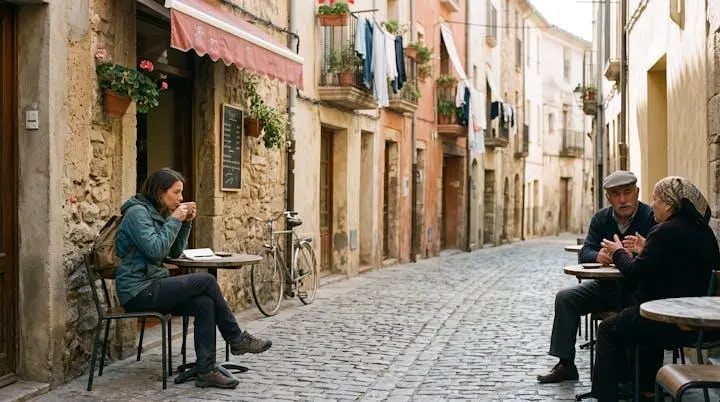
True local immersion isn’t found by avoiding tourist spots, but by fundamentally changing how you structure your time and attention.
- Lasting satisfaction comes from cultivating “time affluence”—the feeling of having enough time—not from a packed itinerary.
- Establishing a daily “anchor” spot, like a neighbourhood café, builds genuine connection much faster than conventional sightseeing.
Recommendation: For your next trip, consciously trade the ‘coverage’ mindset for a ‘connection’ mindset by building a simple, repeatable daily rhythm that lets the city’s character reveal itself to you.
You return from a week-long city break with a camera full of photos but a distinct feeling of emptiness. You saw the monuments, ate at a recommended restaurant, and navigated the metro, yet you feel like you merely skimmed the surface, returning more exhausted than enriched. This experience is the hallmark of modern, fast-paced tourism, a race to check boxes that often leaves the most important thing behind: a genuine connection to the place itself.
The common advice—visit a local market, use public transport—scratches the surface but fails to address the core problem. These are tactics, not a strategy. They treat “living like a local” as an item to be acquired rather than an experience to be cultivated. The traveller, tired of rushing between attractions, wants a meaningful connection but is often left without a clear framework on how to achieve it.
But what if the key to deep immersion isn’t in *what* you do, but in *how* you structure your time and perceive your surroundings? The shift from a tourist’s frantic pace to a temporary local’s rhythm is not about discovering secret spots, but about embracing a new mindset. It’s about trading the pursuit of coverage for the cultivation of connection. This approach values depth over breadth, favouring the rhythm of a single neighbourhood over a city-wide scavenger hunt.
This guide will deconstruct the principles of slow, immersive travel. We will explore the psychology behind traveller satisfaction, provide a practical framework for structuring your days, differentiate authentic activities from “tourist theatre,” and ultimately show you how to experience a city’s true culture—all within a single week.
To help you navigate this shift in perspective, we’ve structured this guide to walk you through the mindset, methods, and practical applications of becoming a temporary local. The following sections will provide a clear roadmap to a more fulfilling travel experience.
Summary: A Guide to Experiencing a City from the Inside Out
- Why Do Slow Travellers Report Higher Satisfaction Than Fast-Paced Tourists?
- How to Structure Your Days to Experience Destinations Like Residents?
- Cultural Immersion vs Sightseeing: Which Activities Actually Connect You to Places?
- The “Local Experience” Tour That’s Actually 100% Tourist Theatre
- How Long Should You Stay in One Place to Move Beyond Tourist Status?
- Why Does Local Gastronomy Reveal More About Cultures Than Museums?
- How to Interact Respectfully With Himalayan Communities During Treks?
- How to Experience a City’s Food Culture Beyond Tourist Restaurant Traps?
Why Do Slow Travellers Report Higher Satisfaction Than Fast-Paced Tourists?
The difference in satisfaction between a rushed tourist and an immersive slow traveller isn’t about the quality of the sights seen; it’s about the quality of the time spent. Traditional tourism often induces a “time famine,” a state of chronic stress where time feels scarce and the pressure to “see everything” leads to diminished enjoyment. The antidote to this is a concept known as time affluence—the subjective feeling of having plenty of time to pursue what matters. This psychological richness, not a packed itinerary, is the true source of travel happiness.
This isn’t just a feeling; it’s a well-documented phenomenon. Extensive research on time affluence shows that its positive association with well-being has been confirmed across multiple independent studies. When travellers intentionally slow down, they swap the anxiety of a checklist for the calm of unstructured time. This allows for spontaneous discoveries, deeper observations, and meaningful interactions—experiences that are crowded out by a back-to-back schedule. By valuing and creating slack in their schedule, slow travellers cultivate the very resource that conventional tourists lack.
Experts argue that this focus on time is a critical, yet overlooked, component of well-being that has direct implications for how we should approach travel. As a team of researchers noted in the scientific journal PNAS:
In the face of an increasing time famine, organizations and policymakers could move beyond their focus on promoting financial affluence to promoting time affluence as well.
– Whillans et al., Buying Time Promotes Happiness, PNAS
The practical application of this principle is clear. A first-hand account from a traveller applying positive psychology to their journeys identified several core happiness triggers, such as anticipation, savouring the moment, and reliving memories. The author highlights that these triggers are amplified specifically through “meaningful slow travel,” arguing that the depth of immersion is what drives lasting satisfaction. It proves that the goal isn’t to accumulate experiences, but to allow a few select experiences the time and space they need to become truly meaningful.
How to Structure Your Days to Experience Destinations Like Residents?
To move from theory to practice, you need a new way to structure your day—one that rejects the frantic zig-zag of sightseeing. The most effective method is the Hub-and-Spoke Model. This approach involves establishing a daily “hub” or anchor point—a place you return to every day—and embarking on just one or two focused “spokes” of exploration from there. This simple routine fundamentally changes your relationship with a city, shifting you from a passive observer to an active participant in its daily rhythm.
Your hub becomes your temporal anchor. It could be a coffee shop where you start your morning, a park bench you visit in the afternoon, or a quiet pub for an evening drink. This isn’t about finding the “best” place, but about choosing a place and making it *yours* through repetition. This repetition builds familiarity. The barista starts to recognize you. You notice the cast of daily regulars. You begin to understand the rhythm of the place. This anchor provides a stable, low-stress base from which you can launch your single, deliberate exploration for the day, be it a museum visit, a long walk in a new district, or a specific market.
Sociologist Ray Oldenburg called these vital community hubs “third places”—environments outside the home (first place) and work (second place) where informal public life unfolds. A great third place serves as the perfect travel anchor. To find one, look for these key characteristics:
- It’s open and inviting, requiring no appointment to enter.
- The atmosphere is comfortable and informal, making you feel you belong.
- It should be conveniently located in your neighbourhood for frequent visits.
- The setting is unpretentious, where everyone feels on the same level.
- You’ll notice regulars and often a host who greets people.
- Conversation is the main activity, with light-hearted banter encouraged.
- The mood is playful and lively, making repeat visits feel rewarding.
Cultural Immersion vs Sightseeing: Which Activities Actually Connect You to Places?
Not all travel activities are created equal. The distinction between true cultural immersion and passive sightseeing lies in one key element: participation. Immersion requires you to step out of the observer role and actively engage with the local culture, while sightseeing often keeps you behind a metaphorical (or literal) glass wall. To build a meaningful connection, you must deliberately choose activities that are participatory over those that are merely performative.
Performative sightseeing is about consumption and observation. It includes activities like riding a hop-on-hop-off bus, watching a staged cultural show, or taking a photo of a landmark just to prove you were there. These experiences are designed for efficiency and can be enjoyable, but they rarely foster a deep sense of connection. Participatory immersion, on the other hand, is about creation, interaction, and vulnerability. It involves activities where you contribute, learn, or interact on a human level.
Thinking about your activities through this lens helps clarify which choices lead to a deeper connection. The following table illustrates the difference:
| Participatory Immersion (Connection-Focused) | Performative Sightseeing (Observation-Focused) |
|---|---|
| Taking a local cooking or craft class | Watching a cooking demonstration for tourists |
| Joining a pickup game of football in a park | Attending a professional sports match as a spectator |
| Volunteering for a few hours at a community garden | Taking a guided tour of a botanical garden |
| Shopping at a neighbourhood market with a local friend | Visiting a famous market to take photos |
The core difference is that participatory activities create opportunities for unplanned, authentic interactions. You might share a laugh over a failed pottery attempt or get a recipe tip from a local chef. These small moments of shared humanity are the building blocks of a true connection to a place. They require a willingness to be a beginner, to ask questions, and to step slightly outside your comfort zone—an investment that always pays richer dividends than simply watching from the sidelines.
The “Local Experience” Tour That’s Actually 100% Tourist Theatre
As travellers increasingly seek authenticity, a new industry has emerged to sell it. Many “local experiences” are, in reality, carefully constructed performances designed to look authentic while channelling profits away from the community. This is “tourist theatre”: a staged version of culture that offers the appearance of immersion without any of the genuine substance or reciprocal benefit. Learning to spot it is a critical skill for any conscious traveller.
The tell-tale sign of tourist theatre is a disconnect between the performance and who actually benefits from it. Does your “traditional village dinner” take place in a home, or in a restaurant designed to look like one, owned by an outside company? Does the “local craft market” feature artisans at work, or is it just a storefront selling mass-produced souvenirs? The fundamental question to ask is always: “Who benefits from my money and my presence?” If the answer isn’t “the local community,” you are likely a spectator at a play, not a participant in a culture.
Case Study: Annapurna Conservation Area, Nepal
A powerful contrast to tourist theatre can be found in Nepal’s Annapurna region. The tourism model here is structured so that revenue directly funds conservation and community development, rather than disappearing into the pockets of outside investors. Responsible Travel notes that this well-managed system is one of the most effective ways to lift rural Nepalese communities out of poverty. This illustrates the profound difference between an experience that merely performs authenticity for profit and one that is structurally designed to reinvest in its host community. It underscores why a traveller’s first question should always be about the flow of money and benefit before assuming an experience is authentic.
Authentic experiences are often less polished and less convenient. They are rooted in the real, functioning life of a place, not in a script designed for tourists. This means choosing a homestay where your host genuinely lives, hiring a local guide who is an accredited member of their community, or buying crafts directly from the person who made them. It requires a bit more research, but the reward is a real connection and the knowledge that your travel is a force for good, not just a transaction.
How Long Should You Stay in One Place to Move Beyond Tourist Status?
The transition from tourist to temporary local isn’t measured in days, but in mindset and milestones. While a week is a great starting point, the “right” amount of time is less about a number and more about how long it takes to shed the tourist’s skin and sync with the local rhythm. You are no longer a tourist when the city ceases to be a checklist of sights and becomes a familiar, navigable environment. This shift is marked by a series of small, significant moments.
Instead of counting days, a slow traveller should look for these key milestones that signal a deepening connection:
- The Orientation Phase (Day 1-2): The focus is on planning and orienting yourself. Research shows that the anticipation phase of a trip is a documented happiness boost, so savour this initial discovery period.
- The Direction-Giver Moment: You notice the first time you can give someone else directions to a nearby street or landmark without hesitation.
- The Recognition Moment: A local vendor at your “hub” café or market stall greets you by name or remembers your usual order. This is a powerful sign of belonging.
- The Map-Free Moment: You track the day you can confidently navigate your immediate neighbourhood without constantly checking your phone.
- The Post-Trip Reliving: True connection is cemented after the trip. When you deliberately revisit photos and memories, you are reliving the experience, which itself is a key trigger of lasting happiness.
These milestones are external markers of an internal shift. Psychologically, staying longer allows for the fulfillment of deeper needs beyond simple novelty. As researchers Kasser and Sheldon found, the link between time affluence and happiness is directly related to mindfulness and the satisfaction of core psychological needs. In their study, they noted:
The experience of mindfulness and the satisfaction of psychological needs partially mediated the positive associations between time affluence and well-being.
– Kasser & Sheldon, Time Affluence as a Path toward Personal Happiness
A longer stay provides the space for these needs—like a sense of competence, autonomy, and relatedness—to be met. You feel competent when you navigate the bus system, autonomous when you choose your own unstructured path, and related when you share a simple nod with a familiar face. A three-day trip is often too short for these feelings to develop.
Why Does Local Gastronomy Reveal More About Cultures Than Museums?
Museums are invaluable archives of a culture’s past, but a city’s gastronomy is its living, breathing present. While a museum displays a society’s artifacts behind glass, its food culture invites you to participate directly in its daily rituals, economy, and history. Eating is an agricultural, economic, and social act, and exploring it with intention reveals more about the soul of a place than almost any other activity.
A single local dish can tell a complex story. It speaks of the region’s geography and climate through its ingredients, its history through trade routes and immigrant influences, and its social fabric through the way it’s prepared and shared—whether as a quick street-side snack or a multi-hour family meal. To taste a city’s food is to taste its identity. This deep connection is why according to the World Food Travel Association, 53% of leisure travellers now identify as “culinary travellers,” recognizing that a plate of food can be a more potent cultural document than a plaque in a gallery.
Furthermore, food venues are often the most accessible and authentic “third places” a traveller can find. A bustling market, a neighbourhood bakery, or a humble tavern are where community happens. They are the stages for daily life, where people don’t just eat but also gossip, debate, and connect. As a Wikipedia entry drawing on Oldenburg’s research notes, “Food and drink often have been closely associated with the idea of third places.” By seeking out these venues, you are not just finding a meal; you are finding a window into the social heart of the city, applying the “hub-and-spoke” model to your culinary exploration.
A museum presents a curated, official narrative. A food market presents a vibrant, chaotic, and uncurated reality. It’s where you can observe the interplay between vendors and regulars, see what ingredients are truly seasonal, and feel the pulse of the local economy. In this sense, gastronomy offers an unfiltered, multi-sensory experience that a museum, by its very nature, cannot replicate.
How to Interact Respectfully With Himalayan Communities During Treks?
The principles of slow, respectful travel are universal, but they take on a heightened importance in culturally sensitive and ecologically fragile environments like the Himalayas. Here, the traveller is not just a visitor in a city but a guest in communities whose way of life is deeply intertwined with the landscape. Interaction must be guided by a profound sense of respect, moving beyond simple politeness to a genuine effort to understand and honour local customs and economic structures.
A core tenet of respectful interaction is ensuring your presence provides a tangible benefit to the community. This means actively choosing services that are locally owned and operated. In a model of responsible tourism like that found in the Annapurna Conservation Area, 100% of entry fees are reinvested directly into conservation and community development. By participating in such systems—hiring local guides and porters, staying in family-run teahouses—you become a partner in sustaining the very culture and environment you have come to experience. This transforms your trek from a personal achievement into a mutually beneficial exchange.
Beyond the economic exchange, respect is demonstrated through daily actions and an awareness of cultural norms. Many of the most important rules are unwritten and require the traveller to be observant and humble. Your guide is not just a navigator but a cultural translator; use their knowledge to understand the proper etiquette before you make a social misstep.
Your Action Plan: Following the Unwritten Rules of Himalayan Trekking
- Cultural landmarks: Always walk to the left of mani walls, stupas, and prayer wheels to move in the traditional clockwise direction, showing respect for sacred objects.
- Photography: Always ask for permission before taking a portrait photo of someone, even when locals seem friendly and approachable. A gesture and a smile are universal.
- Gestures of respect: If you are offered a ceremonial *khata* scarf, always accept it with both hands as a sign of gratitude and respect.
- Modest dress: When passing through villages or, especially, when entering monasteries, ensure your shoulders and knees are covered.
- Local employment: Treat your guide and porters as professional partners and cultural interpreters, not just as staff. Their employment directly sustains mountain communities.
Interacting respectfully in the Himalayas is a microcosm of the entire slow travel philosophy. It demands that you slow down, observe, listen, and prioritize the well-being of your host community over your own convenience. It is the ultimate test of a traveller’s ability to move beyond self-interest and engage with the world with empathy and awareness.
Key Takeaways
- Prioritize “time affluence” over a packed schedule. Lasting travel satisfaction comes from the feeling of having enough time, not from seeing the most sights.
- Adopt a “hub-and-spoke” daily structure. A single, consistent anchor point (like a café or park) builds familiarity and connection faster than rushing between locations.
- Differentiate genuine immersion from “tourist theatre.” Always ask who truly benefits from an experience to ensure your money supports the local community, not a corporate performance.
How to Experience a City’s Food Culture Beyond Tourist Restaurant Traps?
Nowhere is the line between authenticity and “tourist theatre” blurrier than in a city’s food scene. With data from the World Food Travel Association showing that 80% of travellers research food and drink options, an entire industry has sprung up to exploit this curiosity. Tourist trap restaurants—with their multi-language menus, prominent locations, and generic “international” fare—are designed to catch the uninformed visitor. Experiencing a city’s true food culture requires a strategy to bypass these traps and find the places where locals actually eat.
The first rule is to move away from the main square. Authentic eateries thrive on repeat local business, not one-time tourist traffic, so they are often located on side streets or in residential neighbourhoods. Look for clues that signal a place is for locals: a handwritten menu (often only in the local language), a limited number of choices (which suggests ingredients are fresh and specialized), and a crowd of people who look like they just came from the office or are running errands. One of the best strategies is to simply follow the lunch crowd from a nearby office building between 12 and 2 PM.
Apply the “third place” criteria to your search. A good local restaurant often feels like a community hub. The owner might be greeting guests, the decor is functional rather than flashy, and the focus is squarely on the food. Visiting food markets is another key strategy, but with a twist. Instead of just taking photos, use the market as an intelligence-gathering tool. Ask a vendor where they go for a good, simple lunch. Buy one piece of unfamiliar fruit and ask how to eat it. These small interactions can lead to the best recommendations.
Finally, trust your instincts and be willing to take a small risk. Some of the most memorable meals are found in unassuming places that may not have glowing online reviews. If a place is busy, clean, and smells wonderful, it is almost always worth a try. By combining these strategies, you can bypass the traps and tap directly into the delicious, living heart of a city’s culture.
The next time you plan a city break, challenge yourself to apply this framework. Instead of asking “What will I see?”, ask “What rhythm will I create?”. Your journey from tourist to temporary local begins not when you land, but when you decide to value connection over coverage.