In summary:
- Tourist menus often simplify or remove authentic dishes, creating a gap between what travelers want and what they’re offered.
- The key to ordering authentic food isn’t language mastery, but a proactive communication strategy using digital tools and pre-trip research.
- Aligning your schedule with local mealtimes (e.g., late dinners in Spain) is as crucial as knowing what to order for a genuine experience.
- Prepare a “digital toolkit” with offline maps, menu screenshots, and key phrases to navigate any dining situation with confidence.
There’s a universally frustrating moment for any adventurous traveler: sitting in a foreign restaurant, staring at a glossy, picture-laden menu, and feeling a creeping suspicion that the truly amazing local food—the kind the chefs eat themselves—is nowhere to be found. You’ve heard whispers of regional specialties, complex flavors, and time-honored recipes, but the menu in your hands only offers a simplified, tourist-friendly version of the country’s cuisine. The usual advice is to point, use a translation app, or learn a few basic phrases. While helpful for survival, these tactics rarely unlock the door to genuine culinary discovery.
This barrier isn’t just about language; it’s about a fundamental misunderstanding of the traveler’s intent. The intimidation of navigating an unfamiliar script or a rapid-fire dialect often pushes us toward the “safe” options, leaving us wondering what we’ve missed. What if the solution wasn’t about becoming fluent overnight, but about adopting a smarter communication strategy? What if you could build a system that bypasses the language barrier entirely, giving you the confidence to not only find but also order the most authentic dishes a region has to offer?
This guide moves beyond basic tips to provide a concrete, repeatable framework. We will first explore why the best dishes often disappear from translated menus. Then, we will equip you with a powerful toolkit and a step-by-step method for ordering anything, anywhere. Finally, we’ll broaden the scope to show how structuring your entire day around local rhythms can transform your trip from a tourist visit into a temporary residency, one delicious and authentic meal at a time.
To help you navigate this journey from hesitant pointer to confident connoisseur, this article is structured to build your skills progressively. Below is a summary of the strategies we will cover to help you unlock a world of authentic flavors.
Summary: A Strategic Guide to Ordering Food Without the Local Language
- Why Do the Best Local Dishes Rarely Appear on Tourist-Translated Menus?
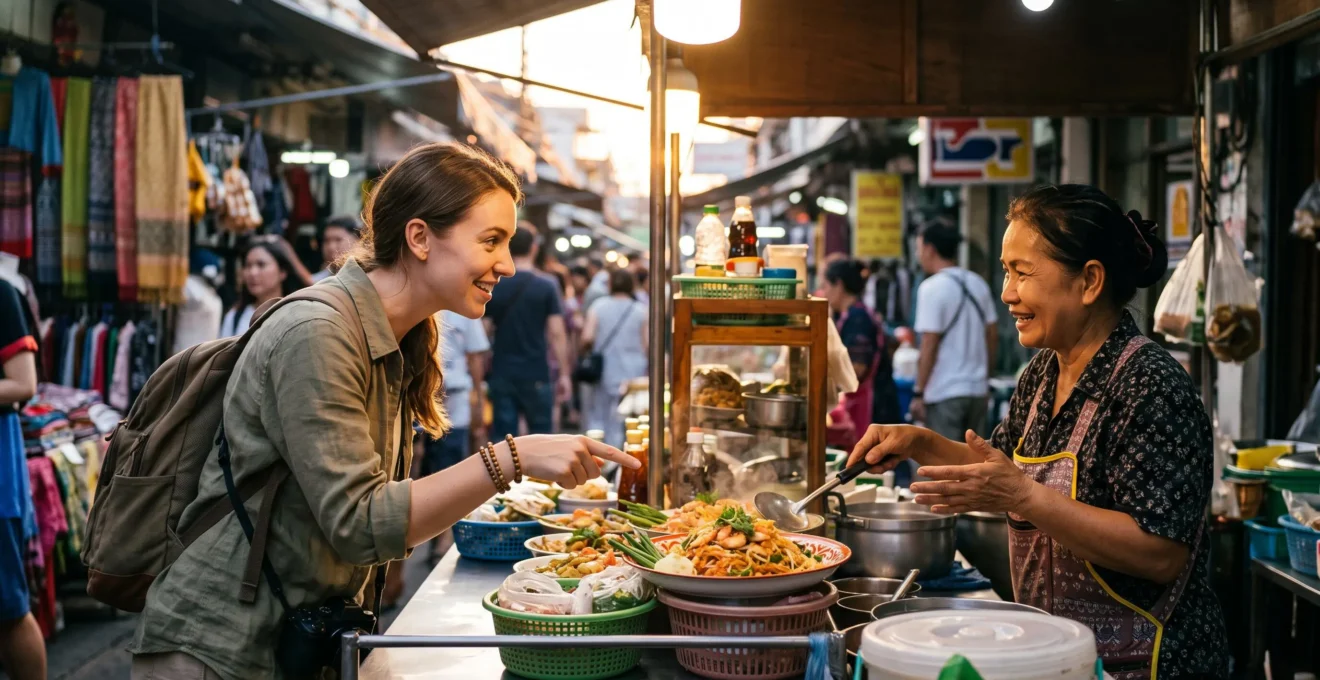
- How to Order Authentic Regional Dishes When You Don’t Speak the Language?
- What Regional Dishes Should You Research Before Visiting Each Destination?
- The “Authentic” Dish Adaptation That Removes the Flavours Locals Actually Eat
- When Do Locals Actually Eat Lunch and Dinner in Different Countries?
- How to Structure Your Days to Experience Destinations Like Residents?
- How to Interact Respectfully With Himalayan Communities During Treks?
- How to Spend One Week in a City Like a Temporary Local?
Why Do the Best Local Dishes Rarely Appear on Tourist-Translated Menus?
The absence of truly local dishes on tourist menus isn’t an accident; it’s a business decision rooted in a perceived paradox. Restaurant owners in tourist hotspots often believe that foreign palates are not ready for the full-throttle flavors, textures, and ingredients of their native cuisine. They simplify recipes, tone down spices, and remove “challenging” items like offal or intensely fermented products in an effort to be more accommodating. This creates a curated, “safe” version of their food culture, designed to be universally palatable rather than authentically representative.
However, this strategy is based on a fundamental miscalculation of the modern traveler’s desires. The goal for many is no longer just to see new places, but to experience them deeply. Food is a primary gateway to culture, and a diluted experience can feel like a missed opportunity. This feeling is backed by data. For example, a 2025 empirical study on tourism in Thailand found that a diner’s perception of authenticity has a massive positive impact on their experience and willingness to recommend a place. The study showed that when tourists perceive a restaurant’s food as authentic, it leads to a powerful sense of “consumer self-expansion”—the feeling of growing as a person through new experiences.
The research confirms that perceived authenticity strongly predicts a preference for local restaurants (with a correlation coefficient of 0.870) and generates positive word-of-mouth. In essence, by trying to please everyone with generic offerings, restaurants are unintentionally undermining the very deep cultural connection that travelers are increasingly seeking. The most memorable meals are rarely the ones from the laminated picture menu; they are the ones that feel like a genuine discovery, a true taste of place that requires a little more effort to find.
How to Order Authentic Regional Dishes When You Don’t Speak the Language?
The secret to ordering confidently without a shared language lies not in last-minute panic pointing, but in a proactive, repeatable system. It’s about preparing a “communication toolkit” before you even leave your accommodation. This strategy shifts the focus from your linguistic shortcomings to your strengths: preparation and the smart use of technology. The goal is to make ordering a smooth, low-stress interaction, not a frantic game of charades. By having everything you need at your fingertips, you project confidence and make it easier for staff to help you.
This system involves a combination of digital preparedness and real-world observation. For example, before heading out, use Google Maps to find potential restaurants and take screenshots of their menus, especially the ones written in the local language. This gives you a visual reference to cross-reference in person, even if you can’t read the script. Similarly, an offline language pack on your translation app is non-negotiable; you can’t rely on spotty public Wi-Fi in the moment of truth.
In a real-world scenario, if you find yourself completely stuck, don’t be afraid to ask for help, but do it strategically. As one experienced traveler noted, a great tactic is to approach younger staff or even other diners. “In 80% of my emergencies, a teenager or a university student saved me,” the traveler shared, highlighting that younger people are often more likely to speak some English and are more comfortable using translation apps to bridge the gap. This human element is the final, crucial piece of your toolkit.
Your Action Plan: Ordering Food Without Speaking the Language
- Set a phone wallpaper with your top 3 food-related phrases (e.g., ‘delicious!’, ‘no meat’, ‘how much?’) in the local language so they are always visible, even offline.
- Identify two backup dining options near your accommodation before you go out: a market with visible food and a restaurant with a photo menu, and write down their names.
- Download the offline language pack for your translation app via its settings. Test it before you leave to ensure it works without a connection.
- Take screenshots of restaurant menus from their Google Maps listings. This gives you a visual reference to point to, even if the menu on-site is different or unreadable.
- Create a note in your phone (or a physical notebook) with 5 key phrases or needs, such as ‘not too spicy’, ‘I have a nut allergy’, ‘please surprise me with a local specialty’, and ‘the bill, please’.
What Regional Dishes Should You Research Before Visiting Each Destination?
Before you can order an authentic dish, you need to know what you’re looking for. The most rewarding culinary journeys begin long before you arrive at the destination, with a bit of pre-travel research. Instead of looking for restaurant recommendations, shift your focus to identifying the region’s signature dishes, ingredients, and cooking methods. This knowledge acts as your treasure map, guiding you toward the very things that are unlikely to appear on a generic tourist menu.
Start by searching for phrases like “[Region name] traditional food,” “what to eat in [City],” or “national dish of [Country].” Look for food blogs, travel articles, and even Wikipedia pages that list and describe local specialties. Pay attention to specific names (e.g., *Bistecca alla Fiorentina* in Florence, *Laksa* in Malaysia). Create a simple list on your phone with the names of 3-5 dishes you want to try, along with a short description or a picture. This simple list is now your most powerful ordering tool.
This research is more than just a travel hack; it’s a way of honoring a deep cultural heritage. Food is so intertwined with identity that many culinary traditions are officially recognized for their cultural significance. According to UNESCO’s Intangible Cultural Heritage records, more than 50 culinary traditions are inscribed for protection, from French gastronomy to Mexican cuisine. As Fumiko Ohinata of UNESCO notes, these practices are a vital part of global heritage. In a landmark decision, Italy even had its entire national cuisine inscribed, a move that recognizes cooking as a communal practice and values the country’s food culture sector at an estimated €250 billion worldwide. By researching these dishes, you are not just planning your dinner; you are engaging with a living piece of history.
The “Authentic” Dish Adaptation That Removes the Flavours Locals Actually Eat
One of the biggest challenges in the quest for authentic food is navigating the “authenticity dilution.” This is the process where a dish, while technically correct in its ingredients, has had its soul—its boldest, most characteristic flavors—toned down for a presumed international palate. The most common casualties are spice, bitterness, funk from fermentation, and complex sour notes. What’s left is a shadow of the original, often sweeter and simpler, which robs the diner of the true experience.
Thai green curry is a perfect case study. An authentic version, made with fresh bird’s eye chilies, is a fiery, aromatic, and complexly layered dish. However, the version served in many tourist-oriented restaurants is often creamy and sweet, with just a whisper of heat. The reason for this is simple: authentic Thai chilies pack a serious punch. A heat comparison guide shows that a standard Thai chili can range from 50,000-100,000 Scoville Heat Units (SHU), a level of spiciness that can be shocking to the uninitiated. To avoid complaints, restaurants dial it way back.
This isn’t malicious; it’s a commercial adjustment. As Sebby Holmes, chef-patron of the acclaimed London restaurant Farang, explains in an interview with National Geographic Traveller, there’s a clear palate preference at play. He notes, “The Western palate has been generations behind when it comes to chillies. We’re attracted to sweetness, from coconut cream and palm sugar, which gives us a welcome breather from spice.” To find the real deal, you often have to specifically ask for it “local style” or “Thai spicy,” signaling to the kitchen that you’re ready for the unfiltered, unabridged flavor experience.
When Do Locals Actually Eat Lunch and Dinner in Different Countries?
Finding authentic food is not just about *what* you eat, but also *when* you eat it. Arriving at a restaurant at the “wrong” time is one of the clearest signs of a tourist. Showing up for dinner in Spain at 6 p.m. will likely mean you’ll be dining alone in an empty room, attended by staff who are just starting their prep shift. This is because local mealtimes can vary dramatically from the 12 p.m. lunch and 6 p.m. dinner schedule common in many Western countries.
Spain offers a classic example of this cultural rhythm. The main meal of the day, lunch (*la comida*), is a leisurely affair that takes place between 2:00 and 4:00 p.m. Consequently, dinner is pushed much later. As a local guide for visitors explains, it’s completely normal for dinner service to only begin after 9 PM, with many families sitting down to eat at 10 p.m. or even later. Trying to eat earlier often funnels you into “continuous service” restaurants specifically catering to tourists. As local expert Ruben from Gamintraveler puts it, “Tourists expecting 6 p.m. dinner reservations often find empty dining rooms and confused hosts. Locals aren’t being rude—they simply haven’t started thinking about dinner yet.”
Aligning your appetite with the local clock is a powerful strategy for a more authentic experience. It means you’ll be eating alongside residents, in places that are buzzing with local energy, and your dining options will expand significantly. Before you travel, a quick search for “mealtimes in [Country]” can be just as valuable as researching dishes. Below is a comparison illustrating the Spanish daily meal schedule versus a typical Western one, showing the multiple smaller meals that structure the day.
| Meal | Typical Spanish Time | Typical Western Time |
|---|---|---|
| Breakfast | 7:00-8:00 AM (light, café con leche) | 7:00-8:00 AM |
| Second Breakfast | 10:00-11:00 AM | Not typical |
| Lunch (main meal) | 2:00-4:00 PM | 12:00-1:00 PM |
| Merienda | 5:00-6:30 PM | Not typical |
| Dinner | After 9:00 PM | 6:00-7:30 PM |
How to Structure Your Days to Experience Destinations Like Residents?
The principle of aligning with local mealtimes can be expanded to structure your entire day. Living like a resident, even temporarily, means embracing the natural ebb and flow of their daily life. This often runs counter to a typical tourist itinerary, which crams sightseeing into a 9-to-5 window. Instead, think about the city’s rhythm: When are the streets crowded? When are they quiet? When do people shop, relax, and socialize?
In many parts of the world, especially in warmer climates, midday is a time of rest. The hours between 1 p.m. and 4 p.m. might see shops close and residential streets fall quiet as people retreat for a long lunch or a siesta. A tourist might see this as “dead time,” but a temporary local sees it as an opportunity. This is the perfect time to explore a park, visit a museum (which often remain open), or simply relax at a café with a book, just as a resident might do on their break. Fighting the rhythm by trying to power through a frantic sightseeing schedule during this period is exhausting and inefficient.
Conversely, the early morning and evening hours are often the most vibrant. Rise early to visit a local market when the produce is fresh and the vendors are setting up. You’ll see a completely different side of the city than the late-morning tourist rush. The evening, or *passeggiata* in Italy, is when public squares and boulevards come alive. This is the time for a leisurely stroll, an aperitif, and people-watching. By structuring your day with a long break in the middle and activity peaks in the morning and evening, you’ll not only avoid the worst crowds but also experience the destination in a more natural, relaxed, and authentic way.
How to Interact Respectfully With Himalayan Communities During Treks?
While the focus is often on language and logistics, the ultimate key to unlocking authentic experiences lies in the quality of human interaction. The principles of respectful engagement are universal, whether you’re ordering coffee in Paris or sharing a trail with yak herders in Nepal. A powerful lesson in this can be taken from the unwritten rules of conduct in Himalayan teahouse culture, which offer a masterclass in cross-cultural communication.
In these remote communities, where tourists and locals constantly intersect, respect is conveyed through small, non-verbal gestures. For example, when offered a cup of tea, accepting it with two hands, or with the right hand supported by the left at the wrist, is a profound sign of respect and gratitude. A simple one-handed grab can be seen as dismissive. Similarly, when navigating crowded spaces or religious sites like stupas, the local custom is always to walk in a clockwise direction. Following this simple rule shows an awareness and respect for the local culture that transcends any spoken language.
These actions, though small, communicate a powerful message: “I see your culture, I respect your customs, and I am a guest in your home.” This mindset transforms the dynamic from a transactional one (tourist and service provider) to a relational one (guest and host). A warm smile, genuine eye contact, and an attempt to use basic greetings like “Namaste” can open doors that a translation app never could. Applying this philosophy of humility and observation to every interaction, from the Himalayas to a Roman trattoria, is what ultimately separates a tourist from a true traveler and grants access to the most genuine hospitality and experiences.
Key takeaways
- Authenticity is often lost in translation on tourist menus, as restaurants simplify dishes to cater to a perceived international palate.
- A pre-travel communication strategy, including researching dishes and creating a digital toolkit, is far more effective than relying on on-the-spot language skills.
- Aligning your daily schedule—especially mealtimes—with local rhythms is a crucial step to avoiding tourist traps and having a genuine cultural experience.
How to Spend One Week in a City Like a Temporary Local?
Integrating all these strategies—the pre-trip research, the communication toolkit, and the alignment with local rhythms—allows you to transform a standard one-week vacation into an immersive experience as a “temporary local.” The goal is to move beyond a checklist of sights and instead cultivate a relationship with the place. Here is a blueprint for how to structure that week.
Days 1-2: Observation and Orientation. Your first two days are for reconnaissance. Use your pre-researched list of dishes as a guide, but focus on observing. Walk through different neighborhoods. Notice when the local bakeries have queues, when the parks are full, and when the restaurants start to get busy. Eat simply, perhaps at a market where you can point to what looks good, and use this time to fine-tune your understanding of the city’s daily pulse. This is when you confirm that, yes, dinner really doesn’t start until 9 p.m.
Days 3-5: Application and Exploration. Now, put your system into practice. Armed with your knowledge of local mealtimes and a list of dishes to try, venture into a restaurant that looks busy with locals. Use your phone with the screenshot of a local dish’s name or your prepared note. Be confident and smile. This is also the time to explore based on the city’s rhythm. Visit a major museum during the midday lull and explore residential neighborhoods in the early evening when they come to life. This is the core of your week, where you actively participate in the local culture.
Days 6-7: Confidence and Spontaneity. By now, you should feel more comfortable and confident. You’ve successfully navigated a few meals and have a feel for the city. This is the time for spontaneity. Wander into a small, family-run place with no English menu and use the ultimate phrase: “[Local language for ‘surprise me’] with a local specialty.” Your preparation throughout the week has earned you this moment. You are no longer an intimidated tourist but a curious, respectful guest, ready for whatever authentic experience comes your way.
By adopting this strategic mindset, you transform a simple meal into a cultural dialogue. You are now equipped not just to order food, but to connect with a place on its own terms, ensuring every trip is richer, more delicious, and more memorable.
Frequently Asked Questions on How to Order Authentic Regional Dishes When You Don’t Speak the Language?
How do you order street food when the vendor doesn’t have a menu at all?
Watch what locals are buying, then point at the item and hold up the number of portions you want. If nothing is visible, use the ‘ingredient charade’ by pointing at a recognizable vegetable or protein and mimicking a cooking motion.
What’s the fastest way to get help ordering in a language you don’t know?
Approach the youngest-looking staff member or a nearby diner, show them your phone with a translation, and they will almost always help.
What’s the best app for translating menus when you don’t speak the language?
Google Translate with the camera feature is the most reliable all-around tool, though it can fail on handwritten or stylized menus, where importing a photo works better than live camera mode.
How do you order food if you have dietary restrictions and don’t speak the language?
Print or write a small card in the local language that clearly lists your allergies and restrictions, using short sentences and icons like a wheat icon or a peanut icon.