In summary:
- True authenticity is proven, not just observed. Focus on verifiable “systems of origin” like Protected Designation of Origin (PDO) labels.
- Master the art of “culinary forensics” by using official guild certifications (like the AVPN for Neapolitan pizza) to identify legitimate establishments.
- Recognize that authenticity has nuance; even origin regions have debates and variations in core ingredients and techniques.
- Plan your pilgrimage around “peak seasonality” by aligning travel with ingredient harvest times and regional food festivals.
- Expand your search beyond restaurants to cooking classes, local markets, and home-dining platforms for a deeper cultural immersion.
For any food pilgrim, there is no greater disappointment than travelling thousands of miles for a legendary regional dish, only to be served a pale, lifeless imitation in the heart of its supposed home. You came for Valencian paella and got a plate of yellow, clumpy rice; you sought Neapolitan pizza and received a thick, bready disc. This experience is all too common, a direct result of relying on generic advice like “avoid picture menus” or “walk off the main square.” These tips are not wrong, but they are profoundly incomplete. They teach you how to passively avoid the worst, not how to actively find the best.
The truth is that genuine culinary authenticity is not a matter of opinion or luck. It is a system. It is rooted in decades, sometimes centuries, of protected agricultural practices, legally defined ingredients, and terroir-specific techniques that are physically impossible to replicate elsewhere. The real key to an authentic taste is to stop looking for what a dish *isn’t* (a tourist trap) and start investigating what it *is*. It requires a shift in mindset from a simple tourist to a culinary investigator, one equipped to decode the provable systems of origin that protect a dish’s soul.
This guide provides that investigative toolkit. We will move beyond surface-level tells and into the world of culinary forensics. We will explore how to use official designations, understand ingredient provenance, and recognize the non-negotiable techniques that separate a genuine regional masterpiece from a hollow souvenir. Prepare to transform your approach and finally taste these iconic dishes as they were meant to be experienced.
To guide your pilgrimage, this article breaks down the complete methodology for finding truly authentic regional cuisine. You will learn to identify the foundational elements that define a dish’s origin, spot the subtle variations that exist even in its homeland, and apply a practical checklist to verify authenticity on the ground.
Summary: A Food Pilgrim’s Guide to Authentic Regional Cuisine
- Why Does Paella in Valencia Taste Completely Different From London Versions?
- How to Identify Where Regional Dishes Are Prepared Most Authentically?
- What Regional Variations Exist for Iconic Dishes Within Their Origin Areas?
- The Tourist-Trap Paradox of Bad Regional Dishes in Their Origin Cities
- When Should You Visit Regions to Taste Iconic Dishes With Peak Ingredients?
- What Regional Dishes Should You Research Before Visiting Each Destination?
- How to Identify Genuinely Local Restaurants in Tourist-Heavy Cities?
- How to Experience a City’s Food Culture Beyond Tourist Restaurant Traps?
Why Does Paella in Valencia Taste Completely Different From London Versions?
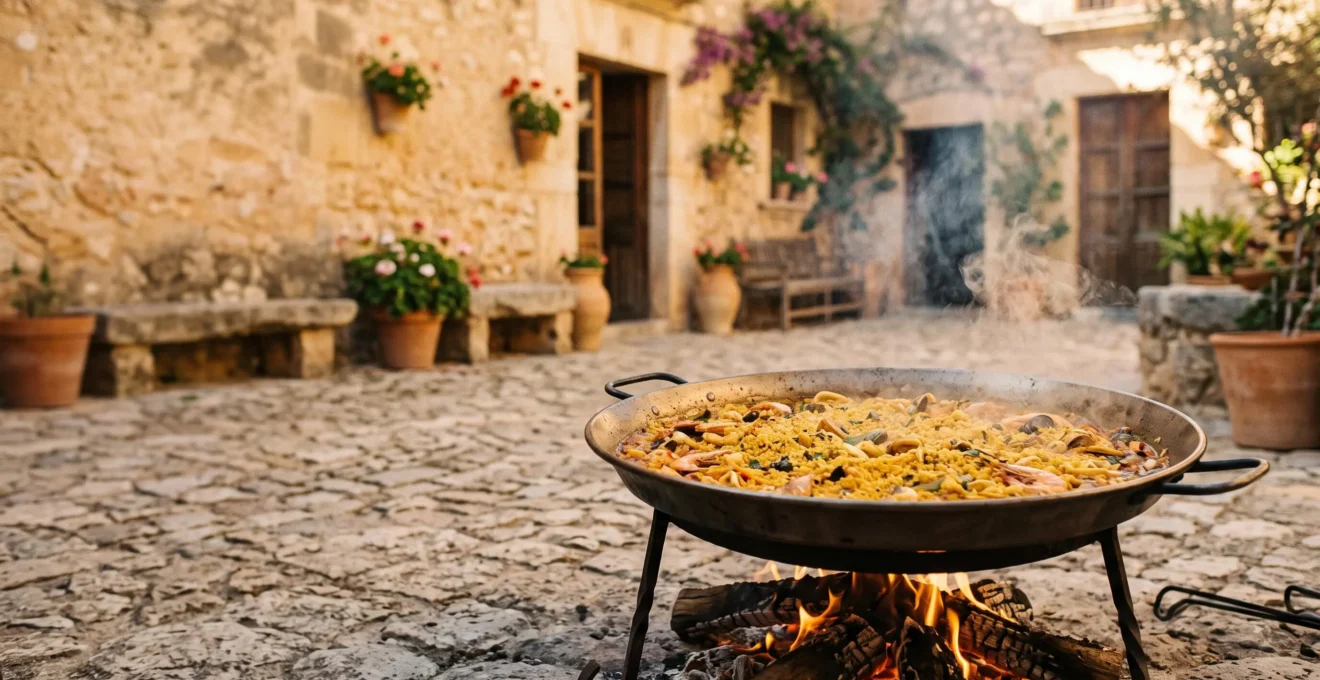
The vast difference between a paella served in Valencia and one in London is not merely about a chef’s skill; it is a lesson in ingredient provenance and legally protected terroir. The foundation of authentic Paella Valenciana is the rice itself, specifically local short-grain varieties like Senia, Bahía, or the prized Bomba. This is not a preference; it is a cornerstone of the dish’s identity. In fact, Arroz de Valencia has been officially protected since 1998 with a Protected Designation of Origin (PDO), a legal guarantee that the rice is grown, harvested, and milled within the specific environment of the Albufera wetlands.
This protection goes beyond just the grain. It encompasses centuries-old, terroir-specific agricultural methods that are impossible to replicate elsewhere. A perfect example is a technique known as ‘eixugons’.
Case Study: The ‘Eixugons’ Technique
According to the EU’s official PDO specification for Valencian rice, local farmers have developed unique practices over centuries. One such practice is the eixugons, which involves leaving the rice crop without water for several days around the end of June. This process, timed after the seedlings have germinated, inhibits the growth of algae in the paddies. This hyper-local agricultural technique is intrinsically tied to Valencia’s specific wetland soils and climate, directly influencing the rice’s final texture and absorption qualities—a crucial factor that generic rice grown elsewhere simply cannot match.
This specific rice, cultivated with these unique methods, is what allows for the creation of the legendary socarrat—the crispy, caramelized crust of rice at the bottom of the pan. This texture is the hallmark of a masterfully cooked paella and is incredibly difficult to achieve with the wrong type of grain, which often turns mushy or fails to toast correctly. The difference in taste is not just in the seasonings; it begins in the soil of the rice paddy itself.
Therefore, the paella in London tastes different because it is, fundamentally, a different dish built on a different foundation. It lacks the legally protected, terroir-specific ingredients and the resulting textural possibilities that define the authentic Valencian experience. It is an approximation, not a replication.
How to Identify Where Regional Dishes Are Prepared Most Authentically?
Moving from the specific example of paella to a general principle, the most reliable way to identify authenticity is to look for official, verifiable “systems of origin.” These are formal certifications awarded by guilds, consortiums, or government bodies dedicated to preserving a culinary tradition. They act as a seal of approval, guaranteeing that a restaurant adheres to strict rules regarding ingredients, equipment, and technique. This is a far more robust method than simply judging a menu’s design. It’s the difference between guessing and knowing.
A prime example of such a system is the Associazione Verace Pizza Napoletana (AVPN), the official guardian of true Neapolitan pizza. This organization certifies pizzerias worldwide, but only those that meet its exhaustive criteria, which dictate everything from the type of flour and tomatoes to the dome temperature of the wood-fired oven. Finding an AVPN-certified pizzeria is a near-guarantee of an authentic experience.
Case Study: Quebec’s First AVPN-Certified Pizzeria
In 2022, Pizzeria NO.900 in Quebec, Canada, became the first pizzeria in the province and the first chain in the world to receive the prestigious AVPN certification. This international distinction was granted only after the restaurant proved its strict adherence to all the rules of Neapolitan pizza making. This demonstrates how food pilgrims can use these official guild certifications as a reliable, checkable marker of authenticity, even when tasting a dish far outside its home region of Naples.
This “culinary forensics” approach can be applied to many dishes. The key is to first identify the governing body and then use their resources to find approved vendors. While a Michelin star indicates high-quality cooking, a PDO or guild certification speaks specifically to tradition and authenticity. These two markers are not mutually exclusive, but they measure different things. For the food pilgrim, the latter is often the more important compass.
Your Action Plan: Verifying Authenticity with Official Certifications
- Research the Guild: Before your trip, look up the official guild or consortium for the dish (e.g., AVPN for Neapolitan pizza, the Consorzio del Prosciutto di Parma for Parma ham). Check their online member directory for a list of certified restaurants or producers in your destination.
- Verify Equipment & Ingredients: During your research, note the specific requirements of the certification. This often includes dedicated equipment (like a specific type of oven or slicer) and protected ingredients. Look for evidence of these in the restaurant.
- Look for the Physical Seal: Once at a potential restaurant, look for the official physical certificate, plaque, or window decal issued by the organization. Certified establishments almost always display this seal with pride.
- Check for Recent Certification: Remember that certification review and inspection cycles can take 60 days or more. A freshly displayed certificate is a powerful signal that the establishment has recently passed a rigorous authenticity audit.
What Regional Variations Exist for Iconic Dishes Within Their Origin Areas?
The quest for authenticity is beautifully complex. Once you arrive in an origin region, you will discover that “authenticity” is not a single, monolithic recipe but rather a spectrum of accepted local variations. The boundaries are drawn not by tourists, but by the locals themselves, often through passionate debate. Understanding these micro-variations is the next level of culinary expertise, allowing you to appreciate the nuanced conversations happening within a food culture.
Paella is again a perfect example. While Paella Valenciana has a strict, almost sacred, list of ten core ingredients (including chicken, rabbit, and specific local beans), other rice dishes from the same region are equally authentic. A paella de marisco (seafood paella) or even a paella mixta (a mix of meat and seafood, often for visitors) are considered legitimate regional variants. The line is crossed when foreign ingredients are introduced that violate the fundamental principles of the dish.
Case Study: The Great Chorizo Controversy
As documented by Spain’s official food and wine promotion body, a significant controversy erupted when British chef Jamie Oliver included chorizo in his “paella” recipe. To Valencians, this was not a creative twist; it was a fundamental misunderstanding of the dish. Chorizo, with its powerful flavour of smoked paprika, completely overpowers the delicate saffron and savoury notes of the sofrito. This single-ingredient debate is a powerful lens for understanding where the non-negotiable boundaries of local authenticity truly lie.
This complexity extends down to the very foundation of the dish. Even within the “Arroz de Valencia” PDO, there are different rice varieties used for different purposes. A chef’s choice between Senia, Bahía, or Bomba rice is a deliberate decision that shapes the final texture and character of the dish, a subtle detail a true food pilgrim can learn to appreciate.
| Variety | Grain Length | Grain Width | Typical Use |
|---|---|---|---|
| Senia | 5.6 mm | 2.4 mm | Creamy, brothy rice dishes |
| Bahía | 5.6 mm | 2.3 mm | Similar taste and texture to Senia |
| Bomba | 5.2 mm | 2.9 mm | Firm-textured, overcook-resistant paella |
This comparative data on rice varieties shows that authenticity is not about a single “correct” way, but about making the right choices from an accepted, traditional palette of ingredients and techniques. The authentic dish is a conversation, and by understanding these variations, you can begin to understand the language.
The Tourist-Trap Paradox of Bad Regional Dishes in Their Origin Cities
One of the most perplexing experiences for a food traveler is the “tourist-trap paradox”: the phenomenon of finding the worst version of a regional dish in the very city that made it famous. This happens because a gap opens between the dish as a cultural artifact and the dish as a commercial product. In high-traffic tourist areas, volume and speed often take precedence over quality and tradition. Restaurants in these locations may cater to an audience that doesn’t know what the authentic dish should taste like, creating a feedback loop of mediocrity.
These establishments often rely on shortcuts: frozen ingredients, pre-made bases, or microwave reheating. They are selling the *idea* of the dish, not the dish itself. The key to avoiding this paradox is to recognize the surface-level warning signs before you even sit down. While our deeper “systems of origin” approach is the ultimate tool, these basic checks are your first line of defense.
Key warning signs of a tourist-trap restaurant often include:
- Aggressive Touting: Staff members standing outside to lure you in are a major red flag. Authentic restaurants with a strong local following rely on their reputation, not on pressuring passersby.
- Multi-Language Picture Menus: Menus prominently displayed in five or more languages, often with faded photos, suggest a business model focused on mass tourism. A genuine local spot will have a menu primarily in the local language, perhaps with a single translation.
- Prime Location, Poor Quality: Restaurants located directly adjacent to a major monument or on a city’s main tourist thoroughfare often pay a premium for location, which can sometimes be compensated for by cutting corners on culinary quality. Venturing just a few blocks away can yield far better results.
These checks are heuristics, not iron-clad rules. However, when you see two or more of these signs together, it’s a strong indicator that the establishment is prioritizing tourist traffic over culinary integrity. The real gems are often the humble-looking places just off the beaten path, quietly serving their community.
When Should You Visit Regions to Taste Iconic Dishes With Peak Ingredients?
A dish’s authenticity is not only tied to place but also to time. The ultimate expression of a regional specialty is often experienced during its peak seasonality, when its core ingredients are at their absolute freshest and most flavourful. A tomato-based dish in Italy will never taste as vibrant in April as it does in August. A pilgrimage for food is therefore not just about *where* you go, but *when* you go.
The most reliable guide to a region’s culinary calendar is its schedule of food festivals. These events, known as sagre in Italy, are celebrations built around the harvest of a single, specific ingredient. Visiting during a sagra is a guarantee that you are tasting a product at its zenith. These festivals are a cornerstone of culinary tourism, with a recent report indicating that food festivals accounted for 30.8% of the market in 2024, highlighting their significance as a driver for travel.
These events offer an unparalleled opportunity to immerse yourself in a food’s cultural context, tasting dozens of variations prepared by local families and vendors, often using recipes passed down through generations. They are living, breathing archives of a region’s culinary soul.
Case Study: Italy’s Ingredient-Driven Festivals
Culinary festivals play a major role in attracting tourists to specific regions at specific times. Celebrations like the Alba White Truffle Fair in Piedmont (October-December), the Sagra del Pesce fish festival in Camogli, Liguria (May), and the Eurochocolate festival in Perugia, Umbria (October) are world-renowned. They are scheduled explicitly to coincide with the peak harvest or season of their star ingredient, proving that a region’s festival calendar is a reliable, built-in guide to when its signature dishes will taste their absolute best.
Before planning your trip, research the agricultural calendar and festival schedule for your destination. Aiming to visit during the harvest of your target dish’s key ingredient will elevate your tasting experience from merely authentic to truly transcendent. It is the final piece of the puzzle in a perfect culinary pilgrimage.
What Regional Dishes Should You Research Before Visiting Each Destination?
The most rewarding culinary pilgrimages begin long before you book a flight. Effective pre-trip research is what separates a hopeful tourist from a prepared investigator. Arriving in a region with a foundational knowledge of its protected culinary heritage transforms your journey, allowing you to bypass the noise and focus directly on the dishes that define the area’s identity. With research showing that 34% of tourists visit places they like for their cuisine, starting with a clear target is essential.
Your research should not begin with blogs or review sites, but with official government registries. Most countries, particularly in Europe, maintain a database of foods with Protected Designation of Origin (PDO) or Protected Geographical Indication (PGI) status. These legal designations are the gold standard of authenticity, certifying that a product’s quality and characteristics are inextricably linked to its geographical origin. Identifying these products for your destination gives you a pre-vetted list of must-try items.
Here is a systematic approach to this pre-trip research:
- Search Official Registries: Begin by searching the official protected food names registry for your destination country (e.g., the EU’s eAmbrosia database or a national equivalent). Look for products registered in the specific region you plan to visit.
- Note the Protection Type: Pay attention to whether a product is PDO or PGI. A PDO is the stricter of the two, requiring that every stage of production, processing, and preparation takes place in the specific region. A PGI requires that at least one stage does.
- Build Your “Hit List”: Compile a list of these officially protected products. This could include cheeses, cured meats, fruits, olive oils, or even, as we’ve seen, staple ingredients like rice. This is your primary target list for an authentic tasting experience.
- Cross-Reference On-Site: During your trip, actively look for these designations on restaurant menus and in market stalls. A restaurant that proudly cites a PDO product (e.g., “made with Prosciutto di Parma PDO”) is sending a strong signal of its commitment to authenticity.
This method of culinary forensics arms you with an objective, evidence-based list of what to seek out. It moves your search beyond subjective recommendations and grounds it in legally recognized, terroir-driven quality, ensuring your efforts are focused on dishes of genuine cultural importance.
How to Identify Genuinely Local Restaurants in Tourist-Heavy Cities?
Armed with your pre-trip research and an understanding of authenticity markers, the final challenge is applying this knowledge on the ground in a bustling, tourist-heavy city. Here, the signals of a genuine local institution can be subtle, often drowned out by the noise of commercial establishments. The key is to synthesize your knowledge with careful observation, learning to “read the room” and the surrounding environment.
The most powerful single indicator of an authentic restaurant is its clientele. A restaurant packed with locals, especially one with a line of residents waiting patiently, is almost always a sign of high-quality, well-loved food. This requires you to observe and listen. Are the conversations around you in the local language? Are the patrons interacting with the staff like regulars? This social proof is far more reliable than any online review.
Another crucial element is timing. Locals and tourists operate on different schedules. A restaurant that is empty at the local dinner hour (e.g., 9:30 PM in Spain) but was full at 6:30 PM is clearly catering to tourists. To find a genuinely local spot, you must dine on local time. Observe when the neighborhood residents begin to head out for their meals and follow their lead. This simple shift can completely change the options available to you.
Reading the Room: How Patron Behavior Reveals Authenticity
In any tourist hotspot, from Rome to Barcelona, you can learn to distinguish authentic spots by observing human behavior. If the majority of diners are clearly tourists—identifiable by their maps, backpacks, and non-local dress—it’s a cautionary sign. Conversely, a spot filled with local office workers on a lunch break or multi-generational families on a Sunday afternoon is a strong endorsement. Long lines of residents are a particularly powerful signal, indicating a place so good that people are willing to wait for it, a testament to its enduring quality and role in the community.
Ultimately, identifying a local gem is about triangulation. You combine your knowledge of PDOs and certifications with the surface-level checks for tourist traps, and then confirm your hypothesis with on-the-ground observation of clientele and dining times. It’s a holistic approach that elevates your chances of finding a truly memorable and authentic meal.
Key Takeaways
- Authenticity is provable through “systems of origin” like PDO labels and guild certifications, which are more reliable than subjective observations.
- The best taste is tied to time; plan your travel around the peak harvest seasons of key ingredients, often highlighted by regional food festivals.
- True culinary immersion often happens beyond restaurants, in local markets, cooking classes, or home-dining experiences.
How to Experience a City’s Food Culture Beyond Tourist Restaurant Traps?
A successful culinary pilgrimage ultimately transcends the search for the perfect restaurant. While finding that hidden gem is a profound victory, the deepest understanding of a city’s food culture comes from experiencing it as the locals do—as a part of daily life, not just a transaction in a dining room. To truly connect with a region’s culinary soul, you must look beyond the confines of the commercial restaurant scene and immerse yourself in the ecosystem that supports it.
One of the most powerful ways to do this is by exploring a city’s food markets. This is where chefs, home cooks, and producers converge. It’s a living museum of local produce, a place to see the raw ingredients from your PDO research up close, and an opportunity to speak with the artisans who make the cheese or cure the meat. Another growing avenue is participating in a local cooking class or a guided food tour. The best of these are led by residents who can provide historical context, explain traditions, and show you their personal favorite spots, which are often far from any tourist guide. In fact, the culinary trails segment is expected to grow at a CAGR of 20.4% from 2024 to 2030, proving this is a rapidly expanding way for travelers to connect with local food culture.
Perhaps the most intimate experience is to dine in a local’s home. Modern platforms have made this more accessible than ever, connecting travelers with home cooks who are passionate about sharing their culture through food.
Case Study: Home-Dining as a Bypass to the Commercial Scene
Platforms like EatWith or other local meal-sharing initiatives offer a direct portal into a city’s home cooking. Dining with locals provides a unique community feel and an unfiltered taste of family recipes and traditions that are rarely found in a commercial setting. While prices can vary, the experience offers a level of personal connection and cultural exchange that a restaurant meal, no matter how authentic, can seldom match. It is an opportunity to hear the stories behind the food, transforming a meal into a lasting memory.
By expanding your definition of a “culinary experience” to include markets, classes, and home dining, you complete your journey. You move from an observer to a participant, gaining a richer, more holistic understanding of the food culture you traveled so far to explore. This is the ultimate goal of the food pilgrim.
To put these principles into practice, the next logical step is to begin your own culinary investigation. Start by researching the PDO and PGI products of your next destination and build your pilgrimage from that foundation of authenticity.