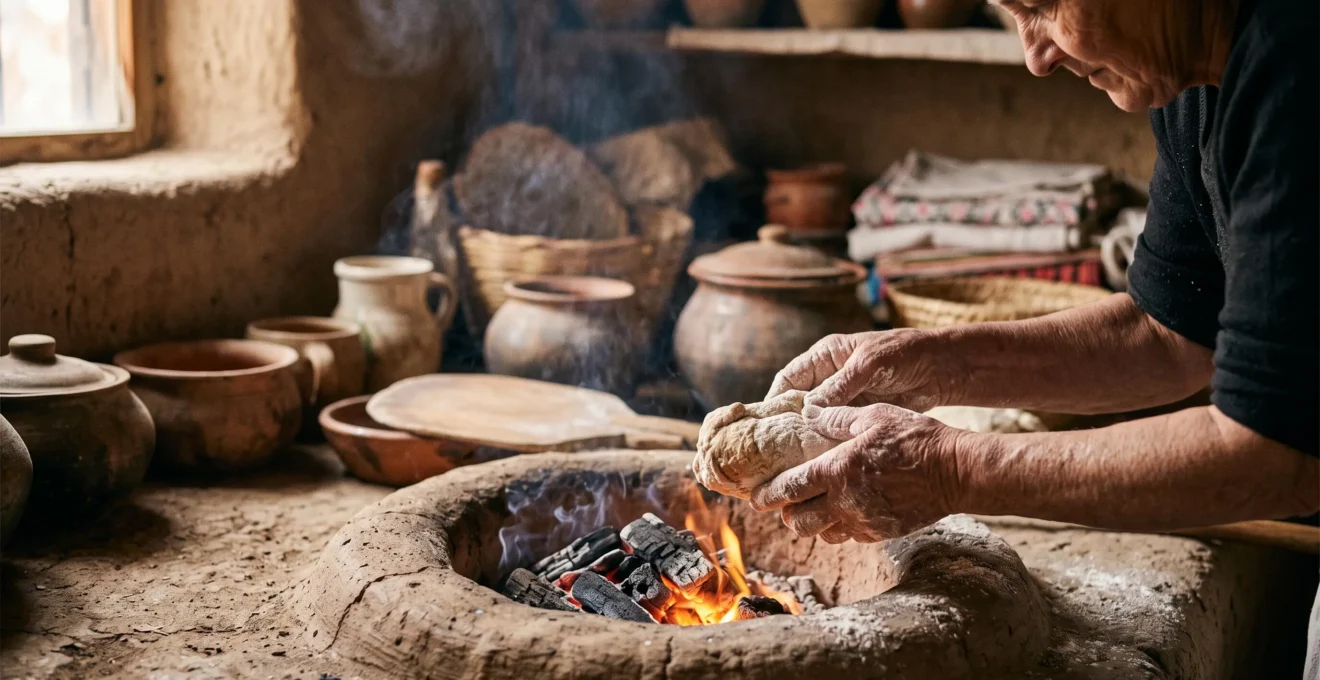
To truly preserve disappearing culinary traditions, travellers must become investigators, not just consumers.
- The most authentic experiences are rarely found on mainstream booking platforms; they require tracing techniques backward from endangered ingredients.
- Learning to identify the “shortcut pattern”—where complex steps are removed for tourist convenience—is essential to finding genuine transmission.
Recommendation: Shift your goal from “finding a class” to “documenting a technique,” and you will find the real guardians of culinary heritage.
For the heritage-conscious traveller, the fear is palpable: the world’s most intricate culinary traditions are fading. We book trips to taste the “real” mole, the authentic tagine, the hand-pulled noodles, only to wonder if what we’re experiencing is genuine transmission or a simplified performance for tourists. The common advice—to visit local markets or book a highly-rated class—often leads us down the same well-trodden paths, where the deep, time-consuming skills we seek have been conveniently edited out.
This isn’t just about flavour; it’s about the erosion of intangible cultural heritage. These techniques, developed over generations, are living archives of a region’s history, agriculture, and social fabric. When the last person who knows how to properly nixtamalize corn or ferment a specific ingredient passes away, that knowledge can be lost forever. But what if the solution wasn’t simply to be a better consumer of these experiences? What if the key was to change our entire approach, to shift from being a tourist to becoming a culinary preservationist?
This guide abandons the passive search for the “best cooking class.” Instead, it provides an active, investigative methodology for technique tracing. We will explore how to identify endangered culinary arts, how to vet the practitioners who hold this knowledge, and how you, as a traveller, can play a crucial role in documenting and honouring these traditions before they vanish from living practice. This is not about finding a meal; it’s about safeguarding a legacy.
To embark on this journey, it’s essential to understand the landscape of culinary preservation and the specific methods required to navigate it. The following sections break down the problem, the methodology for finding genuine experiences, and the respectful approach needed to become a true ally of food heritage.
Summary: How to Find and Learn Endangered Culinary Techniques
- Why Are Traditional Cooking Techniques Disappearing Faster Than Ever?
- How to Find Cooking Experiences That Teach Disappearing Traditional Techniques?
- What Questions Verify Genuine Traditional Techniques Versus Tourist Adaptations?
- The “Traditional” Technique Shortcut That Skips the Skill-Building Steps
- How Can Travellers Help Preserve Endangered Culinary Techniques?
- How to Interact Respectfully With Himalayan Communities During Treks?
- Cultural Immersion vs Sightseeing: Which Activities Actually Connect You to Places?
- How to Spend One Week in a City Like a Temporary Local?
Why Are Traditional Cooking Techniques Disappearing Faster Than Ever?
The erosion of culinary heritage is not a slow, gentle process; it’s an accelerating crisis. Globalisation, industrial agriculture, and shifting social patterns all contribute to what can be called a ‘great forgetting’. When younger generations move to cities for work, the long, slow, and often laborious kitchen tasks—once passed down through daily practice—are abandoned. Standardised supply chains replace local, diverse ingredients, making the techniques that relied on them obsolete. A blender is simply faster than a metate, and a bouillon cube is easier than a multi-day stock.
This loss is not merely sentimental. Each technique that disappears is a library of ecological knowledge and human ingenuity set ablaze. To grasp the sheer scale of the crisis, one need only look at Slow Food’s Ark of Taste, a global catalogue documenting endangered food traditions that has already identified over 5,000 unique products at risk across more than 150 countries. Each entry—a rare apple variety, a specific cheese-making method, a unique cured meat—represents an entire ecosystem of skills and knowledge teetering on the brink of extinction.
The image below symbolises this fragile state. It represents the knowledge held in a traditional tool, not as a solid, permanent artifact, but as a fleeting form, dissolving like steam. This captures the urgency: these techniques are not just old, they are endangered, and their disappearance represents an irreversible loss of our shared human culture.
The speed of this disappearance is what makes the role of the culinary preservationist so critical. The market pressure for speed and convenience is the single greatest enemy of traditional methods, which are often defined by their deliberate, time-intensive nature. This understanding is the first step toward recognising why finding genuine experiences requires looking far beyond the mainstream tourist economy.
How to Find Cooking Experiences That Teach Disappearing Traditional Techniques?
To find endangered techniques, you must stop looking for “cooking classes” and start acting like an investigator. The most valuable traditions are rarely advertised on major platforms because their practitioners are artisans, not marketers. The key is a method of reverse-search and digital ethnography: start with the endangered product, not the polished experience.
Your primary tool is the aforementioned Ark of Taste. Don’t just browse it; use it as a detective’s database. Identify a product listed in the region you’re visiting. Each entry is a lead, a “narrative of the cultures, communities, and ecosystems” that nurtured it. Contact the local Slow Food “convivium” (chapter) connected to that product. These are the people on the ground. Explain your mission: you are not just a tourist; you are a preservationist seeking to learn and document a specific, endangered skill. This approach opens doors that are firmly closed to the average traveller.
A second, powerful method is to explore the fringes of online video. Beyond glossy travel shows, niche YouTube channels often become unintentional archives of authenticity. As one analysis notes, these creators can lead you to the source. A first-hand look at the best cooking videos shows how a creator filming on her ranch in Michoacán provides an unfiltered window into real foodways. Look for channels with no slick branding, where the focus is entirely on the process. The comments section can be a goldmine, with family members and neighbours sharing details and context. These digital breadcrumbs can lead you to the very person or family group still practising the technique you seek.
Your Investigative Workflow for Technique Tracing
- Database Inquiry: Select your destination region on the Ark of Taste website. Identify a listed product or technique (e.g., a specific cheese, a grain processing method).
- Network Activation: Find the contact for the local Slow Food chapter or the individual nominator of the product. Draft a respectful email explaining your interest in preserving, not just consuming.
- Digital Reconnaissance: Search YouTube and blogs for the specific technique or product name (in the local language). Ignore slick, high-production videos; focus on raw, process-oriented content.
- Cross-Reference Clues: Look for names of people, villages, or markets that appear in both your network outreach and digital reconnaissance. This is where your leads converge.
- Initiate Contact: Reach out to the practitioner you’ve identified, referencing the person who connected you or how you learned of their work. Propose a visit focused on learning and documenting, offering fair compensation for their time and expertise.
This investigative work is the core of the culinary preservationist’s mission. It requires patience and diligence but rewards the traveller with an unparalleled level of connection and authenticity, far from any pre-packaged tour.
What Questions Verify Genuine Traditional Techniques Versus Tourist Adaptations?
Once you’ve found a potential experience, the investigation enters a new phase: verification. Your goal is to politely but firmly discern whether you are about to learn a genuine, complex technique or a simplified, tourist-friendly version. The key is not to be confrontational, but to ask questions that reveal the lineage and context of the knowledge.
Avoid generic questions like “Is this authentic?” Instead, focus on the transmission of knowledge. Ask: “From whom did you learn to make this dish?” or “How many generations has your family been using this method?” A genuine practitioner’s face will often light up with stories of a grandmother, an aunt, or a village elder. Their knowledge has a name and a face. As one traveller noted in a review of an Oaxacan mole class that hinted at this depth:
The chef was informative and willing to share his Grandmother’s mole recipes with us.
– Verified traveller review, Viator review, Oaxacan Moles Experience
This mention of a specific, personal source like a “Grandmother” is a powerful clue. It suggests a personal chain of transmission, not a recipe learned from a textbook for a tourism business. Here are the key questions for your authenticity audit:
- Questions about Source: “Who taught you this? How did they learn it? Is this the way your family makes it at home for celebrations?”
- Questions about Ingredients: “Where do these ingredients come from? Do you grow them? If we went to the market, could we find this specific variety of chili?” This probes the connection to the local agricultural ecosystem.
- Questions about Process: “How long does this *really* take when you’re not teaching a class? Are there any steps we are skipping today to save time? What is the hardest part to get right?” This respectfully acknowledges that the class may be abridged and invites an honest conversation.
The answers to these questions are more telling than any marketing claim. A host who enthusiastically details the three-day process they’re simplifying for you is worlds apart from one who defensively claims their two-hour version is “the real thing.” Listen for stories, for specificity, and for a reverence for the process. This is the hallmark of genuine transmission.
The “Traditional” Technique Shortcut That Skips the Skill-Building Steps
One of the most common pitfalls for well-intentioned travellers is what can be termed the “Shortcut Pattern.” This is where a complex, multi-day, or labor-intensive traditional process is compressed into a neat, two-hour “experience” for tourist consumption. The names of the ingredients remain the same, but the soul of the technique—the skill-building, the patience, the physical labor—is completely stripped away.
A documented first-hand account of a cooking class in Oaxaca provides a perfect example of this. The participant noted that while the most traditional moles can take hours or even days, the class created a simplified version by simply roasting and blending pre-selected ingredients. The crucial, difficult steps of sourcing, sorting, toasting dozens of individual components, and the laborious grinding on a stone metate were bypassed. This is the culinary equivalent of a “just-add-water” cake mix. The guest leaves feeling they’ve “made mole,” but they haven’t learned the ancestral technique; they’ve participated in an assembly line.
The visual difference is often stark and tactile. The texture of a chili paste ground by hand on volcanic stone is layered and complex, with individual fragments of seeds and skin creating depth. A paste from a high-speed blender is uniform and homogenous. One is a testament to skill and effort; the other is a product of efficiency.
In contrast, a truly preservation-focused experience frames itself differently. It doesn’t hide the complexity; it celebrates it. A class that traces a dish like mole from its pre-Hispanic origins (molli) through its colonial evolution, and which dedicates significant time to the full grinding and nixtamalization steps, is not just a tourist activity. It is an act of historical transmission. The goal is not just a meal, but an understanding of the immense skill and time embodied in the true, un-shortened technique.
How Can Travellers Help Preserve Endangered Culinary Techniques?
Your role as a culinary preservationist extends beyond simply finding and learning. The final, most crucial step is to contribute actively to the ecosystem of preservation. This transforms your journey from a personal quest into a meaningful act of solidarity with the food producers and knowledge keepers you meet. Your most powerful tool is often your voice and your ability to connect practitioners to a wider network.
The most direct way to contribute is by engaging with the very system that helped you find the technique: Slow Food’s Ark of Taste. If you discover a unique local fruit, a specific fermentation method, or a livestock breed that is not yet catalogued, you can work with the community to nominate it. This act of documentation is a profound form of advocacy. As a concrete example of its power, Slow Food UK celebrated honey from Burkina Faso as the 5,000th item in the catalogue, a move designed to “send a strong message of solidarity” with producers defending their traditions against immense challenges. Your nomination can provide similar global recognition and support.
Beyond formal nomination, your actions after returning home are vital. Write about the practitioner, not just the food. If you have a blog or social media presence, feature the person, name them, and detail the skill you learned. Acknowledge their expertise and generosity. This digital footprint can attract other respectful travellers, researchers, or journalists, creating a virtuous cycle of support that is not exploitative. The goal is to amplify the artisan’s voice, not just your own travel story.
Action Plan for a Culinary Preservationist
- Nominate: Work with local producers to nominate their endangered products or techniques to the Ark of Taste, helping them gain global recognition.
- Purchase & Promote: Buy products directly from the small-scale producers you meet. When you return home, ask local speciality stores to stock them, creating a market link.
- Document & Credit: Write detailed accounts of the techniques and, with permission, the people who taught you. Always give full credit. Share their story, not just your photos of the food.
- Connect: Introduce the practitioner to other networks. This could be researchers at a local university, journalists, or other preservation-minded culinary professionals.
- Compensate Fairly: Go beyond the listed price. If an elder has spent five hours sharing a lifetime of knowledge with you, ensure your payment reflects the immense value of that transmission, not just the cost of ingredients.
Ultimately, helping to preserve these techniques means shifting from an extractive mindset to a reciprocal one. You are not just taking a memory or a recipe; you are participating in a living culture and have a responsibility to support its future.
How to Interact Respectfully With Himalayan Communities During Treks?
The principles of a culinary preservationist—respect, reciprocity, and a desire for genuine connection—are universal, but their application is highly contextual. In no place is this clearer than in the intimate setting of a homestay, such as those in the Himalayan regions of Nepal. Gaining access to the kitchen, where true culinary knowledge resides, is not a given; it is a privilege earned through demonstrated cultural awareness.
In many Himalayan cultures, food is deeply connected to concepts of purity and respect. Understanding and adhering to local etiquette is the first and most important step in showing you are a worthy guest, not just another tourist. Simple gestures can carry enormous weight. For instance, the distinction between the right and left hand is not trivial; it is a fundamental rule of cleanliness and respect. Using your left hand for eating or giving is a significant faux pas. Similarly, the concept of ‘jutho’ (ritually impure) applies to food that has touched your lips. Sharing from your plate or drinking from a shared bottle can be seen as contaminating the food for others.
This level of respect is especially critical in community-based homestay models. Unlike commercial lodges owned by outside entrepreneurs, these homestays are operated by the family themselves. The money you pay stays within the community, and the experience is deeply personal. You are a guest in their home, and they are sharing their meals and lives with you. Asking for permission before entering the kitchen or taking photos is not just polite; it is a recognition of their private space. Adhering to these rules demonstrates that you see them not as service providers, but as hosts and cultural ambassadors.
- Right Hand Rule: Always use your right hand to eat, pay, give, and receive items. The left hand is traditionally reserved for personal hygiene.
- No Sharing ‘Jutho’: Once food or a water bottle has touched your lips, it is considered ‘jutho’. Do not offer it to others or place it back on a communal platter.
- Ask Before Entering: The kitchen is the heart of the home and often a sacred space. Always ask permission before entering or photographing food preparation.
- Greetings and Footwear: Greet your hosts with a ‘Namaste’ (palms together, slight bow) and always remove your shoes before entering their home.
By mastering this basic etiquette, you signal that you are a thoughtful and respectful visitor, making it far more likely that your hosts will voluntarily share the deeper aspects of their culture, including the precious culinary techniques you seek to understand.
Cultural Immersion vs Sightseeing: Which Activities Actually Connect You to Places?
The line between a tourist and a temporary local is drawn by the nature of their activities. Sightseeing is about consumption: you go, you see, you tick a box. Immersion is about participation: you engage, you learn, you connect. For the culinary preservationist, this distinction is everything. The goal is not just to eat the food but to understand its entire journey, from the earth to the table. This is where food becomes a powerful vehicle for deep cultural immersion.
A perfect model for this is the “market-to-kitchen” journey. This is not a rushed tour, but a slow, deliberate process of tracing food to its source. It begins not in the kitchen, but with a walk to a local market, guided by the cook. Here, you are not just a spectator but a participant. You learn to identify specific, local varieties of vegetables, how to judge the freshness of fish by the standards of a local expert, and you witness the social fabric of the community at its most vibrant. The experience of selecting the ingredients under a chef’s guidance transforms you from a passive consumer into an active collaborator.
This journey from the market back to the kitchen creates a narrative. You have seen the raw ingredients, you understand their origin, and now you will participate in their transformation. As one purveyor of a deep culinary experience in Oaxaca states, their class is explicitly for those seeking something “far from conventional tourist circuits.”
This approach stands in stark contrast to the sightseeing model of simply eating at a “famous” restaurant. A restaurant meal is the final chapter of a book read to you by someone else. The market-to-kitchen journey allows you to read the entire book yourself, from the first page. It is this participatory arc that fosters a genuine connection to a place, its people, and its foodways. It is the difference between watching a movie about a country and living a day in the life of one of its residents.
Key Takeaways
- The preservation of culinary heritage is an urgent task, as industrialisation and social change accelerate the loss of traditional skills.
- True preservation requires an investigative mindset, using tools like the Ark of Taste to trace techniques backward from endangered products to their practitioners.
- Authenticity is verified by asking about lineage—who taught the cook and how—and by identifying and avoiding the “shortcut pattern” common in tourist-facing experiences.
How to Spend One Week in a City Like a Temporary Local?
The ultimate application of the culinary preservationist mindset is to transform a short visit into a period of temporary residency. The key to “living like a local” for a week is not to do more, but to do less, and with more intention. It’s about abandoning the tourist’s frantic checklist and adopting the local’s comforting routine. For our purposes, this means establishing a culinary anchor.
Instead of trying to eat at ten different “must-visit” restaurants, choose one technique, one dish, or one market as your anchor for the week. Your goal is to go deep, not wide. Perhaps you decide to understand the full ecosystem of a local bread. Your week would then involve visiting the same bakery every morning, trying a different form each day. You’d talk to the baker, visit the market where they source their flour, and maybe even find the mill. By the end of the week, you wouldn’t just be a customer; you’d be a recognized regular with a deep appreciation for a single, vital craft.
This model of slow, repetitive engagement is mirrored in the calming, rural food channels that have become an “island of charming calm” online. The appeal is watching a cook deftly make something wonderful, not rushing between novelties. As a temporary local, you emulate this by building your own small, daily ritual. This creates a rhythm and a sense of belonging that a packed itinerary can never provide. As one traveller reflected on the satisfaction of this approach:
I’ve done cooking classes in several countries and really enjoy how sociable and interactive they are – and how satisfying it is to eat the food you’ve made yourself.
– Traveller account, Curious Sparrow Travel, Authentic Oaxaca Cooking Class blog
That satisfaction comes from participation, not observation. To spend a week like a local is to choose a small piece of the local culture and engage with it fully. Find your culinary anchor. It could be mastering the perfect cup of coffee from a local roaster, learning the names of five different kinds of cheese from a single fromager, or simply becoming a familiar face at a single market stall. This depth of engagement is what truly connects you to a place, transforming a one-week trip into a lasting memory of belonging.
To begin your journey as a culinary preservationist, the next step is clear. Start your research now, before you even book your flight. Identify a region, dive into its Ark of Taste, and begin the rewarding process of technique tracing. Your next trip could be more than a vacation; it could be a vital contribution to preserving our world’s shared culinary heritage.