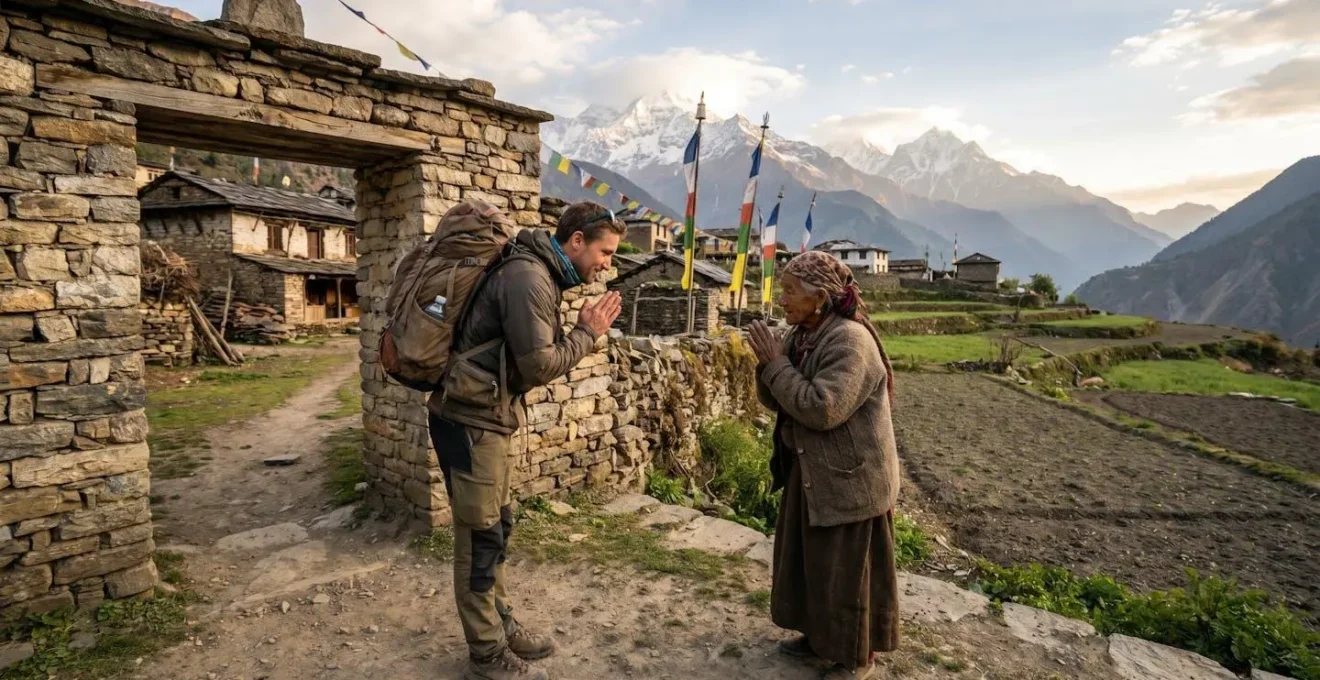
True respect in the Himalayas is not a checklist of etiquette; it’s a conscious economic and cultural partnership that directly impacts local communities.
- Most tourist dollars “leak” away from local economies when using large, foreign-owned operators.
- Many “authentic” cultural experiences are actually staged theatre, which can misrepresent and simplify complex local traditions.
Recommendation: To ensure your journey contributes positively, prioritize booking with verified local operators and staying in family-run lodges.
The moment you step into a Himalayan village, the air changes. The scale of the mountains is humbling, but it’s the quiet dignity of the communities living in their shadow that truly captivates. For many first-time Western trekkers, a deep desire to connect with this culture is a primary motivation. Yet, this desire is often paired with a nagging uncertainty: how do you engage in a way that is genuinely respectful, not intrusive? The common advice feels like a starting point, but somehow incomplete. You learn to say “Namaste,” you know to ask before taking a photograph, and you’ve heard you should dress modestly.
But these are merely the surface-level rules of engagement. They prevent overt offense but don’t necessarily create positive impact. The real challenge—and opportunity—lies in understanding the systems your presence affects. What if the most respectful act wasn’t just saying the right thing, but spending your money in the right place? What if it involved recognizing the difference between authentic interaction and “tourist theatre”? The truth is that every decision a trekker makes, from the tour operator they hire to the teahouse they choose, casts a vote that either strengthens the local cultural and economic fabric or contributes to its erosion.
This guide moves beyond the platitudes. It’s designed for the thoughtful trekker who wants their journey to be a form of reciprocal exchange, not just a transaction. We will explore the “why” behind the etiquette, examining the economic realities of tourism leakage, the ethics of photography in a world of social media, and the crucial distinction between supporting a community and merely observing it. By understanding these deeper dynamics, you can transform your trek from a simple holiday into a meaningful partnership that honours the sovereignty and resilience of Himalayan communities.
To navigate this complex but rewarding landscape, this article breaks down the essential pillars of respectful trekking. From the consequences of cultural missteps to the practical steps for vetting an ethical tour operator, each section provides the insight needed to make conscious, positive choices.
Summary: A Guide to Respectful Interaction in the Himalayas
- Why Can Cultural Missteps Close Mountain Villages to Future Trekkers?
- How to Interact Respectfully With Himalayan Communities During Treks?
- Lodge Stays vs Camping: Which Supports Local Himalayan Economies Better?
- The Photography Taboo That Offends 80% of Mountain Villagers
- How to Contribute Positively to Himalayan Communities Beyond Trekking Fees?
- Why Do Local Operators Keep 70% More Revenue in Destination Communities?
- The “Local Experience” Tour That’s Actually 100% Tourist Theatre
- How to Vet Local Tour Operators for Safety and Authenticity?
Why Can Cultural Missteps Close Mountain Villages to Future Trekkers?
The allure of the Himalayas is undeniable, drawing over 400,000 international trekkers to Nepal alone each year. While this influx can be a vital economic lifeline, it also places immense pressure on the delicate social structures of remote villages. Each interaction, however small, is a drop in a vast ocean of visitor impact. When missteps accumulate, they can erode the goodwill that keeps these communities open and welcoming. This isn’t about a single offensive act; it’s about the cumulative weight of misunderstanding that strains the cultural fabric of a place.
The risk is that tourism, if unmanaged, can feel like an invasion rather than a partnership. A field study in Nepal’s Khumbu region revealed this double-edged sword. While tourism can significantly enhance socio-economic status, the research also highlights how relentless visitor pressure can fray the social bonds that sustain a community’s willingness to host outsiders. When trekkers consistently ignore local customs, treat sacred sites as mere photo backdrops, or engage in transactional relationships that lack human decency, a village may slowly begin to turn inward. This can manifest as less-friendly interactions, restricted access to homes or monasteries, and eventually, a reputation that discourages the very kind of thoughtful travelers the community wishes to attract.
Ultimately, a community’s welcome is not a commercial product; it is a finite social resource. Repeated cultural friction can deplete this resource, leading to a form of “hospitality fatigue.” When the perceived cost of hosting—in terms of privacy, cultural integrity, and dignity—outweighs the economic benefit, the door to genuine connection begins to close. The responsibility, therefore, lies with every trekker to act as a steward of that goodwill, ensuring future generations can experience the same warmth and authenticity.
How to Interact Respectfully With Himalayan Communities During Treks?
Respectful interaction begins with humility and awareness. It is the conscious decision to enter a space as a guest, not a consumer. The most powerful tool in your arsenal is a local guide, who acts as more than just a navigator. As the Nepal Tourism Board notes, experienced guides act as cultural translators, bridging the gap between your world and the rich histories of the Sherpa, Tamang, and Gurung peoples. They can provide real-time context, interpret subtle social cues, and facilitate introductions that would otherwise be impossible. Rely on their expertise, ask questions, and listen to their guidance.
Beyond leveraging your guide, a set of core principles governs respectful conduct in villages, monasteries, and homes. These are not arbitrary rules but expressions of deeply held cultural values. For instance, removing your shoes before entering a home or temple is a universal sign of respect for the sanctity of the space. Similarly, walking and speaking softly in sacred areas demonstrates an understanding that you are in a place of worship, not just a tourist attraction.
The most meaningful connections often arise from simple, shared moments, like accepting a cup of tea. These interactions are a form of reciprocal exchange. To foster them, always begin with a simple greeting. Learning “Namaste” (in Nepal) or “Tashi Delek” (in Tibetan Buddhist areas) before starting a conversation signals respect and opens the door to genuine dialogue. Remember to always circle sacred stupas, chortens, and mani walls in a clockwise direction, following the path of the sun and the flow of positive energy. These small acts demonstrate a willingness to participate in the local culture, rather than just observe it from a distance.
Lodge Stays vs Camping: Which Supports Local Himalayan Economies Better?
A trekker’s choice of accommodation is one of the most direct ways they can influence the local economy. The decision between staying in a family-run teahouse (lodge) and an organized camping trek has significant, though different, economic implications. When you stay in a local lodge, your payment for a room and a meal often goes directly into the hands of a single family. This model concentrates the benefit, creating a powerful micro-economy within one household.
In regions like Langtang or Manaslu, where agriculture provides a baseline income, many families have converted parts of their homes into guesthouses. A case study of these teahouses shows that by staying in these family-run establishments, trekkers directly help them grow. The money is used for children’s education, healthcare, and home improvements. Food is often sourced from their own gardens or from neighbours, keeping the economic benefit hyper-local and minimizing financial leakage to larger cities.
Organized camping treks, on the other hand, distribute employment more broadly but in a more temporary fashion. A single camping trek might hire dozens of locals as porters, cooks, kitchen staff, and camp hands. This creates wider, short-term employment across a village. However, the risk of economic leakage can be higher, depending on the operator’s policies. If the trekking company buys food and supplies in bulk from a major city like Kathmandu, a smaller portion of the trekker’s total fee actually reaches the mountain communities. The following table illustrates how these two models differ in directing your spending.
| Criteria | Family-Run Teahouse/Lodge | Organized Camping Trek |
|---|---|---|
| Primary local beneficiary | Single host family (owner-operator) | Wider team: porters, cooks, kitchen boys, camp staff |
| Food sourcing | Often neighbor-to-neighbor, high local content | Depends on trek company; can be city-sourced in bulk |
| Employment breadth | Narrow (1-2 families per stop) | Wide but temporary (many villagers hired per trek) |
| Risk of leakage | Low if independently owned; high if absentee-owned | Depends heavily on operator’s sourcing policy |
| Best trekker safeguard | Ask ‘Is this your family’s lodge?’ | Ask ‘Which village are your porters and cooks from?’ |
Neither option is inherently “better,” as both support the local economy in different ways. However, for a trekker focused on maximizing direct, household-level impact and minimizing economic leakage, choosing independently owned family lodges is often the most effective strategy.
The Photography Taboo That Offends 80% of Mountain Villagers
In the age of social media, a photograph is no longer just a personal memento; it is a piece of data that can be shared, tagged, and broadcast to a global audience in seconds. This has created a significant point of friction in many Himalayan communities, particularly around the act of photography. The “taboo” is not photography itself, but the act of taking a picture without consent, which is widely seen as disrespectful and objectifying. It transforms a human being into a part of the scenery, a subject to be captured rather than a person to be engaged with.
This growing concern has led to concrete actions. In recent years, many monasteries have banned photography inside their main prayer halls. This isn’t just about protecting artifacts; it’s a reaction to the rise of social media and the discomfort of having sacred ceremonies and private moments of worship shared without context or consent. To many, especially elders, a photograph is not an inert image. Some traditional beliefs hold that a photograph can capture a part of a person’s spirit, making the act of taking one without permission a profound violation. Even where this belief isn’t held, the act of pointing a camera at someone without speaking to them is simply considered rude.
The golden rule is simple, as one expert source puts it: “Always ask your guide before clicking.” Your guide can mediate the request and help you understand if it’s an appropriate moment. When you do ask someone for a photo, frame it as a request for a shared portrait rather than a candid capture. If the person declines, accept it gracefully and without question. Their right to privacy and community sovereignty over their own image is absolute.
Your Action Plan for Ethical Photography
- Ask for consent: Before photographing any individual, ask for permission, ideally with your guide’s help. Frame the request as a shared portrait, not a candid capture.
- Respect sacred spaces: Always remove shoes, speak quietly, and refrain from taking photos inside monasteries or temples unless explicitly permitted. Never climb on monuments.
- Avoid public geotagging: When sharing photos online, avoid tagging precise village or monastery locations. This helps prevent sudden over-tourism that can overwhelm small communities.
- Accept refusal gracefully: If someone says no to a photo, thank them and move on. Understand that for some, a photograph is more than just an image; it is a matter of personal and spiritual significance.
- Offer a shared moment: After taking a portrait, show the person the photo on your camera screen. This simple act transforms the interaction from a taking to a sharing, reinforcing a sense of reciprocal exchange.
How to Contribute Positively to Himalayan Communities Beyond Trekking Fees?
While trekking fees and payments to guides and porters are the primary economic contributions, a truly positive impact extends far beyond these transactions. The most resilient local economies are those with strong “linkages,” where tourist spending creates a multiplier effect. As researchers R. Geoffrey Lacher and Sanjay K. Nepal explain, these linkages between the tourism industry and the local economy are crucial. This means looking for opportunities to support the ancillary economy that revolves around the main trekking routes.
This can be as simple as your daily purchasing decisions. Instead of buying imported chocolate bars, purchase locally made handicrafts, snacks, or textiles. Dine at small, neighbourhood teahouses rather than only at the largest lodge on the trail. These actions directly benefit local artisans, farmers, and small business owners. It’s about consciously spreading your spending to as many different people in the community as possible. Even small acts, like offering a fair tip for excellent service, can make a significant difference to a family’s income.
Your contribution can also be non-monetary. If a moment arises naturally, a genuine skill or story exchange can be far more valuable than a handout. Helping a teahouse owner’s child with their English homework or sharing stories about your own home can build bridges of mutual understanding. After your trek, your voice becomes a powerful tool. Write detailed, honest online reviews that specifically name the guides, porters, and lodges that made your trip special. This helps future travellers make informed, ethical choices and directly rewards those who provided excellent service. The most impactful support often continues long after you’ve returned home, as demonstrated by trekking companies and former clients who fundraise for community welfare. For instance, joint efforts have raised over £20,000 for initiatives like ‘Support4Sherpas’, providing essential resources and demonstrating how post-trek advocacy can create lasting positive change.
Why Do Local Operators Keep 70% More Revenue in Destination Communities?
One of the most significant and often invisible issues in tourism is “economic leakage.” This term describes the phenomenon where the money spent by tourists in a destination does not actually stay in that destination’s economy. When you book a trek with a large, foreign-owned international tour operator, a substantial portion of your fee is siphoned off before a single rupee ever reaches the Himalayas. This money covers marketing in your home country, administrative overhead, and profits that are repatriated abroad. The UNWTO has described this as a “large-scale transfer of tourism revenues out of the host country.”
Research on the topic is stark. In some cases, with large-scale, all-inclusive packages booked through foreign companies, studies show that as much as 70% of tourist spending can leak abroad. This means for every $100 you spend, only $30 might actually enter the local economy to pay for local wages, food, and lodging. This model effectively prevents host communities from reaping the full financial benefits of the tourism they support.
In contrast, choosing a community-based local operator—a company owned and operated by people from the region—radically changes this equation. While these companies also have overhead and profit margins, the vast majority of their costs are inherently local. They hire local guides and porters, buy food from local markets, and pay for lodging in local teahouses. Their administrative offices are in-country, and their profits are far more likely to be reinvested locally. The difference in where your money goes is dramatic.
| Cost Category | International Operator (approx.) | Local Community-Based Operator (approx.) |
|---|---|---|
| Home office marketing/admin | ~50% | ~5% |
| In-country costs (wages, food, lodging) | ~30% | ~80% |
| Company profit | ~20% | ~15% |
By choosing a local operator, you are actively voting to keep your tourism dollars where they are most needed. You are not just buying a service; you are investing in the local economic ecosystem, ensuring that the people whose mountains and culture you have come to admire are the primary financial beneficiaries of your visit.
The “Local Experience” Tour That’s Actually 100% Tourist Theatre
As travelers become more sophisticated, the demand for “authentic” experiences has skyrocketed. This has unfortunately given rise to a phenomenon known as “staged authenticity” or, more bluntly, “tourist theatre.” These are performances or demonstrations designed to look like traditional, everyday life but are, in fact, curated shows created exclusively for a tourist audience. While they can provide employment and a platform for cultural expression, they also risk simplifying and fossilizing dynamic, living cultures into a palatable, marketable product.
A classic example can be found at South Africa’s Lesedi Cultural Village, where performers live on-site to portray “traditional” lifestyles for visitors. While it celebrates heritage, it inevitably presents a static snapshot that doesn’t reflect the complex, modern reality of the cultures it represents. In the Himalayan context, this might take the form of a “traditional” dance performance that only happens when a tour group arrives, or a visit to a “typical” family home that has been perfectly arranged for tourist consumption. The key differentiator is intent: is this an organic part of community life that you are privileged to witness, or is it a show put on for your benefit?
Recognizing the difference requires critical awareness. Be wary of experiences that feel too polished, too perfect, or too easily scheduled. Authentic life is often messy, unscheduled, and not always convenient. If a cultural display is part of a large tour package and happens on a rigid schedule, it is likely a performance. This does not make it inherently bad—it can still be an enjoyable and educational display of skill—but it’s important to understand it for what it is. True authenticity is more likely to be found in the unplanned moments: a spontaneous conversation at a teahouse, being invited to watch a family prepare a meal, or stumbling upon a genuine local festival. These moments cannot be booked or guaranteed, and that is precisely what makes them so precious.
Key Takeaways
- Choose local operators and family-run lodges to maximize the economic benefit that stays within Himalayan communities and reduce financial leakage.
- Treat photography as a respectful exchange, not a right. Always ask for permission before photographing people and understand that a ‘no’ is absolute.
- Your guide is your most important cultural bridge. Vet their employer for ethical treatment of all staff, including fair wages and proper equipment for porters.
How to Vet Local Tour Operators for Safety and Authenticity?
Choosing the right local operator is the single most important decision you will make for your trek. This choice determines not only your safety and the quality of your experience but also the ethical and economic impact of your trip. Vetting an operator for both safety and authenticity requires asking the right questions before you book. Go beyond the price and itinerary and inquire about their operational ethics, particularly regarding their staff.
The welfare of the porters is a powerful litmus test for a company’s overall ethics. As one expert from Nepal Hiking Team states, “How a company treats its most vulnerable staff members directly reflects how it will treat its clients when problems arise on the trail.” Ask specific, pointed questions: Are your porters insured? What are their wage arrangements? Do they have adequate clothing, footwear, and equipment for the altitude? A reputable company will be proud to answer these questions and provide detailed information. Be wary of any operator that is evasive or dismissive. A key standard to check against is the International Porter Protection Group (IPPG) guideline, which states there should be a 25 kg maximum load per porter.
How a company treats its most vulnerable staff members directly reflects how it will treat its clients when problems arise on the trail.
– Nepal Hiking Team, How to Choose the Best Company for the Everest Base Camp Trek
Authenticity can be vetted by testing their pre-trip communication. Ask a nuanced cultural question, such as their policy on gift-giving to local children or how they facilitate interactions with communities. A thoughtful, detailed response suggests they have a genuine cultural liaison program, while a generic answer may indicate they are simply focused on logistics. Finally, always verify their credentials. Check for membership in professional organizations like the Trekking Agencies’ Association of Nepal (TAAN) and ask for a written, itemized breakdown of what the package fee includes, specifically mentioning staff insurance. A transparent, ethical operator will have nothing to hide.
Your journey to a respectful Himalayan trek begins not on the trail, but with the conscious choice of the partners who will guide you. Start vetting local, community-focused operators today to ensure your adventure is a force for good.