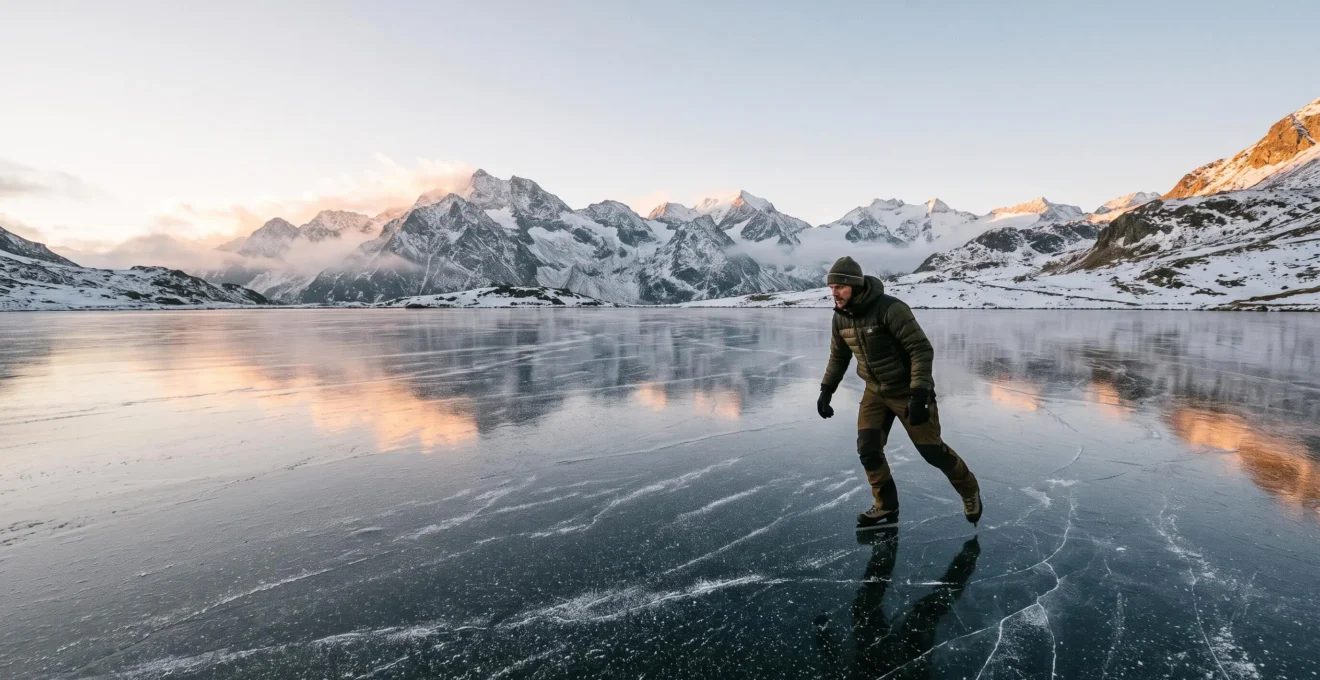
The true magic of alpine skating comes not from chance, but from mastering the art of preparation, turning a potentially risky outing into an unforgettable, safe experience.
- Ice safety is a science, not a guess; understanding key indicators is non-negotiable before stepping onto any natural ice.
- The perfect skating experience—whether on a wild lake or a curated ice trail—is a deliberate choice based on your group’s comfort and skill level.
Recommendation: Prioritise learning a simple ice-testing ritual and how to select properly fitted skates. These two skills are the foundation for all future alpine skating adventures.
The image is iconic: a couple gliding hand-in-hand across a vast, glassy sheet of ice, surrounded by snow-dusted peaks and profound silence. This is the dream of natural alpine ice skating, an experience that promises a blend of romance, adventure, and a deep connection with nature. Yet, for many, this dream is shadowed by uncertainty. How do you know the ice is safe? Where do you even begin to look for such a place? While many articles list potential spots, they often gloss over the most critical aspects.
The common advice is to “be careful” or “check the thickness,” but these platitudes offer little real guidance. The truth is, creating these magical memories isn’t about finding a secret spot; it’s about acquiring a specific set of knowledge. It’s about understanding the invisible physics that govern a frozen lake and the subtle biomechanics that ensure comfort and prevent pain. This guide moves beyond generic tips to empower you with the coordinator’s mindset.
Instead of just seeking beauty, you will learn to architect the entire experience. We will explore how to transform safety checks from a chore into a confidence-building ritual. We will decode the differences between various skating environments to match them to your desires. Ultimately, you will discover that the key to unlocking the most profound and romantic alpine skating moments lies in mastering the details that others overlook.
This article is structured to build your confidence and expertise step by step. Below, you will find a roadmap to help you navigate from foundational knowledge to practical application, ensuring your next alpine adventure is as safe as it is spectacular.
Table of Contents: A Journey to Mastering Alpine Skating
- Why Does Skating on Natural Alpine Lakes Create Unforgettable Winter Memories?
- How to Verify Ice Safety Before Skating on Natural Frozen Lakes?
- Hotel Rink vs Natural Lake vs Ice Trail: Which Skating Experience for Families?
- The Skate Rental Mistake That Causes Ankle Pain Within 15 Minutes
- When Do Alpine Lakes Freeze Solid Enough for Safe Skating?
- How to Shortlist the Perfect Caribbean Island Based on Your Couple Profile?
- Why Do Resorts With 3+ Pools Outperform Single-Pool Properties for Families?
- How to Identify Genuinely Traditional Chalets From Modern Imitations?
Why Does Skating on Natural Alpine Lakes Create Unforgettable Winter Memories?
The allure of skating on a natural alpine lake transcends a simple winter activity; it is an immersive sensory experience. Unlike the predictable loop of an artificial rink, a frozen lake offers a sense of boundless freedom. It is the profound silence of a high-altitude landscape, broken only by the crisp, satisfying scrape of your blades on the ice. It is the feeling of being a small, moving part of an immense, static panorama of mountains and sky. This combination creates a powerful and lasting memory.
This experience is about more than just the view. It’s about the unique quality of the ice itself. As The Impulsive Traveler notes, the sight of “The glassy black ice, the mountains reflecting on the surface” is a key part of the magic. This clear, dark ice, often called “wild ice,” gives the sensation of skating directly on water, offering a thrilling and beautiful perspective that is impossible to replicate indoors. This raw connection to the natural elements—the cold air, the hard ice, the vast space—is what elevates the activity from a sport to a cherished moment.
For couples, this shared adventure in a monumental setting fosters a unique intimacy. For families, it is a lesson in nature’s grandeur and a chance to create a story that will be told for years. The effort and awareness required to skate in such an environment make the reward—the glide, the view, the feeling of accomplishment—all the more potent and unforgettable. It is the very wildness of the experience that makes it so precious.
How to Verify Ice Safety Before Skating on Natural Frozen Lakes?
The absolute prerequisite for a magical skating experience is an unwavering commitment to safety. Trusting your safety to guesswork is the quickest way to turn a dream outing into a disaster. Verifying ice safety is a non-negotiable safety ritual that should become an integral and empowering part of your adventure. The first step is understanding the minimum thickness required for different activities, as ice strength is not intuitive.
This comparative table from Acurite provides a clear, data-driven guideline for various weight loads. For skaters, the magic number is four inches of clear, solid ice.
| Ice Thickness | Activity |
|---|---|
| Less than 4 inches | Stay off the ice |
| 4 inches | Walking, ice fishing, ice skating on foot |
| 5 to 7 inches | Snowmobiling or riding ATVs |
| 8 to 12 inches | Driving a car or small pickup |
| 12 to 15 inches | Driving a medium-sized truck |
However, thickness is just one part of the story. The quality of the ice and its consistency across the entire lake are equally important. A crack in the ice can be a sign of instability or a normal part of the freezing process. Learning to “read” the ice—observing its colour, clarity, and listening to its sounds—is a skill developed over time. Clear, blue or black ice is the strongest, while white or grey ice can be much weaker due to trapped air or snow.
Never trust that the ice is uniformly thick. Inflows, outflows, and underwater springs can create dangerously thin spots even on an otherwise solid lake. This is why a systematic testing protocol is not just for experts; it’s for everyone. Before you commit your full weight, you must test the ice near the shore and continue to assess it as you move.
Your Action Plan: The First Five Meters Ice Testing Protocol
- Drill a Test Hole: Before stepping onto the ice, use an ice chisel, auger, or cordless drill to make a hole within the first few feet of the shore to measure thickness.
- Measure, Don’t Guess: Insert a tape measure into the hole, hook the end on the bottom of the ice, and take a precise reading. Do not proceed unless it is at least four inches (10 cm) of clear, solid ice.
- Assess Cracks: A wet crack running through the ice is a concern. Always cross cracks at a right angle, and be extremely cautious if multiple wet cracks intersect.
- Carry Rescue Gear: Never venture out without basic rescue equipment. This includes a life jacket or float coat, ice picks (worn around your neck), a charged cell phone in a waterproof bag, and a rope.
- Never Go Alone: Your partner is your first line of rescue. Ensure they know what to do in an emergency and can call for help.
Hotel Rink vs Natural Lake vs Ice Trail: Which Skating Experience for Families?
Once safety is addressed, the next step is what we can call experience architecture: consciously designing the perfect outing for your group. Not all ice is created equal, and the ideal setting for a romantic couple may not be suitable for a family with young children. The Alps offer a spectrum of choices, each with distinct advantages.
The hotel or village rink is the most controlled environment. The ice is Zamboni-smooth, boards provide a safety barrier, and amenities like skate rentals and hot chocolate are just steps away. For families with first-time skaters or small children, this is an excellent, low-stress option. It provides a taste of the alpine winter atmosphere with maximum convenience and guaranteed safety, allowing kids to build confidence without the added variables of natural ice.
The natural frozen lake is the pinnacle of wild skating. It offers unparalleled beauty, a sense of adventure, and complete freedom. This is the ideal choice for experienced couples or families with confident older children who understand and respect the safety protocols. The “magic” factor is highest here, but so is the level of personal responsibility. It requires planning, proper gear, and a solid understanding of ice safety.
A wonderful hybrid option is the prepared ice trail. Many alpine regions, particularly in Austria, maintain and monitor sections of large lakes or create meandering ice paths through forests. These offer a best-of-both-worlds scenario: you get the feeling of journeying through a natural landscape on a vast surface, but with the added security of regular ice-thickness checks and cleared pathways. As the team at Austria.info rightly states, Austria’s natural ice rinks offer a magical experience!, often referring to these magnificent, maintained surfaces. This is often the perfect choice for a family’s first “adventure” skate beyond the confines of a small rink.
The Skate Rental Mistake That Causes Ankle Pain Within 15 Minutes
Nothing shatters the dream of a graceful glide across an alpine lake faster than searing ankle pain. The most common culprit is a surprisingly simple one: improperly fitted rental skates. Many people assume skates should fit like comfortable shoes, but this mistake leads to a lack of ankle support, causing your foot to wobble and forcing your tendons and muscles to overcompensate. This is the fast track to pain, blisters, and a ruined experience.
The goal of a skate boot is to act as a rigid extension of your leg, transferring energy directly to the blade. If your heel can lift or your foot can slide side-to-side, that energy is wasted, and your ankle is put under immense strain. As Dr. Giovanna Medina, a foot and ankle specialist, explains, “And without ankle stability, you won’t have appropriate balance, which increases the risk of falling.” This underscores that proper fit is not just about comfort; it’s a critical safety issue, especially on the uneven surfaces of natural ice.
Achieving this “locked-in” feeling is about biomechanical comfort—a precise fit that supports your foot’s structure. The boot should be snug all around, tighter than a street shoe, but without creating painful pressure points or cutting off circulation. Tying the laces tightly is only part of the solution; if the boot is the wrong size or shape for your foot to begin with, no amount of lacing will fix it.
Before you even leave the rental shop, you must perform a quick fit test. Don’t be shy about trying on several pairs or sizes. Remember to wear the same socks you’ll be skating in, as thickness can dramatically alter the fit. Taking five minutes to ensure a proper fit will save you from hours of pain and frustration on the ice. The following checklist is your best defence against a bad rental.
Your Action Plan: The 3-Point Fit Test for Rental Skates
- The Heel-Lock Test: After lacing up, stand and bend into a skating stance. Try to slip a finger down the back of the boot behind your heel. You should not be able to fit more than one finger; any more space means your heel will lift and cause blisters.
- The Toe-Brush Test: When standing up straight, your longest toe should just barely brush the inside of the toe cap. When you bend your knees into a skating position, your heel should lock into the back, and your toes should slide back slightly, no longer touching the cap.
- The Snugness Squeeze: The boot should feel snug and secure around the sides of your foot. It should feel like a firm handshake, providing support without pinching or causing numbness.
- The Sock Rule: Always try on skates with the exact socks you plan to wear on the ice. A thin sock versus a thick ski sock can change the fit by half a size.
- The Lace-Up Strategy: Ensure laces are pulled tightest over the curve of your ankle to lock the heel in place, with slightly less tension over the toes to allow for circulation.
When Do Alpine Lakes Freeze Solid Enough for Safe Skating?
The formation of safe skating ice is a process governed by what we can call invisible physics—a combination of factors far more complex than just a cold forecast. While the prime alpine skating season generally runs from January to March, the exact timing is weather-dependent each year. The key to understanding it is the concept of sustained cold.
Scientists and experienced skaters don’t just look at the daily temperature; they track the accumulation of cold over time. According to the Lake Ambassadors of Canada, ice growth is calculated using Freezing Degree Days (FDD). It takes a consistent accumulation of cold—roughly 15 FDD—to create just one inch of ice. This explains why a few cold nights aren’t enough; the lake needs a prolonged period of deep freeze to build a solid, safe foundation.
Furthermore, several hidden variables can dramatically affect how a lake freezes. For instance, snow cover is a crucial factor. A blanket of snow acts as a powerful insulator, trapping heat in the water and significantly slowing down or even stopping the ice formation process, even when air temperatures are well below freezing. Other factors include:
- Wind: Wind can break up forming ice but can also help cool the water surface faster.
- Lake Size and Depth: Smaller, shallower lakes will freeze much faster and more reliably than large, deep bodies of water.
- Solar Radiation: A sunny day, even if cold, can warm the ice and weaken its structure, especially dark-coloured ice.
This complexity is why local knowledge is invaluable. In many alpine regions like Austria and Switzerland, official bodies monitor popular lakes and only give the green light for skating once the ice has reached a certified minimum thickness. Always check local tourist offices or municipal websites for the current status before heading out.
Case Study: Lake Weissensee, Austria: Europe’s Largest Natural Ice Surface
A prime example of these principles in action is Austria’s Lake Weissensee. At 6.5 square kilometres, it is Europe’s largest consistently frozen and maintained natural ice surface. Its reliability is due to a combination of high altitude, which ensures sustained cold temperatures, and a dedicated team of “ice masters” who monitor, maintain, and prepare up to 25km of skating tracks. This demonstrates how natural conditions and human management can combine to create a world-class, reliable natural skating destination.
How to Shortlist the Perfect Caribbean Island Based on Your Couple Profile?
The process of choosing a vacation is always an exercise in matching a destination to a desire. Just as a couple might analyse Caribbean islands based on their “profile”—seeking the vibrant nightlife of one, the secluded beaches of another, or the adventurous eco-tourism of a third—so too must a winter enthusiast approach the Alps. The question is not simply “Where can I skate?” but “What kind of experience am I looking for?”
This concept of profile-based selection is directly transferable to our alpine quest. A couple seeking a secluded, romantic glide on a wild, untouched lake has a very different profile from a family needing the convenience and safety of a resort-managed rink. Applying this filter—understanding your own group’s profile, skills, and risk tolerance—is the first and most crucial step in crafting an experience that doesn’t just look good in photos but feels right in the moment. It transforms a generic search into a personal journey.
The “perfect” alpine skating experience, like the perfect island, is not a universal constant. It is a subjective match, a resonance between a place and a person. Before you even look at a map of alpine lakes, you must first draw a map of your own expectations and capabilities. This is the strategic foundation for a truly successful and memorable winter adventure.
Why Do Resorts With 3+ Pools Outperform Single-Pool Properties for Families?
Experienced family travellers understand a fundamental truth of resort selection: the number of pools is often a direct indicator of the quality of the family experience. A resort with three or more pools is not just offering more water; it is offering segmentation and choice. There is the bustling activity pool for the kids, the quiet adults-only pool for a moment of peace, and perhaps a lazy river for everyone. This variety reduces crowding and minimizes conflict between different guest demographics, ensuring everyone has a better time.
This very principle of “experience segmentation” is why a rich alpine environment offers a superior winter holiday. The single, crowded village rink is the equivalent of the single-pool resort—functional, but limited and often over-subscribed. An alpine valley that offers a village rink, a prepared ice trail, AND access to a monitored natural lake is the 3-pool resort of winter sports. It provides tailored experiences for every skill level and mood within the same family.
On Monday, the kids can take lessons on the safe village rink. On Tuesday, the whole family can enjoy a scenic glide on the forested ice trail. And on Wednesday, the more experienced members can venture out for a thrilling skate on the vast natural lake. This segmentation ensures that no one is bored, no one feels unsafe, and the magic of the alpine setting can be appreciated by everyone, on their own terms.
Key Takeaways
- True skating magic is built on a foundation of safety; mastering ice-testing protocols transforms fear into confidence.
- The best experience is a conscious choice: match the skating environment (rink, trail, or wild lake) to your group’s skill and desires.
- Comfort is critical: a proper skate fit prevents pain and is as important for safety as it is for enjoyment.
How to Identify Genuinely Traditional Chalets From Modern Imitations?
In the world of alpine architecture, the discerning eye learns to distinguish an authentic, centuries-old chalet from a modern imitation. It’s a skill based on observing subtle cues: the way the sun-darkened timbers are joined, the gentle sag of a stone-laden roof, the proportions of the windows. The genuine article tells a story of function, history, and harmony with its environment. The imitation, however well-crafted, often misses this essential spirit.
This same skill of “reading the signs” is precisely what you must cultivate to skate safely on natural ice. The surface of a frozen lake, like the facade of a chalet, tells a story. An expert learns to identify the deep, honest character of strong, clear black ice from the superficial, deceptive beauty of weak, snow-covered ice. They learn to interpret the language of cracks, booms, and groans that the ice uses to communicate its tension and stability.
Developing this “eye for ice” transforms you from a passive tourist into an active, engaged participant in the alpine environment. You are no longer simply hoping the surface will hold you; you are making an informed assessment based on observable evidence. This shift in mindset is the final step in your journey. It is the moment where knowledge fully integrates with experience, and you can approach the ice not with fear, but with respect and understanding.
Now, armed with this comprehensive understanding—from the physics of ice to the biomechanics of your own ankles—you are ready to architect your perfect alpine skating adventure. Begin by applying this newfound knowledge not as a list of rules, but as a framework for observation and decision-making to create an experience that is truly your own.