In summary:
- Treat groomed runs as a predictable ‘laboratory’ to isolate and master carving skills, not just as easy terrain.
- Progress isn’t about skiing faster on harder slopes, but about executing specific drills with precision on the *right* terrain.
- Breaking the intermediate plateau requires deliberate practice—skiing with a clear technical goal—rather than simply logging more hours on the snow.
- Understand that piste color ratings are only a guide; real progress comes from analyzing pitch, width, and conditions to suit your practice needs.
You’ve been skiing for a few seasons. You can comfortably handle blue runs and even venture onto the occasional black. Yet, you feel stuck. You watch other skiers lay down clean, effortless arcs in the snow, their skis seemingly locked onto a railway track, while you still feel yourself skidding and chattering through turns. This is the intermediate plateau, a frustrating place where more mileage doesn’t seem to translate into better technique. The common advice is often to “bend your knees” or “just get on your edges,” but this rarely unlocks the fluid power of a true carved turn.
Many skiers believe that to improve, they must tackle more challenging terrain like moguls or powder. But what if the secret to a breakthrough lies in the exact opposite direction? What if the key to unlocking advanced technique is hidden in plain sight, on the very runs you might now consider ‘easy’? The answer lies not in what you ski, but *how* you ski it. It’s about shifting your mindset from simply descending the mountain to using the predictable canvas of a groomed run as a high-performance physics laboratory.
This guide will deconstruct that process. We will explore why the uniform surface of a groomed piste is the ultimate accelerator for skill development. We’ll provide a systematic approach with specific drills, explain how to read terrain beyond its color-coded rating, and reveal the strategies needed to break free from the comfort zone trap. By the end, you will no longer see a groomed run as just a motorway, but as your personal training ground for achieving carving mastery.
To help you navigate this path, this article is structured to build your understanding from the foundational principles to practical application. Here is a summary of the key areas we will cover.
Summary: Using Groomed Runs to Systematically Improve Carving
- Why Do Groomed Pistes Accelerate Skiing Technique Better Than Powder or Moguls?
- How to Use Groomed Runs Strategically to Improve Carving Technique?
- What Do Piste Colour Gradings Mean and How Reliable Are They?
- The Comfort Zone Trap That Stops Intermediate Skiers Progressing on Blues
- How to Find Empty Groomed Pistes at Busy Ski Resorts?
- Why Weekend Gym Sessions Aren’t Enough for Multi-Day Mountain Treks?
- Why Doesn’t Rock Climbing Experience Prepare You for Ice Climbing Challenges?
- Skiing vs Snowboarding: Which Offers More Progression After 10 Years?
Why Do Groomed Pistes Accelerate Skiing Technique Better Than Powder or Moguls?
The fundamental reason groomed pistes are superior for technical development is one simple word: predictability. Unlike powder, which has variable density, or moguls, which demand constant reactive movements, a groomed run offers a consistent, uniform surface. This turns the piste into a controlled laboratory where you can focus on a single variable: your technique. When the snow surface is a known constant, any change in your turn—be it success or failure—is a direct result of what you did with your body. This immediate, clear feedback is the catalyst for rapid learning.
This environment is perfect for understanding the critical difference between skidding and carving. A skidded turn is a braking maneuver where the skis are pushed sideways against the direction of travel. A carved turn, by contrast, is when the ski is tipped onto its edge, and the sidecut (the hourglass shape of the ski) bends into an arc, guiding the ski through a clean turn with minimal braking. On a groomed run, the evidence is unmistakable: a carved turn leaves behind a thin, perfect pencil line in the snow. A skidded turn scrapes away a wide swath of snow. The groomed surface doesn’t lie; it provides a visual scorecard for every turn you make.
This pristine canvas allows you to truly feel the forces at play. As your technique improves, you will start to generate more pressure and speed. This is where the real magic happens.
A carving ski will move faster and build more pressure, so you feel higher g-forces than in any other turn.
– Carv Ski Coaching, How To Carve On Skis – 4 Steps to Transform your Skiing, Carv
This feeling of ‘high g-forces’ is the hallmark of efficient skiing. It’s the sensation of the ski locking into its arc and accelerating you through the turn. You can only learn to manage and enjoy these forces in an environment free from the distractions of bumps and unpredictable snow. The groomed piste is that environment.
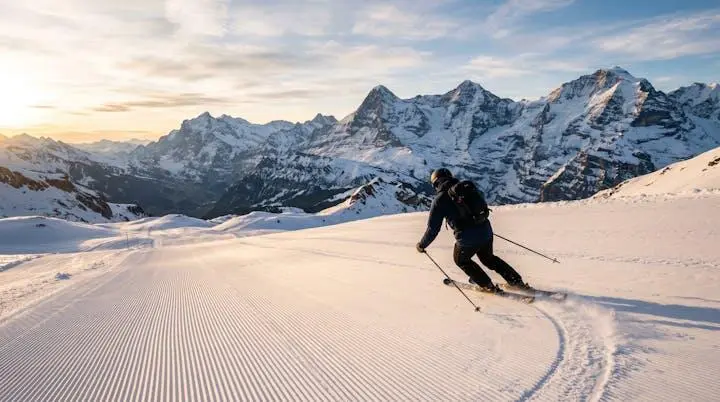
The image above perfectly illustrates this ideal interaction: the ski edge precisely engaging with the firm, predictable snow. Mastering this engagement is the first step, and it can only be achieved through focused, deliberate practice where the terrain itself is not part of the challenge.
How to Use Groomed Runs Strategically to Improve Carving Technique?
Once you embrace the piste as your lab, you need a method for your experiments. The strategy is not to just ski down a blue run, but to use specific sections of terrain to isolate and master the individual components of a carved turn. This is variable isolation in practice. Instead of trying to do everything at once, you pick one skill and one ideal piece of terrain to perfect it.
A systematic approach involves breaking the carve down into its fundamental building blocks: edge engagement, balance on the outside ski, and upper body stability. Here are three foundational drills and the specific terrain to practice them on:
- Ankle and Knee Edging Drills: On a gentle, wide-open green or easy blue run, practice rolling your ankles and knees into the hill to tip the skis onto their edges. The goal is to initiate a turn with only your lower joints, keeping your upper body completely still. The low pitch allows you to focus on the sensation of the edge biting without building up intimidating speed.
- Outside-Ski Balance Drills: Find a smooth, low-angle slope. As you make long, sweeping turns, practice lifting your inside ski off the snow for a second or two in the middle of the turn. This forces 100% of your weight onto the outside, carving ski, which is essential for a powerful turn. If you can’t balance, it’s a sign you’re not committing enough weight to the outside ski.
- Full Turn Combination: Once you’re confident with the first two drills, find a slightly steeper, consistent blue run. Start combining the movements. Begin the turn by rolling the ankles and knees, feel the outside ski engage, and focus on maintaining that balance and edge angle through the entire arc of the turn, keeping your torso facing down the fall line.
This deliberate, data-driven approach is proven to work. It’s not about how many runs you do, but what you do on those runs.
Data-Driven Edge Angle Progression: Tom Gellie & Carv’s Edge Build Analysis
Using wearable sensor data from the Carv system, ski coach and biomechanics expert Tom Gellie’s turns were analyzed to show that elite skiers don’t just build edge angle quickly, they sustain it far longer through the mid-turn phase. This “Early Edging” and “Mid-Turn Edge Build” actually improves as the pitch increases. The case demonstrates how deliberately practicing edge-build on progressively steeper groomed sections, rather than randomly skiing, produces measurable technique gains that skiers can track over time. It is a perfect example of using the groomed run as a tool for quantifiable improvement.
The key is to master each drill on easier terrain before moving to a steeper pitch. Each skill builds on the last, creating a solid foundation for powerful, efficient carving on any slope.
What Do Piste Colour Gradings Mean and How Reliable Are They?
To use groomed runs strategically, you must understand what their classifications—Green, Blue, Red, Black—actually mean, and more importantly, what they don’t. These colors primarily indicate the steepness or gradient of a slope. However, the exact gradient percentages for each color can vary significantly between continents and even between neighboring resorts. Generally, North American standards state that green runs have a gradient of 6% to 25%, blues are 25% to 40%, and blacks are anything over 40%.
These numbers provide a useful baseline, but the experience of a run is affected by much more than just its average pitch. Factors like width, grooming quality, and snow conditions can make a blue run feel like a black, or vice-versa. A wide-open, perfectly groomed blue run is an ideal carving laboratory. The same run, when narrow, icy, and crowded, becomes a survival exercise. The table below gives a general comparison between European and North American grading systems, but remember these are just guidelines.
| Difficulty Level | European (Alps/France) Colour | Typical Gradient | North American Equivalent | Typical Gradient |
|---|---|---|---|---|
| Beginner | Green | 5–15% | Green Circle | 6–25% |
| Confident Beginner / Lower Intermediate | Blue | Up to 25% | Green Circle (upper range) / Blue Square (lower range) | 6–25% / 25–40% |
| Confident Intermediate / Advanced | Red | 25–40% | Blue Square (steep) / Black Diamond (easy) | 25–40% |
| Expert | Black | 40%+ (no fixed ceiling) | Black Diamond / Double Black Diamond | 40%+ |
The strategic skier learns to look beyond the color. Instead of asking “Is this a blue run?”, ask “Does this run have a consistent, moderate pitch for 200 meters where I can practice my outside-ski balance drills?” Or, “Is this section wide enough to make full, round carved turns without getting too close to the edge?” This reframing is crucial. A short, steep section of a blue run might be the perfect place to test your edge hold, while a long, gentle green might be better for slow-motion ankle-rolling drills.
Ultimately, conditions on the day trump any static rating. A change in weather can completely alter a run’s character.
A piste may be marked blue, but if conditions are icy then it may feel more like a red.
– Snowplaza Editorial Team, Slope difficulty levels explained: What makes a piste blue, red or black?, Snowplaza
This is why you must learn to assess the terrain for yourself. Use the piste map to identify potentially suitable runs, but make your final decision based on what you see and feel on the mountain that day.
The Comfort Zone Trap That Stops Intermediate Skiers Progressing on Blues
The biggest obstacle to breaking the intermediate plateau is often the plateau itself: the comfortable, familiar feeling of cruising down a blue run without challenge. When you can get down a slope without falling and with a sense of control, your brain switches to autopilot. You are simply performing a known skill, not developing a new one. This is mileage, not practice. You might ski 50 blue runs in a week this way and not improve one bit, because you’re not pushing the boundaries of your ability.
This is the comfort zone trap. Your body defaults to its most ingrained habits—for most intermediates, this means defensive, skidded turns that control speed but lack efficiency and power. To progress, you must consciously choose to be uncomfortable. You must try to make a turn that feels different, that demands more balance, or that generates more speed. This is the essence of deliberate practice. Foundational research on expertise development shows that top performers in any field accumulate up to three times more deliberate practice than novices. It’s the quality and focus of the time spent, not the quantity.
Breaking out of this trap means skiing with intent. Before you drop in, decide your goal for the run: “On this run, I will focus only on lifting my inside ski,” or “I will try to make five perfect, round carved turns.” This focused attention forces your brain and body to adapt and learn. It will feel awkward. You might even fall. This is a sign of progress, not failure. It shows you are operating at the edge of your abilities, which is where growth happens.
The reward for this effort is not just better technique, but also greater endurance. Skidding is tiring work, fighting against the mountain. Carving is efficient, working with gravity and the design of your skis.
You’ll also be able to stay out longer, because repeatedly tensing leg muscles to absorb skids exacts a toll.
– REI Co-op Expert Advice, How to Carve Turns on Skis, REI Expert Advice
By pushing through the initial discomfort of learning to carve properly, you are investing in a more efficient, powerful, and ultimately more enjoyable way of skiing that will allow you to ski harder and longer.
How to Find Empty Groomed Pistes at Busy Ski Resorts?
Your plan for deliberate practice is set. You know which drills to do and what kind of terrain you need. There’s just one problem: crowds. It’s impossible to focus on technique when you’re constantly dodging other skiers and snowboarders. Finding your own space, your “private laboratory,” is a critical skill, even at the busiest resorts. The secret lies in understanding crowd flow and timing.
Crowds are predictable. They follow the path of least resistance, which usually means flocking to the newest, fastest lifts that access the most popular runs. Data on lift infrastructure shows that modern high-capacity chairlifts and gondolas can move over 3,000 people per hour, concentrating skiers in specific zones. Your strategy is to go against this flow. Look for older, slower, fixed-grip chairlifts on the trail map. They often access excellent intermediate terrain that is overlooked by the masses racing to the flagship lifts. These areas are goldmines for quiet practice runs.
Timing is just as important as location. The first 90 minutes of the day offer the best snow and the fewest people. Being on one of the first chairs up the mountain guarantees you at least an hour of pristine, empty corduroy to practice on. Similarly, there is often a lull during the peak lunch hours (12:00 PM to 2:00 PM) and in the last hour before the lifts close. By planning your practice sessions for these off-peak windows, you can dramatically increase your chances of finding an empty slope.
To consistently find the space you need, a clear plan is essential. Follow these steps to maximize your time on quiet, groomed terrain.
Your Action Plan: Finding Untouched Corduroy
- Be on the first chairlift: The lifts are always emptiest during the first 60–90 minutes of the day, offering the best snow and space.
- Target the lunch lull: Plan a practice session between late morning and early afternoon as ski schools and families take breaks, thinning out the main runs.
- Favor midweek skiing: If possible, ski on Tuesdays, Wednesdays, or Thursdays, which remain the quietest window for uncrowded terrain.
- Avoid peak windows: Steer clear of long weekends and public holidays, which concentrate massive crowds on the most popular runs.
- Study the trail map: Identify smaller, older, or less obvious lift infrastructure that is often overlooked by crowds heading to flagship gondolas.
Why Weekend Gym Sessions Aren’t Enough for Multi-Day Mountain Treks?
This question might seem unrelated to skiing, but it holds a powerful analogy for technical progression. Just as weekend gym sessions often fail to prepare the body for the sustained, specific endurance of a multi-day trek, simply skiing on weekends without a plan won’t build the technical prowess needed to break your carving plateau. A trekker doesn’t just lift weights; they train by hiking with a weighted pack, conditioning their muscles and joints for the exact stresses of the trail. They focus on specificity.
The same principle applies directly to skiing. Your “weekend gym session” is the equivalent of just cruising down blue runs. It maintains a baseline of ski fitness, but it doesn’t prepare you for the unique demands of high-performance carving. A carved turn requires a unique combination of balance, pressure control, and core strength that can only be developed through skiing-specific drills. It’s not about being generally “fit”; it’s about being “carving fit.”
A multi-day trek exposes any weakness in preparation; by day three, blisters form and muscles ache if the training wasn’t specific enough. Similarly, trying to carve on a steep, firm slope will instantly expose a lack of specific practice. Your outside ski will wash out, your upper body will rotate, and you’ll revert to skidding. The mountain, like the long trail, is an honest judge of your preparation. Therefore, think of your time on groomed runs not as casual skiing, but as your specific, targeted training to build the technical endurance required for mastery.
Why Doesn’t Rock Climbing Experience Prepare You for Ice Climbing Challenges?
An experienced rock climber often assumes their strength and movement skills will transfer directly to ice climbing, only to discover it’s a fundamentally different discipline. The tools are different (ice axes vs. hands), the medium is different (brittle ice vs. solid rock), and the technique is different (precision strikes vs. static holds). This is the perfect analogy for the intermediate skier moving towards carving. You may have years of experience on pistes, but that doesn’t automatically prepare you for the challenge of a true carved turn.
Skidding turns, which most intermediates master, are like the rock climber’s reliable handholds. They are a stable, defensive way to control descent. Carving, however, is like ice climbing. It requires trusting a new set of tools—the sharp edges and sidecut of your skis—and a completely different technique. It’s a transition from a pushing, braking motion to a tipping, guiding motion. It feels counter-intuitive and insecure at first, just as trusting a tiny axe point in the ice does.
The mental shift is the hardest part. The rock climber has to stop trying to “pull” on the ice and instead learn the subtle art of the swing and kick. The intermediate skier has to stop “pushing” the ski away and instead learn to trust tipping it over and letting the sidecut do the work. This requires un-learning old, deeply ingrained habits and building a new foundation of movement from the ground up. Your experience gets you to the base of the climb, but it won’t get you to the top without a new approach.
Key Takeaways
- True carving improvement comes from deliberate practice on groomed runs, not from tackling more difficult terrain.
- Use the piste as a ‘lab’ by isolating variables—choosing specific pitches and widths to work on specific drills.
- Breaking the intermediate plateau requires a mental shift: move from skiing on autopilot to skiing with conscious, focused intent on every run.
Skiing vs Snowboarding: Which Offers More Progression After 10 Years?
After a decade on the snow, both skiers and snowboarders can reach an incredible level of mastery. However, the question of which discipline offers “more progression” can be framed as: which offers a deeper, more technically nuanced path for continuous improvement? While snowboarding has its own complex world of advanced techniques, skiing—specifically the pursuit of the perfect carved turn—presents a near-infinite journey of refinement. It is a path of diminishing returns that can fascinate a technical mindset for a lifetime.
The reason lies in the separation of your feet. With two independent skis, the number of variables to control—edge angles, pressure distribution between feet, rotation, fore/aft balance—is exponentially greater. Mastering the orchestration of these elements to produce a flawless, high-speed carved turn on challenging terrain is a pursuit that is never truly finished. There is always a way to be more efficient, to generate more pressure, to be more balanced.
This is where the principles of this entire guide come together. The groomed run is the perfect arena for this lifelong pursuit. It allows you to get instant, precise feedback on the subtle changes you make. Are you pressuring the tip of the ski 0.5 seconds earlier? The line in the snow will tell you the result. Did you roll your ankles a degree further? The g-force you feel will be your data point. For the skier dedicated to technical mastery, the sport doesn’t get boring after 10 years; it gets more interesting. The groomed piste, once seen as simple, becomes a canvas for endless technical expression.
Your journey to breaking the intermediate plateau and mastering the art of carving starts now. It’s not about buying new gear or throwing yourself down steeper slopes. It’s about a strategic, intelligent shift in how you approach your time on the snow. Start by applying these principles on your very next run.