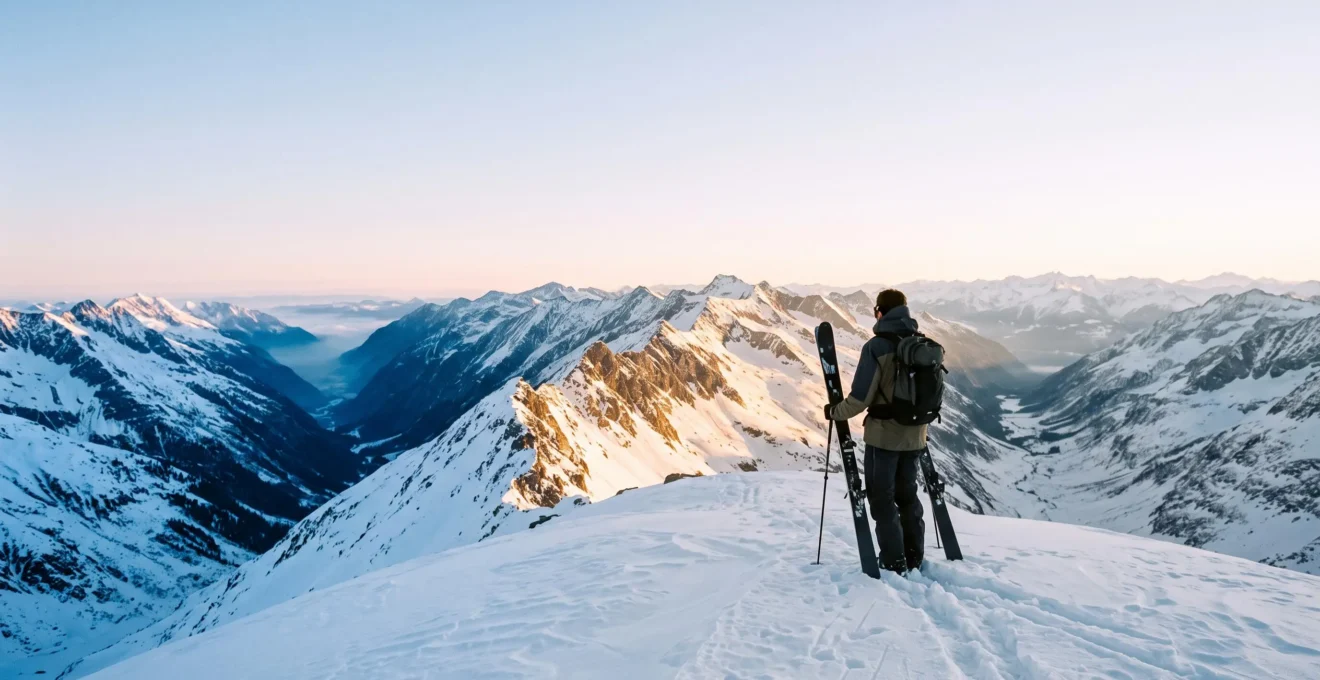
Choosing your first North American ski destination isn’t about finding the “best” resort, but understanding which region’s unique DNA—snow quality, resort scale, or logistical ease—best matches your Alpine-honed expectations.
- Utah offers unparalleled snow quality and airport proximity, ideal for short trips focused purely on powder.
- Colorado provides the largest variety of resorts and vibrant town life, but requires navigating high altitude and potential traffic.
- The Canadian Rockies deliver epic wilderness scenery and less crowded slopes at the cost of longer travel times and colder temperatures.
Recommendation: Prioritise Utah for guaranteed snow quality, Colorado for resort variety and social life, and Canada for immense wilderness and fewer crowds.
For a European skier, planning a trip to the Alps is a familiar ritual of navigating train schedules, studying interconnected lift maps, and debating the merits of one valley versus another. The prospect of skiing the Rocky Mountains, however, presents a different kind of challenge. You’ve heard the names—Vail, Park City, Banff—and seen the marketing: vast acreage, deep powder, endless blue skies. But these metrics often fail to translate into a tangible understanding of the experience.
Common advice suggests Utah has the best snow and Colorado offers the most resorts, but this is a gross oversimplification. What does “5,000 skiable acres” truly mean to someone accustomed to the 600 kilometres of pistes in Les Trois Vallées? How does the dry “Champagne Powder®” of the Rockies actually feel under your skis compared to Alpine snow? And critically, what are the hidden logistical and physiological challenges that glossy brochures fail to mention?
The key to choosing the right North American destination is not to find a direct equivalent to Chamonix or St. Anton, but to translate the fundamental differences in the experience. This guide moves beyond the simple statistics to decode the DNA of each major region. We will explore the unique character of the snow, the reality of resort scale and access, and the critical, often underestimated, factor of high-altitude acclimatisation. This is about equipping you with the insight to choose not the “best” resort, but the one that represents the right cultural, practical, and experiential fit for your first transatlantic ski adventure.
This article breaks down the essential factors every European skier should consider, providing a clear framework for making an informed decision. The following sections will guide you through the key differences to help you plan the perfect trip.
Summary: A European Skier’s Guide: How to Choose Between Colorado, Utah, and Canadian Rocky Mountain Resorts
- Why Does Powder Snow in the Rockies Feel Completely Different From Alpine Snow?
- How to Choose Between Colorado, Utah, and Canadian Rocky Mountain Resorts?
- Rockies vs Alps: Which Ski Experience for Advanced European Skiers?
- The Altitude Mistake Europeans Make at High Rocky Mountain Resorts
- When Do Rocky Mountain Resorts Offer the Best Snow Conditions?
- Why Do Genuine Historic Chalets Offer Atmosphere Modern Builds Can’t Replicate?
- How to Acclimatise Properly When Ascending Above 4,000 Metres?
- How to Identify Genuinely Traditional Chalets From Modern Imitations?
Why Does Powder Snow in the Rockies Feel Completely Different From Alpine Snow?
The first and most profound difference you’ll notice in the Rockies is the snow itself. European skiers are accustomed to a wide range of conditions, but the legendary “powder” of the North American West is a distinct phenomenon rooted in science. It’s not just marketing jargon; it’s a product of a continental climate that creates a much lighter, drier, and more buoyant skiing surface than the typically heavier, maritime-influenced snow of the Alps.
The secret lies in water content. According to research on snow density, the celebrated “Champagne Powder” of a resort like Steamboat, Colorado, can have a water content as low as 6%, compared to an average of 15% or higher for typical resort snow. This low density means the snow crystals are less cohesive, creating a weightless sensation. Instead of cutting through heavy snow, your skis float on top of it. This requires a different technique, favouring a more centred stance and equal weighting on both skis to maintain flotation, rather than the aggressive edging often needed in variable Alpine conditions.
This unique composition is a result of specific atmospheric conditions. As Gannet Hallar, Director of the Storm Peak Laboratory, explains, the ideal crystal formation contributes to this effect. He notes:
If you have the perfect snowflake, which we tend to call a stellar dendrite, it has a lot of air and not so much water in its formation.
– Gannet Hallar, Professor of Atmospheric Sciences, University of Utah
This structure, with its intricate branches and high air-to-water ratio, is what gives the snow its famous lightness. For a European skier, the first few turns in true Rocky Mountain powder are a revelation—an experience of effortless floating that redefines what off-piste skiing can feel like. It’s less of a battle and more of a dance.
How to Choose Between Colorado, Utah, and Canadian Rocky Mountain Resorts?
Once you understand the allure of the snow, the next question is logistical: which region is the right fit? Colorado, Utah, and the Canadian Rockies each offer a distinct proposition in terms of access, resort character, and crowd density. Unlike the Alps, where extensive rail and bus networks often connect multiple villages, North American ski trips are typically more car-centric and focused on a single base area or a small cluster of resorts.
Colorado is defined by its sheer variety, with the most resorts of any state. A state-by-state comparison shows that Colorado boasts 34 resorts to Utah’s 21, offering everything from mega-resorts like Vail and Breckenridge to smaller, more local mountains. However, this comes with a trade-off: many of the most popular resorts are located along the I-70 corridor, a highway notorious for heavy traffic, especially on weekends. Utah, by contrast, wins on convenience. Several world-class resorts, including Snowbird and Alta, are located in the Cottonwood Canyons, less than an hour’s drive from Salt Lake City International Airport (SLC). This makes Utah an excellent choice for shorter trips where maximizing time on snow is the priority. The Canadian Rockies, centred around Banff and Lake Louise, offer a different appeal—a sense of vast, protected wilderness. Access is via Calgary (YYC), and while the drive is longer, the reward is breathtaking scenery and generally lower crowd levels.
This table summarises the key logistical differences that will shape your on-the-ground experience:
| Criteria | Colorado (I-70 Corridor) | Utah (Urban Corridor) | Canadian Rockies (Wilderness) |
|---|---|---|---|
| Airport to resort time | 1-2+ hours, heavy I-70 traffic | Under 1 hour, SLC to Cottonwoods | ~2-3 hours, Calgary to Banff/Lake Louise/Kicking Horse |
| Snow character | Dry, cold, bluebird days common | Very dry, consistent ‘lake effect’ dumps | Light, dry, often colder and longer-lasting |
| Public transport | Bustang, Summit Stage available | UTA Ski Bus network | Shuttles between Banff tri-area resorts |
| Crowd density | High at headline resorts | High in Cottonwood canyons | Generally lower, more breathing room |
Case Study: The Colorado vs. Utah Decision Framework
A comparative analysis by PeakRankings highlights the core trade-off. It finds that Colorado resorts often feature longer vertical drops and larger overall footprints, appealing to those who prioritise vast terrain and vibrant nightlife. In contrast, Utah consistently scores higher for both snow quality and sheer convenience of access. This illustrates that the “right” choice depends entirely on a traveller’s priorities: is it the scale of the mountain and the town atmosphere, or the quality of the snow and the ease of getting to it?
Ultimately, the decision rests on what you value most. For a quick, powder-focused trip, Utah’s proximity to a major airport is hard to beat. For a trip combining skiing with a classic American mountain town experience and a wide choice of terrain, Colorado is a strong contender. For those seeking epic scenery and a sense of solitude, the Canadian Rockies are unparalleled.
Rockies vs Alps: Which Ski Experience for Advanced European Skiers?
For an advanced skier, one of the most confusing aspects of North American resorts is the concept of scale. In Europe, resort size is measured in kilometres of marked and groomed pistes. In North America, the primary metric is “skiable acres” (or hectares), a figure that encompasses all terrain within the resort boundary, including groomed runs, gladed tree areas, open bowls, and ungroomed expert terrain. This fundamental difference in measurement leads to a vastly different on-mountain experience.
A North American resort’s “skiable acres” represent a philosophy of in-bounds freedom. While there are groomed pistes, the true appeal for advanced skiers is the vast, patrolled but largely ungroomed terrain. You are encouraged to explore the bowls and trees within the resort’s boundaries, offering a sense of wilderness and discovery that is often only found in off-piste guided tours in the Alps. This means fewer people are concentrated on the groomed runs, leading to a feeling of more space, even on a busy day. An Alpine resort might boast 400km of pistes, but this network can feel crowded as skiers are channelled along specific routes.
The implications for an advanced skier are significant. You spend less time navigating crowded intersections and more time finding your own line through varied terrain. The tree skiing, in particular, is often a highlight, with vast forests of perfectly spaced aspen and pine trees that are managed for skiing.
Case Study: Vail vs. Kitzbühel – A Tale of Two Metrics
A Ski Area Management analysis directly compared these two philosophies. Vail, Colorado, measures over 5,300 acres (2,140 hectares), while Kitzbühel in Austria advertises over 230 kilometres of pistes. The analysis concluded that despite the different systems, Vail’s sheer acreage, combined with its wide average trail width and extensive ungroomed bowls, delivers a significantly greater volume of skiable terrain and less overall crowding than the linear network of Kitzbühel. It’s a choice between a vast, open playground (Vail) and an extensive, interconnected highway system (Kitzbühel).
For the European skier, this means shifting your mindset from “how many kilometres can I cover?” to “how much terrain can I explore?”. It’s a move from a linear journey to a three-dimensional exploration, offering a different but equally rewarding kind of advanced skiing.
The Altitude Mistake Europeans Make at High Rocky Mountain Resorts
Perhaps the most critical and overlooked factor for European skiers is altitude. While you may have skied at high elevations in the Alps, such as the Aiguille du Midi in Chamonix (3,842m), the key difference in the Rockies is the high base elevation. Many Colorado resort villages, where you will eat, sleep, and acclimatise, sit above 2,500 metres (8,200 feet). Breckenridge’s base is at 2,926m, and Telluride’s Mountain Village is at 2,908m. This is significantly higher than most Alpine resort bases like Val d’Isère (1,850m) or Zermatt (1,620m).
This means your body is under stress from the moment you arrive, not just when you ascend to the highest peaks. The mistake many Europeans make is planning an aggressive first day on the slopes, assuming they are fit and accustomed to altitude. However, sleeping at nearly 3,000 metres is a profound physiological challenge. The risk of developing Acute Mountain Sickness (AMS) is very real and can ruin the first few days of a trip. Symptoms include headache, nausea, fatigue, and shortness of breath, and they often don’t appear for several hours after arrival.
The statistics are sobering. According to clinical research, the incidence of AMS can range from 25% to 43% for unacclimatised individuals ascending to these altitudes. A foundational study on travellers to Colorado resort towns found that AMS symptoms typically appeared within the first 12 hours of arrival, underscoring the importance of taking the first day and night extremely easy. The best approach is to plan a low-key arrival day: hydrate aggressively (water, not alcohol), eat a light meal, and avoid strenuous exercise. A short walk is fine, but heading straight for the highest lift is a recipe for a miserable night and a lost ski day.
Disregarding this advice is the single biggest preventable error a European skier can make. Your fitness at sea level or even on Alpine peaks does not grant you immunity. The key is respecting the high base elevation and giving your body the time it needs to adjust before you start chasing powder.
When Do Rocky Mountain Resorts Offer the Best Snow Conditions?
Timing your trip to the Rockies is crucial for ensuring you experience the best conditions. While the ski season can run from November to May, the optimal window is more focused. Unlike the Alps, where early season skiing can be excellent, the Rockies often need more time to build up a deep and stable base, especially for opening the vast off-piste terrain that makes them so appealing. Booking a trip too early in December can be a gamble, with limited terrain open.
The sweet spot for a Rocky Mountain ski trip is generally from late January through mid-March. During this period, the snowpack is typically at its deepest and coldest, ensuring high-quality powder is preserved. Storm cycles are frequent, bringing regular refills of fresh snow. By February, virtually all resorts in Colorado, Utah, and Canada will have their entire mountain open, from the highest bowls to the lowest glades. This ensures you can experience the full scale of the resort you’ve travelled so far to visit.
While both Utah and Colorado receive abundant snow, Utah generally has a slight edge in both quantity and early-season reliability. An analysis of seasonal snowfall data shows that Utah’s snowiest resorts can average around 500 inches (12.7 metres) per season, compared to about 430 inches (10.9 metres) for Colorado’s snowiest contender, Wolf Creek. This is due in part to the “lake effect,” where storms pick up moisture from the Great Salt Lake, depositing it as light, dry powder in the nearby Wasatch Mountains. Consequently, a study by PeakRankings notes that Utah is generally a safer bet for a full-mountain experience in December or early January. However, by February, this advantage levels out, and both states offer excellent and reliable conditions.
Spring skiing, from late March into April, can also be fantastic, with warmer temperatures, sunny “bluebird” days, and a more relaxed atmosphere. The snow transitions to a softer, more forgiving “corn snow” in the afternoons. However, for the quintessential deep, cold powder experience that the Rockies are famous for, the period from February to mid-March remains the prime time to book your trip.
Why Do Genuine Historic Chalets Offer Atmosphere Modern Builds Can’t Replicate?
Beyond the slopes, the character of the accommodation plays a huge role in the overall holiday experience. For a European skier, the word “chalet” evokes images of centuries-old timber, a smoke-blackened fireplace, and a sense of history worn into the floorboards. In North America, the term is used more loosely, often describing modern, large-scale homes built in a “mountain style.” While luxurious, these new builds can lack the intangible atmosphere of a genuine historic structure.
The magic of an authentic historic chalet lies in its patina of time. Every nick in a wooden beam, every smoothed-down stone step, tells a story. These buildings were not constructed as holiday homes but as functional farmhouses or family dwellings, evolving over generations. The materials themselves—hand-hewn logs, local stone, and slate roofs—are deeply connected to the surrounding landscape. The low ceilings were designed to conserve heat, and the small windows were a practical defence against harsh winters, creating an inherently cosy and protective feeling that is difficult to replicate with modern, open-plan designs and floor-to-ceiling glass.
This atmosphere is about more than just aesthetics; it’s a sensory experience. It’s the scent of old wood and woodsmoke, the feel of an uneven plank floor underfoot, and the play of firelight on dark, textured walls. This contrasts with many North American resort villages, which are often purpose-built and relatively new. While towns like Aspen and Telluride in Colorado have beautiful historic cores from their mining-era past, much of the ski-in/ski-out lodging is modern construction. Finding a truly “historic” chalet experience in North America is rare and often requires looking in older, established mountain towns rather than at the base of a modern resort.
This isn’t a criticism of modern mountain architecture, which offers its own comforts and stunning views. Rather, it’s an acknowledgement that the deep, layered sense of history found in a 200-year-old Alpine chalet provides a unique and almost irreplaceable kind of mountain soul.
How to Acclimatise Properly When Ascending Above 4,000 Metres?
For skiers aiming to tackle the highest lifts in the Rockies, some of which approach or exceed 4,000 metres (13,000 feet), proper acclimatisation isn’t just a suggestion—it’s a safety imperative. Building on the awareness of high base elevations, a strategic approach to your first few days on the mountain can make the difference between a successful trip and one cut short by AMS. The core principle is staged ascent: gradually exposing your body to higher elevations while sleeping at the lowest possible altitude.
Even in the Alps, the effects of altitude are well-documented. A study of 1,370 mountaineers in the Western Alps found that AMS prevalence rose from 5.8% at 2,850m to 21.9% at 4,559m, showing a clear dose-response relationship. The risk is magnified in the Rockies, where you start and sleep higher. Another study highlighted that even with a careful, staged ascent protocol, the overall incidence of AMS can be substantial when pushing to very high elevations, reinforcing the value of the “climb high, sleep low” mantra.
Applying this to a ski holiday is straightforward. Resist the temptation to take the highest chairlift on your first morning. Instead, spend the first day or two skiing on the lower and mid-mountain terrain. This allows you to enjoy the slopes while letting your body begin its adaptation process. After skiing, you return to the village base, which serves as your “low” altitude for sleeping. Only after a couple of days, and provided you feel no symptoms like a persistent headache or unusual breathlessness at rest, should you venture to the highest peaks. This simple strategy dramatically reduces your risk of feeling unwell.
Your Action Plan: Staged Ascent for a Ski Week
- First 1-2 Days: Stick to lower and mid-mountain lifts exclusively. Do not push to the highest accessible peaks, no matter how tempting the view or snow looks.
- Sleep Low: Always return to the village base to sleep. Avoid staying overnight at a higher-altitude on-mountain lodge if possible. This is the “sleep low” part of the principle.
- Ascend Later: Attempt the highest terrain (near or above 4,000m) only on day three or later, and only if you feel completely well with no signs of AMS.
- Monitor and Descend: Treat any worsening headache, nausea, or confusion as a clear signal. The cure for AMS is descent. Do not try to “push through it” by ascending further.
This disciplined approach requires patience, but it is the most effective way to ensure you can enjoy every day of your hard-earned ski vacation without the debilitating effects of altitude sickness.
Key Takeaways
- The decision between Colorado, Utah, and Canada hinges on translating their unique offerings to your Alpine-based expectations.
- Prioritise Utah for unmatched snow quality and convenience, Colorado for resort variety and town life, and the Canadian Rockies for epic wilderness and fewer crowds.
- Altitude is the most critical, non-negotiable factor. Respecting the high base elevations and acclimatising slowly is essential for a successful trip.
How to Identify Genuinely Traditional Chalets From Modern Imitations?
For the traveller seeking authentic character, distinguishing a genuinely traditional chalet from a modern imitation is a valuable skill. While North America has fewer centuries-old structures than the Alps, historic mountain towns do exist, and spotting the real thing involves looking for subtle clues in the construction and materials. Modern builds often mimic the style but miss the substance.
First, examine the wood and joinery. In a true historic chalet, the timber tells a story. Look for massive, hand-hewn logs or beams, often with visible adze marks or slight irregularities. The wood will have a deep, dark patina from decades or centuries of exposure to sun, weather, and woodsmoke—a colour that cannot be replicated with a simple coat of stain. In contrast, modern imitations often use perfectly milled, uniform logs or timber cladding that looks too clean and consistent. Pay attention to the corners: authentic log cabins often use complex, interlocking joinery (like dovetail notches), whereas modern kits may use simpler techniques hidden by trim.
Next, consider the scale and proportions. Traditional chalets were built with practicality in mind. Roof overhangs are typically deep to protect the walls from snow and rain. Windows are often smaller and fewer in number to conserve heat. A modern “chalet-style” home, built for views and light, will often feature massive picture windows and soaring vaulted ceilings that are structurally and aesthetically different from the cosy, human-scale interiors of an old building. The foundation is another clue. A historic chalet might rest on a simple stone foundation, appearing to grow naturally from the ground, while a modern build will have a poured concrete foundation that is often more prominent.
Finally, look at the context and location. Is the building part of a historic town centre, clustered with other buildings of a similar age and style? Or is it a standalone structure in a new development of ski-in/ski-out properties? Authenticity is often found in clusters, reflecting the organic growth of a village over time. While a beautiful new build can be a wonderful place to stay, identifying these markers of age and craftsmanship allows you to appreciate the rare examples of true mountain heritage.
Now that you are equipped with an understanding of the snow, the scale, and the crucial safety considerations, the final step is to align these factors with your personal travel style. This informed perspective is the key to planning a truly unforgettable first ski trip to the Rocky Mountains.