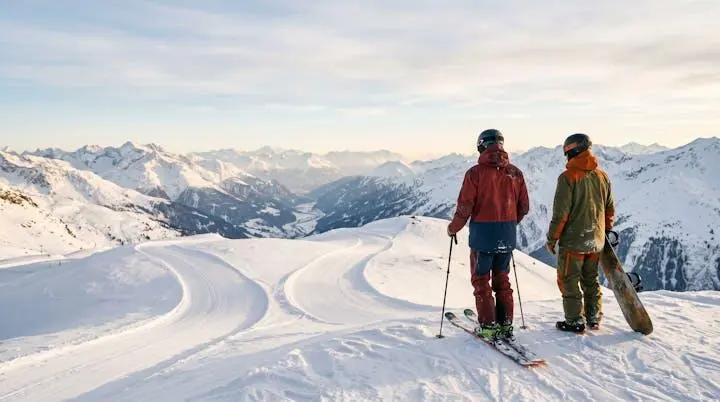
For competent skiers, the real challenge of snowboarding isn’t the learning curve, but the process of unlearning years of ingrained skiing reflexes.
- Your skiing skills create a ‘muscle memory conflict’ that makes the initial snowboarding stance feel counter-intuitive.
- Long-term progression depends more on embracing a beginner’s mindset than leveraging existing mountain knowledge.
Recommendation: Instead of asking ‘which is better?’, ask ‘which new challenge aligns with my goals?’. The answer determines if the switch is a worthwhile investment of your time.
As a competent skier, you know the feeling. The effortless glide, the precise edge control, the confidence to tackle almost any run the mountain throws at you. After years of practice, your skis feel like a natural extension of your body. Yet, you see snowboarders floating through powder with a surf-like grace or buttering and pressing on flats with a playful style that skiing doesn’t quite replicate. The curiosity builds: “Should I try it? Is it worth starting from zero?”
The common wisdom says that skiing is easy to learn but hard to master, while snowboarding is the opposite. This is true, but it misses the crucial point for an experienced skier. Your advantage of knowing the mountain, understanding snow conditions, and having no fear of speed is significant. However, it’s paired with a major disadvantage: a deeply ingrained muscle memory that fights the fundamental principles of snowboarding. Your body instinctively wants to operate your legs independently, a habit that must be completely unlearned to succeed on a board.
This guide isn’t a generic comparison. It’s written from the perspective of an instructor who teaches both disciplines, specifically for you—the established skier. We’ll explore the ‘muscle memory conflict’ in detail, analyze the true long-term progression potential after a decade, and help you determine if the initial struggle of snowboarding is a worthy investment for your personal mountain journey. We will look at how to bypass the most painful parts of learning and when the right moment is to finally give it a try.
This article provides a structured path to help you make an informed decision. The following sections break down the key considerations, from the initial challenges for a skier to the long-term rewards and practical steps for getting started.
Summary: A Skier’s Roadmap to Understanding the Snowboarding Transition
- Why Do Skiers Struggle More With Snowboarding Than Complete Beginners?
- How to Learn Snowboarding Basics Without the Painful Falling Phase?
- Skiing vs Snowboarding: Which Offers More Progression After 10 Years?
- The Wrist Injury That Sidelines 50% of First-Week Snowboarders
- When in Your Skiing Journey Should You Try Snowboarding?
- Why Doesn’t Rock Climbing Experience Prepare You for Ice Climbing Challenges?
- Grade III vs Grade IV Rapids: Which for First-Time Rafters Seeking Thrills?
- How to Use Groomed Runs Strategically to Improve Carving Technique?
Why Do Skiers Struggle More With Snowboarding Than Complete Beginners?
The core of a skier’s struggle comes down to one thing: muscle memory conflict. A true beginner arrives as a blank slate. They have no preconceived notions of how to turn or stop on snow. A skier, however, arrives with a decade of highly refined reflexes that are fundamentally at odds with snowboarding. Your brain is hardwired to use independent leg action, turning your inside and outside ski differently to carve a turn. On a snowboard, your feet are locked into a single platform. This forced unity is the first and biggest mental and physical hurdle.
A true beginner learns the basic snowboard movement pattern from scratch. As coaching experts at Snowskool explain, the sequence is simple and holistic: “Turn shoulders, which turns hips, which turns ankles and feet, which turns snowboard.” For a skier, this feels unnatural. Your instinct is to initiate turns with your feet and legs, often leading to catching an edge as your upper body remains facing downhill—a classic skier’s mistake. You have to unlearn the habit of looking over your inside shoulder to turn and instead learn to lead with your front shoulder and head.
Furthermore, the common refrain is that skiing is easier to learn but harder to master. While true for novices, for a transitioning skier, this “easy to learn” part of skiing becomes a liability. You’ve already passed the hard-to-master phase on skis, so the initial, clumsy “falling leaf” stage of snowboarding feels like a massive step backward. A beginner expects to fall; an expert skier finds it deeply frustrating, which can sabotage the learning process. You’re not just learning a new sport; you’re demoting yourself from expert to novice, a psychological challenge that is often tougher than the physical one.
How to Learn Snowboarding Basics Without the Painful Falling Phase?
Let’s be direct: you cannot completely eliminate falling when learning to snowboard. It’s an integral part of understanding edge limits. However, you can absolutely eliminate the pain, bruises, and potential injuries that make the first week so notorious. The key is not to “try not to fall,” but to prepare to fall correctly and safely. This shifts the focus from fear to productive learning.
The first step is investing in a ‘no-bruise’ protective setup. This isn’t about being timid; it’s about being smart and enabling yourself to commit to turns without hesitation. Your number one purchase should be a pair of quality impact shorts. These padded shorts protect your tailbone and hips, the two areas that take the most impact from the frequent low-speed falls during the initial learning phase. Second, wrist guards are non-negotiable, a topic we’ll cover in-depth later. Knee pads are also highly recommended, as you’ll spend a lot of time on your knees practicing heel-side edge control.
This preparation is critical because research on snowboard falls shows that beginners in their first five days are most prone to injury. By gearing up, you’re not just protecting your body; you’re protecting your confidence. A fall without pain is just feedback. A fall that results in a bruised tailbone is a lesson in fear that will make you ride defensively and slow your progression. A professional lesson is the other part of the equation. An instructor will teach you how to fall correctly—like a rolling motion rather than putting your arms out straight—and guide you through a progression of drills that build skills systematically, minimizing the uncontrolled tumbles.
Skiing vs Snowboarding: Which Offers More Progression After 10 Years?
This is the central question for a competent skier. After a decade on two planks, where does the ceiling for progression lie on one? The answer depends entirely on what you define as “progression.” If it’s about pure, top-end speed in variable, big-mountain conditions, skiing retains an advantage. The ability to use independent leg absorption and a wider base of support gives expert skiers more stability on gnarly terrain and at extreme velocities. However, if progression means style, creativity, and a different connection to the snow, snowboarding opens new doors.
Once you overcome the initial learning curve, the progression rate can feel incredibly rewarding. As the Freeride World Tour notes, “once past the beginner stage, snowboarders often advance more quickly.” This is because mastering intermediate skills like carving, riding switch, and basic freestyle feels more intuitive once the edge control clicks. The following table breaks down where each discipline tends to have a long-term advantage, based on analysis of equipment and technique.
| Terrain / Skill Area | Skiing Advantage | Snowboarding Advantage |
|---|---|---|
| High-speed groomed runs | Skiing wins | – |
| Flatground butters, presses, spins | – | Feels more natural on a snowboard |
| Powder riding for beginners | – | Easier learning curve |
| Big mountain, variable conditions, big features, top speed | Skiing wins | – |
| Backcountry uphill travel / touring | Easier and more efficient on skis | Possible via splitboarding |
Beyond the terrain, there’s a psychological component to long-term engagement. The two disciplines may attract riders seeking different kinds of challenges, which influences what “progression” feels like over a decade.
Case Study: Sensation-Seeking and Rider Mentality
A matched re-analysis of 414 winter sport participants found that snowboarders consistently scored higher on sensation-seeking scales compared to alpine skiers. This suggests that the long-term appeal of snowboarding may be tied to a greater inherent drive for new, intense, and varied experiences—like those found in freestyle, park riding, and creative line choices. For a skier feeling they’ve hit a progression plateau, snowboarding may offer a new and more potent form of thrill that isn’t just about speed, but about style and expression.
The Wrist Injury That Sidelines 50% of First-Week Snowboarders
Of all the barriers to entry for snowboarding, one stands out for its frequency and severity: the wrist injury. The natural human instinct when falling backward is to extend an arm to break the fall. On a snowboard, this is the single most dangerous thing you can do. The force of the impact is concentrated on the small bones of the wrist, leading to sprains and, most commonly, a distal radius fracture. The risk is not hypothetical; it’s a statistical reality of the sport’s learning curve.
In fact, the numbers are stark. Comprehensive clinical research on snowboarding injuries has found that wrists account for more than 50% of severe injuries among beginners. This single injury type is responsible for sidelining more aspiring snowboarders than any other. For a skier accustomed to falling sideways and rarely using their hands to brace, this is a completely new and significant risk factor that must be proactively managed.
The solution is simple and incredibly effective: wear wrist guards. Modern wrist guards are low-profile, fit comfortably under most gloves, and are designed to prevent the wrist from hyperextending on impact. They transfer the force of the fall up the forearm, which is far more capable of absorbing it. Along with impact shorts, they are the most important piece of protective equipment a new snowboarder can own. Wearing them isn’t a sign of weakness; it’s a sign of intelligence that ensures your first week on a board isn’t also your last.
When in Your Skiing Journey Should You Try Snowboarding?
There’s no single “right” time, but there are clear signals that you’re ready for the challenge. The ideal moment is when your skiing has reached a comfortable plateau of mastery. You should be able to ski all marked trails on the mountain with confidence, in any condition. This level of expertise means you possess crucial, transferable skills: mountain awareness, line choice, and an understanding of snow dynamics. You know how to read terrain and anticipate changes, which frees up your mental energy to focus solely on the new mechanics of snowboarding.
Another strong indicator is your background in other sports. As experts at Retrospec point out, “If you know how to skateboard, longboard, wakeboard, surf, or paddleboard, snowboarding is going to feel more natural to you.” These activities all share the same core principle: a sideways stance and turning initiated by the shoulders and core. If you have experience in any of these, you’ve already partially overcome the “muscle memory conflict” that plagues pure skiers. Your body already understands the fundamentals of balance and rotation from a sideways perspective.
Ultimately, the best time to try is when your motivation shifts from “getting better at skiing” to “having a new experience on the mountain.” Are you intrigued by the surf-like float in powder? Are you drawn to the creative possibilities in the terrain park? If the answer is yes, and you’re mentally prepared to embrace being a beginner again, then you’re ready. It’s not about replacing skiing; it’s about adding a new dimension to your love for the mountains.
Why Doesn’t Rock Climbing Experience Prepare You for Ice Climbing Challenges?
This question, from a different world of mountain sports, serves as a perfect analogy for the skier-to-snowboarder transition. A skilled rock climber has immense strength, balance, and mountain sense. They understand movement and trust their gear. Yet, on an ice wall, much of that specific expertise doesn’t directly translate and can even be a hindrance. Rock climbing is about finding and using existing holds; ice climbing is about creating your own with tools. It requires a different rhythm, a different kind of power, and a different relationship with the medium.
Similarly, your expert skiing skills are your “rock climbing experience.” You are strong, balanced, and confident on the mountain. But snowboarding is your “ice wall.” It demands you learn to use new tools (a single edge instead of four) and a new movement pattern (torsional rotation instead of independent leg steering). Trying to “ski” on a snowboard is like trying to find a handhold on a sheer wall of ice—it’s the wrong technique for the environment.
The ice climber must learn to trust the swing of their axe and the kick of their crampons. The transitioning skier must learn to trust their toe and heel edges. In both cases, the athlete must suppress their old instincts and adopt a beginner’s mindset. They must accept that their previous mastery doesn’t grant them a free pass. Instead, it provides a strong foundation of general athleticism and mental toughness, upon which a completely new and specific skillset must be built, piece by piece.
Grade III vs Grade IV Rapids: Which for First-Time Rafters Seeking Thrills?
Let’s use another analogy to manage expectations about fun and challenge. A seasoned thrill-seeker might look at a rafting guide and demand Grade IV rapids, assuming “bigger is better.” But a good guide knows that for a first-timer, a Grade III rapid will feel more than thrilling enough. It provides excitement, challenge, and a sense of accomplishment without overwhelming them to the point of fear or failure.
As a competent skier, your “Grade IV” is a steep, black diamond run. That’s your current definition of a thrill. When you switch to a snowboard, your entire scale needs to be recalibrated. Your new “Grade IV thrill” will be linking your first three S-turns on the greenest of beginner slopes. It will be the moment you successfully traverse the entire width of a run on your heel edge without falling. These small victories will provide a massive sense of accomplishment precisely because they were so hard-won.
Trying to chase your old thrills by taking the snowboard onto a blue or black run too early is a recipe for disaster. It’s like putting a first-time rafter into a Grade IV+ whirlpool. You won’t have the fundamental skills to navigate it, the experience will be terrifying instead of fun, and you’ll likely revert to your skiing instincts (like trying to turn with your feet), which will lead to a punishing fall. The key to long-term success is to redefine your definition of a thrill and find joy in the progression of a beginner, not the performance of an expert.
Key Takeaways
- The primary obstacle for skiers is not learning snowboarding, but unlearning ingrained skiing reflexes (the ‘muscle memory conflict’).
- Long-term progression is less about top speed (where skiing often wins) and more about creative expression, style, and a different kind of ‘flow’.
- Proactive safety—specifically wrist guards and impact shorts—is the smartest way to ensure the painful initial learning phase doesn’t end your journey prematurely.
How to Use Groomed Runs Strategically to Improve Carving Technique?
Once you’ve mastered basic S-turns, the next great frontier in snowboarding progression is the carved turn. This is where the board rides purely on its edge, leaving a clean, pencil-thin line in the snow. For a skier used to the satisfying feeling of a perfectly carved arc, achieving this on a snowboard is a major milestone. Groomed runs, or “corduroy,” are your perfect training ground for this skill, as the consistent surface provides predictable feedback.
Unlike skiing, where carving involves pressure on both inside and outside edges, snowboard carving is a pure transfer of weight from your toe-side edge to your heel-side edge. The strategy is to start with low-angle green and blue runs where you can focus on technique without being intimidated by speed. Your goal isn’t to get down the mountain; it’s to feel the edge engage. A common mistake is trying to turn with your back foot. A proper carve is initiated by your front knee and hip, tipping the board onto its edge, while your body remains aligned and stacked over that engaged edge.
From my experience teaching, the best way to develop this feel is through a series of focused drills. Don’t just ride down the hill. Dedicate entire runs to specific exercises. Focus on making perfect C-shaped turns, first on your toe-side, then on your heel-side, traversing the entire run on one edge. This builds balance and confidence. Once you can do that, you can start linking them together. The following plan provides a structured approach to practicing on groomers.
Your Action Plan: Mastering the Carve on Groomed Runs
- Edge-to-Edge Balance: On a very gentle slope, stand still and practice rocking from your toe edge to your heel edge without moving forward. Feel the balance points.
- The Falling Leaf Drill: Traverse across the hill on one edge (e.g., heel edge), then gently shift weight to stop and go back the other way, still on your heel edge. Repeat for the toe edge. This builds edge control.
- Single-Edge Arcs (C-Turns): Pick an edge (e.g., toe-side). Point the board slightly downhill to gain minimal speed, then immediately tip the board on that edge and let it guide you in a wide arc across the run until you slow down. Repeat on the other edge.
- Linked Skidded Turns: Start connecting your toe and heel side C-turns. At this stage, it’s okay if the tail “skids” or “washes out” during the turn transition. Focus on a smooth weight transfer.
- The Carving Commitment: Once skidded turns are easy, try to link turns with more edge angle and forward pressure. The goal is to keep the edge engaged through the entire turn, eliminating the skid. Look where you want to go and let the board follow.
Ultimately, the decision to take on snowboarding is a personal one, rooted in your goals for your time in the mountains. By understanding the real challenges—the unlearning of reflexes, the recalibration of “thrill”—and preparing for them, you set yourself up for a rewarding journey that can add a rich, new chapter to your life on snow. The first step is always the hardest, but also the most important. To truly test the waters, the logical next step is to book a professional lesson.