In summary:
- Snowshoeing offers an accessible, low-impact way to enjoy winter landscapes, requiring no prior skiing skills.
- Choosing the right snowshoes depends on your weight, the terrain, and snow conditions, but the basics are easy to learn.
- It has a much gentler learning curve and lower joint impact than cross-country skiing, making it ideal for a wide range of fitness levels.
- The activity promotes a “slow travel” mindset, fostering a deeper, more mindful connection with nature.
Does the sight of a snow-covered forest fill you with a sense of wonder, followed by a hint of frustration? For many nature lovers, the winter wilderness feels just out of reach, a private club for skiers. The perception is that to truly explore these silent, beautiful landscapes, you need the skill, confidence, and athletic ability that skiing demands. This often leaves those between 40 and 70, who seek connection with nature without the high-impact risks, feeling like they’re looking through a window at a party they can’t join.
The common advice is to simply “take up skiing,” but this ignores the steep learning curve, the cost of equipment, and the very real concerns about balance and joint health. But what if the key to unlocking the winter wasn’t about mastering a difficult sport, but about embracing an activity as natural as walking? What if the goal wasn’t speed, but immersion? This is the promise of snowshoeing: it’s not a lesser version of skiing, but a fundamentally different and, for many, a more rewarding way to experience the outdoors. It transforms the landscape from an intimidating challenge into an accessible sanctuary.
This guide is designed to demystify snowshoeing for the aspiring winter explorer. We will walk you through why it’s such a uniquely freeing activity, how to choose the right gear for your needs, and the simple techniques to get started. We’ll also explore the philosophy of slowness that makes snowshoeing a deeply satisfying pursuit, allowing you to connect with winter’s pace on your own terms.
To help you navigate this introduction to accessible winter adventure, we’ve broken down the essentials into clear, encouraging sections. The following guide will cover everything from the unique freedom snowshoeing provides to the simple mistake beginners make, ensuring you step onto the snow with confidence.
Summary: Your Path to Winter Wilderness Exploration
- Why Does Snowshoeing Open Winter Landscapes Closed to Most Skiers?
- How to Choose Snowshoes Based on Terrain and Snow Depth?
- Snowshoeing vs Cross-Country Skiing: Which for Moderate Fitness Over 50?
- The Technique Mistake That Exhausts Beginners After 30 Minutes of Snowshoeing
- When Are Snow Conditions Perfect for Snowshoeing Adventures?
- Why Do Slow Travellers Report Higher Satisfaction Than Fast-Paced Tourists?
- Why Do Norwegian Fjords Rank as Europe’s Most Dramatic Cruise Destination?
- How to Find Natural Frozen Lakes Safe for Ice Skating in the Alps?
Why Does Snowshoeing Open Winter Landscapes Closed to Most Skiers?
The magic of snowshoeing lies in a simple concept: flotation. Unlike a boot that sinks deep into powder, a snowshoe distributes your weight over a large surface area, allowing you to walk on top of the snow. This single principle unlocks terrain that is impractical or impossible for most skiers. While cross-country skiers are often confined to groomed tracks and downhill skiers to prepared runs, a snowshoer can venture into the untracked wilderness. You can weave through dense forests, cross open meadows blanketed in fresh powder, and explore the quiet, hidden corners of the winter world.
This freedom creates a more intimate and personal connection with nature. You are not following a prescribed route; you are making your own. This accessibility is empowering, especially for those who lack the technical skills for off-piste skiing. As winter activity expert Stephanie Long notes, the experience is profoundly different. Her observation highlights the unique perspective this activity offers:
Snowshoeing gives you an unrestricted look at the beauty of nature up close
– Stephanie Long
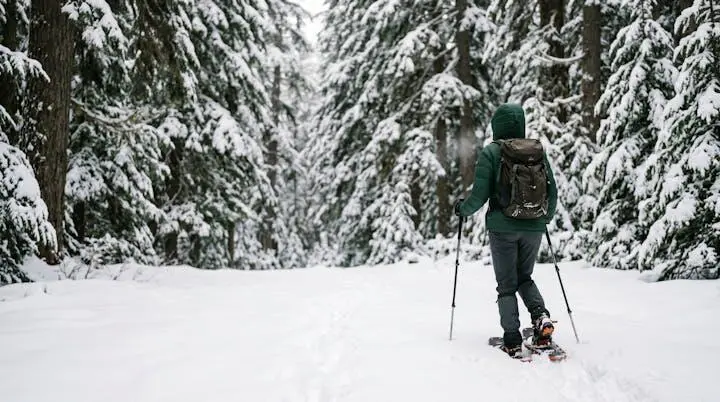
The image below captures this essence of solitude and boundless access. There are no tracks to follow, only the vast, quiet landscape waiting to be explored at your own pace. This is the core appeal: turning the entire snowy landscape into your personal trail.
This feeling of kinetic confidence—the stability and security you feel with each step—is what truly sets snowshoeing apart. You are not worried about catching an edge or losing control at high speed. Instead, you can focus entirely on the crunch of the snow, the crisp air, and the serene beauty surrounding you. It’s an invitation to a winter sanctuary, not a ticket to an extreme sport.
How to Choose Snowshoes Based on Terrain and Snow Depth?
While snowshoeing is wonderfully simple, choosing the right pair can make the difference between a joyful walk and a frustrating slog. Your decision shouldn’t be based on brand or color, but on three key factors: the type of snow you’ll encounter, your total weight (including gear), and the terrain you plan to explore. Thinking about these elements beforehand ensures you get the perfect balance of flotation, traction, and comfort.
For example, exploring deep, light powder in an open meadow requires a longer, wider snowshoe to maximize flotation and keep you from sinking. Conversely, if you plan to stick to packed, established trails, a smaller, more maneuverable snowshoe is more efficient and less cumbersome. Modern snowshoes also come with features like heel lifts (or ascenders) for climbing hills, which reduce calf strain significantly, and aggressive crampons for gripping icy or hard-packed surfaces. These features might seem technical, but they are designed to make your walk more comfortable and secure.
Don’t be intimidated by the options. Most manufacturers provide clear weight and usage recommendations. The goal is to find a snowshoe that feels like a natural extension of your foot, providing security without feeling bulky. The following checklist breaks down the essential considerations to help you make a confident choice.
Action Plan: Matching Snowshoes to Your Adventure
- Identify your snow type: Determine if you’ll be in light, dry powder (requiring longer snowshoes for flotation) or dense, wet snow (which allows for shorter models).
- Calculate your total load: Add your typical gear weight (backpack, water, extra layers) to your body weight to choose a snowshoe rated for the correct load.
- Check the fit and bindings: Ensure the bindings are easy to use with your winter boots and that the frame width is comfortable for your natural stride.
- Consider your primary terrain: If you’ll mostly be on packed or groomed trails, opt for smaller, more manageable snowshoes for better agility.
- Plan for deep powder: If venturing into deep, ungroomed backcountry is your goal, prioritize a larger surface area for maximum flotation to stay on top of the snow.
Ultimately, the best snowshoe is the one that gives you the confidence to explore. For most beginners and intermediate users sticking to rolling terrain and marked trails, a versatile “rolling terrain” or “recreational” model is the perfect starting point.
Snowshoeing vs Cross-Country Skiing: Which for Moderate Fitness Over 50?
For nature lovers over 50 seeking a winter activity, the choice often comes down to snowshoeing versus cross-country skiing. Both offer a fantastic workout in beautiful settings, but they present very different challenges and rewards, especially concerning joint health, balance, and the learning curve. For those with moderate fitness or who are new to snow sports, snowshoeing almost always emerges as the more accessible and encouraging option.
The fundamental difference is in the motion. Cross-country skiing requires a gliding technique that demands balance, coordination, and continuous engagement of the arms and core. While it’s relatively low-impact, the learning process can be frustrating and may lead to falls. In contrast, snowshoeing is based on a natural walking motion. If you can walk, you can snowshoe. The wide, stable platform under your feet provides immediate confidence, and the snow itself acts as a natural cushion. As the experts at TSL Outdoor note, this makes it an excellent choice for those mindful of their joints.
Snowshoeing is a low-impact activity, making it a gentler option for those with joint concerns
– TSL Outdoor Editorial Team
This low barrier to entry means you can start enjoying the full experience from your very first outing, rather than spending weeks mastering a technique. The following table breaks down the key differences, highlighting why snowshoeing is often the preferred choice for a stable, low-stress winter workout.
This direct comparison, based on an analysis of factors like joint health and balance, clearly shows the advantages for those prioritizing accessibility.
| Factor | Snowshoeing | Cross-Country Skiing |
|---|---|---|
| Joint Impact | Low-impact; snow cushions each step, easing stress on knees and hips | Relatively low-impact but involves continuous gliding motion requiring more coordination |
| Balance Requirement | Wide, stable platform; natural walking motion | Narrow skis; requires learning to glide and balance |
| Learning Curve | Minimal; walking motion transfers almost directly | Steeper; requires practice to master gliding technique |
| Upper Body Engagement | Optional, via poles for added propulsion | Continuous, dynamic engagement of arms and core |
While cross-country skiing is a wonderful sport, its demands on balance and technique can be a barrier. Snowshoeing removes that barrier, offering a direct path to the peace and beauty of the winter woods.
The Technique Mistake That Exhausts Beginners After 30 Minutes of Snowshoeing
Many people assume snowshoeing technique is identical to walking, and while it’s close, one common mistake can turn a pleasant stroll into an exhausting workout: the exaggerated high-knee lift. Beginners, often subconsciously trying to clear the snowshoe from the snow with every step, adopt a high-stepping, marching gait. This motion is inefficient and quickly tires out the hip flexors and quads, leading to premature fatigue.
The secret to efficient snowshoeing is to trust the equipment and maintain a more natural, shuffling stride. Instead of lifting your foot high, you should slide it forward, letting the curved tip of the snowshoe rise naturally above the snow. This preserves energy and allows you to walk for hours, not minutes. It also requires widening your stance slightly—just an inch or two more than your normal walk—to prevent the snowshoe frames from clipping each other. It might feel a little awkward for the first five minutes, but your body quickly adapts, and the motion soon becomes second nature.
Another key to efficiency and confidence is the proper use of trekking poles. They aren’t just for skiers. When fitted with snow baskets (wide plastic discs near the tips that prevent them from sinking), poles provide significant benefits. As noted in a beginner’s guide to snowshoeing, you should “use them to help with balance and propelling you forward.” They provide extra stability on uneven terrain, help you power up hills, and offer control on descents. Correcting your gait and using poles properly are the two biggest technical leaps a beginner can make.
To move from feeling clumsy to confident, focus on these simple adjustments:
- Walk with a purposeful, natural step rather than an exaggerated high-knee lift.
- Widen your stance slightly to keep the snowshoe frames from clipping each other.
- Use trekking poles fitted with snow baskets to boost stability and propulsion.
- Ensure your bindings are snug enough to prevent your foot from slipping, but not so tight that they cut off circulation.
- Give your body a few minutes to adapt; the stride will start to feel natural very quickly.
By avoiding the “beginner march” and embracing a relaxed, efficient stride, you transform snowshoeing from a chore into a graceful way to glide through the winter world.
When Are Snow Conditions Perfect for Snowshoeing Adventures?
Unlike skiing, which can be highly dependent on specific snow quality, snowshoeing is wonderfully versatile. However, certain conditions make for a truly magical and effortless experience, especially for those new to the activity. The ideal scenario is a trail covered with at least six inches (15 cm) of packed powder. This provides enough depth for the snowshoes to be effective, but the consolidated base makes walking easy and efficient.
The day or two after a fresh snowfall is often perfect. The new snow is still light and beautiful, but it has had a chance to settle slightly or has been packed down by other users. This is when you truly feel like you’re floating across the landscape. Another excellent condition is “crust,” where a sunny day or a brief thaw followed by a freeze creates a firm top layer on the snow. Your snowshoe crampons will provide excellent grip, and you can cover ground with minimal effort. Can you snowshoe on a packed trail with less snow? Absolutely, but the real benefit of flotation comes when there’s enough snow to sink into without them.
Conversely, there are conditions to be cautious of. Very deep, unconsolidated, and light powder can be exhausting, even with large snowshoes. Icy conditions, especially on steep terrain, can also be hazardous and require more aggressive crampons and confident technique. And most importantly, if you are venturing into mountainous backcountry terrain, you must always be aware of avalanche conditions. Check local avalanche forecasts before you go, even on seemingly gentle slopes. For most recreational snowshoers sticking to marked forest trails, this is less of a concern, but awareness is always key to safety.
The perfect day is less about a specific snow type and more about the combination of safe, enjoyable conditions: a good snow base, stable weather, and a trail that matches your comfort level. This focus on enjoyment over technical perfection is what makes it such an accessible winter adventure.
Why Do Slow Travellers Report Higher Satisfaction Than Fast-Paced Tourists?
In a world that often glorifies “seeing it all,” a growing movement toward “slow travel” suggests that true satisfaction comes from experiencing more by doing less. Instead of rushing through a checklist of sights, slow travellers immerse themselves in a single location, prioritizing connection over coverage. This mindset directly correlates with higher levels of well-being and lower stress, a finding that has profound implications for how we approach our leisure time—including our winter adventures.
Snowshoeing is, in its essence, a form of slow travel. Its unhurried, deliberate rhythm is a perfect antidote to the pressures of a fast-paced life. You move at winter’s pace, a speed that allows you to notice the subtle details: the intricate patterns of frost on a fallen leaf, the faint tracks of a fox in the snow, the sound of your own breath in the quiet air. This is a level of immersion that is lost when rushing from one point to another.
The benefits of this approach are not just anecdotal. They are backed by research that connects a slower pace with deeper contentment. A mindful pause in the middle of a snowy forest can be more memorable than a whirlwind tour of famous landmarks.
The Value of a Slower Pace: A 2019 Study
This idea is supported by a 2019 study in the Journal of Sustainable Tourism. Researchers found that travelers who spent more time in fewer destinations reported significantly higher levels of psychological wellbeing and lower stress than their fast-paced, multi-destination counterparts. This supports the case that a deliberate, unhurried pace—like that fostered by snowshoeing—breeds deeper satisfaction than simply covering more ground quickly.
The following image perfectly illustrates this concept of mindful exploration. It’s not about the destination, but about the quality of the moments along the way—pausing, listening, and truly being present in the environment.
By choosing an activity like snowshoeing, you are not just choosing a way to get from A to B. You are choosing a philosophy of travel that values depth over distance, and personal connection over a packed itinerary. This is where the true, lasting satisfaction of a day in the winter wilderness is found.
Why Do Norwegian Fjords Rank as Europe’s Most Dramatic Cruise Destination?
Destinations like the Norwegian Fjords captivate us with their sheer scale and passive grandeur. From the deck of a cruise ship, one can witness monumental cliffs plunging into deep, dark waters—a breathtaking spectacle of nature’s power. This type of travel, focused on observing vast, dramatic landscapes from a comfortable distance, offers a powerful visual experience and ranks high on many travel bucket lists for its undeniable “wow” factor. It is a tourism of grand gestures and unforgettable, large-scale vistas.
This appeal is understandable. The drama is served to you, requiring little more than turning your head to see another waterfall or a towering peak. It is a highly curated and predictable encounter with the wild. However, this form of spectatorship stands in stark contrast to the kind of experience offered by an activity like snowshoeing. One is about observing the drama; the other is about quietly entering it.
While a fjord cruise presents a magnificent, wide-angle shot of nature, a snowshoe trail offers an intimate, close-up perspective. You are not a passive observer in a floating hotel; you are an active participant within the landscape itself. The “drama” is not a distant cliff face, but the profound silence of a snow-laden forest, the sudden flight of a bird from a branch, or the feeling of being the only person for miles around. It’s a personal, sensory experience rather than a shared, visual one.
For many, especially as they seek deeper connections, the quiet satisfaction of creating their own path through a silent wood offers a more lasting sense of fulfillment than watching a famous landscape pass by a window. One is an impressive show; the other is a personal story. Snowshoeing allows you to find the drama in the details, turning a simple winter walk into an immersive and meaningful adventure.
Key takeaways
- Accessibility is key: Snowshoeing is the most direct path to winter wilderness for non-skiers, built on the simple principle of flotation.
- Low-impact, high reward: It’s gentle on the joints and has a minimal learning curve, making it ideal for a wide range of ages and fitness levels.
- It’s a mindful practice: The slow, deliberate pace fosters a deeper, more present-moment connection with nature, aligning with the principles of slow travel.
How to Find Natural Frozen Lakes Safe for Ice Skating in the Alps?
The image of gliding across a natural, frozen lake in a stunning alpine setting is a powerful one. Finding a safe place to do so, however, is a complex and potentially dangerous undertaking. Ice thickness can be dangerously inconsistent on natural bodies of water, varying due to currents, springs, and snow cover. Safely ice skating on natural lakes requires local expert knowledge and adherence to strict safety protocols, including drilling to test ice depth—a skill far beyond that of the average visitor.
For this reason, a much safer and more accessible way to experience the beauty of these frozen landscapes is by snowshoeing around their perimeters. This approach offers all of the breathtaking scenery without any of the risks associated with stepping onto uncertain ice. You can explore the shoreline, venture into the surrounding snow-covered forests, and admire the vast, icy expanse from a position of complete safety and stability.
Snowshoeing provides a unique vantage point. You can witness the way the low winter sun plays across the ice, see the patterns formed by the wind on the snow, and enjoy the profound quiet of a frozen world. It allows for an immersive experience that is both physically engaging and peacefully contemplative. Instead of the singular focus of skating, you are free to stop at any time, take in the view, and explore the terrain that borders the lake.
This shifts the goal from a high-risk, specialized activity to an inclusive and rewarding adventure. It’s a perfect example of how snowshoeing opens up the winter environment, allowing you to create your own safe and memorable experiences in places of incredible beauty. The focus is no longer on the ice itself, but on the entire winter ecosystem surrounding it, transforming a potentially hazardous spot into a magnificent, accessible sanctuary.
Now that you understand the what, why, and how of this wonderfully accessible sport, the final step is to embrace the mindset it encourages. It’s about giving yourself permission to slow down and connect with the quiet beauty of the season. Start by renting a pair of snowshoes on your next winter trip or joining a guided tour to build your confidence. The silent, snowy woods are waiting for you.