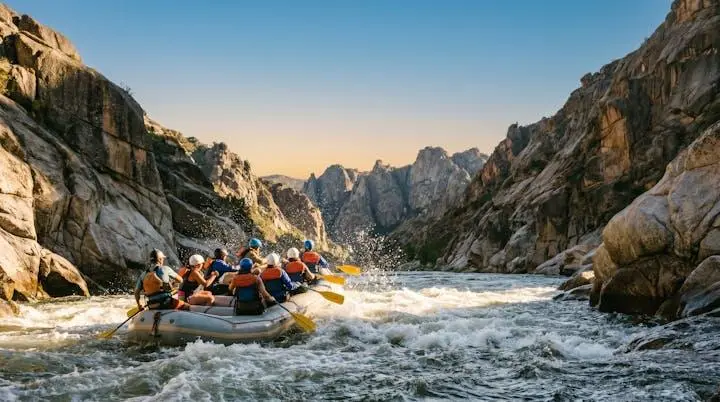
In summary:
- River grades (I-VI) measure the consequences of a swim, not just the difficulty of paddling.
- Honestly assess your group’s fitness, appetite for thrills, and ability to stay calm under pressure before choosing a grade.
- For adventurous first-timers, a Class III trip is the sweet spot for excitement and manageable risk.
- Your guide’s certification (Swiftwater Rescue, WFR) and the outfitter’s license are non-negotiable safety elements.
The first time you see a video of a raft punching through a towering wave, a mix of adrenaline and apprehension floods your system. You see the high-fives, you hear the whoops of joy, and a question sparks in your mind: “Could I do that?” For over fifteen years, I’ve guided people down rivers all over the world, and I can tell you the answer is almost always yes. But the key to turning that apprehension into pure exhilaration isn’t about being a champion athlete; it’s about making an informed choice.
Many beginners hear generic advice like “just pick a Class III trip” or “as long as you can swim, you’ll be fine.” These platitudes are not only unhelpful, but they can also be dangerous. They overlook the most critical factor in choosing your first whitewater adventure: understanding the river’s language. The International Scale of River Difficulty is more than a simple rating; it’s a detailed description of a river’s power, predictability, and, most importantly, the consequences of going for an unexpected swim.
But what if the secret wasn’t just about picking a number off a chart, but about learning to read what that number truly implies? The real key is to match the river’s personality to your own honest self-assessment of your group’s fitness, mindset, and tolerance for thrilling—but potentially scary—situations. This guide is designed to give you that insider knowledge. We’ll decode the grading system, explore the critical difference between a fun Class III and an intense Class IV, and equip you with the questions you need to ask to ensure your first rafting trip is memorable for all the right reasons.
This article will walk you through the essential steps to make a confident and safe choice for your first rafting experience. We’ll cover everything from understanding the rating system to vetting your guide, ensuring you’re fully prepared for the adventure ahead.
Summary: A Guide to Whitewater Rafting Grades and Safety
- Why Does River Grading Matter More Than Your Swimming Ability?
- How to Choose Your First Whitewater Rafting Experience Based on Grade Ratings?
- Grade III vs Grade IV Rapids: Which for First-Time Rafters Seeking Thrills?
- The Overconfidence Mistake That Flips 40% of Beginner Rafting Groups
- How to Maximise Safety Without Sacrificing the Adrenaline Rush?
- Why Do 85% of Adventure Accidents Involve Unqualified Guides?
- What Are the Warning Signs of Serious Altitude Sickness Requiring Descent?
- How to Match Costa Rican Rivers to Your Group’s Rafting Experience Level?
Why Does River Grading Matter More Than Your Swimming Ability?
The most common misconception I hear from new rafters is, “I’m a strong swimmer, so I’ll be fine.” While swimming ability is useful, the controlled environment of a pool has almost nothing in common with the powerful, dynamic force of a river. In whitewater, the river is in charge. Water moves in complex ways, forming powerful hydraulics and currents that can challenge even Olympic-level swimmers. The grade of a river tells you about the intensity of these forces and what to expect if you find yourself outside the raft.
This is why guides focus on teaching you defensive swimming techniques. It’s not about fighting the current but working with it. The primary technique is the “whitewater float position,” a defensive posture where you float on your back with your feet up and pointed downstream. This position allows you to see where you are going, use your feet to fend off rocks, and protects your head. It also crucially minimizes the risk of foot entrapment, one of the most serious dangers on a river, where a foot becomes wedged between submerged rocks.
Your ability to execute this defensive float and remain calm is far more critical than your speed in a freestyle stroke. The river’s grade directly correlates to the difficulty of self-rescue. On a Class II river, a swim is often brief and straightforward. On a Class IV, a swim is a serious event requiring quick thinking and potentially assistance from your guide and team. Understanding the grade is about respecting the river’s power and preparing for the real-world consequences, not just your perceived athletic ability.
How to Choose Your First Whitewater Rafting Experience Based on Grade Ratings?
The International Scale of River Difficulty is your roadmap to choosing the right trip. It classifies rivers from Grade I (easy) to VI (extreme and exploratory). For a first-timer, the focus should be on Grades I through IV. Thinking about these grades not just as a measure of “difficulty” but as a profile of “experience” is the key to making a great choice. Each level offers a different blend of scenery, excitement, and physical demand.
A Grade II trip is a fantastic introduction, perfect for families or anyone feeling nervous. It’s about enjoying the scenery with some fun splashes. A Grade III trip is often the sweet spot for adventurous first-timers; it introduces you to exciting, moderate waves and requires you to paddle as part of a team, but the risks are still very manageable. Grade IV is a significant step up, demanding a higher level of fitness and a cool head. It should only be attempted by athletic rafters who have previously experienced Class III and are hungry for more intensity.
This table, based on the internationally recognized system, breaks down what to expect at each level. As an authoritative resource, the American Whitewater organization provides a detailed framework that guides the entire industry.
| Grade | Character | Typical Rafter Profile | Self-Rescue Difficulty |
|---|---|---|---|
| I–II | Fast moving water, small waves, few obstructions | First-timers, families, children | Easy, swimming is straightforward |
| III | Moderate, irregular waves; complex maneuvers required | Athletic first-timers and intermediate rafters | Self-rescue usually easy, occasional group assistance |
| IV | Intense, powerful but predictable rapids; precise maneuvering | Rafters with prior Class III experience | More difficult, consequences of mistakes increase |
| V | Long, violent, obstructed rapids; steep gradient | Experienced paddlers with prior Class IV runs | Very difficult, expert rescue skills required |
| VI | Extreme, exploratory, rarely attempted | Teams of experts only, favorable water levels | Rescue may be impossible |
Your most important tool in this process is honesty. Be honest about your fitness, your comfort with turbulent water, and the overall desire of your group. A mismatched trip, where one person is terrified while another is bored, is a recipe for a bad day. The goal is shared adventure, and that starts with choosing a river that everyone can enjoy together.
Grade III vs Grade IV Rapids: Which for First-Time Rafters Seeking Thrills?
This is the question I get most often from fit, adventurous people in their 20s and 30s: “Should we just go for Class IV to get the real experience?” My answer always starts with a focus on consequences. The difference between a Class III and a Class IV rapid is not linear; it’s an exponential jump in both intensity and the consequence of a swim. While a Class III offers big, fun, splashy waves, a Class IV introduces powerful, river-wide features that require precise maneuvering from the entire team and the guide.
On a Class III river, a swim is usually an exciting surprise, and self-rescue is straightforward. On a Class IV, a swim is a serious and physically demanding event. The water is more powerful, the swims can be longer, and the need for quick, calm action is paramount. Guides on a Class IV run are operating with a heightened sense of awareness; even experienced guides will often stop to scout a major rapid before running it, a practice that is rare on Class III.
The following comparison, drawing from insights shared by veteran outfitters like the Northwest Rafting Company in their system explanation, highlights the true nature of the risk you are choosing.
| Factor | Grade III | Grade IV |
|---|---|---|
| River Environment | Moderate, irregular waves; passages evident without scouting | Difficult, with powerful rapids and hazardous features requiring precise maneuvering |
| Consequence of a Swim | Injuries rare, self-rescue usually easy | More consequential; often smart to stop and scout before running |
| Team Demand | Individual paddling contribution matters but is forgiving | Coordinated, physically capable team response is expected |
| Guide Behaviour | Confident, routine execution | Even experienced guides often feel a healthy level of nervousness |
For 99% of first-timers, even very athletic ones, Class III is the perfect choice. It delivers the adrenaline and challenge you crave without the high-consequence environment of a Class IV. Master the Class III, enjoy the thrill, and come back for the next level of challenge. And remember, beyond Class IV lies the domain of experts. As the saying goes, “Class V is the apex predator of commercially rafted whitewater.” It’s a world that demands respect and significant experience.
The Overconfidence Mistake That Flips 40% of Beginner Rafting Groups
While the “40%” figure might be an exaggeration used by guides to make a point, it highlights a profound truth: the single biggest mistake that gets beginner groups into trouble isn’t a lack of physical strength, but a combination of overconfidence and mental unpreparedness. It’s the belief that because you’re strong, you can handle anything the river throws at you. In reality, your mindset is your most important piece of safety equipment.
When things go wrong—a big wave hits unexpectedly or you fall into the cold water—the body’s natural reaction is to tense up, hold your breath, and sometimes, to panic. As veteran river guide Marty McDonnell wisely notes, “Panicky behavior accelerates your consumption of oxygen and diminishes your ability to aid in your own rescue.” A calm mind that can listen to instructions and revert to the defensive float position is infinitely more effective than panicked, powerful swimming.
This is why an honest self-assessment before your trip is so crucial. It’s not just about your physical condition. Are you coachable? Can you listen and respond to commands under pressure? How do you react to sudden, startling events? Answering these questions honestly will guide you to a better trip choice than any measure of your bench press. A team that is mentally prepared and ready to paddle together is far safer than a boat full of individualistic athletes.
Your Whitewater Readiness Self-Assessment
- Physical Swimming Ability: Can you swim effectively, kick your feet, and keep your head above water in a dynamic environment?
- Personal Readiness Score: Honestly rate yourself on a scale of 1-10 for endurance, desire to participate, and trainability (ability to listen and follow commands instantly).
- Prior Experience: Have you rafted before? If so, what class? Add points for prior successful experiences on similar or lower-class rivers.
- Mental Fortitude: How do you react to sudden stress or fear? Can you remain calm and focused, or are you prone to panic?
- Commitment Check: Before tackling a serious challenge (like a Class IV), does your combined score from these factors feel like a confident ‘yes’ (e.g., above a self-assessed 70%)?
Ultimately, respecting the river means respecting your own limits. Choosing a slightly easier trip and having an amazing time is always better than choosing a trip that’s too hard and spending the day terrified.
How to Maximise Safety Without Sacrificing the Adrenaline Rush?
The beauty of commercial rafting is that it’s a masterclass in managed risk. The goal isn’t to eliminate risk—that would eliminate the adventure—but to build a robust system of safety around you so you can experience the thrill with confidence. In fact, professionally guided rafting is remarkably safe; one analysis shows the fatality rate for commercial rafting is just 0.55 per 100,000 user days, placing it well below many other popular outdoor activities. This incredible record is not an accident; it’s the result of a comprehensive safety system.
This system includes three key components: the equipment, the training, and the guide. The equipment—a certified Personal Flotation Device (PFD), a helmet, and a well-maintained raft—is your first line of defense. But the gear is useless without the training. Every reputable rafting trip begins with a thorough safety briefing. This isn’t just a formality; it’s critical instruction on paddling commands, how to hold your paddle, how to secure yourself in the raft, and exactly what to do if you fall out.
Finally, the guide is the lynchpin of the entire system. A professional guide does more than just steer the boat; they are constantly reading the water, managing the crew, and prepared to perform a rescue at a moment’s notice. Your role is to be an active participant in this system. Ask questions. Pay attention during the safety talk. And before you even book, you should be asking the outfitter critical questions about their safety protocols. A good outfitter will be proud to tell you about their safety record, their guide certifications, and their operating procedures.
Why Do 85% of Adventure Accidents Involve Unqualified Guides?
The title’s statistic, while difficult to pin down to a single source, reflects a universal truth in the adventure travel industry: the single most important safety decision you make is choosing a qualified, professional outfitter and guide. The river is a powerful and unforgiving environment, and the guide’s experience, training, and judgment are what transform a potentially dangerous situation into a controlled, exciting adventure. An unqualified guide puts everyone at risk.
So, what separates a professional from a liability? It comes down to verifiable credentials and a culture of safety. A professional outfitter will operate under a state or federal license, such as a US Forest Service or Bureau of Land Management (BLM) Special Use Permit. These permits are not just paperwork; they mandate strict safety requirements, regular inspections, and proof of insurance. If an outfitter cannot produce a license, that is a major red flag.
The guides themselves must hold specific certifications. The gold standard is Swiftwater Rescue (SWR) certification, which trains them in the complex techniques required to rescue swimmers in moving water. Additionally, guides should have advanced medical training, such as Wilderness First Responder (WFR) certification, which is far more comprehensive than basic first aid. Don’t be shy about asking an outfitter about their guide requirements. A reputable company will be happy to confirm their guides are SWR and WFR certified. As one guide from Outdoor Norway puts it:
The river is powerful, but with the right training and equipment, we manage it safely every day.
– Rafting guide, Outdoor Norway
Choosing a guide is not the time to bargain-hunt. You are placing your safety in their hands. Investing in a reputable, certified, and experienced outfitter is the best investment you can make in your own well-being and enjoyment.
What Are the Warning Signs of Serious Altitude Sickness Requiring Descent?
As an adventure guide, my job is to ensure your safety across all aspects of a trip, not just on the water. Many of the world’s best rafting destinations are in mountainous regions, and trips often combine river days with high-altitude trekking. Therefore, understanding other environmental risks, like altitude sickness, is part of developing a total safety mindset. While it’s a different challenge from whitewater, the core principle is the same: listen to your body and respect the environment.
Serious altitude sickness is a life-threatening condition that occurs when your body fails to adapt to the lower oxygen levels at high elevations. The cardinal rule is that any illness at altitude is altitude sickness until proven otherwise. The initial stage, Acute Mountain Sickness (AMS), feels much like a bad hangover: headache, nausea, fatigue, and dizziness. These are warning signs to stop ascending and acclimatize.
However, if these symptoms worsen or are ignored, AMS can progress to two life-threatening conditions: High Altitude Cerebral Edema (HACE), which is swelling of the brain, or High Altitude Pulmonary Edema (HAPE), which is fluid in the lungs. The key signs of HACE are severe headache, confusion, loss of coordination (inability to walk a straight line), and altered mental state. The key signs of HAPE are extreme shortness of breath (even at rest), a persistent cough producing pink, frothy sputum, and a gurgling sound in the chest. The appearance of any of these severe symptoms is an unambiguous medical emergency. The only effective treatment is immediate and rapid descent. Waiting or hoping it will get better is not an option; descent is mandatory.
Key Takeaways
- The river grading system (Class I-VI) is your most reliable tool for matching a trip to your group’s true appetite for risk and adventure.
- An honest self-assessment of your physical fitness, mental calmness under pressure, and coachability is more important than your swimming prowess.
- A professional guide with verifiable certifications (Swiftwater Rescue, WFR) operating under a licensed outfitter is the cornerstone of a safe and enjoyable trip.
How to Match Costa Rican Rivers to Your Group’s Rafting Experience Level?
Let’s put all this theory into practice with a real-world example. Costa Rica is a world-class rafting destination, with lush jungle canyons and pristine rivers. But choosing the right river is essential to having a great experience. Using our knowledge of the grading system and group assessment, we can easily match a river to a rafter profile. The country offers a perfect spectrum of options, from gentle floats to intense challenges, especially during the green season from mid-May to mid-December when water levels are highest.
For a family or a group of first-timers who are more interested in scenery and wildlife than massive rapids, the Savegre River (Class II-III) is an ideal choice. It runs through a stunning UNESCO Biosphere Reserve and offers a gentle introduction to whitewater. For the adventurous first-timer or mixed-ability group we’ve been discussing, the Pacuare River (Class III-IV) is legendary. It consistently ranks as one of the most beautiful rivers in the world, offering a perfect blend of exciting rapids and breathtaking canyon scenery. For experienced rafters looking for a more technical and continuous challenge, a trip on the Sarapiquí or Naranjo rivers would be a better fit.
By applying the principles of the grading system, you can make a highly informed decision. This comparative look at some of Costa Rica’s most popular rivers, based on information from travel experts like GetYourGuide’s rafting overview, shows how each river has a distinct personality.
| River | Grade | Personality | Best For |
|---|---|---|---|
| Pacuare | III–IV | Remote jungle gorge, waterfalls, canyon walls | Thrill-seekers wanting scenery + rapids |
| Sarapiquí | II–IV (by section) | More open, continuous, technically demanding | Families and travelers combining Arenal/Caribbean routes |
| Naranjo | III–IV (Class V in high water) | Technical, dam-free, highly season-dependent | Athletic, adventurous first-timers in dry season only |
| Savegre | II–III | Forested, UNESCO Biosphere Reserve, gentler | Beginners and families |
This approach transforms trip planning from a game of chance into a strategic choice. You’re no longer just picking a tour; you’re selecting an experience tailored to your group’s specific desires for adventure, scenery, and challenge.
Now you have the tools and the mindset of an experienced guide. You know how to decode the language of the river, perform an honest self-assessment, and vet the professionals you trust with your safety. It’s time to stop wondering and start exploring. Use this knowledge to research outfitters, ask the right questions, and book that first unforgettable river adventure with total confidence.