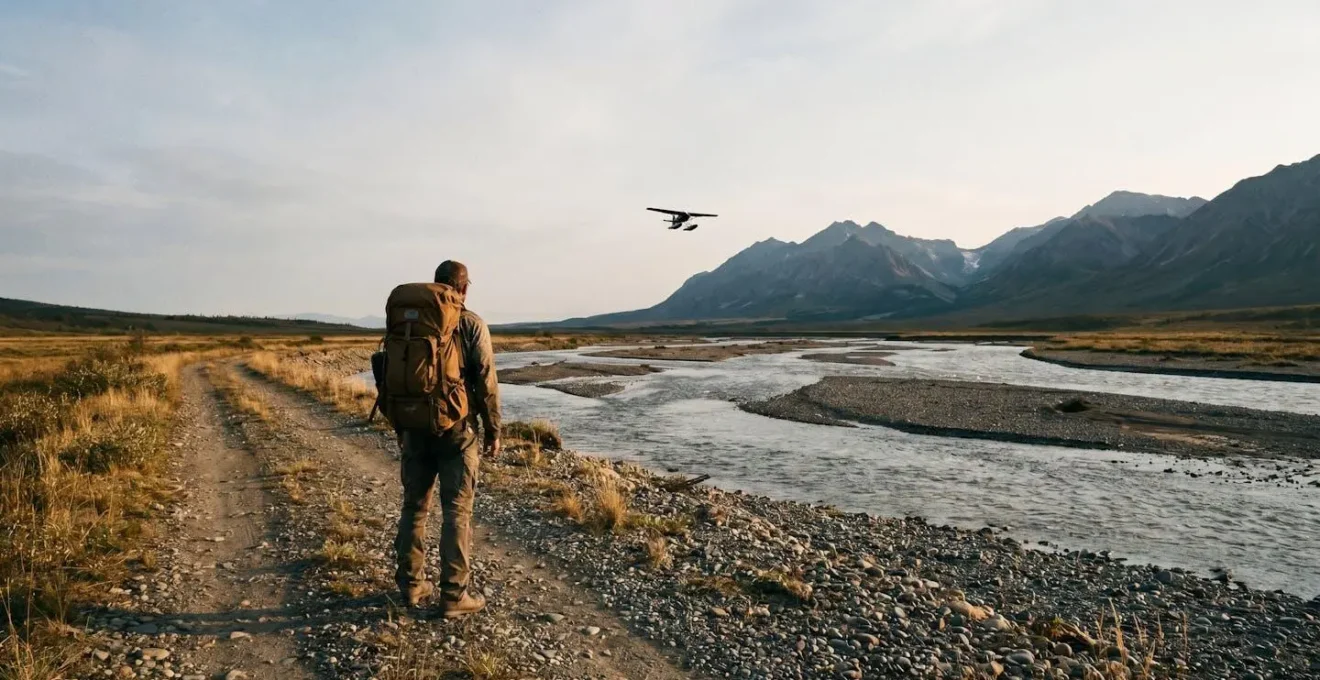
Planning a trip to a road-less destination is not about one master plan, but about mastering a sequence of interlocking logistical links.
- Deconstruct your journey into distinct transport, supply, and communication stages.
- For each stage, identify the single point of failure and build in systemic redundancy.
Recommendation: Vet your ‘last-mile’ solution—whether a guide, a ship, or your own skills—with the most scrutiny; it is the most critical link in your entire logistical chain.
The allure of true isolation—of reaching a place on the map where the roads end and the wilderness begins—is a powerful draw for the experienced traveller. You’ve navigated complex airports and bustling cities, but the final frontier is different. It’s the glacier-carved valley, the remote archipelago, the deep jungle accessible only by a sequence of increasingly specialised modes of transport. The conventional wisdom of “packing well” and “researching your destination” feels inadequate when faced with such profound logistical complexity. It’s this complexity, not a lack of courage, that often keeps these pristine locations just out of reach.
The fundamental mistake is viewing such an expedition as a single trip. This perspective leads to overwhelming, monolithic plans that are brittle and prone to collapse. The key is to adopt the mindset of an expedition logistician. A multi-stage journey is not one trip; it is a chain of smaller, distinct journeys, each presenting a unique problem that must be solved before the next can begin. It is a sequence of logistical links—transport, communication, supply, and expertise—and the entire endeavour is only as strong as its weakest link.
This guide will provide a methodical framework for deconstructing these complex journeys. We will move beyond generic advice to analyse each critical link in the chain. From understanding the psychological rewards that justify the effort to the granular details of building redundant systems, vetting local operators, and choosing the right communication tools, you will learn to manage complexity, mitigate risk, and finally unlock the world’s most remote and rewarding destinations.
To navigate this methodical approach, the following sections break down each critical component of your logistical planning. This structure is designed to guide you systematically from the ‘why’ to the ‘how’ of remote expedition planning.
Summary: A Breakdown of Remote Journey Logistics
- Why Do Remote Destinations Offer Experiences Impossible in Accessible Tourist Spots?
- How to Plan Multi-Stage Journeys to Reach Destinations Without Road Access?
- Guided Expedition vs Independent Travel: Which for First-Time Remote Explorers?
- The Communication Breakdown That Strands Travellers in Isolated Regions
- How to Pack for Remote Destinations Where Resupply Is Impossible?
- Local Operator vs International Chain: Which for Remote Destination Treks?
- Why Do Expedition Ships Offer Experiences Impossible on Ocean Liners?
- How to Vet Local Tour Operators for Safety and Authenticity?
Why Do Remote Destinations Offer Experiences Impossible in Accessible Tourist Spots?
The profound satisfaction of arriving in a remote location is not merely about the pristine scenery or the absence of crowds. It is a deep-seated psychological phenomenon. The immense effort required to reach these places fundamentally changes our perception of their value. This is a cognitive bias known as “effort justification,” where we place a higher value on outcomes that were difficult to achieve. The multi-day trek, the series of connecting bush flights, the navigation of complex permit systems—these are not just obstacles; they are the ingredients that transform a trip into a deeply meaningful accomplishment.
As the PsychoTricks Editorial Team explains in their exploration of the topic, effort justification describes our tendency to place a higher value on outcomes that required significant effort. A sunset viewed after a five-day hike through challenging terrain is perceived as more beautiful and earned than one seen from a tour bus. This is the core experiential difference: accessible tourism sells a product (a view, an activity), while remote travel facilitates an achievement. The destination is intertwined with the journey itself, creating a narrative of personal challenge and success that is impossible to replicate in easily accessible spots. The memory created is not just of a place, but of your capacity to reach it.
This emotional release upon arrival, as seen in the faces of seasoned explorers, is the culmination of that effort. It’s a moment of quiet awe, a confirmation that the logistical hurdles and physical exertion were a worthy price for an experience of true solitude and unspoiled nature. The unfiltered connection with the environment, free from the infrastructure of mass tourism, allows for a level of immersion and personal reflection that is the ultimate luxury for the modern traveller.
How to Plan Multi-Stage Journeys to Reach Destinations Without Road Access?
The key to managing the overwhelming complexity of a road-less journey is logistical deconstruction. Instead of a single, sprawling itinerary, you must view the trip as a chain of independent links. Each link represents a discrete logistical problem: getting to the gateway city, securing reliable ground transport to the trail head, executing the “last-mile” trek or boat ride, and having a solid extraction plan. Your task is to solve for each link individually, ensuring it is robust before connecting it to the next.
This process begins by mapping out every stage. For a trek in a remote mountain range, the links might look like this: International flight -> Gateway city accommodation -> Domestic flight to a regional town -> Pre-arranged 4×4 transport to the road’s end -> The multi-day trek itself. For each link, you must identify the primary point of failure. Is it a notoriously unreliable local airline? A single road prone to landslides? A river crossing that depends on a single ferryman? Once identified, you must build in contingency and redundancy. This could mean booking a flexible ticket, scheduling buffer days, or having a satellite communication plan to re-route if necessary.
Even fundamental navigation requires this redundant mindset. As overlanding expert Chris Cordes notes, you cannot rely on a single system: “You need to have that recorded on your charts… they don’t let you just rely entirely on electronics.” A GPS device is your primary tool, but paper maps and a compass are your failsafe. The same principle applies to every critical component of your plan.
Core Expedition Planning Checklist for Remote, Road-less Destinations
- Medical Preparation: Schedule required inoculations well in advance as some courses start months ahead, and get a pre-departure dental check-up.
- Medical Supplies: Assemble remoteness-appropriate supplies and first aid training; the kit’s severity should scale with distance from care.
- Base & Transit: Secure a reliable base/accommodation in the transit city before heading into the wilderness and keep proof of reservation.
- Gear Selection: Decide deliberately on what to take and leave behind, as this is one of the most consequential parts of remote planning.
- Physical Training: Match your physical training to the specific demands of the trip (e.g., paddling for a river expedition, load-carrying for a portage-heavy trek).
Guided Expedition vs Independent Travel: Which for First-Time Remote Explorers?
One of the most critical decisions in the logistical chain is whether to “buy” or “build” the expertise link. For a first-time foray into a truly remote, road-less region, this choice between a fully guided expedition and independent travel carries significant weight. A guided expedition externalises the bulk of the logistical planning and risk management to a professional operator. This is often the most prudent choice when dealing with complex permit requirements, unfamiliar terrain, or high-consequence environments.
Independent travel, conversely, places the entire burden of planning, navigation, safety, and emergency response on your shoulders. While it offers maximum freedom and can be more cost-effective, it demands a high level of pre-existing skill in navigation, first aid, and self-rescue. A third path, the hybrid approach, offers a compelling balance. Here, you might independently manage the travel to a gateway region but hire a local guide or specialist for the most technically difficult or logistically challenging “last-mile” segment. As expedition planner Tim Moss states, this is a common and effective strategy: “I’ve always had some form of in-country support, usually arranging transport into the mountains and sorting out the necessary permits.”
The following table, based on an analysis of different adventure travel styles, breaks down the core differences to help you assess which model best fits your skill level and the specific demands of your chosen destination.
| Criteria | Fully Guided Expedition | Independent Travel | Hybrid Approach |
|---|---|---|---|
| Guide-to-traveller ratio | Structured, often 1:5-6 or better on technical sections | None (self-managed) | Local guide only for the riskiest ‘last-mile’ segment |
| Required skill level | Lower technical skill needed | High: navigation, first aid, mechanical skills | Moderate: independent skills for main legs, reliance on expert for the hardest part |
| Cost structure | Higher, all-inclusive | Lower, pay-as-you-go | Mid-range, concentrated spend on critical segment |
| Risk management | Externalised to operator/guide | Fully self-managed | Shared: self-managed except for highest-risk stage |
| Best suited for | First-timers, complex permits/logistics | Experienced, well-documented routes | Competent travellers facing one major logistical bottleneck |
The Communication Breakdown That Strands Travellers in Isolated Regions
In remote travel, the communication link in your logistical chain is not merely an emergency tool; it is an active instrument for dynamic problem-solving. A common point of failure is relying on devices with limited functionality. The critical distinction lies between one-way and two-way satellite messengers. A one-way device can send pre-set “I’m okay” messages or a one-trigger SOS signal. While better than nothing, it is a passive tool. If your 4×4 breaks down or a trail is washed out, you can signal for help, but you cannot discuss options, receive updated weather reports, or coordinate a new extraction point.
A two-way satellite messenger, in contrast, transforms your ability to manage unforeseen events. It allows for a full text-based conversation with your home contact or emergency responders. This dialogue is crucial. You can describe the specific nature of your problem, collaboratively decide on a new plan, and receive confirmation that help is on the way to the correct, updated location. As one expert review puts it, the debate “fundamentally comes down to one question: Do you need true global two-way communication.” For complex, multi-stage journeys, the answer is unequivocally yes.
The choice of hardware is only half the battle. You must also build and test a rigorous communication protocol before departure. This involves leaving a detailed written route plan with a responsible contact, ensuring they understand what each preset message means, and testing the device from home to confirm it is functioning correctly. Your satellite messenger is not a magic amulet; it is one component in a comprehensive safety system that you design and control. The table below, derived from a comparative review of popular devices, highlights the operational differences.
| Feature | One-Way Messenger (e.g., classic SPOT) | Two-Way Messenger (e.g., Garmin inReach / SPOT X) |
|---|---|---|
| Message direction | Outbound only (preset alerts) | Full two-way text conversation |
| Receiving updated info (weather, extraction points) | Not possible | Possible, transforming device into a dynamic logistical tool |
| SOS interaction | Single trigger, no confirmation dialogue | Interactive SOS with responder communication |
| Typical use case | Basic check-ins on a budget | Complex remote expeditions requiring adaptive decisions |
How to Pack for Remote Destinations Where Resupply Is Impossible?
When resupply is not an option, your packing list ceases to be a matter of convenience and becomes your lifeline. Every item must be deliberately chosen, and the entire system must be built on the principle of systemic redundancy. This is the most difficult part of expedition planning, as one expert team from Peak Mountaineering admits: “What to take and what to leave behind is a really difficult decision.” The goal is not just to have backups, but to have layered, independent systems for critical needs.
Consider water purification. Your primary method might be a lightweight pump filter. Your secondary, backup method should be a completely different technology, such as chemical purification tablets (iodine or chlorine dioxide). The filter can clog or break; the tablets are nearly foolproof. This is true redundancy. The same logic applies to fire (waterproof matches and a ferro rod), navigation (GPS and paper map/compass), and shelter (tent and emergency bivy).
This philosophy extends beyond gear to supplies. You must carry sufficient high-calorie food for the entire duration, plus a contingency buffer, never assuming a resupply point will be stocked. Similarly, always carry extra local currency, as ATMs in remote regions are often unreliable or non-existent. A rigid itinerary is fragile; a plan with built-in redundancy is resilient. The following points are essential for building a robust supply chain:
- Carry a primary water purification method (filter or UV) plus a lightweight backup like iodine tablets.
- Never assume resupply points will be open or stocked; carry sufficient high-calorie, lightweight food for the full route, plus a 2-3 day emergency buffer.
- Bring reliable, compatible fuel canisters and account for altitude’s effect on boil times if cooking is required.
- Always keep extra local currency on hand since ATMs may be unreliable or absent in remote areas.
- Build in contingency options — an extraction plan, spare cash, or alternate routes — because rigid itineraries rarely survive contact with remote terrain.
Local Operator vs International Chain: Which for Remote Destination Treks?
When selecting a guided trip for a remote trek, the choice often comes down to a large international brand versus a smaller, locally-based operator. While international chains offer brand recognition and streamlined booking, they often function as marketing fronts that subcontract the actual guiding to a fluctuating pool of local freelancers. This can introduce a critical weakness in the logistical chain: a lack of staff continuity and deep, institutional knowledge.
A high-quality local operator, conversely, often builds its strength on a stable, in-house team. This creates a powerful, often invisible, structural advantage. Guides and porters who have worked together for years develop a seamless rapport and a shared understanding of safety protocols and crisis response. They are not just gig workers; they are a cohesive unit.
Case Study: In-House Staff Continuity vs Outsourced Freelancers in Nepal
A prime example of this can be seen in how top-tier local operators function. As detailed by the Nepal Hiking Team, a key differentiator is the direct employment of professionals. Their guides and porters undergo continuous, in-house training in first aid, high-altitude rescue, and language skills. This investment builds a loyal, experienced team that has a shared history of navigating specific routes and weather patterns together. This stands in stark contrast to the model of simply hiring the cheapest available freelancer for a given trip, a practice that can compromise the depth of on-the-ground expertise and team cohesion, especially when a crisis occurs.
The allure of a cheap price from a major international reseller can be tempting, but you are not just buying a route; you are buying a safety and logistics system. The quality of that system is paramount. As the team at Redpoint Travel Protection wryly notes, “A solid policy is your lifeline when the nearest hospital is three days and a yak ride away.” The true value of an operator is revealed not when things go right, but when they go wrong. A cohesive, well-trained local team is often the more resilient and reliable logistical asset in that moment.
Why Do Expedition Ships Offer Experiences Impossible on Ocean Liners?
For accessing remote archipelagos, polar regions, or complex coastlines without ports, the expedition ship serves as a unique and powerful logistical solution: a self-contained, mobile base of operations. It is fundamentally different from a regular ocean cruise liner, and confusing the two is a common mistake. An ocean liner’s destination is often the ship itself—its entertainment, dining, and onboard activities. It is a floating resort that travels between large, developed ports on a fixed schedule.
An expedition ship, by contrast, is a tool for exploration. Its purpose is to get a small number of passengers into wild, inaccessible places. As expedition travel expert Edwina Lonsdale points out, “Every expedition ship is staffed, in addition to the normal crew, by a group of naturalists and expedition leaders who will enhance your experience.” The focus is external, on the environment, with daily lectures on geology, wildlife, and history replacing stage shows. The most critical difference is access. These smaller, often ice-strengthened vessels can navigate narrow fjords and shallow coves, anchoring where no large ship could dream of going. From there, a fleet of Zodiacs (inflatable boats) acts as the “last-mile” transport, landing passengers directly onto wild beaches, ice floes, or rocky shores.
This model allows for unparalleled itinerary flexibility. Schedules are not rigid; they are adapted in real-time to follow whale pods, wait for optimal light on a glacier, or take advantage of a sudden polar bear sighting. The ship is not just transport; it is the entire logistical chain—accommodation, food, transport, expertise, and safety—bundled into one resilient platform. The following table, based on a breakdown of cruise types, illustrates these structural distinctions.
| Feature | Ocean Cruise Ship | Expedition Ship |
|---|---|---|
| Passenger capacity | Often thousands, up to 5,000+ | Typically fewer than 300 |
| Itinerary flexibility | Fixed schedule of arrival/departure | Adapted in real time for wildlife and weather, with no precise arrival/departure time |
| Onboard focus | Shows, dancing, games — the ship itself is the destination | Enrichment lectures and up-close natural encounters are central |
| Access to landings | Limited to large, developed ports | Small ports, hidden coves, and beaches inaccessible to larger vessels |
| Expert staff | Cruise director and entertainment team | Expedition leaders and subject-matter lecturers (wildlife, geology, marine biology) |
Key Takeaways
- The core of remote travel planning is not creating a single itinerary, but deconstructing the journey into a chain of distinct logistical links.
- For every critical link—transport, supply, communication, expertise—you must identify the most likely point of failure and build in systemic redundancy.
- Your ‘last-mile’ solution, whether a guide, a specialised vehicle, or your own skills, is the highest-risk and most important part of the plan and deserves the most rigorous vetting.
How to Vet Local Tour Operators for Safety and Authenticity?
Once you decide to “buy” the expertise link for your logistical chain—especially for the critical “last mile”—the vetting process becomes the single most important task in your planning. An operator’s marketing materials and website promises are insufficient. You must dig deeper to verify their commitment to safety and their operational authenticity. A reputable operator will be transparent and welcome scrutiny; evasiveness is a major red flag.
Your audit should focus on verifiable procedures, not just vague assurances of quality. Ask direct questions: How often is equipment inspected? What are the specific certifications held by the lead guide for this particular route? What is the emergency communication protocol and who is the on-shore contact? Look for reviews that mention how an operator handled unexpected problems, not just how beautiful the scenery was. Professionalism under pressure is the true measure of a guide. Furthermore, be wary of operators whose primary selling point is being the cheapest option. In remote and high-risk environments, cutting corners on safety, equipment, or guide pay is a recipe for disaster.
Case Study: Three Ways to Verify a Certified Guide in Uttarakhand
A Himalayan guide provides a concrete example of practical verification. When vetting a guide for a trek in Uttarakhand, India, travellers should take three steps. First, request a government-issued guide ID from a recognised tourism board or mountaineering institute. Second, ask to see course completion certificates from accredited institutions. Third, check the validity dates on these licenses. As the guide notes, reputable professionals will share this documentation readily. Anyone who hesitates or makes excuses should be immediately disqualified from consideration. This simple, direct verification process cuts through marketing claims and establishes a baseline of professional credibility.
The following checklist provides a framework for your vetting process:
- Confirm the operator clearly explains safety procedures and provides a proper safety briefing before the activity.
- Verify that instructors or guides are appropriately trained or certified for the specific activity.
- Ask how often equipment is inspected or maintained, and by whom.
- Check that there is a clear weather cancellation or postponement policy.
- Ensure emergency procedures are explained, including what happens if something goes wrong.
- Look at whether reviews consistently mention professionalism, safety, and staff conduct—not just excitement.
- Confirm transparency about pricing rather than a sole focus on being the cheapest option.
With this logistical framework, the world’s most remote destinations are no longer daunting puzzles, but solvable challenges. The next step is to select your destination and begin deconstructing the journey, link by link.
Frequently Asked Questions About Planning Multi-Stage Journeys
What guide-to-client ratio should I request on technical sections?
A low ratio is critical on the highest-risk sections; a 1:4 ratio may seem efficient, but attention and rescue capability matter more than raw numbers, so request a designated guide rather than one shared among many clients.
Are the guides certified and experienced enough for the terrain?
Look for internationally recognised certifications (such as UIAGM/IFMGA) or leaders with extensive route-specific experience who can read weather changes and make sound, ego-free decisions.
How can I verify an operator’s track record if reviews aren’t enough?
Ask to speak directly with past clients; their willingness to connect you is telling, and interviews reveal how the operator actually handled crises, not just how the marketing describes the trip.