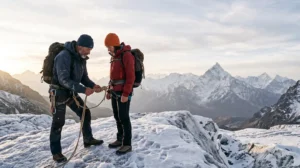
Contrary to popular belief, extensive “local knowledge” is not a substitute for professional certification; it’s a dangerous assumption that overlooks the systemic risk management that defines a qualified guide.
- True qualification is a verifiable system of technical mastery, crisis protocol, and decision-making under duress, not just familiarity with a trail.
- Life-threatening conditions like HACE present subtle signs that only guides with specific medical training can reliably detect.
Recommendation: Never book a guide without first independently verifying their credentials through their national or international governing body (like the IFMGA).
In the world of high-stakes adventure, the person you trust with your life is your guide. They are your navigator, your medic, your meteorologist, and your strategist. Yet, a chilling reality exists in the adventure tourism industry: the single greatest risk factor on many expeditions is not an avalanche, a sudden storm, or equipment failure. It is an unqualified guide. The assumption that a friendly face with years of “local experience” is sufficient for a challenging trek is a common, and potentially fatal, misconception.
Most aspiring adventurers look for good reviews or a low price, believing that guiding is a simple matter of following a path. They fail to understand the qualification delta—the vast, invisible gap between an enthusiastic amateur and a certified professional. This gap is not about knowing the trail; it’s about a systematic approach to risk management. It’s about possessing the standardised competency to diagnose the subtle onset of High-Altitude Cerebral Edema (HACE), execute a technical rope rescue on an exposed ridge, or make the difficult but correct call to turn back in deteriorating weather, even when clients are pushing to continue. These are skills forged not just by experience, but by rigorous, standardised training and assessment.
This article moves beyond the platitude of “hire a good guide.” We will deconstruct what “qualified” truly means in a non-negotiable, safety-first context. We will not just tell you to check credentials; we will show you how to verify them, what to look for, and why the “gold standard” of certification is the only acceptable benchmark when your life is on the line. This is about equipping you, the adventurer, with the knowledge to distinguish a professional from a performer—a distinction that can mean the difference between a successful summit and a statistic.
To navigate this critical topic, this guide breaks down the essential components of guide qualification. We will explore the concrete steps to verify a guide’s credentials, decipher the meaning behind different certifications, and analyse the life-threatening risks associated with specific environments like high-altitude ascents and whitewater rivers. This structured approach will provide a clear framework for making your next expedition as safe as it is thrilling.
Summary: The Definitive Guide to Vetting Your Adventure Guide for Maximum Safety
- Why Do 85% of Adventure Accidents Involve Unqualified Guides?
- How to Verify Your Guide’s Credentials Before Remote Expeditions?
- What Certifications Should Adventure Guides Hold for High-Altitude Treks?
- The Deadly Assumption About “Local Knowledge” That Endangers Trekkers
- How to Find English-Speaking Certified Guides in Remote Destinations?
- What Are the Warning Signs of Serious Altitude Sickness Requiring Descent?
- Why Does River Grading Matter More Than Your Swimming Ability?
- How to Acclimatise Properly When Ascending Above 4,000 Metres?
Why Do 85% of Adventure Accidents Involve Unqualified Guides?
The stark figure linking accidents to unqualified guides stems from a fundamental misunderstanding of what guiding entails. It’s a profession where the barrier to entry can be dangerously low in unregulated markets. The issue is not malice, but a critical gap in systemic risk management. An unqualified guide may know a route intimately but lack the structured protocols for emergency response, group management under stress, and objective decision-making. Their experience is often anecdotal, not based on a tested, standardised curriculum designed to mitigate predictable dangers. This gap is exacerbated by economic pressures that incentivise operators to hire less-expensive, uncertified staff.
Case Study: The Camp Cook Turned “Guide”
A real-world illustration highlights this risk perfectly. An individual with a background as a camp cook took a single Wilderness First Responder course. Shortly after, she was hired by a guide service to lead clients on challenging alpine climbs, including Mt. Whitney. Despite having no formal mountain guide training or significant personal alpine climbing experience, she was now responsible for client safety in a high-consequence environment. This scenario, far from being unique, demonstrates how easily a minimal qualification can be misrepresented as comprehensive expertise in unregulated guiding markets, creating a predictable gamble for unsuspecting clients.
This problem is pervasive. For example, a recent internal audit of Eastern Sierra guide services found that only 23% of guides held full certification across every discipline they were practicing. This means the majority were operating outside the scope of their formal, assessed qualifications. The distinction is critical, as IFMGA Mountain Guide Rob Coppolillo points out the severity of the consequences:
Sure, as mountain guides we don’t do surgery… but ask yourself: are the consequences of an avalanche or climbing accident any less than a botched surgery or shoddy bridge?
– Rob Coppolillo, 57hours – A Guide Explains: What is a Professional Mountain Guide?
The answer is a resounding no. The “85% problem” is a direct result of an industry where, in some corners, appearances are valued over proven, standardised competency. It is a market failure where the client, often a novice, is unable to assess the true level of risk they are assuming.
How to Verify Your Guide’s Credentials Before Remote Expeditions?
Verifying a guide’s credentials is not an insult; it is a mandatory, non-negotiable step in your expedition planning. In an industry where titles can be self-appointed, objective verification is your only true safeguard. Relying solely on a company’s website or a guide’s personal claim is insufficient. You must seek third-party validation from the issuing body. For the highest level of mountain guiding, this means checking with the International Federation of Mountain Guides Associations (IFMGA/UIAGM) or its national member associations.
Hiring a guide with verified credentials means engaging a professional who has been trained to a vetted international standard. This isn’t just a certificate; it’s proof of a comprehensive education in technical skills, rescue systems, and decision-making under duress. Many travelers find this process daunting, which is why some turn to vetted platforms that pre-screen guides. A traveler on a major booking platform noted that using a service with verified certifications is not just good for your safety; it’s also good for the mountains and the communities by supporting true professionals.
The process of verification is more straightforward than it appears. It involves a clear, step-by-step method to ensure the guide you’re hiring has met the rigorous requirements of their certification. This diligence is the foundation of a safe and successful adventure.
Your Action Plan: Verifying an IFMGA/UIAGM Guide
- Initial Search: Look for a mountain guide agency, alpine centre, or mountain guide office in your destination region. These entities typically work with certified professionals.
- National Association Check: Consult the corresponding national mountain guide association’s website. Most maintain a public list of their active, certified members.
- Proof of Training: Confirm the guide has completed the full training according to IFMGA standards. Look for the official international mountain guide badge as physical proof.
- Request the Card: Do not hesitate to ask to see the guide’s official IFMGA membership card. Every currently certified guide possesses one and should be willing to present it.
- Cross-Reference: Use the official IFMGA guide search tool to cross-reference the guide’s name and confirm their status within the international federation.
What Certifications Should Adventure Guides Hold for High-Altitude Treks?
Not all certifications are created equal. For high-altitude treks, where the risks of remoteness, weather, and altitude sickness converge, the level of a guide’s training is paramount. A simple “First Aid” certificate is grossly inadequate. While it may cover treating a minor cut, it offers no framework for managing a multi-day medical emergency in a remote setting. The hierarchy of qualifications is clear, and as a client, you must understand what each tier truly signifies for your safety. Your goal should be to secure a guide who holds a certification that matches the objective hazards of your trip.
The industry standard for advanced medical training in the wilderness is the Wilderness First Responder (WFR) certification. This is an intensive, 80-hour course that goes far beyond basic first aid, focusing on patient assessment, long-term care, and critical evacuation decisions. However, even WFR is a medical qualification, not a guiding qualification. It doesn’t cover technical rope skills, avalanche safety, or navigation.
The undisputed global gold standard is the IFMGA/UIAGM Mountain Guide certification. This is the highest level of qualification in the world for mountaineering, climbing, and ski mountaineering. Achieving it is a multi-year process of extreme rigor. To put it in perspective, the IFMGA training framework requires that candidates complete a minimum of 94 days of training and assessment, with at least 84 of those days being practical, hands-on learning in demanding alpine terrain. This is the ultimate expression of systemic risk management, combining technical mastery with medical knowledge and leadership.
This table breaks down the tiers of qualification, clarifying what they mean in practical terms for a trekker’s safety at altitude.
| Tier | Typical Certification | What It Really Means for Trekker Safety |
|---|---|---|
| Good | Basic First Aid / Local Guide License | Covers minor wound care but offers no structured protocol for multi-day remote medical emergencies. |
| Better | Wilderness First Responder (WFR) | An industry-standard 80-hour course covering patient assessment, evacuation decisions, and remote emergency care. |
| Gold Standard | IFMGA / UIAGM Mountain Guide | Includes a minimum of 94 days of training, with at least 84 days dedicated to practical, hands-on learning in alpine terrain. |
The Deadly Assumption About “Local Knowledge” That Endangers Trekkers
One of the most dangerous myths in adventure travel is the idea that “local knowledge” is a sufficient, or even superior, substitute for formal certification. This is a false dichotomy. While intimate familiarity with a region’s terrain, weather patterns, and culture is incredibly valuable, it is not a replacement for a standardised, systemic approach to risk management. An uncertified local guide may have walked a trail a hundred times, but that experience does not automatically translate into the ability to manage a medical emergency, execute a technical rescue, or make unbiased decisions when conditions change unexpectedly.
It’s important to acknowledge the immense skill of many uncertified guides. As the team at Andescross notes, there are excellent guides who are not yet certified, whose background is an accumulation of mountain experiences that leads to a deep understanding of the mountains. In many regions, including on the world’s highest peaks, numbers of uncertified guides work leading groups on routes like Mount Everest, Cho Oyu, and Aconcagua, and their practical experience can be immense. The critical error is in viewing experience and certification as mutually exclusive.
The safest and most effective guide is one who possesses both: deep, localised experience and a globally recognised certification. The certification provides the “software”—the proven systems for risk assessment, emergency protocols, and client care. The local knowledge provides the “database”—the nuanced understanding of a specific environment. Relying on one without the other is a predictable gamble. The guide who has walked a trail a hundred times may be excellent at avoiding known rockfalls, but the certified guide is trained in what to do when an unexpected rockfall occurs and injures a client, miles from the nearest road. That is the qualification delta that truly matters.
How to Find English-Speaking Certified Guides in Remote Destinations?
Finding a qualified guide is one challenge; ensuring you can communicate effectively with them is another, especially in remote destinations where English may not be widely spoken. Clear communication is a critical safety component. You need to be able to understand instructions, explain your physical condition, and comprehend the guide’s risk assessments. Fortunately, the global nature of high-level guide certifications often simplifies this process.
The first and most reliable method is to use the official channels of the certifying bodies. The IFMGA website offers a search tool to help locate and verify guides globally. Furthermore, the websites of the national mountain guide associations for your destination country (e.g., the NNMGA in Nepal, the AAGM in Argentina) are invaluable resources. These sites often have public directories of their members, which may include the languages they speak. Contacting these associations or their recommended guide agencies directly is the most effective way to confirm a guide’s English proficiency before you book.
A growing alternative is the use of boutique adventure booking platforms. These specialized services act as intermediaries, vetting and curating a pool of certified local guides from around the world. As one traveler noted, these platforms simplify the process by allowing you to filter for guides with verified certifications and confirmed language skills, removing the uncertainty of direct, unverified bookings. This not only streamlines logistics but adds a crucial layer of accountability and safety to your planning. Whether you go direct to an association or use a trusted platform, the key is to confirm both qualification and language before committing.
What Are the Warning Signs of Serious Altitude Sickness Requiring Descent?
At high altitude, a headache is not just a headache. It is a potential warning sign of a spectrum of illnesses, ranging from benign Acute Mountain Sickness (AMS) to the life-threatening conditions of High-Altitude Cerebral Edema (HACE) and High-Altitude Pulmonary Edema (HAPE). The ability to distinguish between these conditions is a critical skill that defines a qualified guide. Unqualified guides often misinterpret or dismiss early symptoms, waiting until a serious medical crisis is undeniable. A professional, however, is trained to recognize the subtle, early indicators that demand immediate action: descent.
AMS is common and presents with symptoms like headache, nausea, fatigue, and insomnia. While uncomfortable, it is not immediately life-threatening. The lethal transition occurs when AMS progresses to HACE. According to a definitive review from the National Center for Biotechnology Information, the hallmark features of HACE are an altered mental status and ataxia (loss of coordination). The person may become confused, irritable, or drowsy, and their gait will become unsteady, resembling drunkenness. This is a five-alarm medical emergency indicating swelling of the brain. Immediate and rapid descent is the only effective treatment.
The following table, based on clinical data, distinguishes the typical signs of AMS from the critical red flags of HACE that necessitate immediate descent.
| Condition | Typical Symptoms | Critical Red-Flag Signs |
|---|---|---|
| Acute Mountain Sickness (AMS) | Headache, fatigue, nausea, insomnia, and lightheadedness after rapid ascent | Benign if isolated and improving with rest |
| High-Altitude Cerebral Edema (HACE) | Preceded by AMS symptoms | The hallmark features of HACE are altered mental status and ataxia. |
| Overlap with HAPE | Chest tightness, breathlessness | Fifteen percent of individuals with HAPE develop HACE, while 85%–100% of HACE cases requiring hospitalization occur with HAPE. |
A simple field test for ataxia can be a lifesaver. If a trekker shows signs of AMS and you suspect HACE, a trained guide will immediately administer this test.
Field Checklist: The Heel-to-Toe Ataxia Test for HACE
- Observe Early Signs: Watch for deteriorating physical coordination. The key indicator is an unsteady gait (ataxia) that strongly resembles intoxication.
- Administer the Test: Ask the individual to walk heel-to-toe in a straight line on flat ground. Their inability to perform this simple task is a primary indicator of developing HACE.
- Act Immediately on Failure: If the person fails the test, begin immediate descent. Do not wait for further deterioration, as the condition can rapidly progress to decreased consciousness and coma.
- Involve the Team: Inform the entire party of the situation. A guide will coordinate the descent, ensuring the patient is accompanied and supported.
- Consider Medication: A certified guide with appropriate training may administer Dexamethasone as a temporary measure to facilitate descent, but it is not a cure. Descent remains the only definitive treatment.
Why Does River Grading Matter More Than Your Swimming Ability?
In water-based adventures like kayaking or rafting, a common and dangerous assumption is that being a “strong swimmer” provides a significant safety net. This could not be further from the truth. In moving water, especially whitewater, your swimming ability is largely irrelevant when faced with the immense and unforgiving power of hydraulics. Understanding the International Scale of River Difficulty, a grading system from Class I (easy) to Class VI (extreme and exploratory), matters infinitely more because it quantifies the river’s power, not your ability to resist it.
A Class IV rapid, for example, is defined by powerful, turbulent water, unavoidable waves, and constricted passages that demand precise maneuvering. A mistake can lead to a long swim in dangerous conditions where features like “holes” and “strainers” (submerged trees or rocks) can trap a person underwater with thousands of pounds of force. No amount of swimming skill can overcome the physics of a river’s hydraulic power. This is why a qualified river guide’s expertise is not in their swimming, but in their ability to read the water, choose the correct line, and execute rescue protocols when things go wrong.
A certified guide understands that safety on a river comes from avoiding danger, not confronting it. They are trained to identify the river’s features and navigate a path that minimizes risk. Their job is to keep you in the boat. If you do end up in the water, their skill with a throw rope and their knowledge of swiftwater rescue techniques are what will save you, not your freestyle stroke. Choosing an expedition on a river whose grade is far above your guide’s certified ability is to fundamentally misunderstand the nature of the risk you are taking.
Key Takeaways
- Verification is mandatory: Never take a guide’s qualifications at face value. Use official national and international databases to confirm their certification status.
- Certification is a system: A “gold standard” certification like IFMGA represents a holistic, standardised system for risk management, not just a single skill.
- “Local knowledge” is insufficient: While valuable, local experience alone does not replace the structured protocols for crisis management and medical emergencies taught in formal training.
- Know the red flags: The ability to recognize the subtle onset of life-threatening conditions like HACE (ataxia, confusion) is a hallmark of a qualified guide and can save your life.
How to Acclimatise Properly When Ascending Above 4,000 Metres?
Proper acclimatisation is the single most important factor for safety and success on any high-altitude expedition. It is the process by which the body gradually adapts to the decreased oxygen levels at elevation. Failing to acclimatise properly is not a sign of weakness; it is a physiological inevitability that can lead to severe illness or death. The core principle is simple: your rate of ascent must not outpace your body’s ability to adapt. According to clinical research, the primary risk factors for severe altitude illness are a combination of rapid ascent and inadequate acclimatisation.
A professionally designed itinerary, created and enforced by a qualified guide, is your greatest defense. Such an itinerary will incorporate golden rules: above 3,000 metres (approx. 10,000 feet), ascend no more than 300-500 metres per day, and include a rest day for every 1,000 metres gained. It will follow the “climb high, sleep low” principle wherever possible. An unqualified guide, often pressured by a client’s tight schedule or their own lack of knowledge, may push a dangerously fast pace. A textbook example of this occurred when a trekker on a pilgrimage in Uttarakhand ascended from 300m to over 3500m in just two days, a “fairly rapid” ascent that triggered a life-threatening case of HACE.
Ultimately, a proper acclimatisation schedule is the ultimate expression of a professionally managed expedition. It demonstrates a guide’s commitment to systemic risk management over summit fever. It shows they understand the invisible physiological battle being fought by every member of the team. They will monitor the group for signs of AMS, enforce rest days, and have the authority to halt or alter the plan based on the team’s condition, not just the calendar. Choosing a guide who prioritises and enforces a conservative acclimatisation schedule is choosing a professional who understands that the true summit is a safe return.
To ensure your next adventure is guided by expertise, not by chance, the next logical step is to rigorously vet potential guides against the gold standards discussed. Do not compromise on qualifications; your safety is non-negotiable.