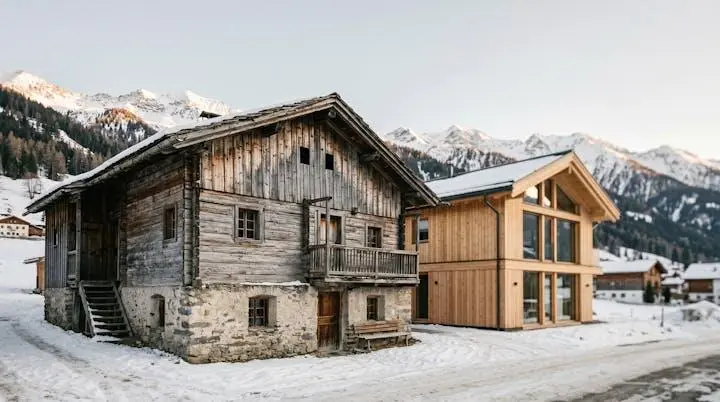
Spotting a true heritage chalet isn’t about ticking off aesthetic features; it’s about reading a story written in wood and stone.
- Genuine chalets reveal a functional logic: stone bases historically housed livestock, and separate storage huts protected valuables from fire.
- True modern comfort in an old building relies on verified insulation and dual-heating systems, not just a cosmetic fireplace.
Recommendation: Apply the same rigor to vetting your accommodation as you would a mountain guide—question the details, demand proof beyond marketing, and prioritize structural substance over superficial style.
For discerning travellers, the allure of the Alps is inseparable from the vision of a traditional chalet. It’s a dream of crackling fires, thick timber beams, and a deep, soul-soothing connection to mountain history. Yet, the booming popularity of alpine tourism has spawned a generation of imitations: buildings cloaked in a thin veneer of “alpine style” that lack the substance and spirit of the genuine article. These are often little more than modern constructions with some wood cladding, a pastiche that offers the look but none of the soul.
The common advice—”look for wood and stone”—is woefully inadequate. Many modern builds use these materials cosmetically. The real challenge, and the true mark of a connoisseur, is to look beyond the surface. It’s about understanding that an authentic chalet is not an aesthetic; it’s a functional artifact shaped by centuries of survival, craftsmanship, and a deep respect for the mountain environment. It’s a historical document waiting to be read.
This guide moves beyond the superficial. It provides a forensic framework for distinguishing heritage from hoax. We will not just list features; we will decode their meaning, exploring why genuine historic chalets possess an inimitable atmosphere. We will tackle the critical paradox of balancing traditional charm with modern comfort, addressing practical concerns like heating, space, and ski access. Ultimately, you will learn to apply the same critical eye to your accommodation as you would to any other crucial part of your alpine experience.
To navigate these nuances, this guide is structured to build your expertise progressively. The following sections will equip you with the knowledge to make an informed and truly authentic choice for your next mountain escape.
Summary: Distinguishing True Alpine Heritage from Modern Pastiche
- Why Do Genuine Historic Chalets Offer Atmosphere Modern Builds Can’t Replicate?
- How to Identify Genuinely Traditional Chalets From Modern Imitations?
- Traditional Charm vs Modern Heating: Can Old Chalets Stay Warm Enough?
- The Space Limitation in Traditional Chalets That Surprises Modern Families
- How to Find Traditional Chalets That Don’t Sacrifice Ski Access?
- The “Local Experience” Tour That’s Actually 100% Tourist Theatre
- The “Local” Label Scam That Funnels Money to Foreign Owners
- How to Vet Local Tour Operators for Safety and Authenticity?
Why Do Genuine Historic Chalets Offer Atmosphere Modern Builds Can’t Replicate?
The profound atmosphere of a genuine historic chalet isn’t a design choice; it’s the accumulated result of time, purpose, and material honesty. Modern replicas, however well-crafted, can only mimic the form, not the story. The difference lies in the very fabric of the building, particularly the wood. As Roger, owner of MountainPassions, explains, traditional builders used slow-growing timber from local forests. This wood has an intrinsic character that evolves over centuries: “This slow-growing timber can live for 500 years or more, and contains tannins which darken upon prolonged contact with the atmosphere, eventually allowing the chalet to blend harmoniously into its natural surroundings.” This is not a stain or a paint; it’s a chemical and physical transformation, a dialogue between the building and its environment.
This concept of “material forensics” is crucial. A Swiss chalet-building specialist highlights that authentic chalets are built with local old wood, which is more stable and has an inherent history. A key takeaway from their approach to using reclaimed wood in new high-end builds provides a clear benchmark for what to look for. According to a case study on their methods, genuinely reclaimed timber displays rich grain patterns, character marks from previous use, and distinct patina that cannot be faked with new, artificially distressed planks. These are not imperfections; they are credentials.
As you can see in the texture of genuinely aged wood, there is a depth and irregularity that tells a story. Look for the subtle marks of hand tools, the silver-grey patina from sun and snow, and the fine cracks of a life lived in the mountains. This is the physical evidence of history. A new build can have wood, but it cannot have this aged-in authenticity. The atmosphere you feel is the resonance of that history, something no modern imitation can replicate overnight.
How to Identify Genuinely Traditional Chalets From Modern Imitations?
Moving from the ‘why’ to the ‘how’, identifying a genuine chalet requires a forensic eye. It’s about understanding the structural logic that governed their original construction. These were not holiday homes; they were self-sufficient agricultural units, and every feature had a purpose. A modern imitation often gets the aesthetics right but misses this underlying functional grammar. For instance, a small, separate hut on stone stilts might seem like a quaint decorative feature, but it was a critical piece of fire-safety technology. This is the *mazot* or *raccard*, a granary built apart from the main dwelling.
The purpose of the *mazot* was brutally practical. It was built to store a family’s most valuable possessions—grain, dried meats, and legal documents—at a safe distance from the main chalet, where the risk of a chimney fire was ever-present. The stone pillars, often topped with large, flat “mushroom” stones, served a specific purpose: as The Swiss Spectator notes, “The pillars prevented mice and rats from entering.” Seeing a genuine *mazot* or *grénier* alongside a main building is a powerful sign of authenticity, indicating you are looking at a historic farmstead, not a modern construction playing dress-up.
Action Plan: A Forensic Checklist for Spotting a Genuine Chalet
- Check the ground floor: As outlined in a guide on traditional chalet construction, authentic chalets typically show a stone-built base, often recessed into the mountainside. This wasn’t for style; it was where livestock were stabled, their body heat rising to warm the human accommodation above.
- Look for a date and initials: Tradition dictates that each chalet carries the date of its construction and the initials of the original owner, either carved on the upper gable roof timber or incised in a stone lintel above a door or window.
- Inspect for a separate storage annex: A genuine *mazot* or *grénier* beside the main building was built to store a family’s most valuable possessions away from the risk of fire in the main chalet. Its presence is a strong indicator of an authentic agricultural past.
- Confirm regional material logic: Authentic builds used materials sourced from nearby. The style of wood, type of stone, and even the roof design (slate, wood shingles) should correspond logically to the geology and resources of that specific valley, not a generic “alpine” look.
By using this checklist, you shift your perspective from that of a tourist to that of an architectural detective. You are no longer just looking at a pretty building; you are reading its biography and verifying its claims to history. A building that passes these tests is not just a place to stay; it is an experience in itself.
Traditional Charm vs Modern Heating: Can Old Chalets Stay Warm Enough?
One of the most significant concerns for travellers considering a historic chalet is the “comfort paradox”: the fear that authentic charm comes at the cost of being cold. It’s a valid question. Original chalets, designed for heat retention in a central living area around a single stove, can feel draughty to modern sensibilities. However, assuming all old chalets are cold is a mistake. The best historic properties resolve this paradox by masterfully integrating modern heating technology without compromising the building’s character.
The key is to look for evidence of smart, systemic upgrades, not just a big fireplace. A roaring fire is for atmosphere; a high-performance heating system is for genuine comfort. The most successful renovations often employ a dual approach. For instance, the combination of a modern heat pump with underfloor heating has become a gold standard. As heating specialists at Alpha Innotec note, this combination can be highly effective:
Even in older buildings, the combination of a heat pump and underfloor heating is a successful model—provided the building is well prepared. Those who invest in insulation and optimize the heating surfaces can also heat efficiently and comfortably with a heat pump in existing buildings.
– Alpha Innotec heating specialists, Heat Pump with Underfloor Heating
This trend is backed by national policies, with a Buildings Performance Institute Europe report showing ambitious targets like Germany’s goal for 6 million installed heat pumps by 2030, demonstrating a major shift toward this technology.
Therefore, when vetting a chalet, ask specific questions. Don’t settle for “it’s warm and cozy.” Ask for the property’s Energy Performance Certificate (EPC) or its national equivalent. Inquire if a heat pump is paired with significant fabric improvements like loft and wall insulation. A high-quality renovation will have invested in this crucial, though invisible, infrastructure. A property that has only installed a heat pump without upgrading insulation may still struggle to maintain comfortable temperatures. This diligence separates the truly comfortable historic gems from the chilly, poorly-updated relics.
The Space Limitation in Traditional Chalets That Surprises Modern Families
After warmth, the second major surprise for modern families is often space. Accustomed to spacious, open-plan living, many are taken aback by the compact, compartmentalized, and sometimes interconnected rooms of a traditional chalet. This is not a design flaw; it is a fundamental feature of the original architectural logic, born from the necessity of heat conservation and the realities of multi-generational living in a harsh environment.
Case Study: The Original Single-Room Logic
Architectural analyses of historic alpine structures reveal a focus on a central, heated living space. As 4D Architecture explains, the original mountain chalet would often have encompassed a single living area with small bedroom spaces often interlinked. Plumbing was minimal or non-existent. This compactness, now sometimes misread as a ‘limitation,’ was in fact the entire design principle of the building: maximize the utility of every calorie of heat produced by the stove and the animals below.
This historical context is vital. What feels “cramped” by today’s standards was revolutionary in its efficiency. Instead of seeing it as a limitation, discerning travellers can choose to see it as an invitation to a different kind of togetherness. The smaller rooms and central living area encourage families to gather, interact, and share the space in a way that sprawling modern layouts often prevent. It’s a shift from private, isolated spaces to shared, intimate experiences. Many renovated chalets cleverly embrace this, creating cozy, light-filled interiors that connect with the landscape, transforming what was once a dark necessity into a modern luxury.
Choosing a traditional chalet is therefore also a choice about how you want to spend your time together. It can mean trading expansive private bedrooms for a vibrant, shared hearth where board games are played, stories are told, and memories are forged. It’s about embracing the coziness of proximity, an experience that is, in its own way, a profound luxury.
How to Find Traditional Chalets That Don’t Sacrifice Ski Access?
For many, the ultimate alpine dream combines the historic charm of a traditional chalet with the convenience of ski-in/ski-out access. However, these two ideals are often in conflict. Purpose-built ski-in/ski-out properties are typically modern constructions clustered on the piste, while authentic chalets are often located in historic village centers or hamlets, set back from the main runs. The key is to understand the real-world tiers of ski access and align them with your desire for authenticity.
The term “ski-in/ski-out” is used loosely in marketing. To make an informed choice, you need to verify which of the three real tiers of access a property offers:
- True Piste-Side: Your building is literally on or immediately beside a marked run. You ski from your door in the morning and back to it in the afternoon. This is the rarest and most premium tier, usually associated with modern apartment blocks.
- Lift-Adjacent: Your accommodation is a short walk (under five minutes in ski boots) from a lift station. While not technically “skiing from the door,” this offers excellent convenience and is often the best compromise for accessing authentic chalets in village centers.
- Ski-In or Ski-Out Only: Some properties allow you to ski back at the end of the day but require a walk or shuttle to start, or vice-versa. It’s crucial to know which part of the journey is compromised.
The most charming traditional chalets are rarely true piste-side, but many offer excellent lift-adjacent access. The car-free village of Zermatt is a prime example. As one of the most expensive and revered ski destinations, Zermatt, famed for its Matterhorn views, proves that a historic, authentic village core can coexist with world-class ski access. Its model relies on a network of electric taxis and strategically placed lifts, allowing access to historic properties without sacrificing convenience.
This demonstrates the most rewarding path for the discerning traveller: seek out a chalet in a traditional hamlet or village with verified lift-adjacent access. You may trade the absolute convenience of a piste-side apartment for the far richer experience of walking through a historic village in the evening, surrounded by genuine alpine culture.
The “Local Experience” Tour That’s Actually 100% Tourist Theatre
The quest for authenticity extends beyond the walls of your chalet. It influences the experiences you seek, from the food you eat to the tours you take. Herein lies another trap for the unwary traveller: the rise of “performative authenticity.” This is the curated, staged “local experience” designed entirely for tourist consumption, which has all the appearances of culture but none of the substance. It’s the “traditional” cheese-making demonstration that happens on a fixed schedule for tour buses, or the “spontaneous” folk music performance in a restaurant where the performers are on a nightly payroll.
This is tourist theatre. It’s a sanitized, simplified, and commercialized version of a living culture, packaged for easy consumption. While often harmless and entertaining, it is not authentic. The danger is when travellers mistake this performance for the real thing, leaving with a skewed and superficial understanding of the place they visited. It’s the cultural equivalent of a modern chalet with fake wooden beams—it looks the part, but it’s hollow inside.
To avoid this, a discerning mindset is crucial. Be wary of experiences that seem too polished, too convenient, or too perfectly timed for tourists. True local life is often messier, less scheduled, and harder to access. It might be found in visiting a genuine weekly market rather than a “farmers’ market” at a resort, or by asking a local for their favourite walking path rather than following the perfectly signposted “scenic trail.” The most authentic experiences are often those you stumble upon, not those you book from a glossy brochure. It requires more effort, curiosity, and a willingness to step off the beaten path, but the reward is a genuine connection, not just a purchased memory.
The “Local” Label Scam That Funnels Money to Foreign Owners
Perhaps the most insidious form of inauthenticity is the economic mirage. You’ve done your homework: you’ve found a charming, seemingly traditional chalet, and its name, “Chalet Heidi” or “Le Mazot du Berger,” evokes a sense of deep-rooted local heritage. You book it, feeling good about supporting a local family-run business. The reality, however, can be starkly different. The property may be owned by a distant investment fund, a foreign corporation, or a wealthy individual from another continent, managed by a large, international property company.
This is the “local label” scam. It’s the practice of using folksy, traditional branding to mask a purely transactional, often international, ownership structure. The money you spend, which you believe is supporting the local community, is instead funneled out of the valley and into the pockets of distant shareholders. The “local” branding is just another layer of marketing, as superficial as fake wooden beams on a concrete building. This undermines the economic sustainability of the very communities that make these destinations so special.
Vetting for economic authenticity is challenging, but not impossible. Look beyond the name of the chalet. Investigate the managing company. Is it a small, local agency with a physical office in the village, or a large, multinational platform with a generic website? Read the “About Us” section. Does it tell the story of a specific family with roots in the region, or does it use vague corporate language? Sometimes, a simple search of the property or management company name can reveal its true ownership. Choosing to book through a genuinely local operator, even if it costs slightly more or is less convenient, is a powerful act. It ensures your tourism dollars contribute to the preservation of the community, not just the extraction of its aesthetic value.
Key Takeaways
- An authentic chalet’s value lies in its readable history—look for a stone base, a dated lintel, and a separate storage ‘mazot’.
- True comfort in a historic building comes from systemic upgrades like insulation and modern heating, not just a cosmetic fireplace.
- Embrace the unique spatial logic: what seems ‘small’ is an invitation to cozy, shared experiences, a hallmark of traditional alpine living.
How to Vet Local Tour Operators for Safety and Authenticity?
The discerning mindset required to select an authentic chalet should be applied with even greater rigor when choosing the people who will guide you in the mountains. Just as a chalet can be a hollow imitation, a “guide” can be someone with a nice jacket and a website but no real qualifications. In the mountains, this distinction is not just about authenticity; it’s about safety. Therefore, learning how to vet a guide or tour operator serves as the ultimate metaphor for our entire approach: you must look past the surface and demand proof of substance.
The benchmark for this is certification. In the world of mountaineering, there is one undisputed gold standard: the IFMGA/UIAGM diploma. As the team at Arctic Heli Skiing states unequivocally, “The IFMGA standard is the highest and most respected in the world.” This is not a simple weekend course. It represents years of rigorous training and assessment in alpine climbing, skiing, and rescue. It is so demanding that, according to the International Federation of Mountain Guides Associations, it is an incredibly exclusive qualification. An operator who employs IFMGA-certified guides is demonstrating a non-negotiable commitment to safety and professionalism.
When vetting an operator, apply the same forensic questioning you’d use on a chalet:
- Ask about certification: Don’t just ask if they are “qualified.” Ask specifically if their guides hold the IFMGA/UIAGM diploma.
- Question the details: Ask about group sizes. Smaller groups suggest a focus on quality and safety over volume. Ask about the specific safety gear provided. A confident, detailed answer about transceiver models and service dates is a very good sign.
- Judge the response: A professional organization will welcome these questions. They are proud of their standards and happy to explain them. Evasiveness or annoyance is a major red flag.
This process of vetting a guide—demanding credentials, questioning specifics, and judging the substance of the answers—is the perfect model for the discerning traveller. Whether you are examining the wooden beams of a chalet or the qualifications of a guide, the principle is the same: look for the evidence of genuine expertise and commitment to quality. Only then can you ensure your experience is not just enjoyable, but truly authentic and safe.
Begin today to apply this discerning approach. By questioning the surface and seeking the substance, you not only guarantee a more profound and rewarding travel experience for yourself but also contribute to the preservation of true alpine heritage.