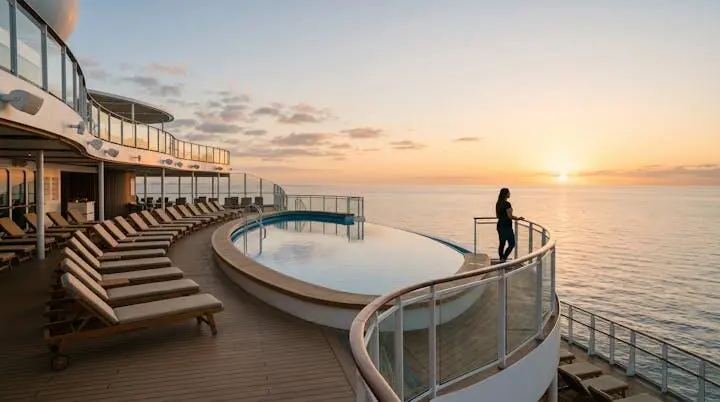
Choosing the right cruise isn’t about finding the ship with the most amenities, but understanding which ones deliver real value without the crowds and hidden costs.
- Mega-ships can create “amenity traps” where headline attractions become too crowded to enjoy, a concept we call low amenity density.
- Smaller or value-focused lines often deliver higher satisfaction through better service, more personal space, and a clearer value proposition.
Recommendation: Create your “Personal Amenity Profile” *before* you look at brochures to avoid being swayed by marketing for features you’ll never use.
For first-time cruise bookers, the lists of onboard amenities can be both dazzling and dizzying. Royal Caribbean’s ships are becoming “adventure hubs,” as the CruiseDirect Editorial Team notes, boasting everything from surf simulators to robotic bartenders. It’s easy to assume that the ship with the longest feature list is automatically the best choice. This leads many to spend hours comparing brochures, trying to find a vessel that has it all.
But this “more is more” approach is a common trap. It overlooks the crucial questions that truly define a great vacation experience. Will you actually use that rock-climbing wall? What does “poolside oasis” really mean when you’re sharing it with 3,000 other people? And how many of these “features” come with an extra price tag that inflates your final bill?
The secret to finding the perfect cruise ship isn’t about finding the most amenities, but about mastering a different kind of math. It’s about understanding the relationship between a ship’s facilities and its passenger count—a concept we’ll call amenity density. This guide will shift your focus from a simple checklist of features to a smarter analysis of the *experience* those amenities deliver. We will explore why less can be more, how to define what you truly value, and how to decode marketing hype to see the reality of life onboard.
This article provides a complete framework to help you navigate the sea of choices. By understanding the core principles of amenity value, you can confidently select a ship that’s not just impressive on paper, but is the perfect match for you.
Summary: A Guide to Choosing Your Ideal Cruise Ship Amenities
- Why Do Budget Cruise Lines Offer Fewer Amenities Yet Higher Satisfaction Ratings?
- How to Choose Cruise Ships Based on the Amenities That Actually Matter to You?
- Which Cruise Ship Amenities Are Included and Which Cost Extra?
- The Popular Amenity Trap That Means 200+ Passengers Queue for Hot Tubs
- Do You Really Need Ships With Water Parks and Surf Simulators?
- How Do Modern Ocean Liners Compare to Floating Resort Hotels?
- How to Decode Resort Pool Descriptions to Find the Perfect Fit?
- How Do Modern Ocean Liners Compare to Floating Resort Hotels?
Why Do Budget Cruise Lines Offer Fewer Amenities Yet Higher Satisfaction Ratings?
It’s one of the great paradoxes of the travel industry: ships with fewer headline-grabbing attractions often receive the highest praise from their passengers. This isn’t a fluke; it’s a lesson in the difference between volume and value. While mega-ships market a sprawling list of activities, smaller or more focused lines concentrate on the core elements of a great vacation: service, atmosphere, and a sense of space. The result is often a more relaxing and rewarding experience, a fact reflected in broad industry data.
For instance, a Q4 2023 industry survey of over 2,400 cruisers found that overall satisfaction with the cruise experience reached a remarkable +86% net score. This indicates that the fundamental cruise product is highly successful, often independent of having a go-kart track on the top deck. People are satisfied by the whole package, not just a single feature.
Case Study: The Lindblad Expeditions Model
A prime example is Lindblad Expeditions, which earned the highest Overall Satisfaction Score of 93 in a Consumer Reports survey. The line offers none of the flashy attractions found on mass-market ships. Instead, with a small passenger capacity of around 150, it provides an experience free from long buffet lines and crowded public areas. Reviewers consistently praise the personalized service, with staff who quickly learn guest names and preferences. This proves that for many travelers, a high-quality, low-stress environment is a far more valuable amenity than a surf simulator.
This focus on quality over quantity is what separates a good vacation from a great one. As Lisa L. Gill of Consumer Reports notes, their recommendations are based on “food, customer service, value for the price, onshore excursions, and other factors” — the very things that smaller, high-quality lines excel at. They deliver exceptional value by not over-promising on features and instead over-delivering on the experience.
How to Choose Cruise Ships Based on the Amenities That Actually Matter to You?
The key to escaping the “amenity trap” is to stop looking at cruise brochures and start looking inward. Before you get swayed by the promise of a zip line or a celebrity chef’s restaurant, you need to build your Personal Amenity Profile. This is an honest assessment of what you, personally, want and need from a vacation. The goal is to create a blueprint of your ideal experience that you can then use to filter your ship choices, rather than letting the ships dictate your desires.
Think back to your best and worst vacation moments. What were you doing? Were you seeking thrilling activity, quiet relaxation, gourmet food, or intellectual stimulation? Were you annoyed by crowds, or energized by them? Answering these questions helps you identify your non-negotiables. The traveler in the image below is doing just that—reflecting on past experiences to define future priorities. This is your first and most important task.
Once you have a clear sense of your vacation priorities, you can begin to translate them into specific ship features. A desire for “relaxation” might mean a ship with an adults-only solarium, a well-curated library, and a high passenger-space ratio. A preference for “great food” doesn’t just mean looking for specialty dining, but perhaps a line known for the quality of its main dining room. Use your profile as a lens to critically evaluate what a ship offers, asking “Does this feature serve my ideal vacation?” for every item on the list.
Your Action Plan: Creating Your Personal Amenity Profile
- Balcony or Bust?: Verify whether the ship offers standard balcony cabins. Some older or smaller vessels may only include them in expensive suites, which could be a deal-breaker if you value private outdoor space.
- Casino Check: If gambling is part of your vacation fun, confirm there’s a casino onboard. Premium and luxury lines often shrink or omit them entirely to foster a different atmosphere.
- Laundry Logistics: Planning to pack light? Check for self-service laundry facilities. Depending on this amenity can save you significant luggage space and fees for the ship’s laundry service.
- Quiet vs. Quenching: If you value a quiet reading space, look for ships with a well-curated library or observation lounge. If you’re traveling with kids, confirm the specifics of the waterslides or water parks, as offerings vary dramatically.
- Wellness Wants: Don’t just look for a “spa.” Investigate the details. Check the size of the fitness center, the quality of equipment, and whether the thermal suite’s features (saunas, steam rooms) appeal to you and are worth the potential extra cost.
Which Cruise Ship Amenities Are Included and Which Cost Extra?
Understanding the financial side of onboard amenities is central to building your Personal Amenity Profile and avoiding post-cruise sticker shock. A common mistake for first-time cruisers is assuming the upfront fare covers everything. In reality, modern cruise ships operate on a hybrid model where a generous number of services are included, but a significant portion of the most heavily marketed amenities come at an additional cost. Knowing the difference is key to budgeting accurately and assessing true value.
The table below, based on an analysis of standard cruise fares, breaks down what’s typically free versus what will cost you extra. This is a general guide, as policies can vary by cruise line and even by ship, but it provides a solid starting point for managing your expectations and your wallet.
| Category | Typically Included (Free) | Typically Extra-Cost |
|---|---|---|
| Dining | Main dining room, buffet, casual grill | Specialty restaurants, premium steak/lobster upcharges, room service fees on some lines |
| Drinks | Tap water, iced tea, regular coffee and tea | Soda, bottled water, specialty coffee, alcohol, drink packages |
| Fitness & Wellness | Gym access, sun deck, pool | Fitness classes, spa treatments, thermal suites |
| Entertainment | Theater shows, bingo, mini-golf | Specialty performances, casino play |
| Excursions | None as standard | Shore excursions, guided tours |
Beyond this table, you also have to account for automatic charges. For example, most mainstream cruise lines like Royal Caribbean automatically apply a daily gratuity that currently ranges from $18 to $21 per person, per day. Over a week-long cruise for a couple, this adds over $250 to the final bill—a cost that should be factored in from the start. This isn’t an “amenity,” but it’s a crucial part of the total price.
As a frequent cruiser, I hardly ever splurge on a drink package because they’re extraordinarily expensive, and I struggled to get my money’s worth the one time I bought one, ultimately losing money by trying to keep up with the required level of drinking.
– A Frequent Cruiser, via Royal Caribbean Blog
This perspective on drink packages is a perfect example of an extra cost that may not provide equivalent value for everyone. The decision to purchase should be based on a realistic assessment of your habits, not just the appeal of “all-inclusive” drinking.
The Popular Amenity Trap That Means 200+ Passengers Queue for Hot Tubs
Here we arrive at the core concept that separates savvy cruisers from disappointed ones: amenity density. It’s a simple but powerful idea. The existence of an amenity is meaningless if you can’t comfortably use it. A ship may boast about its “multiple pools and hot tubs,” but if the ratio of passengers to those facilities is too high, your vacation dream of a relaxing soak can quickly turn into a reality of queues and crowds. This is the popular amenity trap.
Mega-ships, with their vast passenger counts, are particularly susceptible to this problem. A single headline attraction can become a major bottleneck. A startling example comes from Royal Caribbean’s Icon of the Seas, which can hold nearly 10,000 people (passengers and crew) at full capacity. On ships of this scale, even dozens of features can feel crowded if the passenger flow isn’t managed perfectly across a vast array of venues.
The problem is most visible with shared, high-demand resources like pools and hot tubs. Consider a smaller, mid-size ship for a clearer picture of the math. For example, on Ambassador Cruise Line’s Ambience, for example, there are 4 hot tubs and 2 pools for roughly 1,400 passengers. A quick calculation reveals this is about 350 passengers per hot tub. While not everyone wants to use a hot tub at the same time, it illustrates how quickly a popular amenity can reach its functional capacity, especially on sea days when everyone is onboard.
This isn’t to say mega-ships are bad, but a cruiser must be aware of this dynamic. Your choice shouldn’t just be “Does this ship have a hot tub?” but rather, “How many people will I be competing with for that hot tub?” This shift in perspective is crucial for aligning your expectations with reality.
Do You Really Need Ships With Water Parks and Surf Simulators?
The modern trend in cruising is clear: ships are becoming destinations in themselves, packed with amusement-park-level attractions. This marketing-driven arms race has led to an explosion of “wow” features designed to look great in commercials. But as a discerning traveler, you must ask a critical question: do you really need them? More importantly, what are you giving up in exchange for those features?
The answer often lies in a metric known as the passenger space ratio. This number, which we’ll decode further in a later section, gives you a tangible way to measure how crowded a ship is likely to feel. It’s a direct trade-off: ships packed with water parks and ice rinks often have to accommodate more passengers to be profitable, which can lead to a lower space ratio and a more crowded feeling throughout the vessel, from the buffet to the sun deck.
The differences can be stark. According to data from Cruise Fever, a comparison of 153 ships from nine major cruise lines found that passenger space ratios range from a tight 30 to a spacious 57. A ship on the lower end of that scale will feel fundamentally different from one on the higher end, regardless of its list of attractions. Choosing a ship with a surf simulator might mean implicitly choosing a more crowded experience overall.
This isn’t an argument against fun features. If you are traveling with teenagers who would spend all day on a waterslide, then a ship with a water park is an excellent choice. The point is to make that choice consciously. Don’t be seduced by a feature you might use once, at the expense of a comfortable, spacious environment you will inhabit for your entire vacation. It’s about aligning the ship’s design philosophy with your own.
How Do Modern Ocean Liners Compare to Floating Resort Hotels?
One of the most useful frameworks for choosing a cruise is to think of the ship not as a boat, but as a floating, all-inclusive resort. This mental shift helps you compare the cruise experience to a land-based vacation you already understand. When you do, you’ll find that cruises offer several distinct advantages that are often overlooked when focusing solely on flashy amenities.
The first and most significant advantage is often the level of service. While luxury resorts on land are known for great service, cruise ships operate with a logistical efficiency that allows for remarkably high staff-to-guest ratios. On land, a high-end resort might feel bustling; on a ship, service is built into the very fabric of the experience. According to research from Explore.com, on average, cruise ships employ one crew member for every two to three travelers, with some luxury lines even approaching a one-to-one ratio. This is a level of staffing that is rarely matched in the land-based resort world and it translates directly into attentive, personalized service.
The second major advantage is the simplification of logistics. As Mary Jean Tully, CEO of Tully Luxury Travel, points out, “Cruises also simplify much of the planning and booking that a lot of vacations require.” Think of a multi-destination trip on land: you’d be booking multiple hotels, arranging transport between them, and researching restaurants in each new city. A cruise consolidates all of this. Your floating resort hotel gently transports you from one destination to the next, often overnight, so you wake up to a new view without ever having to pack or unpack.
This “resort” framework helps you assess value more clearly. When you factor in accommodation, transportation, meals, and entertainment, the price of a cruise is often highly competitive with a comparable land-based vacation, with the added benefit of superior service levels and logistical simplicity.
How to Decode Resort Pool Descriptions to Find the Perfect Fit?
Now that we’ve established the “floating resort” framework, let’s dive into a practical skill: decoding the marketing language used to sell these resorts. Amenity descriptions, especially for things like pools and outdoor spaces, are often masterpieces of evocative but vague language. Learning to see through the prose to the practical reality is essential for making a good choice.
Consider this description from a cruise line: “Bask on the fragrant grass of the Lawn Club on Solstice-series ships and gaze up at the sky.” It sounds idyllic, and for many, it is. But a savvy traveler asks deeper questions. How big is this lawn? How many other people will be “basking” alongside me? Is it a quiet space for reading or a social hub for games? The description sells a feeling, but you need to find the facts.
The most powerful tool for this is the passenger space ratio we mentioned earlier. It’s a number that cuts through the marketing fluff. Here’s how it works: the space ratio is calculated by dividing gross tonnage by passenger capacity, so a 45,000 GT ship with 1,000 passengers has a space ratio of 45. A higher number means more space per passenger. You can find these numbers on many cruise-focused websites. If a ship’s brochure describes “sprawling sun decks” but it has a low space ratio (e.g., in the low 30s), you can anticipate a more crowded, high-energy environment. A ship with a high ratio (e.g., 50+) is more likely to deliver on a promise of “serene, uncrowded spaces.”
This doesn’t mean high-ratio ships are always better. A family with young children might prefer the lively, action-packed atmosphere of a lower-ratio ship. The goal is to match the ship’s reality to your own preferences. By pairing the marketing descriptions with hard data like the space ratio, you create an “Experience Blueprint,” a much more accurate picture of what life onboard will actually be like.
Key Takeaways
- Profile Before Poring Over Brochures: Define what you truly value in a vacation *before* looking at ship options. This creates a “Personal Amenity Profile” that acts as your most important filter.
- Analyze Amenity Density: The number of amenities is less important than the passenger-to-amenity ratio. A ship with fewer crowds can offer a more luxurious experience than a mega-ship where you have to queue for everything.
- Budget for the Full Experience: The advertised cruise fare is just the beginning. Factor in automatic gratuities, specialty dining, drink packages, and other extra costs to understand the true price of your vacation.
How Do Modern Ocean Liners Compare to Floating Resort Hotels?
As we’ve seen, viewing a cruise ship as a floating resort is the most effective way to make a smart choice. It forces you to move past a simple checklist of features and instead evaluate the entire vacation ecosystem. The comparison brings the ultimate question into sharp focus: what kind of resort experience are you looking for? Do you prefer a mega-resort with endless activities, or a boutique hotel where the staff knows your name?
The cruise industry offers both. The average cruise ship has a capacity of around 3,000 passengers with 800 to 1,200 crew members, creating a bustling, city-like environment. But the spectrum is vast, from intimate expedition vessels to colossal mega-ships. Your work in defining your Personal Amenity Profile, understanding amenity density, and decoding marketing language all leads to this final decision point.
Ultimately, the “best” ship is the one whose philosophy aligns with yours. The most luxurious amenity a cruise can offer isn’t a rock-climbing wall or a celebrity-chef restaurant. It’s the feeling of being genuinely cared for, of having your needs anticipated in a relaxing and seamless environment. It’s the moment a crew member remembers your name or your favorite drink. As one traveler noted about a high-satisfaction cruise line, the staff “quickly learned names and personal preferences.” This is the hallmark of true hospitality, whether on land or at sea.
By focusing on the quality of the experience rather than the quantity of the features, you empower yourself to find a cruise that will not only meet your expectations but exceed them, creating memories that last long after you’ve disembarked.
The next logical step is to apply these principles. Start by drafting your Personal Amenity Profile today to begin the journey toward your perfect cruise vacation.