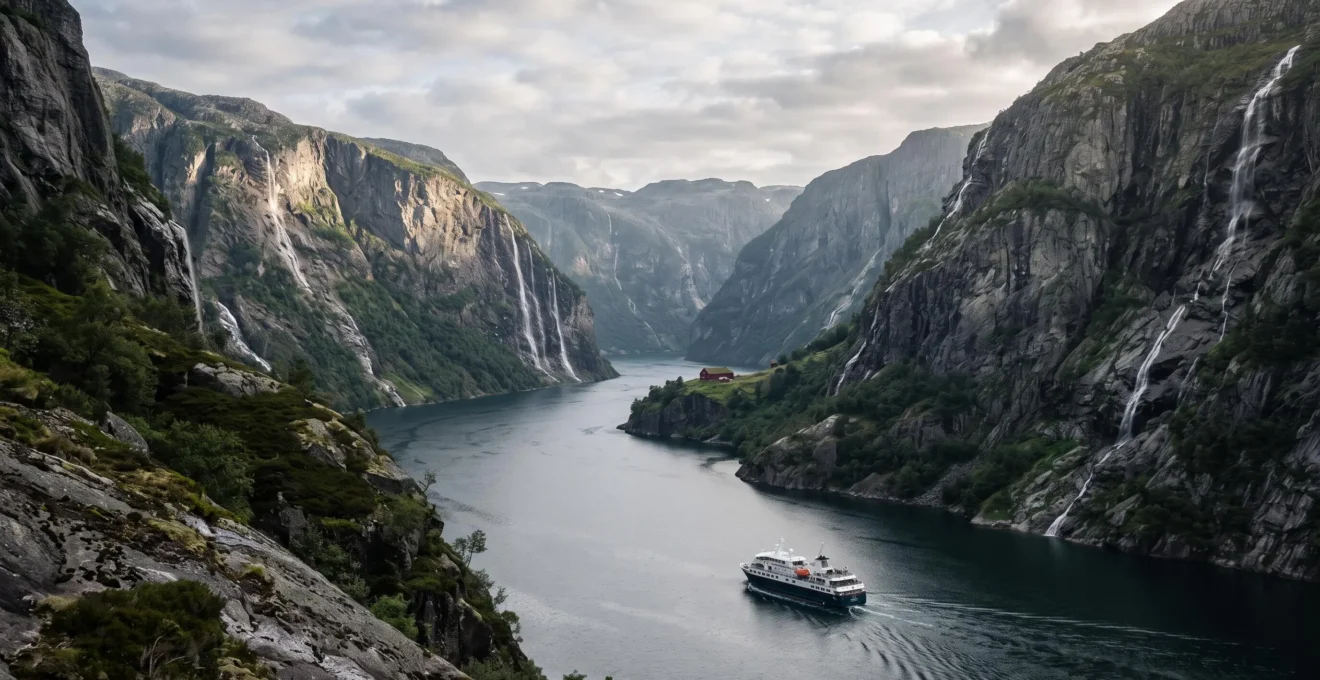
In summary:
- Understand the distinct character of each fjord: Geirangerfjord offers grand, open scale, while Nærøyfjord provides dramatic, narrow intimacy.
- Recognize that seeing both UNESCO fjords requires strategic planning, often involving a combination of sea and land travel, not a single cruise loop.
- Distinguish between a cruise ship’s “destination” focus and a coastal ferry’s “transport” role to align the vessel with your travel style.
- Choose your season wisely: Midnight Sun (summer) for energy and long days, or Autumn for moody atmosphere and fewer crowds.
- Select your ship type based on priority, from ultimate luxury to adventure-focused expedition vessels with exclusive access.
For first-time visitors, the promise of cruising through Norway’s fjords is the promise of witnessing nature at its most theatrical. The towering cliffs, cascading waterfalls, and serene, deep-blue waters are iconic. Yet, this dream can quickly become a logistical puzzle, especially for cruisers aged 50-75 aiming to experience the crown jewels: the UNESCO-listed Geirangerfjord and Nærøyfjord. Many tour brochures present them as interchangeable highlights on a map, leading to confusing itineraries and missed opportunities. The common advice is to simply pick a cruise that “visits the fjords,” but this approach often overlooks critical differences in geography and vessel philosophy.
The real challenge isn’t just seeing the fjords; it’s experiencing them in a way that does justice to their unique character. But what if the key wasn’t simply choosing a destination, but consciously designing your journey? The secret to a truly unforgettable fjord experience lies not in a checklist of sights, but in understanding the geographical logic that dictates travel flow and the distinct operational philosophy of the ships that navigate these waters. This guide moves beyond the surface-level highlights to provide a strategic framework for planning your route.
We will dissect the unique personality of each fjord, compare the very different experiences offered by large cruise ships versus local coastal ferries, and explore how factors like season and even fog can shape your journey. By the end, you will be equipped to choose a route and vessel that perfectly aligns with your vision of the ultimate Norwegian fjord adventure, ensuring your time is spent in awe, not in regret.
This comprehensive guide is structured to walk you through every critical decision point for planning your Norwegian fjord cruise. Below, the table of contents outlines the key topics we will cover, from understanding the fundamental appeal of the fjords to making the final choice between different ship styles.
Summary: A Strategic Guide to Norway’s Premier Fjord Cruises
- Why Do Norwegian Fjords Rank as Europe’s Most Dramatic Cruise Destination?
- How to Choose Fjord Cruise Routes to See Geirangerfjord and Nærøyfjord?
- Coastal Ferry vs Cruise Ship: Which Offers Better Norwegian Fjord Experiences?
- The Fog Phenomenon That Obscures Norwegian Fjord Views for 30% of Cruisers
- Should You Cruise Norwegian Fjords in Midnight Sun or Autumn Colours?
- Why Do Patagonian Glaciers Offer Photography Impossible Anywhere Else on Earth?
- Why Do Slow Travellers Report Higher Satisfaction Than Fast-Paced Tourists?
- How to Choose Between Luxury and Adventure-Focused Expedition Ships?
Why Do Norwegian Fjords Rank as Europe’s Most Dramatic Cruise Destination?
The magnetic pull of the Norwegian fjords stems from a scale and grandeur sculpted over millennia. These are not simply coastal inlets; they are deep, glacially carved valleys flooded by the sea, the result of a geological process spanning 2.5 million years that created over 1,000 distinct fjords along Norway’s coastline. This immense geological timeline has crafted a landscape of extremes: sheer rock walls plunging thousands of feet into dark, tranquil waters, creating a sense of being enveloped by the earth itself. It is this verticality and raw power that sets them apart from any other coastal scenery in Europe.
More than just geological wonders, the West Norwegian Fjords, specifically Geirangerfjord and Nærøyfjord, are recognized by the highest global authority on natural and cultural significance. The UNESCO World Heritage Committee inscribed them on its prestigious list, citing their “outstanding natural beauty.” As the committee noted, they are considered among the most scenically exceptional fjord areas on the planet. This designation is not given lightly; it confirms that their combination of narrow, dramatic cliffs, numerous waterfalls, and free-flowing rivers constitutes a landscape of superlative and universal value.
This combination of raw geological power and officially recognized beauty makes a fjord cruise more than a simple sightseeing trip. It is an immersion into a primordial landscape where the forces of ice and time are visible in every cliff face and hanging valley. For a cruise passenger, this translates into a constantly evolving panorama of breathtaking scale, where the ship itself feels dwarfed by the environment, delivering a humbling and deeply memorable travel experience that is simply unmatched elsewhere on the continent.
How to Choose Fjord Cruise Routes to See Geirangerfjord and Nærøyfjord?
Choosing between Geirangerfjord and Nærøyfjord is the central dilemma for many first-time cruisers, but framing it as an “either/or” choice is a mistake. The key is to understand their profoundly different characters and plan accordingly. Geirangerfjord is about raw power and grand scale, famous for its iconic waterfalls like the Seven Sisters plunging down steep cliffs into a wide, open basin. Nærøyfjord, in contrast, offers claustrophobic intimacy. It is defined by its extreme narrowness—a mere 250 meters at its tightest point—with cliffs soaring up to 1,700 meters, creating a breathtakingly dramatic and enclosed atmosphere.
Because they offer such different experiences, the ideal strategy is not to pick one, but to design an itinerary that includes both. A common misconception is that a single cruise can easily cover both. Geographically, they are separated by significant distance, making a combined visit on a single day-trip or short cruise loop impractical. The most effective approach treats each fjord as a distinct destination, requiring separate travel logistics. The following comparative table highlights their key differences, helping you understand why they are complementary, not interchangeable.
| Criteria | Geirangerfjord | Nærøyfjord |
|---|---|---|
| Character | Raw power, iconic waterfalls, grand scale | Claustrophobic intimacy, extreme narrowness |
| Length | 15 km | 17 km |
| Narrowest width | Wide, open basin | 250 meters |
| Cliff height | Steep cliffs framing waterfalls | Up to 1,700 meters |
| 2024 cruise passengers | 510,049 (Norway’s 4th busiest cruise port) | Hundreds of thousands annually via Norway in a Nutshell |
Successfully navigating these two UNESCO sites requires a deliberate plan. Instead of a rushed tour, a more thoughtful approach involves basing yourself in a hub city and using a mix of ferry, bus, and rail to experience each fjord’s unique personality fully. This method ensures you have ample time to absorb the distinct atmosphere of each location.
Your 5-Step Fjord Itinerary Audit
- Points of Contact: List your primary access points. Base yourself in a hub like Bergen for Nærøyfjord and consider Ålesund as a gateway for Geirangerfjord.
- Collect Itinerary Components: Inventory the travel segments needed—local fjord cruise on Nærøyfjord (e.g., Gudvangen-Flåm), rail/bus connections (e.g., Flåm Line), and the separate journey north to the Geirangerfjord area.
- Check for Coherence: Confront your plan with the map. Does the flow make geographical sense? Avoid backtracking by planning a linear north-south or south-north route.
- Assess the Experience: Review your plan. Are you treating each fjord as a dedicated day trip to savor its unique character, or are you rushing to tick boxes? Prioritize immersive time over a packed schedule.
- Integrate and Book: Finalize your multi-part journey by booking the distinct components. Secure your spot on the “Norway in a Nutshell” style tour for Nærøyfjord and the separate cruise for Geirangerfjord.
Coastal Ferry vs Cruise Ship: Which Offers Better Norwegian Fjord Experiences?
The choice between a traditional cruise ship and a Norwegian coastal ferry (like Hurtigruten or Havila) is a decision about your entire travel philosophy. A cruise ship is a floating destination. Its primary purpose is tourism, offering extensive onboard amenities, entertainment, and leisurely-paced port calls designed for sightseeing. The experience is curated for passenger comfort and enjoyment, with the journey itself being a central part of the vacation. In contrast, the coastal ferry is a working lifeline. Its fundamental mission is transportation—moving local passengers, mail, and essential cargo between 34 ports along the coast, day and night, all year round.
This difference in “operational philosophy” has profound implications for your fjord experience. As one account of the coastal route notes, the ferry “may arrive in the middle of the night, open its doors briefly for cargo and local passengers, then continue north or south before most tourists have finished their coffee.” This illustrates the transport-first mentality. While these ferries traverse the same stunning landscapes, the rhythm is dictated by logistics, not leisure. This “working ship” dimension offers an authentic glimpse into Norwegian coastal life that a large cruise ship, isolated from local commerce, cannot provide.
This public service mission is so critical that the route receives a Norwegian government subsidy of around NOK 788 million annually to ensure its reliability. For the traveler, this means choosing between two distinct models. The cruise ship offers a polished, comfortable, and scenery-focused bubble. The coastal ferry offers a more rugged, authentic, and immersive connection to the places it serves. There is no right or wrong answer; the better choice depends entirely on whether you prioritize resort-style travel or an authentic transportation experience.
The Fog Phenomenon That Obscures Norwegian Fjord Views for 30% of Cruisers
While marketing brochures exclusively feature sun-drenched fjord photos, the reality of Norway’s maritime climate includes a significant variable: fog. This is not a rare occurrence but a recognized atmospheric risk for cruisers. The complex interplay between cold fjord water, humid air, and shifting temperatures creates ideal conditions for dense fog banks, which can roll in quickly and obscure the very views you traveled thousands ofmiles to see. Travel experts acknowledge that fog can impede visibility in Norway’s fjords, turning a much-anticipated sail-in into a wall of white. While no official statistics exist for “ruined views,” anecdotal evidence and cruiser reports suggest this phenomenon significantly impacts a notable portion of sailings, particularly in the early mornings.
Rather than being a source of anxiety, fog should be treated as a manageable variable. The key is not to hope for perfect weather but to have a strategy to maximize your viewing chances regardless of conditions. This involves a proactive mindset and a few practical adjustments to your routine. An early start, flexible viewing positions, and appropriate clothing can make the difference between a complete white-out and a memorable, atmospheric experience. In fact, many photographers seek out these conditions for the moody, ethereal quality they lend to the landscape.
By preparing for the possibility of fog, you can mitigate its impact and even learn to appreciate the unique beauty it creates. The following tips form a practical toolkit for any cruiser heading into the fjords, ensuring you are ready for whatever the Norwegian weather has in store:
- Get up early for the sail-in: Morning light is often best, and an early start gives you a second chance if fog develops later.
- Position yourself on a top deck: This provides 360-degree views and is far superior to a private balcony, which can have its view blocked by fog on one side of the ship.
- Check local conditions before excursions: Norway’s weather is notoriously fickle; what starts as a foggy morning can become a clear afternoon.
- Pack for changeable weather: Having layers, a hat, and an umbrella allows you to stay on deck comfortably, waiting for the fog to lift, rather than retreating inside.
Should You Cruise Norwegian Fjords in Midnight Sun or Autumn Colours?
Choosing when to cruise the Norwegian fjords is a trade-off between energy and atmosphere. The two most popular seasons, summer and autumn, offer dramatically different experiences, and the best choice depends entirely on your personal preferences for light, temperature, and crowds. Summer, from June to August, is the season of the Midnight Sun. North of the Arctic Circle, the sun doesn’t set for weeks, creating a vibrant, high-energy atmosphere with seemingly endless daylight for activities like hiking and late-night kayaking. As noted by Fred. Olsen Cruise Lines, “the sun doesn’t set in Tromsø, which creates long golden hours that make fjord landscapes glow.” This extended “golden hour” is a photographer’s dream.
Autumn, from September to November, presents a completely different character. The days grow shorter, and the landscape transforms. The vibrant greens of summer give way to a rich palette of gold, orange, and red, creating a stunning contrast against the dark cliffs and deep blue water. The atmosphere becomes more moody and contemplative. As a significant bonus, the summer crowds dissipate, leading to quieter ports and a more intimate experience with the landscape. While temperatures are cooler, the crisp air and dramatic, low-angled light offer their own unique and powerful beauty.
Ultimately, there is no single “best” time to go. The decision hinges on what you value most in a travel experience. Do you seek the boundless energy and 24-hour daylight of a Nordic summer, or are you drawn to the quiet, dramatic beauty and rich colours of autumn? The following table breaks down the key factors to help you make an informed choice.
| Factor | Midnight Sun (Summer) | Autumn |
|---|---|---|
| Daylight | Sun doesn’t set for weeks, extended golden hours | Shifts from long lingering nights in September to crisp November nights |
| Temperature | 15°C–25°C, mild and calm | 10°C–15°C, cool and crisp |
| Atmosphere | Vibrant, energetic, ideal for hiking and late kayaking | Dark cliffs, deep water and vibrant foliage create a moody contrast |
| Crowds | Busiest season | Fewer tourists, quieter ports |
Why Do Patagonian Glaciers Offer Photography Impossible Anywhere Else on Earth?
While Norwegian fjords are defined by their rock walls and water, Patagonian glaciers offer a different kind of photographic subject: ancient, dynamic ice. What makes Patagonian ice unique for photographers is its incredible density and vibrant colour. Unlike younger, whiter alpine glaciers, Patagonian ice has been compressed over millennia, squeezing out air bubbles. This process turns the ice into a natural filter that absorbs every colour of the spectrum except blue, which it transmits. The result is a deep, otherworldly blue that seems to glow from within, a phenomenon that is exceptionally pronounced in the massive, fast-moving glaciers of this region.
Furthermore, the accessibility and behaviour of these glaciers create unparalleled photographic opportunities. Glaciers like Perito Moreno in Argentina are among the few in the world that are stable or advancing, leading to dramatic calving events where building-sized icebergs crash into the water. This constant activity provides a dynamic element of action and scale that is rare elsewhere. Photographers can capture not only the static beauty of the ice wall but also the explosive power of nature in motion. This combination of colour, texture, and action is a trifecta for compelling landscape photography.
At a macro level, the ice itself becomes an abstract subject. Close-up shots reveal intricate patterns of fractures, trapped air bubbles tracing ancient flows, and crystalline structures. This allows a photographer to tell a story on multiple scales: the vast, panoramic landscape; the dramatic, active glacier front; and the intimate, abstract beauty of the ice itself. It is this multi-layered visual potential, from the grand to the minute, that makes Patagonian glaciers a uniquely rewarding subject, offering a richness of detail and colour that is truly impossible to replicate anywhere else on Earth.
Why Do Slow Travellers Report Higher Satisfaction Than Fast-Paced Tourists?
In a world of whirlwind tours and checklist tourism, the concept of “slow travel” has emerged as a powerful counter-narrative. The core idea is simple: prioritize depth over breadth. Instead of rushing to see as many sights as possible, slow travellers choose to spend more time in fewer locations, fostering a deeper, more meaningful connection with the place, its culture, and its people. This shift in mindset appears to have a profound impact on overall trip satisfaction. It’s not just a philosophy; it’s a measurable phenomenon.
The link between the pace of travel and happiness is not merely anecdotal. Academic studies have explored this connection, revealing a strong correlation. For example, research into slow tourism motivations found that the slow tourism process explained an impressive 43% of the variance in tourist satisfaction. This suggests that the *how* of travel—the process of immersing oneself, taking time, and engaging with a location—is nearly as important as the *what*—the destination itself. Fast-paced travel can often induce stress and a sense of being on a “hedonic treadmill,” where the pressure to see the next thing prevents enjoyment of the present moment.
Slow travel, by its nature, allows for serendipity. It creates space for unplanned discoveries, spontaneous conversations with locals, and the simple pleasure of observing daily life. This approach changes the traveller from a passive consumer of sights into an active participant in an experience. By reducing the logistical stress of constant movement and the mental burden of a packed itinerary, travellers can more fully absorb their surroundings, leading to more vivid memories and a greater sense of fulfillment. In essence, they are trading a long list of ticked boxes for a shorter list of deeply felt experiences.
Key Takeaways
- The best Norwegian fjord experience comes from understanding the unique “personality” of each fjord, not just ticking them off a list.
- Your choice of vessel—a comfort-focused cruise ship or a transport-oriented coastal ferry—will fundamentally define the nature of your trip.
- Strategic planning that accounts for geography, season, and even weather risks like fog is essential to avoid disappointment and maximize your experience.
How to Choose Between Luxury and Adventure-Focused Expedition Ships?
Once you’ve decided on a route and season, the final crucial choice is the ship itself. In the Norwegian fjords, the spectrum of options has expanded far beyond the traditional large cruise liner. The decision now often comes down to a trade-off between refined luxury and active adventure. Your priority—be it ultimate comfort, unstructured discovery, or exclusive access—should guide your selection. Luxury ships, like those from Seabourn or Viking, offer a highly polished experience with five-star service, gourmet dining, and spacious suites, focusing on scenic cruising from a comfortable, elegant platform.
On the other end of the spectrum are the adventure-focused expedition ships, such as those operated by Scenic or Hurtigruten Expeditions. These smaller vessels are built for exploration. Their key feature is not a formal dining room, but a fleet of Zodiacs, kayaks, and an onboard Expedition Team of geologists, marine biologists, and historians. The focus is on getting off the ship and into the landscape. Hurtigruten, for example, leverages its smaller ships to gain exclusive access, noting that “as well as visiting big hitters like Geirangerfjord and Trollfjord, we also sail into little-known Hjørundfjord – and are the only cruise line to do so.” This model combines scenic sailing with guided hikes, local insights, and the ability to reach fjords inaccessible to larger vessels.
Between these two poles lie hybrid options, such as the small, relaxed yachts of Windstar, which offer a more intimate, less structured cruise experience. The choice is no longer one-size-fits-all. It requires an honest assessment of your travel style. Are you looking for a floating luxury hotel with stunning views, or a floating basecamp for active exploration? The table below categorizes the main options to help you align a ship with your priorities.
| Priority | Ship type | Example |
|---|---|---|
| Ultimate comfort & scenery | Refined luxury ships on longer routes | Seabourn Ovation, Seabourn Encore |
| Unstructured discovery | Expedition-style ships with Zodiacs | Scenic Eclipse, Scenic Eclipse II |
| Relaxed yacht-style cruising | Small yacht cruising | Windstar Star Legend, Star Explorer |
| Modern destination-led design | Larger scenic-focused ocean ships | Viking Sky, Viking Saturn |
Now that you are equipped with a strategic framework for choosing your route, season, and ship, the next logical step is to start exploring the specific itineraries that match your criteria. Begin by comparing the offerings of a luxury line, an expedition company, and a coastal ferry to see how their different philosophies translate into real-world schedules and port calls.