Choosing a science-focused Antarctic cruise hinges on one key skill: verifying an operator’s commitment to substantive engagement, not just its marketing promises.
- A station visit’s value lies in direct interaction with scientists and understanding ongoing research, not just a photo opportunity.
- Genuinely educational programs feature hands-on citizen science that contributes to real-world studies, a clear distinction from passive lectures.
Recommendation: Use a critical checklist to question an operator’s scientific claims, success rates for landings, and the expertise of their expedition team before booking your voyage.
For the intellectually curious traveller, an Antarctic voyage promises more than just otherworldly landscapes of ice and light. It offers a rare window into one of the planet’s most critical scientific frontiers. Yet, many expedition itineraries present a beautiful but ultimately passive experience: stunning views from a distance. The common advice is to simply “check the itinerary” for a research station visit, but this approach often falls short. It equates a mere pin on a map with a deep, educational encounter.
The reality is that the difference between a scenic tour and a substantive scientific journey is vast. It involves understanding the types of research conducted, the accessibility of different bases, and the calibre of the onboard educational program. Many travellers are drawn to the idea of “citizen science” but struggle to discern between genuine, data-gathering activities and what amounts to light “edutainment.” This can lead to a feeling of missed opportunity—a journey to the end of the Earth that only scratches the surface.
But what if the key wasn’t just *if* a station is listed, but *how* you can verify the depth and integrity of the entire scientific offering? This guide shifts the perspective. It’s not about passively accepting an itinerary; it’s about actively vetting it. We will explore the framework for transforming your trip from a simple sightseeing cruise into a profound educational expedition. You will learn how to identify the hallmarks of a truly science-focused voyage, what to expect from a meaningful station visit, and the critical questions you must ask to ensure your Antarctic experience delivers the intellectual enrichment you seek.
This article provides a detailed roadmap for making that choice. We will cover why these visits are so transformative, how to critically assess itineraries, what you can realistically experience, and how to identify expedition ships that are genuinely committed to science.
Summary: Navigating the World of Science-Focused Antarctic Expeditions
- Why Do Research Station Visits Transform Antarctic Expeditions From Scenic to Substantive?
- How to Choose Antarctic Cruises That Visit Active Research Stations?
- What Can You Actually Experience During Antarctic Research Station Visits?
- The Research Station Visit Cancellation That Affects 40% of Antarctic Itineraries
- How to Choose Antarctic Cruises With Strong Scientific Lecture Programmes?
- How to Identify Genuinely Educational Activities From Basic Childminding?
- Why Do Expedition Ships Offer Experiences Impossible on Ocean Liners?
- How to Choose Between Luxury and Adventure-Focused Expedition Ships?
Why Do Research Station Visits Transform Antarctic Expeditions From Scenic to Substantive?
An Antarctic expedition is inherently awe-inspiring, but a visit to an active research station elevates the journey from passive observation to active engagement. It bridges the gap between the continent’s breathtaking beauty and the critical science unfolding upon it. Antarctica is not a museum; it is a living laboratory governed by the Antarctic Treaty, where, as of 2023, dozens of nations actively operate research stations. Stepping ashore at one of these outposts is to step into the human story of polar exploration and discovery.
The experience provides a tangible connection to science that lectures alone cannot replicate. You are no longer just a tourist; you become a witness to the dedication, challenges, and breakthroughs of polar research. This direct human connection is what creates a truly substantive experience. Shaking the hand of a meteorologist who has overwintered in total darkness or speaking with a biologist studying extremophiles offers a perspective that is both humbling and profoundly inspiring.
These visits ground abstract scientific concepts in a physical place, turning historical footnotes into living realities. You see the instruments, hear the stories, and feel the palpable sense of purpose that permeates these remote communities. This shift from scenic to substantive is not just an added bonus; for many discerning travellers, it is the very heart of the modern Antarctic experience.
Case Study: Vernadsky Station and the Birth of a Global Discovery
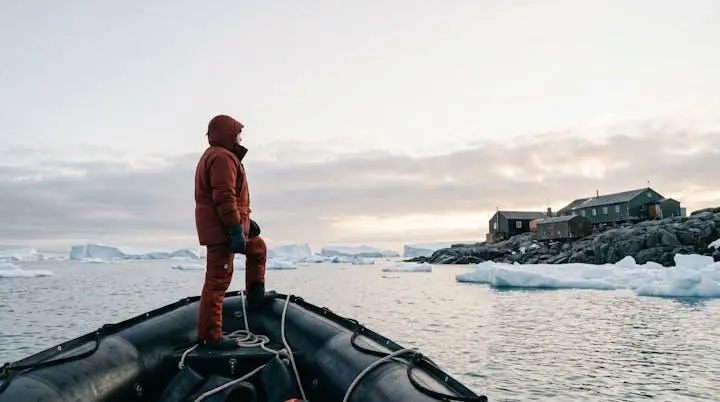
Originally Britain’s Faraday Station, Vernadsky Station on Galindez Island provides a powerful example of this connection. The base is renowned for its long-term atmospheric measurements which first revealed the depletion of the ozone layer. For a visitor, touring the facility and seeing the Dobson spectrophotometer that collected this crucial data offers a ‘ground zero’ link to a landmark discovery in planetary science. It transforms a global environmental issue into a story of specific people in a specific place, a story in which you can briefly, tangibly participate.
How to Choose Antarctic Cruises That Visit Active Research Stations?
Identifying a cruise that genuinely facilitates meaningful station visits requires more than a cursory glance at an itinerary. The key lies in scientific vet-ability—the process of scrutinizing an operator’s claims. Your first step is to understand that stations vary widely in their purpose, accessibility, and willingness to host visitors. An operator’s ability to navigate these complexities is a strong indicator of their expertise.
Some stations, like Chile’s Frei Base on King George Island, are part of larger logistics hubs and are more frequently accessed by fly-cruise itineraries. Others, like the UK’s Rothera Station, are major research centres that rarely permit landings, allowing only views from the water. Then there are visitor-friendly outposts like Ukraine’s Vernadsky or certain Argentinean bases, which more regularly welcome small groups of expedition travellers. Knowing these distinctions is crucial for setting realistic expectations.
Beyond the station’s name, investigate the operator’s track record. A reputable company will be transparent about the likelihood of a successful landing, which is always subject to weather and ice conditions. They should be able to provide statistics on their success rate for a specific station over past seasons. Lack of such operational transparency is a red flag. The best operators have robust contingency plans and expedition teams with the experience to make opportunistic landings at secondary sites if the primary objective is inaccessible.
The following table gives an overview of some well-known Antarctic Peninsula stations, highlighting their diverse scientific missions and general accessibility for tourists. This context is vital for discerning which itinerary promises are realistic.
| Station | Operating Country | Primary Scientific Focus | Typical Tourist Accessibility |
|---|---|---|---|
| Vernadsky | Ukraine | Atmospheric physics, ozone and climate monitoring | Regularly visited by expedition cruises; station tour and bar visit possible |
| Rothera | United Kingdom | Marine biology, glaciology, ice-shelf monitoring | Rarely landed; mostly viewed from the water during Peninsula transits |
| Esperanza | Argentina | Biology, meteorology, year-round community research | One of the few permanent settlements open to occasional landings |
| Frei | Chile | Geology, biology, atmospheric monitoring | Reachable via fly-cruise itineraries landing at the King George Island airstrip |
What Can You Actually Experience During Antarctic Research Station Visits?
A visit to an Antarctic research station is a highly structured and brief encounter, designed to minimize disruption to scientific work while maximizing educational value for visitors. Typically, you can expect a guided tour lasting one to two hours. This is not a casual wander but a curated walk-through of specific areas, often including a main science lab, a communications room, and common living quarters. The highlight is the opportunity for direct, informal conversation with the scientists and support staff who live and work there.
During these interactions, you can ask questions about their specific research projects—from monitoring penguin populations to analysing ice cores—and gain insight into the daily realities of life at the bottom of the world. Some stations have small gift shops where you can buy unique souvenirs and post letters with an Antarctic postmark, with proceeds often supporting the station’s welfare fund. At Ukraine’s Vernadsky Station, a visit to the famous Faraday Bar for a shot of home-distilled vodka is a memorable tradition.
Crucially, these visits help contextualize the “citizen science” programs that are increasingly a feature of expedition cruises. After seeing the professional equipment in a lab, participating in a phytoplankton tow from a Zodiac takes on new meaning. You understand that your small contribution is part of a much larger scientific endeavour. This sense of purpose is deeply rewarding; indeed, a NASA-backed study found that 97% of respondents reported high satisfaction from participating in such programs.
For many thoughtful travellers, participating in science is a way to transition from feeling like an intruder to feeling like a contributor, a sentiment captured perfectly by one participant:
I was worried that I would feel guilty being a tourist in a place as remote and untouched as Antarctica.
– Anonymous FjordPhyto participant, NASA Science – Polar Tourists Give Positive Reviews to NASA Citizen Science in Antarctica
The Research Station Visit Cancellation That Affects 40% of Antarctic Itineraries
The single most important factor governing any Antarctic activity is the weather. It is a powerful and unpredictable force that can change in minutes, turning a calm, sunny bay into a maelstrom of wind and ice. It is a fundamental reality that every reputable operator plans for, and it is the primary reason why a planned research station visit might be cancelled. While no official statistics exist for all operators, experienced expedition leaders privately estimate that up to 40% of *scheduled* station landings may be altered or cancelled due to unforeseen conditions.
The most common culprits are fast-moving sea ice (or “brash ice”) blocking the station’s landing site, or high katabatic winds making Zodiac operations unsafe. A station that was accessible in the morning can become completely unreachable by the afternoon. This is not a sign of a poor itinerary, but a testament to the operator’s commitment to safety, which always takes precedence. An experienced captain will never risk passenger or crew safety to meet an itinerary goal.
However, you can take steps to mitigate this risk. The timing of your voyage is significant. While every part of the season has its merits, weather is most unstable in the earliest and latest months of the season (November and March). Choosing a sailing during the high summer months of December and January generally offers more stable and predictable conditions, increasing the probability of a successful landing.
Furthermore, the choice of vessel matters. Smaller, more manoeuvrable ice-class ships often have a better chance of navigating into tight, ice-choked bays where some stations are located. They require less complex logistics for landings compared to larger vessels. Ultimately, the best approach is to view a station visit as a privileged opportunity, not a guarantee. Choose an operator whose onboard program is so rich and engaging that even if a landing is cancelled, your journey remains intellectually fulfilling.
How to Choose Antarctic Cruises With Strong Scientific Lecture Programmes?
A strong scientific program extends far beyond a single station visit; it is woven into the daily fabric of the expedition. The hallmark of a superior program is its emphasis on experiential learning over passive reception. While all expedition cruises offer lectures, the best ones treat them as a starting point, not the main event. They are designed to provide context for what you will see, do, and experience outside the lecture hall.
When vetting an operator, look at the credentials of their expedition team. They should have a diverse group of experts, including marine biologists, glaciologists, ornithologists, and historians, many with PhDs and active research backgrounds. These are not just guides; they are field scientists who can provide deep, nuanced answers to your questions. A top-tier operator invests in ongoing training for its team, ensuring they are not just reciting facts but are up-to-date with the latest polar science.
Case Study: The FjordPhyto Model of Active Guide Training
The FjordPhyto citizen science program exemplifies this commitment. Before each season, selected expedition guides receive specific training from research scientists. This empowers them to lead designated Zodiac cruises where they teach travellers to use oceanographic tools like Secchi disks and phytoplankton nets in real time. This model transforms the guide from a simple lecturer into a hands-on science facilitator, and the Zodiac from a sightseeing vehicle into a mobile research platform.
The most telling sign of a program’s scientific integrity is whether its citizen science efforts produce verifiable results. Ask if the data collected by passengers is contributed to recognized scientific bodies and if it has led to published research. For example, the programme’s data have been results presented at 30 scientific conferences and featured in nine peer-reviewed publications. This demonstrates a genuine commitment to science, not just “edutainment.” As phytoplankton ecologist Martina Mascioni notes, “There’s a lot of things that you can do just with simple equipment, and that’s where FjordPhyto leads.”
How to Identify Genuinely Educational Activities From Basic Childminding?
In the competitive Antarctic cruise market, the term “citizen science” is used frequently, but its meaning can vary dramatically. For the discerning traveller, the challenge is to distinguish between genuinely educational activities that contribute to real research and simplified “edutainment” designed merely to occupy guests. The key difference lies in hands-on participation and data contribution. A genuine program will have you doing, not just watching.
Authentic programs are often partnerships with established research institutions like NASA, the Scripps Institution of Oceanography, or non-profits like the Polar Citizen Science Collective. The presence of these partnerships is a strong signal of legitimacy. The scientific communicators onboard are often active researchers themselves, capable of explaining not just the “what” but the “why” of the data being collected. As one guest noted about their experience:
The 2 scientists from Wood’s Hole were excellent science communicators and well able to explain what they were studying and why.
– Guest review, Swoop Antarctica
The impact of these programs can be significant. For instance, whale fluke photos submitted by travellers to the Happywhale database, a platform used by researchers for tracking individual animals, have provided invaluable data on population distribution and migration. In a remarkable success story, data collected by passengers through the Happywhale programme led to a maximum cruising speed limit for ships around the Peninsula to reduce the risk of whale strikes. This is the ultimate proof of value: your holiday photos contributing directly to conservation policy.
To cut through the marketing language, you need a practical way to test an operator’s claims. The following checklist provides concrete points to look for that separate a substantive scientific activity from a superficial one.
Your Action Plan: The Hands-On Test for Spotting Genuine Science
- Ask if guests personally use equipment like a Secchi disk to measure water clarity, or if they only watch a demonstration.
- Inquire about live hydrophone sessions to listen for marine mammals, as opposed to simply playing pre-recorded audio in a lounge.
- Verify whether photos of whale sightings are actively submitted to a research platform like Happywhale for scientific use.
- Confirm that activities like cloud observation or phytoplankton sampling feed into a named, external research institution or project.
- Check if the expedition team includes dedicated science coordinators or specialists beyond generalist guides.
Why Do Expedition Ships Offer Experiences Impossible on Ocean Liners?
The ability to engage in science, visit research stations, and explore remote coastlines is predicated on one fundamental choice: travelling on a true expedition ship. The distinction between a small expedition vessel and a large, conventional cruise ship (or “ocean liner”) is the most critical one in Antarctic travel. While large ships can sail through Antarctic waters, they are forbidden by the Antarctic Treaty and IAATO (International Association of Antarctica Tour Operators) regulations from landing passengers if they carry more than 500 guests.
This single rule defines two completely different types of Antarctic experience. The “cruise-only” journey on a large vessel is one of passive observation from a distance. In contrast, an expedition ship is a purpose-built platform for exploration. These vessels are smaller (typically carrying 100-200 passengers), are ice-strengthened, and carry a fleet of Zodiacs specifically for off-ship excursions and landings. This is the only way to set foot on the continent, walk among penguin colonies, and visit research stations. The numbers clearly reflect this divide; IAATO’s category breakdown shows that traditional expedition tourism, carrying 69,059 landing passengers, vastly outnumbers the 28,360 cruise-only passengers in the 2024-25 estimates.
The very design and philosophy of an expedition ship are geared towards maximizing time off the vessel and engaging with the environment. They have dedicated “mud rooms” for preparing for Zodiac excursions, open bridge policies that allow you to watch the navigation and chat with the officers, and observation lounges designed for wildlife spotting. Their smaller size allows them to navigate narrow channels and shallow bays that are inaccessible to larger ships, opening up a world of discovery that ocean liners simply cannot reach.
These vessels are not just transport; they are an integral part of the scientific and exploratory experience. They function as a floating base camp, equipped for discovery and staffed by experts whose goal is to immerse you in the polar world, not insulate you from it.
Key Takeaways
- A “scientific” cruise is defined by verifiable actions—hands-on activities, expert-led training, and data contribution—not just marketing language.
- Question everything: an operator’s transparency about landing success rates, contingency plans, and team credentials is a key indicator of quality.
- Focus on the entire program’s integrity, from the lecture content to citizen science partnerships, to ensure a fulfilling journey even if a specific landing is cancelled.
How to Choose Between Luxury and Adventure-Focused Expedition Ships?
Once you’ve committed to a true expedition vessel, a final, more nuanced choice emerges: the style of the ship itself. The Antarctic expedition market, valued at roughly $800 million to $1.4 billion USD annually, has diversified significantly. Today, the choice is no longer simply between rustic and comfortable; it spans a spectrum from rugged, adventure-focused vessels to five-star luxury expedition ships.
Luxury expedition ships offer a high level of comfort, with spacious suites, fine dining, spas, and sometimes even helicopters or submarines. These ships appeal to travellers who want to explore in ultimate comfort without sacrificing the expeditionary spirit. Adventure-focused ships, while still comfortable and safe, prioritize function over form. Cabins may be smaller and amenities simpler, with the focus squarely on maximizing time in the field and fostering a communal, exploration-centric atmosphere. There is no “better” choice; it is entirely a matter of personal travel style and priorities.
It’s a mistake to assume luxury precludes serious science, or that a more basic ship guarantees a more authentic experience. Many high-end operators have invested heavily in state-of-the-art science labs and top-tier expedition teams. Conversely, some of the most storied and respected expedition vessels have a more traditional, no-frills feel. The key is to apply the same “scientific vet-ability” framework to both. A luxury ship’s submarine is only a scientific tool if it’s used for more than just a joyride; a rugged ship’s Zodiac cruise is only educational if led by a knowledgeable expert.
The market is seeing significant growth in the higher-end expedition segment, as shown by the planned passenger increases for operators in this space. This trend provides more options than ever for the discerning traveller.
| Operator | 2023-24 Passengers | 2024-25 Passengers (est.) | Growth |
|---|---|---|---|
| Atlas Ocean Voyages | 5,086 | 6,336 | +24.6% |
| Hapag-Lloyd Cruises | 1,541 | 2,550 | +65.5% |
Armed with this framework, you are now equipped to look past the glossy brochures and vet your options with the critical eye of an expedition specialist. The goal is to find an operator whose commitment to science is as vast and deep as the continent itself, ensuring your journey is not just a trip, but a true Antarctic education.