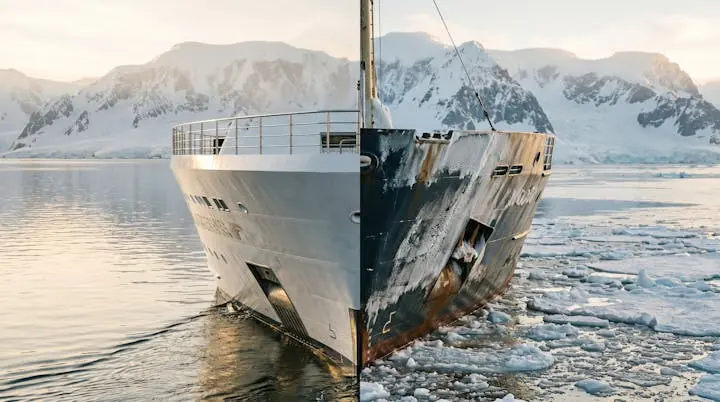
Choosing an expedition ship is not about sacrificing comfort for authenticity; it is a strategic decision about the *quality and type of access* you will have to the wilderness.
- A ship’s technical specifications—like its ice-class and Zodiac-to-guest ratio—are more important than its star rating as they directly dictate itinerary flexibility and time spent ashore.
- Smaller passenger counts (under 200) are not about being “basic”; they are a regulatory and practical necessity for maximizing landing opportunities in places like Antarctica.
Recommendation: Prioritize a ship’s expedition DNA and operational philosophy. Analyze its capacity for wilderness immersion, not just its onboard amenities, to ensure it aligns with your travel goals.
For the discerning traveller dreaming of the immense, silent landscapes of Antarctica or the Arctic, the choice of vessel can feel like a paradox. On one hand, the allure of a luxury expedition ship promises sublime comfort: fine dining, spacious suites, and spa services, all while navigating through a sea of icebergs. On the other, the call of the wild whispers of rugged, adventure-focused vessels, suggesting that true exploration requires forgoing creature comforts. Many guides will tell you the decision boils down to budget or personal travel style, reducing it to a simple trade-off between opulence and experience.
This perspective, however, misses the fundamental point. The most critical distinction between these ship categories is not the thread count of the sheets but the vessel’s core design as an access mechanism to the wild. The very architecture of a ship—its size, ice-strengthening, and fleet of landing craft—determines the spontaneity, intimacy, and depth of your engagement with the polar environment. A ship is not just your floating hotel; it is the key that unlocks specific types of experiences, some of which are physically impossible for others to offer.
This guide moves beyond the surface-level debate of luxury versus adventure. We will dissect the expedition DNA of these incredible vessels, exploring how technical specifications translate directly into the quality of your polar encounters. By understanding the “why” behind their design, you will be empowered to select a ship that doesn’t just transport you to a remote destination, but that facilitates the exact kind of immersive journey you envision.
Summary: Luxury vs. Adventure: How to Choose the Right Expedition Ship for Your Polar Voyage
- Why Do Expedition Ships Offer Experiences Impossible on Ocean Liners?
- How to Evaluate Expedition Ship Ice Class and Zodiac Capacity?
- Luxury Expedition vs Adventure-Focused: Which Ship Style for Antarctic First-Timers?
- The “Expedition Cruise” Label Used by Ships That Never Leave Port
- When Should You Book Expedition Cruises for the Best Polar Wildlife Encounters?
- Guided Expedition vs Independent Travel: Which for First-Time Remote Explorers?
- Local Operator vs International Chain: Which for Remote Destination Treks?
- How to Plan Multi-Stage Journeys to Reach Destinations Without Road Access?
Why Do Expedition Ships Offer Experiences Impossible on Ocean Liners?
The term “cruise” often conjures images of colossal ocean liners, floating cities that travel between bustling port cities. An expedition ship operates on a completely different philosophy. It is not a destination in itself, but a mobile basecamp designed to explore regions where ports, and sometimes even charts, are nonexistent. Their smaller size is their greatest asset, allowing them to navigate narrow fjords, shallow bays, and channels choked with ice that are inaccessible to larger vessels. This isn’t just a matter of convenience; it’s the fundamental enabler of a true wilderness experience.
This structural difference dictates the entire rhythm of the journey. While an ocean liner’s day is structured around onboard entertainment and shore excursions in developed towns, an expedition ship’s focus is almost entirely off-ship. The daily program is fluid, guided by wildlife sightings and weather conditions, with the primary activities being Zodiac cruises among icebergs and landings on untouched shores. This immersive approach is made possible by a low passenger count. For example, strict regulations mean that, in Antarctica, only 100 guests can land at any given time. A ship with 200 passengers ensures everyone gets maximum time ashore, whereas a ship with 400 means guests must take turns, halving their potential exploration time.
The table below highlights these core differences in operational philosophy. The onboard programming on an expedition ship consists of lectures from geologists, marine biologists, and historians who provide context to the environment you’re exploring. On an ocean liner, it’s theatre shows and gala balls. One is designed for deep environmental immersion; the other, for resort-style entertainment. This distinction is the first and most important filter when planning a polar voyage.
As this comparative analysis shows, the two models are built for entirely different purposes.
| Feature | Expedition Ship | Ocean Liner (Cruise Ship) |
|---|---|---|
| Passenger Capacity | Rarely carries over 250 people | Can carry over 6,000 passengers |
| Itinerary Focus | Off-ship experiences like shore landings and zodiac trips | A string of established ports for city exploration |
| Onboard Programming | Daily informative talks from onboard experts as standard | Theatre performances, cinema showings, live music, gala balls |
| Navigation | Small size allows traversing narrow channels and shallow bays | Requires deep-water ports and large terminals |
How to Evaluate Expedition Ship Ice Class and Zodiac Capacity?
Once you’ve committed to a genuine expedition vessel, the next layer of analysis involves its technical capabilities. Two of the most critical factors that define a ship’s expedition DNA are its ice class rating and its Zodiac capacity. These are not just technical jargon; they are direct indicators of the vessel’s ability to safely and efficiently get you into the heart of the action. An ice-strengthened hull is a prerequisite for any polar travel, but not all ice ratings are equal. The Polar Class (PC) notation, an international standard, ranks a ship’s ability to operate in different ice conditions.
A higher rating, like a PC5, means the ship can handle thicker, multi-year ice and can often operate for a longer season or push deeper into ice-filled channels than a more common PC6-rated vessel. While very few passenger ships have the highest ratings (reserved for scientific icebreakers), understanding the difference between a PC6 and a lower-rated ship is crucial. For instance, the world’s only PC2-rated passenger vessel is an actual icebreaker capable of breaking up to 2.5 metres of multi-year ice, allowing it to reach the geographic North Pole—a feat impossible for any other expedition ship. This illustrates how ice class directly translates to access.
Equally important is the Zodiac fleet. Zodiacs are the rugged inflatable boats that serve as the workhorses of any expedition, ferrying guests from the ship to shore landings and on intimate cruises around glaciers and wildlife. The crucial metric here is the Zodiac-to-guest ratio and the efficiency of deployment. The goal is to have enough boats and embarkation points to get all passengers off the ship quickly and simultaneously. A ship with a 1:10 guest-to-Zodiac-seat ratio and multiple loading platforms can launch an impromptu whale-watching excursion in minutes. This “spontaneity factor” is a hallmark of a true expedition, allowing the crew to react instantly to the opportunities the wilderness provides.
This table from a detailed industry analysis breaks down what these ratings mean in practice.
| Polar Class | Ice Conditions Handled | Practical Access Implication |
|---|---|---|
| PC1 (highest) | Extreme year-round polar ice | Very few passenger vessels carry this rating |
| PC5 | Year-round in medium first-year ice | Usually offers more access than PC6 ships in shoulder months |
| PC6 (most common) | Main polar destinations in primary season | Handles main polar destinations effectively but has less reach than PC5 vessels |
| PC7 (lowest) | Thin first-year ice only | Most limited range and seasonal window |
Luxury Expedition vs Adventure-Focused: Which Ship Style for Antarctic First-Timers?
For a first-time visitor to Antarctica, the choice between a luxury and an adventure-focused ship can be paralyzing. The “luxury” category, with operators like Silversea and Scenic, offers an exceptionally high level of comfort. Think butler service, multiple gourmet restaurants, and sometimes even helicopters or a submarine. These are not just amenities; they represent an “all-inclusive” philosophy where virtually everything, from top-shelf drinks to gratuities and even Wi-Fi, is bundled into the upfront cost. For travelers who value seamless service and a high-end hotel environment, this can be extremely appealing, with fares for 10-night Antarctica trips starting at over $10,000 per person.
On the other end of the spectrum are the “adventure-focused” or “traditional” expedition ships. These vessels are comfortable and safe, but their primary investment is in the expedition program itself. The focus is less on the breadth of onboard dining and more on the depth of the expert lecture series. Cabins are functional and well-appointed, but the real luxury is defined by the quality of the expedition team, the efficiency of Zodiac operations, and an itinerary designed for maximum time outdoors. This style often attracts a self-selecting crowd of passionate explorers, photographers, and nature lovers, fostering a strong sense of camaraderie.
So, which is right for a first-timer? The key is to honestly assess your priorities. It’s a misconception that luxury ships are less adventurous. Many have excellent expedition teams and robust off-ship programs. The primary difference is the onboard atmosphere and emphasis. If the idea of returning from a cold, wet Zodiac ride to a hot tub, a glass of champagne, and a choice of five restaurants is your definition of a perfect day, then a luxury ship is an excellent choice. If, however, you would rather spend that time in the lounge discussing the day’s sightings with a glaciologist and fellow passengers, and you see the ship primarily as a comfortable and efficient base for exploration, then a traditional adventure-focused vessel may be a better cultural fit. Neither is inherently better; they are simply different approaches to experiencing the same magnificent place.
The “Expedition Cruise” Label Used by Ships That Never Leave Port
As the popularity of expedition cruising has exploded, the “expedition” label has been co-opted by some operators for marketing purposes. This has created a category of “cruise-by” vessels—large ships that sail into Antarctic waters but are structurally and legally incapable of offering a true expedition experience. These ships might have an onboard naturalist or two, but they lack the fundamental tools for exploration. The most critical limiting factor is passenger count. Under the rules of the International Association of Antarctica Tour Operators (IAATO), which governs virtually all tourism on the continent, those Antarctic ships with more than 500 guests onboard are prohibited from making any landings. Passengers on these vessels can only experience Antarctica from the deck of their ship.
This is not an expedition; it is a scenic cruise. While visually impressive, it completely misses the essence of a polar journey: the humbling experience of standing on the continent, the sound of a penguin colony, and the thrill of navigating through an ice field in a small Zodiac. A true expedition ship is defined by its capabilities, not its marketing. As the experts at Wilderness Travel emphasize, it’s a purpose-built machine.
Operating in Antarctic waters responsively and comfortably requires an expedition ship specifically outfitted with an ice-strengthened hull, state-of-the-art navigation technology, a fleet of go-anywhere Zodiac landing craft, and a crew of officers and naturalist guides who are experts in this ecosystem.
– Wilderness Travel, Antarctic Cruise Ships: Compare Luxury Expedition Ships
To avoid disappointment, it is crucial to look past the brochure’s headlines and scrutinize the ship’s specifications. A ship carrying 1,000 passengers that lists “Antarctica” on its itinerary is selling a view, not an experience. The checklist below provides clear warning signs to help you identify a genuine expedition vessel from a pretender.
Action Plan: How to Spot a “Fake” Expedition Cruise
- Onboard Programming: Verify that the schedule is built around daily expert-led talks and briefings, not theatre shows, casinos, or gala balls, which are hallmarks of a port-focused liner.
- Itinerary Structure: Look for a focus on off-ship activities like Zodiac cruises and multiple shore landings per day, rather than a fixed schedule of sailing between established city ports.
- Ship Specifications: Confirm the passenger count is under 500 (ideally under 200 for maximum landing time) and that the ship is explicitly described as having an ice-strengthened hull and a full fleet of Zodiacs.
- Operator Language: Pay attention to whether the operator talks about “landings” and “exploration” or simply “scenic cruising” and “sailing by” key sights.
- Landing Guarantees: Check if the operator guarantees landing opportunities (weather permitting). A “cruise-by” operator cannot make this promise.
When Should You Book Expedition Cruises for the Best Polar Wildlife Encounters?
Timing your polar expedition is just as important as choosing your ship, as the wildlife and landscape change dramatically throughout the short austral summer season. The vast majority of voyages occur between November and March, with nearly 98% of tourism voyages operating in the Peninsula during this window. Each part of this season offers a different experience.
Early Season (November to early December) is a time of pristine beauty. The continent is draped in a heavy blanket of fresh snow, and the sea ice is still breaking up, creating dramatic, sculptural landscapes. For wildlife, this is the courtship and nest-building period for penguins. You’ll witness penguins stealing stones from each other’s nests and engaging in elaborate mating rituals. It’s also a great time for photographers seeking stark, high-contrast icy scenery.
Mid-Season (Mid-December to January) is the peak of summer, with longer daylight hours and the warmest temperatures. This is when penguin chicks begin to hatch, and colonies are bustling with activity as parents ferry krill back and forth to feed their hungry young. It’s a period of incredible energy and is often considered the prime time for general wildlife viewing. The sea ice has typically receded, allowing for deeper exploration of some bays and channels.
Late Season (February to March) offers the best opportunities for whale watching. As the krill blooms, large numbers of humpback, minke, and orca congregate in the Peninsula’s rich feeding grounds. You may also see more leopard seals. The penguin chicks are now fledging—losing their downy fluff and taking their first swims—which can be a chaotic and fascinating spectacle. The setting sun also begins to paint the sky with spectacular colours, a bonus for photographers.
Case Study: The Douglas Mawson and Expanding the Seasonal Frontier
The choice of ship and operator can also unlock regions beyond the standard Peninsula circuit. The newly launched Douglas Mawson, for example, demonstrates how a highly capable vessel can access rarer wildlife regions. Alongside its sister ships, it operates voyages that take travelers across the Antarctic Circle and into remote areas like East Antarctica and the Ross Sea. These multi-week odysseys, such as a “34-Day Epic Antarctic Odyssey,” operate on the fringes of the main season and go far beyond the typical wildlife circuit, targeting specific phenomena in less-visited locations.
Guided Expedition vs Independent Travel: Which for First-Time Remote Explorers?
For many of the world’s wild places, the debate between joining a guided tour and forging your own path is a valid one. For Antarctica, however, this is a settled question: independent travel is not a feasible or responsible option. The continent is governed by the Antarctic Treaty System, an international agreement that designates it as a natural reserve devoted to peace and science. Tourism is strictly managed through IAATO to minimize environmental impact, a framework that makes organized, guided expeditions the only practical and legal means of access for visitors.
The logistical and regulatory hurdles for an independent traveler are insurmountable. Every activity on the continent, from where a ship can anchor to where a person can walk, is subject to rigorous environmental protocols. During the 2024-25 season, it was confirmed that all commercial SOLAS passenger ship operators conducting tourism activities in the Antarctic Treaty Area were IAATO members, meaning 100% of tourist access is channeled through these vetted organizations. An operator acts as your access broker, handling not just the transportation but the complex web of permits, environmental impact assessments, and safety procedures required to set foot on the continent.
Case Study: Operator-Managed Biosecurity as an Access Broker
Biosecurity provides a clear example of why independent access is impractical. To prevent the introduction of non-native species, operators are required to meticulously check and decontaminate all equipment and clothing before and after every landing. For the 2024-2025 season, IAATO further tightened these rules, mandating that operators assess wildlife colonies for any signs of disease before allowing a landing and be prepared to close sites immediately if necessary. An independent traveler has no mechanism to perform these checks or obtain the permissions needed to land safely and legally, effectively barring them from the core Antarctic experience.
Therefore, the choice is not *if* you go with a guide, but *which* guided expedition you choose. The operator is your gateway, your safety net, and your environmental steward. They provide the ship, the expert guides, the Zodiacs, the permits, and the crucial operational framework that makes a journey to the world’s most remote wilderness both possible and responsible.
Local Operator vs International Chain: Which for Remote Destination Treks?
With a marketplace of over 70 Antarctica cruise ships now sailing the Southern Ocean, the choice of operator becomes a critical differentiator. The field can be broadly divided into large, international travel companies that offer polar expeditions as part of a global portfolio, and smaller, specialist operators whose entire identity is rooted in polar exploration. While both can offer excellent experiences, their “expedition DNA” is often quite different, and this can have a significant impact on your journey.
Large international chains, often part of major cruise corporations or luxury travel brands, bring the advantages of scale: often newer ships, extensive global marketing, and sometimes highly integrated booking and transfer systems. They may offer a very polished, consistent product that appeals to travelers seeking reliability and a certain standard of service. However, their expedition programs can sometimes feel like one of many products they offer, with a corporate structure that is several steps removed from the on-the-ground realities of polar exploration.
Specialist operators, by contrast, are often founded and run by people who are themselves seasoned polar explorers. Their entire business is built around a deep passion and expertise for these specific regions. This “deep bench” advantage often translates into a more nuanced and flexible expedition program. The company’s DNA is intrinsically linked to exploration, which can manifest in a more experienced expedition team, more creative itinerary planning, and a culture that prioritizes the off-ship experience above all else.
Case Study: A Specialist Operator’s Founding Roots in Polar Governance
AE Expeditions (part of Aurora Expeditions) perfectly illustrates the ‘deep bench’ advantage of a specialist. The company was founded in 1991 by the acclaimed Australian mountaineer Greg Mortimer, inspired by his own pioneering voyages to Antarctica. Crucially, the founders were also among the founding members of IAATO, the very body that governs Antarctic tourism. This means that deep polar expertise and a commitment to responsible travel were embedded in the company’s DNA from its inception, rather than being added as a feature to a pre-existing travel business.
Key Takeaways
- A true expedition ship is defined by its function as an access mechanism, with a passenger count under 500 (ideally under 200) being essential for Antarctic landings.
- A ship’s ice-class rating and Zodiac-to-guest ratio are critical metrics that directly determine the scope and spontaneity of your exploration.
- The choice between luxury and adventure is about your preferred onboard atmosphere and cultural fit, not necessarily a trade-off in the quality of the off-ship expedition.
How to Plan Multi-Stage Journeys to Reach Destinations Without Road Access?
Reaching the embarkation point for a polar expedition is an adventure in itself. For Antarctica, the vast majority of voyages depart from Ushuaia, Argentina, the southernmost city in the world. This small city acts as a critical gateway, and understanding its logistics is key to a smooth start to your journey. Ushuaia is a bottleneck, and its infrastructure is strained by the sheer volume of travelers. For the 2023-2024 season, the port handled a staggering 548 ship calls and an estimated 195,000 tourists, numbers that underscore the importance of meticulous planning.
The single most important rule is to arrive at your gateway city at least one full day before your ship is scheduled to depart. Most operators make this a mandatory recommendation. International flights can be delayed, and luggage can be lost. The ship, operating on a tight and complex schedule, absolutely cannot and will not wait for late passengers. Building in a buffer day is not a luxury; it is an essential form of trip insurance against the risk of missing the entire voyage. This buffer time is also a valuable opportunity to decompress from long-haul travel and begin transitioning into an expedition mindset.
The strain on gateway cities was highlighted in late 2025, when Ushuaia hosted a record-breaking nineteen cruise ships over just three days, with over ten thousand passengers disembarking. This demonstrates how hotels, restaurants, and local transport can be overwhelmed, making last-minute arrangements difficult. Use your buffer day productively: explore the town, visit the fascinating maritime museum, or take a short excursion on the Beagle Channel. This not only allows you to acclimatize but also enriches your overall experience, turning the necessary logistical stop into a memorable part of your journey to the end of the world.
Booking pre-and-post-voyage accommodation and transfers well in advance is highly advisable, either independently or through your expedition operator. A well-planned multi-stage journey ensures that you arrive at the gangway relaxed, prepared, and ready for the grand adventure ahead, rather than stressed and rushing.
Now equipped with this strategic framework, you can analyze ship brochures and operator websites not just for their promises of comfort, but for their demonstrated capacity to deliver the authentic, immersive polar experience you seek. Your ultimate adventure awaits.