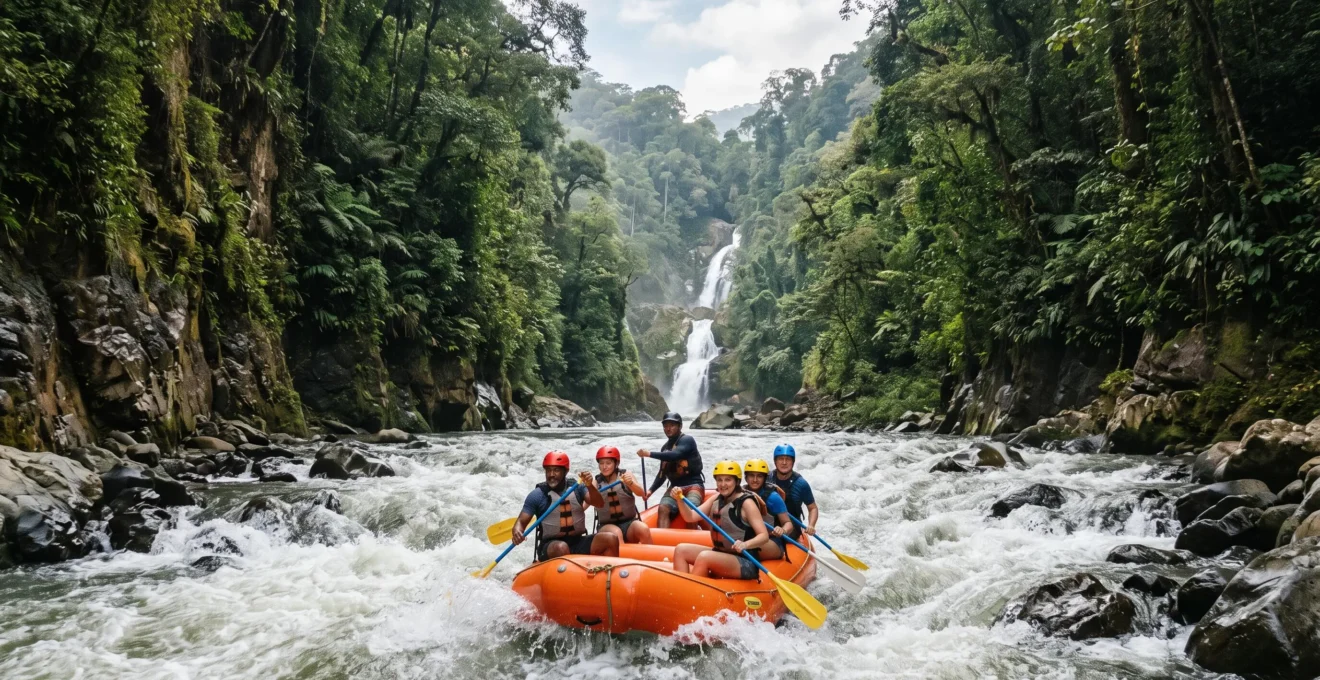
The secret to a perfect Costa Rican rafting trip isn’t the river’s class rating, but matching its fundamental structure to your group’s unique “Experience Spectrum.”
- A “pool-drop” river with calm sections between rapids is ideal for mixed-ability groups, giving nervous paddlers recovery time.
- Seasonal timing is critical; a Class III river in the dry season can become an intense Class IV during peak rainy months like October.
Recommendation: Diagnose your group’s blend of thrill-seekers and cautious members first, then select a river journey whose rhythm and logistics fit everyone, not just the most experienced.
Planning a whitewater rafting trip in Costa Rica feels like a dream. The promise of lush rainforest canyons, exotic wildlife, and world-class rapids is intoxicating. Yet, for the person in charge of the booking, it can quickly become a source of anxiety. You’re staring at a list of over a dozen rivers—Pacuare, Reventazón, Sarapiquí, Balsa—each with a cryptic Class II, III, or IV rating. The core problem isn’t just a lack of information, but a fear of making the wrong choice for your group, a group likely composed of a mix of eager adrenaline junkies and quietly apprehensive first-timers.
Most guides will tell you to simply match the river class to your skill level. But this advice often fails because it treats the group as a monolith. What if your brother-in-law is a seasoned kayaker, but your partner has never held a paddle? This is where the real challenge lies. The common approach of picking a “middle ground” river often results in an experience that is underwhelming for the experts and terrifying for the beginners. It’s a recipe for a tense van ride back to the hotel.
But what if the key wasn’t just the river’s power, but its personality? The true art of planning the perfect group rafting trip is to move beyond simple class ratings and instead focus on the river’s very structure and rhythm. This guide abandons the one-size-fits-all approach. We will teach you how to diagnose your group’s unique Experience Spectrum and select a trip architecture—from the river’s flow to its duration—that guarantees an unforgettable adventure for every single member of your crew. We’ll explore why the world-famous Pacuare might be perfect or completely wrong for you, how seasonal changes can dramatically alter a river’s character, and how to decode the industry jargon to make a truly informed decision.
To help you navigate these choices, this comprehensive guide breaks down everything you need to know. From understanding why certain rivers are globally renowned to the practical details of timing your trip, you’ll find the answers needed to plan with confidence.
Summary: A Strategic Guide to Costa Rica’s Whitewater
- Why Does Costa Rica’s Pacuare River Rank Among the World’s Top 5 Rafting Destinations?
- How to Match Costa Rican Rivers to Your Group’s Rafting Experience Level?
- Pacuare vs Reventazón: Which Costa Rican River for Families With Teens?
- The Seasonal Timing Error That Makes Costa Rican Rivers Unraftable
- When Do Costa Rican Rivers Offer the Best Whitewater Conditions?
- How to Choose Your First Whitewater Rafting Experience Based on Grade Ratings?
- How to Shortlist the Perfect Caribbean Island Based on Your Couple Profile?
- How to Choose Your First Whitewater Rafting Experience Based on Grade Ratings?
Why Does Costa Rica’s Pacuare River Rank Among the World’s Top 5 Rafting Destinations?
The Rio Pacuare isn’t just another river; it’s an icon in the adventure travel world. Its reputation is built on a rare combination of thrilling whitewater and profound, untouched wilderness. It’s widely recognized as one of the top five rafting rivers on the planet, not just for the quality of its Class III-IV rapids, but for the immersive journey it provides. To paddle the Pacuare is to disappear into a world that time seems to have forgotten, a deep, primordial canyon carved through dense primary rainforest.
What truly sets the Pacuare apart is its pristine, protected state. The river corridor is a vibrant ecosystem, home to jaguars, monkeys, sloths, and an incredible diversity of birdlife. This natural sanctuary exists thanks to a powerful conservation legacy. Decades of activism resulted in a landmark decision, and thanks to these conservation efforts, a law was passed protecting the river from hydroelectric development until at least 2040. This ensures the river flows freely, preserving its wild character and the stunning gorge scenery that defines the experience.
This commitment to preservation means a trip down the Pacuare is more than an adrenaline rush; it’s an intimate encounter with one of Central America’s most significant tropical wilderness areas. The towering canyon walls, draped in mist and echoing with the calls of toucans, create a sense of scale and isolation that few other commercially rafted rivers can offer. It’s this unique blend of raw adventure and ecological sanctity that cements its legendary status.
How to Match Costa Rican Rivers to Your Group’s Rafting Experience Level?
The single most important decision you’ll make is selecting a river that aligns with your group’s collective skill and, more importantly, its psychological comfort. This goes beyond looking at a simple class number. A group’s Experience Spectrum is diverse, and the perfect river is one whose very structure accommodates this. For a group with nervous first-timers, a “pool-drop” river—where intense rapids are followed by calm, gentle pools for recovery—is infinitely better than a river with continuous, non-stop whitewater, even if they have the same class rating.
The goal is confidence matching: ensuring the least experienced person feels safe and excited, not terrified. This is where you must become a trip diagnostician. Are you a crew of adrenaline junkies seeking a challenge, or a multi-generational family wanting a mix of splashes and wildlife spotting? The answer dictates not just the river, but the specific section you should run.
The following table provides a strategic starting point for this matching process, moving beyond simple class ratings to consider the overall trip architecture and group dynamic.
| Group Type | Recommended River | Typical Class | Why It Fits |
|---|---|---|---|
| Adrenaline Junkie Crew | Pacuare River / Reventazón | Class III-IV | Continuous, powerful rapids through a remote gorge |
| Multi-Generational Family | Sarapiquí River | Class II-III | Beginner-friendly with strong wildlife-spotting potential |
| Nervous First-Timers | Río Balsa / Río Peñas Blancas | Class I-III | Accessible near La Fortuna with calmer pools between rapids |
| Nature-Loving Couple | Pacuare River (multi-day) | Class III-IV | Remote jungle gorge scenery with eco-lodge stays |
Your Action Plan: Solving the Mixed-Experience Group Dilemma
- Group Sections: Identify if your river option offers distinct Class II/III and Class III/IV sections, as operators often group trips this way to manage mixed abilities.
- Analyze River Structure: Actively seek out a ‘pool-drop’ style river where intense rapids are followed by calm pools, giving nervous paddlers crucial recovery and enjoyment time.
- Inquire About Raft Types: Ask the tour operator if they can run an oar-rig (guide-powered) raft alongside paddle boats, providing a secure option for less confident members to still enjoy the journey.
- Verify Requirements: Before booking, confirm that the minimum age and weight requirements for the specific trip section match every single member of your group without exception.
Pacuare vs Reventazón: Which Costa Rican River for Families With Teens?
For families with teenagers, the choice often narrows to two giants of Costa Rican rafting: the Pacuare and the Reventazón. Both offer fantastic whitewater near the Turrialba region, but they provide fundamentally different experiences. The decision hinges on your family’s appetite for adventure, logistical preferences, and desired level of immersion. The Reventazón River, particularly its Florida and El Carmen sections, is often the go-to for a more accessible family adventure. As The Real Deal Tours notes, its Class II-III rapids make it welcoming for a wider range of ages and abilities; it’s a place where, as they say, “It is also perfect for mixed generations.”
In contrast, the Pacuare is a bigger commitment, both in intensity and duration. Its Class III-IV rapids demand more teamwork and a higher minimum age, but the reward is a deeper, more profound wilderness experience. The choice between a thrilling half-day trip on the Reventazón or an unforgettable overnight expedition on the Pacuare is a classic trip architecture dilemma.
The following comparison breaks down the key factors to help you decide which river’s personality best fits your family’s profile.
| Factor | Pacuare River | Reventazón River (Florida/El Carmen) |
|---|---|---|
| Rapid Class | Class III-IV | Class II-III |
| Minimum Age/Weight | Typically 12 years / 110 lbs | 6-9 years depending on section |
| Trip Structure | Full day or 2-3 day overnight at eco-lodge | Half-day, same-day return |
| Distance from San José | ~2.5 hours | Turrialba/Siquirres, similar distance |
| Nearby Activities | Remote, self-contained jungle experience | Closer to Turrialba volcano and canyoning tours |
For some, the Pacuare offers a chance to create a landmark family memory. One operator shared the story of a couple who had honeymooned on the river 23 years prior. They returned with their teenage children and mother-in-law, recreating the experience as a multi-generational adventure, complete with an overnight stay at a riverside eco-lodge. This highlights the Pacuare’s power as a setting for milestone family trips, provided everyone meets the age and fitness requirements for its more demanding waters.
The Seasonal Timing Error That Makes Costa Rican Rivers Unraftable
One of the most dangerous assumptions a planner can make is that a river’s class rating is static. In Costa Rica, seasonal volatility can transform a fun, splashy river into a raging, hazardous torrent. The “green season” (roughly May to November) brings rain, which swells the rivers. While this often creates more exciting whitewater, the peak rainy months of October and November can push water levels to extremes, making some rivers unsafe to run. A local guide memorably captured this transformation, saying, “During high water, the ‘Aye, mami!’ rapids become ‘Oh, crap!’ rapids.”
This isn’t just about a more intense ride; it’s a serious safety issue. Extremely high water can wash out eddies (calm spots for resting and recovery), submerge crucial navigational markers, and increase the power and unpredictability of rapids to a point where even expert guides deem them unraftable. Booking a Class III trip in late October without understanding this risk can lead to disappointment at best (a last-minute cancellation) or a genuinely dangerous situation at worst. The water level intensity doesn’t follow a simple on/off switch; it varies significantly by month.
This table gives a rough estimate of relative water levels, showing the dramatic spike late in the year. A level of 8-10 can often trigger trip cancellations on more technical rivers.
| Month | Relative Water Level (1-10) |
|---|---|
| January | 5 |
| February | 3-4 |
| March | 2-3 |
| April (early) | 1 |
| April (late) | 5 |
| May | 5-6 |
| June-August | 5 |
| September | 6 |
| October | 7-9 |
| November | 8-10 |
| December (early) | 8 |
| December (late) | 5 |
To mitigate this risk, it’s crucial to discuss the operator’s high-water protocol. A professional outfitter will monitor river gauges daily and have a clear “Plan B.” Before you book, ask them directly: ‘What is your backup river if our chosen one is too high?’ Also, inquire about their cancellation and refund policy for weather-related changes. This foresight protects both your safety and your travel investment.
When Do Costa Rican Rivers Offer the Best Whitewater Conditions?
Defining the “best” time to raft in Costa Rica depends entirely on your desired experience. There is no single correct answer, only a series of trade-offs between water volume, weather, and crowds. The key is to align the season with your group’s specific goals. Are you seeking maximum thrills with the biggest, most powerful rapids, or a more relaxed float with clearer water and better opportunities for photography and wildlife viewing?
The green season (May-November) is generally considered the prime rafting season because the rains feed the rivers, ensuring consistent and exciting flows. During this time, the higher water levels can increase rapid intensity by about half a class, turning a standard Class III into a more robust Class III+. The shoulder months of this season, like June through August, often strike a perfect balance, offering reliable water, lush and vibrant green scenery, and sunny mornings before the afternoon showers arrive. For peak adventure, however, the later months of September to November deliver the highest water levels and the most powerful whitewater.
Conversely, the dry season (December-April) has its own advantages. While some rain-fed rivers may become too low to raft, others (especially dam-controlled rivers like the Reventazón) remain reliable. The primary benefit of this period is clearer water and more consistently sunny days, making it ideal for those who prioritize scenic beauty and photography over raw power. Your choice of “best” season is a strategic one, as outlined below:
- Best for Maximum Thrills: September-November, when water levels are at their peak and the rapids are at their most formidable.
- Best for Family Fun & Photos: June-August, offering a perfect blend of reliable water, stunningly green landscapes, and generally good weather.
- Best for Avoiding Crowds: May and early December. These shoulder months provide great conditions with fewer fellow travelers on the river.
- Best for Clear Water & Scenics: The dry season from December to April, when the rivers run clearer, ideal for photography despite lower water volume.
How to Choose Your First Whitewater Rafting Experience Based on Grade Ratings?
For any first-time rafter, the International Scale of River Difficulty is the foundational language of the sport. These classes, from I to VI, are not arbitrary labels; they are a universal system for describing the intensity, technicality, and risk of a stretch of river. Understanding what these numbers truly mean in terms of feeling and required effort is the first step toward making a safe and enjoyable choice. For most beginners and families, the sweet spot lies in Class II and Class III rapids.
A Class II river is your “fun, splashy rollercoaster.” It features straightforward rapids with wide, clear channels that are easy to navigate. It’s exciting enough to get your heart pumping without feeling intimidating. A step up, a Class III river requires active participation. The waves are more moderate and irregular, demanding teamwork and maneuvering from the paddlers. This is often the perfect introduction to “real” whitewater, providing a genuine sense of adventure and accomplishment. Class IV, however, is a significant leap. As Canoe Sport Outfitters states, “Class IV is serious whitewater.” It involves intense, powerful, but predictable rapids that require precise boat handling.
The key is to translate these technical definitions into what you will actually experience on the water. A chart from American Whitewater, the governing body for this scale, helps bridge that gap.
| Class | Technical Definition | What It Feels Like |
|---|---|---|
| Class I | Fast moving water, small waves, few obstructions | A gentle warm-up, minimal risk |
| Class II | Straightforward rapids, wide clear channels | A fun, splashy rollercoaster |
| Class III | Moderate, irregular waves, some maneuvering required | Exciting, requires teamwork and paddling |
| Class IV | Intense, powerful, but predictable rapids requiring precise handling | An intense, hold-on-tight challenge with real accomplishment |
How to Shortlist the Perfect Caribbean Island Based on Your Couple Profile?
The same strategic matching principle we apply to rivers and rafters can be used to plan other types of travel, such as a couple’s getaway. Just as no single river is right for every group, no Caribbean island is perfect for every couple. The key is to look beyond generic brochure promises of “sun, sand, and sea” and instead diagnose your “Couple Profile” to find an island whose personality and offerings align with your shared travel DNA.
Think of it as destination architecture. Are you an “Adventure Duo” that thrives on hiking volcanoes, ziplining through rainforests, and scuba diving in deep trenches? An island like Dominica or St. Lucia, with their dramatic, mountainous terrain and eco-adventure focus, would be a perfect fit. Or are you “Relaxation Purists” whose ideal vacation involves pristine, calm beaches, five-star service, and quiet sunsets? In that case, an island like Anguilla or Turks and Caicos, renowned for their tranquil turquoise waters and luxury resorts, would be a far better match.
The mistake is choosing an island based on a single photo without considering its core identity. A “Culture & History” couple, who loves exploring colonial towns, sampling local cuisine, and listening to live music, would be far happier in the vibrant streets of San Juan, Puerto Rico, or wandering through historic Bridgetown in Barbados than on a secluded, resort-focused island. By first identifying what truly energizes you as a couple, you can filter the dozens of options down to a shortlist of islands that genuinely resonate with your travel style, ensuring a trip that feels tailor-made.
Key Takeaways
- Group dynamics over everything: Prioritize your group’s least confident member when choosing a river; a “pool-drop” structure provides essential recovery time.
- Class ratings are fluid: A river’s class can increase by half a point or more in the rainy season (Sept-Nov), so your trip’s timing is a critical safety factor.
- Define your “best” season: “Maximum thrills” are in Sept-Nov, while “family fun and photos” are best from June-Aug. Choose based on your primary goal.
How to Choose Your First Whitewater Rafting Experience Based on Grade Ratings?
Once you understand the basic definitions of the river classification scale, the next step is to use that knowledge like a seasoned traveler. Interpreting a river’s advertised class rating requires a bit more nuance than simply picking the lowest number. Several factors can influence how a river “feels” compared to its official rating, and understanding them is key to avoiding an experience that is either more intense or more tame than you bargained for.
First, remember that the scale is not strictly linear. A river described as an “easy Class III” can feel much gentler than a “hard Class II,” especially if the latter involves cold water or tight, technical channels. Furthermore, water volume plays a huge role. A high-volume Class III river can feel immense and powerful, with big, rolling waves, while a low-volume, technical Class IV might feel less intimidating but require more precise, quick maneuvers. As experts from Canoe Sport Outfitters wisely state about the leap to higher classes, “The margin for error narrows significantly.”
Your job as a planner is to ask the right questions before you book. Use the class rating as your starting point, then dig deeper. Ask the outfitter about the river’s character: Is it pool-drop or continuous? How does the character change during the specific month you’re traveling? The presence of a safety kayaker—a skilled kayaker who paddles alongside the rafts to provide support—is often a strong indicator of a highly professional and safety-conscious operation, especially on Class III+ and IV rivers.
Now that you are armed with the strategy to diagnose your group and decode the language of the river, you can move forward with confidence. The next logical step is to start conversations with reputable Costa Rican outfitters, using your newfound knowledge to ask targeted questions and co-create the perfect adventure for your entire group.