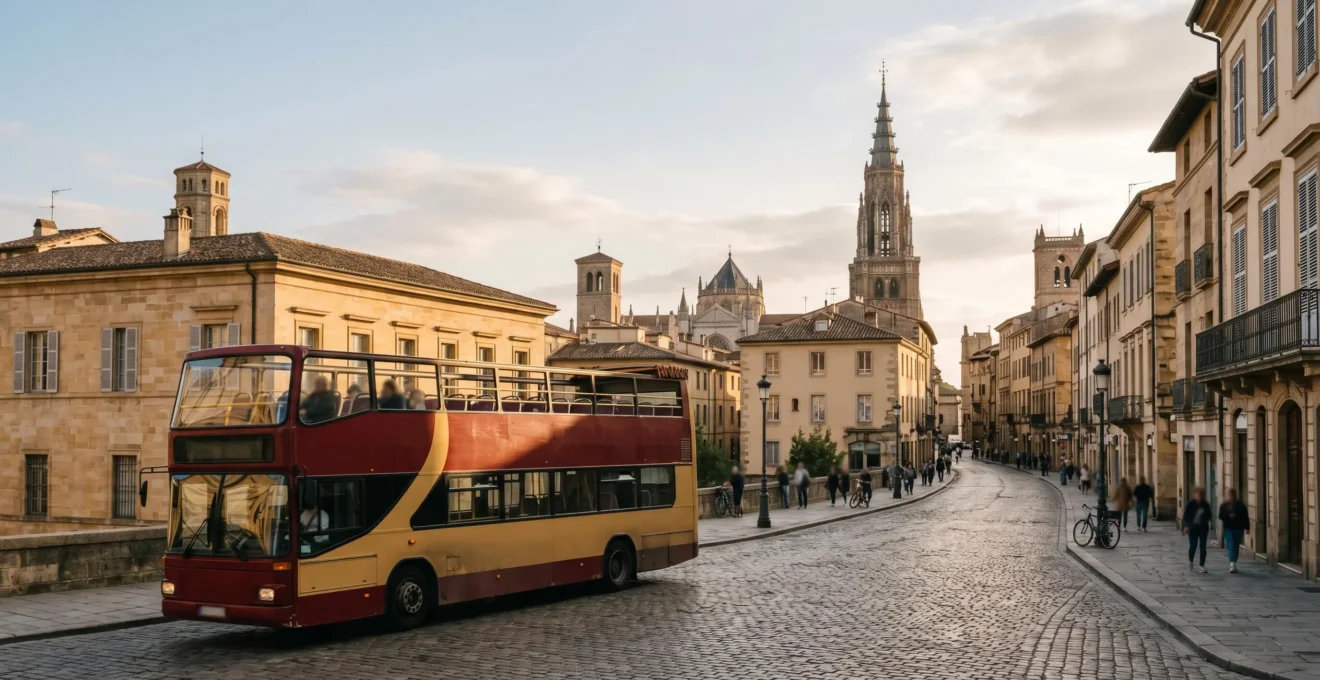
The secret to seeing over 15 landmarks in one day isn’t rushing; it’s treating the hop-on hop-off bus as a strategic transport system, not a passive tour.
- Effective planning transforms the bus route into a personalized itinerary connecting your must-see sights.
- Avoiding common timing mistakes, like aimless hopping and lunch-hour traps, can save you up to three hours of valuable exploration time.
Recommendation: Before you even board, map your top five “must-visit” landmarks and three “nice-to-see” spots to build a flexible but focused daily plan.
Arriving in a new European city is a thrill, but it’s quickly followed by a daunting question: how can you possibly see everything without running yourself into the ground? The traditional options feel limiting. You can walk for miles until your feet ache, stick to a rigid guided tour that dictates your every move, or spend half your day underground navigating a complex metro system, missing the city’s actual beauty.
Many travellers turn to open-top hop-on hop-off buses, seeing them as a simple way to get a panoramic view. But most people only scratch the surface of what these services can do. They ride the full loop once, snap a few photos, and consider it done. They treat it like a theme park ride, passively observing the city from a distance. This approach misses the entire point and the incredible potential for freedom.
What if the key wasn’t the bus ride itself, but how you use it? The real power of a hop-on hop-off bus lies in transforming it from a simple tour into your personal, strategic transport system. It’s about becoming the architect of your own discovery, choreographing a day that is both packed with sights and perfectly paced to your own rhythm. This guide will show you how to shift your mindset and leverage this tool to conquer any major city, covering more ground than you ever thought possible, all while feeling completely in control.
In the following sections, we’ll break down the exact strategies and insider tips to turn your bus ticket into a master key for urban exploration. You’ll learn how to plan your route, when to board to avoid crowds, and how to avoid the common mistakes that waste precious hours.
Summary: Your Guide to Strategic Sightseeing with an Open-Top Bus
- Why Do 70% of First-Time Visitors Choose Hop-On Hop-Off Over Walking Tours?
- How to Plan Your Open-Top Bus Route to Cover 15+ Landmarks in One Day?
- Open-Top Bus vs Metro Pass: Which Saves You More Time in Paris?
- The Common Mistake That Wastes 3 Hours on Sightseeing Bus Tours
- When to Board the Open-Top Bus to Avoid Crowds and Get the Best Photos?
- How to Identify Genuinely Local Restaurants in Tourist-Heavy Cities?
- How to Choose Cruise Itineraries That Cover Must-See Regional Highlights?
- How Do Modern Ocean Liners Compare to Floating Resort Hotels?
Why Do 70% of First-Time Visitors Choose Hop-On Hop-Off Over Walking Tours?
For a first-time visitor, a sprawling city like Rome or London can feel overwhelming. Faced with an endless list of landmarks and a confusing public transport map, the initial excitement can quickly turn into decision fatigue. While dedicated walkers attempt to conquer the city on foot, they often end up exhausted, having only seen a fraction of their list. This is where the strategic advantage of a hop-on hop-off bus becomes clear, and it’s about more than just resting your feet.
The primary reason so many travellers opt for this mode of transport is orientation and control. Instead of staring at a map on a street corner, the elevated, open-air deck provides a live, 3D map of the city. You can see how landmarks relate to one another, discover charming neighbourhoods you didn’t know existed, and get a feel for the city’s layout in a single loop. It’s an efficient reconnaissance mission that empowers you for the rest of your trip.
This method isn’t about laziness; it’s about efficiency. According to recent industry analysis, hop-on hop-off buses are a favoured way for new visitors to quickly cover multiple attractions. A walking tour might take three hours to show you five sights in one district. In that same time, a bus can introduce you to fifteen landmarks across the entire city, allowing you to mentally flag the ones you want to return to for a deeper dive. You’re not just a passenger; you are a scout, gathering intelligence for your urban exploration.
How to Plan Your Open-Top Bus Route to Cover 15+ Landmarks in One Day?
The difference between a frantic, stressful day and a seamless adventure covering 15+ sights lies in one word: planning. Treating the bus map as your playbook, rather than a simple guide, is the secret. This isn’t about creating a rigid, minute-by-minute schedule. It’s about smart route choreography that gives you structure while preserving your freedom to be spontaneous.
Start the night before. Lay out the bus map and circle your absolute “must-see” five to seven landmarks. Next, identify a secondary list of “nice-to-see” spots located near your primary targets. Now, look at the route. Your goal is to cluster your visits. Can you hop off at the Louvre, then easily walk to the Tuileries Garden and Place de la Concorde before hopping back on? This creates efficient “exploration zones” and minimises time spent waiting for the next bus.
Don’t just follow the route in numerical order. If your top priority is seeing the Eiffel Tower with morning light, consider starting your journey at a stop closer to it, even if it’s Stop #5 on the map. You can always complete the rest of the loop later. You are the discovery architect, and the bus route is your flexible blueprint. This strategic approach transforms a passive ride into an active, goal-oriented mission.
As you can see, the plan comes together when you physically map out your intentions. Assign a rough time budget for each stop—a technique called time-boxing. For example: “We’ll hop off for the Colosseum, spend 90 minutes exploring the area, and catch the bus no later than 11:30 AM.” This simple rule prevents you from accidentally spending half your day in one spot.
Open-Top Bus vs Metro Pass: Which Saves You More Time in Paris?
In a city like Paris, the Métro is a marvel of efficiency. It will whisk you from Montmartre to the Latin Quarter in minutes. For a commuter or a local, it’s the undisputed champion of A-to-B travel. However, for a visitor whose goal is discovery, what you gain in speed, you lose in experience. The time spent underground is time you’re not seeing Paris. Every street corner, every charming café, every stunning piece of architecture is missed.
The open-top bus operates on a different philosophy. It embraces the idea that the journey is the destination. The 15 minutes it takes to travel from the Arc de Triomphe to the Trocadéro isn’t “wasted” transit time; it’s a front-row seat to the magnificent avenues of Paris. You’re scouting, observing, and soaking in the atmosphere. This is time saved on discovery, not lost to travel.
So, which saves you more time? It depends on what you value. If your goal is to tick off three specific, distant locations as quickly as possible, the Métro wins. But if your goal is to *experience the city* and see a dozen or more landmarks in a fluid, scenic, and context-rich way, the bus is far more time-efficient. It eliminates the time spent finding Métro stations, deciphering line changes, and reorienting yourself every time you emerge from underground. The bus provides a seamless, continuous stream of sightseeing.
As travel planning expert Nandini succinctly puts it in an analysis for the ISANGO travel guide:
The metro helps you reach Paris. The bus helps you feel Paris.
– Nandini, travel planning expert, ISANGO travel guide comparison analysis
The bus saves you the mental energy of navigation, freeing you up to simply enjoy the view and decide on your next adventure. It’s the difference between efficient transit and efficient exploration.
The Common Mistake That Wastes 3 Hours on Sightseeing Bus Tours
The single biggest mistake travellers make on a hop-on hop-off tour is “aimless hopping.” It sounds liberating to get off the bus whenever something catches your eye, but without a clear objective, this quickly devolves into wasted time. You wander for 20 minutes, realize there’s not much to do, and then face a long, frustrating wait for the next bus. This reactive approach can easily consume hours of your day.
The time lost is staggering. For major attractions, the combination of navigating crowds and waiting for transport adds up. For instance, according to tour industry analysis, visits to landmarks can involve nearly two hours of waiting, with further delays for the next available tour bus seat. Compounded over two or three unplanned stops, you’ve lost half your day.
Another black hole for time is the “lunch hour trap.” Hopping off near a major landmark at 1 PM to find food guarantees you’ll end up in an overpriced, low-quality tourist restaurant, likely waiting 90 minutes for your meal. A far better strategy is to pack snacks or use the bus to travel to a pre-researched, authentic neighbourhood for a quick and delicious local bite. Avoiding these common pitfalls requires a proactive mindset and a clear plan of action.
Your Action Plan: Avoid These Time-Wasting Traps
- Define Your Objective: Before disembarking, state your goal and a time limit (e.g., “Take a photo of the fountain, 15 minutes max”).
- Pre-Plan Your Meals: Use the bus as transport to a genuine food district. Never eat in a high-traffic tourist zone during peak hours.
- Verify the Timetable: Check the “fine print” on the schedule. The advertised frequency often drops significantly during off-peak hours and at the end of the day. Know the last departure time.
- Calculate Your Return Window: Before entering a time-consuming museum, calculate if you have enough time to finish your visit AND catch one of the last buses. Don’t get stranded.
- Set a Departure Deadline: For every stop, have a hard “back at the bus stop” time. This creates urgency and keeps your day moving.
When to Board the Open-Top Bus to Avoid Crowds and Get the Best Photos?
Strategic timing can completely transform your hop-on hop-off experience, turning a crowded, rushed trip into a relaxed and beautiful journey. Boarding the bus at the right time not only helps you avoid the biggest crowds but also puts you in the perfect position for capturing stunning, postcard-worthy photos. The majority of tourists follow a predictable pattern; your goal is to move against the current.
Most people start their tour between 10 AM and 12 PM, leading to long queues at Stop #1 and packed upper decks. By employing a few simple timing tactics, you can secure the best seats and enjoy a more peaceful ride. Consider these proven strategies:
- The Early Start: The first bus of the day is often the least crowded. Being on board by 9 AM means you’ll arrive at the first few major attractions before the masses descend.
- The Lunch-Hour Lull: The window between 1:00 PM and 3:00 PM is a golden opportunity. While most tourists are sitting down for a long lunch, the buses and landmarks become noticeably quieter.
- The “Mid-Route First Bus” Tactic: Instead of joining the main queue at the official starting point, walk to Stop #2 or #3. The first bus of the day will arrive there virtually empty, allowing you to pick any seat you want.
For photographers, the final loop of the day is an unmissable opportunity. As the sun begins to set, the crowds thin out dramatically, leaving the top deck peaceful and open. This is the “golden hour,” when the soft, warm light bathes the city’s architecture in a magical glow. You’ll have unobstructed views and the perfect conditions for photography, capturing memories that others, stuck in dinner queues, will miss entirely.
Choosing your moment wisely is the hallmark of an experienced traveller. You trade the conventional for the exceptional, gaining both solitude and superior photo opportunities.
How to Identify Genuinely Local Restaurants in Tourist-Heavy Cities?
One of the greatest joys of travel is discovering authentic local food, but this can be challenging in areas swarming with tourists. The hop-on hop-off bus, unexpectedly, can be your most powerful tool for this culinary quest. Instead of just looking for landmarks, use the elevated perspective as a scouting platform for authentic neighbourhoods.
As the bus moves through the city, pay attention to the areas just off the main tourist drags. Look for streets with small bakeries, butcher shops, and locals going about their day. When you spot a promising area, hop off. Now, apply the “Three-Block Rule”: walk three blocks in any direction away from the main road and the bus stop. This simple action is often enough to escape the “tourist bubble” and find where the locals eat.
Your ears can be as useful as your eyes. Listen to what the audio guide *doesn’t* say. If it enthusiastically points out a “famous” café with menus in five languages, the real gem is likely two doors down—the one with no English sign, a handwritten menu taped to the window, and a queue of office workers out the door. Your best clues for authentic dining are:
- No Pictorial Menus: A restaurant that needs photos of its food is catering to people who don’t know what to order.
- A Limited Menu: A small, focused menu often means the kitchen specializes in a few dishes and does them exceptionally well.
- The Presence of Locals: If the clientele consists of office workers on their lunch break or families from the neighbourhood, you’ve found the right place.
Never, ever eat in a high-traffic square right next to a major landmark. These establishments don’t rely on repeat business, so quality and value are often low. Use the bus to find a real neighbourhood, then dive in to find a place that has to earn its local reputation every single day.
How to Choose Cruise Itineraries That Cover Must-See Regional Highlights?
Thinking about a cruise itinerary might seem out of place in a discussion about city buses, but the underlying logic is identical. The most experienced travellers approach both with the same strategic mindset. You should think of your hop-on hop-off bus ticket as a pass for a “city cruise,” where the landmarks are your “ports of call.”
When selecting a real cruise, you don’t just pick a boat; you study the itinerary. Does it stop in all the cities you want to see? Does it give you enough time in each port? You should apply this exact same scrutiny to the different bus routes available in a city. Many companies offer multiple coloured routes (red, blue, green) that cover different districts. Don’t just buy the default ticket; choose the “itinerary” that best matches your personal “must-see” list.
A great cruise itinerary offers a balanced mix of marquee ports and hidden gems. Your bus tour plan should do the same. Allocate the majority of your time to your top-priority landmarks (your “marquee ports”), but also build in time to hop off at a less-famous stop that looks intriguing (a “hidden gem” port). This is where the real magic of discovery happens.
Furthermore, just as a savvy cruiser knows which excursions to book and which to skip, a smart bus traveller knows which stops are worth getting off for and which are better viewed from the top deck. A quick photo of a statue might only require a 10-minute stop, while a world-class museum deserves a two-hour “excursion.” By treating the bus route as a flexible cruise itinerary, you take full command of your day’s adventure.
Key Takeaways
- Shift Your Mindset: The bus is not a ride; it’s a strategic transport system that you control.
- Plan Like an Architect: Choreograph your route by clustering landmarks and time-boxing your stops to maximize efficiency.
- Master Your Timing: Avoid crowds and capture the best photos by starting early, using the lunch-hour lull, and enjoying the golden hour loop.
How Do Modern Ocean Liners Compare to Floating Resort Hotels?
In the world of travel, there’s a fundamental difference between a vehicle and a destination. A floating resort hotel, like many modern mega-cruise ships, is designed to be the destination itself. The onboard waterparks, casinos, and shows are the main event; the ports of call are almost secondary. A classic ocean liner, however, had a different purpose: its primary function was the journey and the exploration of multiple destinations.
This is the perfect metaphor for how you should view your hop-on hop-off bus. You must see it as an ocean liner, not a floating resort. Its purpose is not to entertain you with flashy features; its purpose is to facilitate exploration. The value is in the places it takes you and the freedom it gives you to discover them on your own terms. The audio guide is a helpful narrator, not the main show. The upper deck is your viewpoint, not your destination.
As one urban tourism analysis aptly states, the philosophy is centered on the voyage. In a comparison of tour philosophies, they note:
The bus is the ‘Ocean Liner’: a vehicle focused on the journey and visiting multiple destinations. Its purpose is to facilitate exploration.
– Urban tourism industry analysis, Comparison of tour philosophies and traveler mindsets
When you embrace this “ocean liner” mindset, your entire approach changes. You stop being a passive passenger and become an active explorer. You use the bus to create your own grand tour, connecting the dots between magnificent sights and creating a travel story that is uniquely yours. You are the captain of your own city voyage.
Now that you have the strategy, the only thing left to do is choose your city, book your ticket, and begin architecting your own incredible day of discovery. Your adventure awaits.