The true value of a kids’ club lies not in its theme, but in its methodology for building confidence and curiosity.
- Genuine educational activities are open-ended “provocations” that spark curiosity, not crafts with a specific outcome.
- The best programs focus on developing core skills like resilience and problem-solving through structured, child-led challenges.
Recommendation: Instead of asking “What will my child do?”, ask “How will the activity challenge my child to think, try, and grow?”
As an education-conscious parent, you know a family holiday is more than just a break; it’s a precious opportunity for growth and connection. Yet, when faced with the glossy brochures of resort kids’ clubs, a nagging question arises: is this a genuinely enriching experience or just glorified, high-end babysitting? Many parents scan the schedule for familiar labels like “arts & crafts” or “sports,” hoping they equate to developmental value. They often find that these activities are little more than passive entertainment, designed to keep children occupied rather than engaged.
This approach misses the crucial point. The secret to identifying a high-quality program doesn’t lie in the *what* but in the *how*. But what if the true measure of an educational activity isn’t its subject matter, but its underlying methodology? What if the goal isn’t just to teach a skill, but to systematically cultivate a child’s intrinsic confidence, spark their natural curiosity, and build their resilience? A truly exceptional program is built on a deep understanding of child development, using structured challenges and guided exploration to foster growth.
This guide will equip you with a new lens to evaluate these offerings. We will move beyond surface-level schedules to explore the core mechanics of confidence-building, the difference between a simple craft and a “child-led provocation,” and the importance of balancing structured fun with intentional downtime. By the end, you will be able to confidently distinguish the programs that merely entertain from those that genuinely empower your child.
To navigate this exploration of what truly constitutes an educational holiday, the following guide breaks down the key principles and provides actionable frameworks. You’ll learn to look past the marketing and see the developmental methodology at the heart of the best children’s programs.
Summary: A Parent’s Guide to Truly Educational Holiday Activities
- Why Do Supervised Activities Boost Children’s Confidence More Than Free Play?
- How to Identify Genuinely Educational Activities From Basic Childminding?
- Sports-Focused vs Creative Activities: Which Programme Suits Your Child’s Personality?
- The Over-Scheduling Trap That Exhausts Children at Resorts
- When Should Children Join Group Activities Versus Enjoy Family Time?
- Why Do Research Station Visits Transform Antarctic Expeditions From Scenic to Substantive?
- Why Do Local Food Markets Reveal Social Structures Better Than Any Museum?
- How to Spend One Week in a City Like a Temporary Local?
Why Do Supervised Activities Boost Children’s Confidence More Than Free Play?
While unstructured free play is vital for imagination and self-discovery, it’s a misconception that all structured activities stifle a child’s spirit. In fact, well-designed supervised activities are powerful engines for building genuine, lasting confidence. The key lies in what I call “confidence mechanics”—the intentional design of challenges that are just beyond a child’s current abilities, offered in a safe and supportive environment. When a child masters a new skill, whether it’s climbing a wall, completing an obstacle course, or learning a new dance step, they aren’t just having fun; they are receiving tangible proof of their own competence.
This is not about pressure or competition. It’s about guided risk-taking. A facilitator’s role isn’t to direct, but to create a space where a child feels safe enough to try, and potentially fail, without judgment. This process builds resilience and an adventurous spirit. The pride a child feels after conquering a challenge they initially found daunting is a profound developmental milestone. This earned success—not empty praise—is the foundation of robust self-esteem.
Many leading resorts are now building their programs around this philosophy. For example, some programs have been redesigned around positive education principles, explicitly using structured challenges to build self-assurance. According to their framework, kids gain self-confidence by overcoming challenges, like designing and finishing “Ninja Bootcamp” obstacle courses. This model demonstrates that a structured environment, when focused on empowerment rather than simple supervision, becomes a catalyst for personal growth that echoes far beyond the holiday.
How to Identify Genuinely Educational Activities From Basic Childminding?
The single most powerful way to distinguish a developmental program from simple childminding is to look for signs of a “child-led provocation” rather than a prescriptive craft. This concept, inspired by the renowned Reggio Emilia educational philosophy, is a game-changer for parents. A prescriptive craft has a predetermined outcome: every child’s paper plate turtle is meant to look the same. It’s about following instructions. A provocation, however, is an open-ended invitation to explore, question, and create. It’s about sparking curiosity.
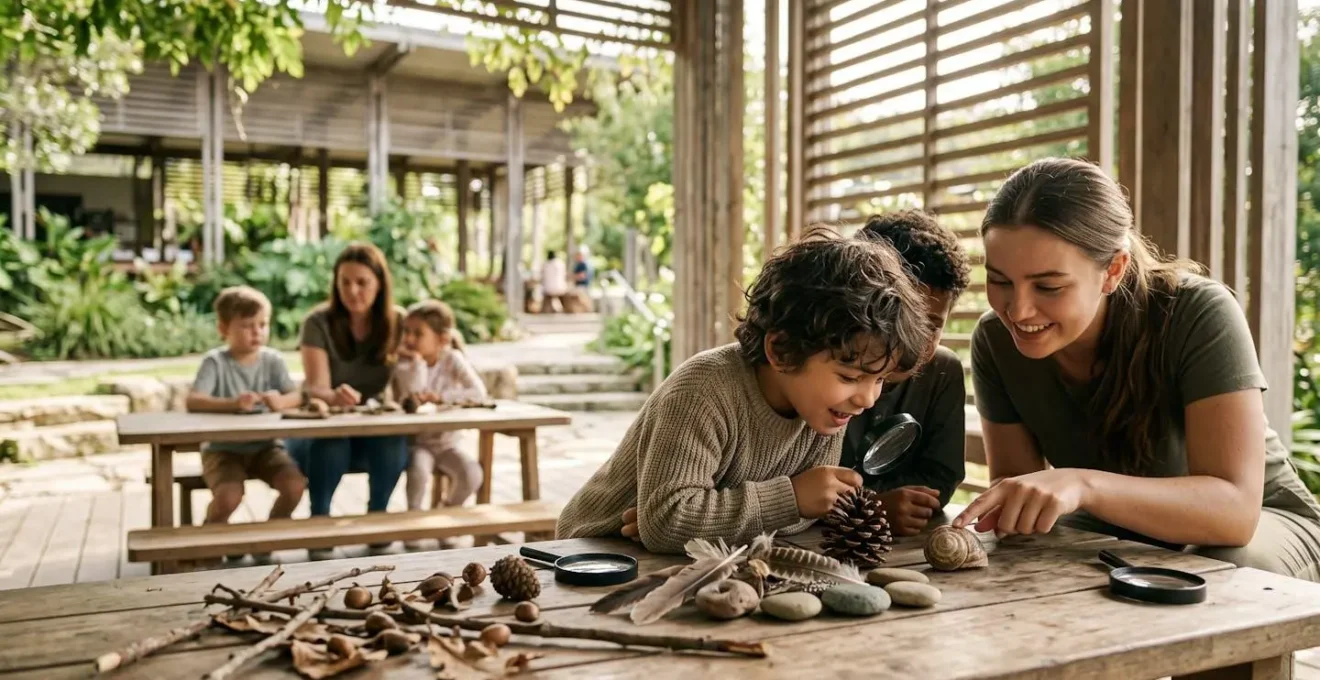
Imagine a table set not with identical craft kits, but with a collection of interesting, related objects: seashells of different shapes and textures, a magnifying glass, smooth stones, and blank paper. There is no “right” way to interact with this setup. One child might sort the shells by color, another might draw their textures, and a third might invent a story about where they came from. This is where real learning happens. The facilitator’s role is not to provide answers, but to observe each child’s interest and ask thoughtful questions to deepen their exploration.
This approach trusts the child’s innate curiosity and values the process over the final product. A program rooted in this philosophy fosters critical thinking, problem-solving, and creativity. Children in such an environment learn that their ideas have value, which in turn gives them what experts call a growing confidence to share their thinking. When you are evaluating a kids’ club, ask the staff how they encourage child-led discovery. Their answer will tell you everything you need to know about their educational intent.
Your Checklist for Spotting a True ‘Provocation’
- Is the setup an open-ended invitation to spark curiosity, or a craft with a specific, identical outcome for all?
- Do staff observe what fascinates each child and then build follow-up experiences based on those individual interests?
- Does the environment and staff attitude trust an open-ended process, or do they prioritize a “picture-perfect” result?
- Are the materials varied and interesting, encouraging exploration rather than simple assembly?
- Is the focus on asking questions and fostering discovery, rather than giving instructions and expecting compliance?
Sports-Focused vs Creative Activities: Which Programme Suits Your Child’s Personality?
Parents often fall into the trap of categorizing their children: “He’s a sports kid,” or “She’s the artistic one.” Consequently, they search for kids’ clubs that match these labels. While it’s important to consider a child’s natural inclinations, the most forward-thinking programs are breaking down these silos. They understand that skills like teamwork, problem-solving, and creativity are not domain-specific. A creative child can learn collaboration through a team sport, and a sporty child can develop fine motor skills and patience through an artistic project.
Instead of looking for a program that is exclusively “sports” or “creative,” look for one with a balanced, holistic methodology. Does the program offer a variety of activities that appeal to different temperaments? More importantly, does it use these activities to teach transferable life skills?
Observing real-world examples can clarify this distinction. Some resorts specialize in a single area, while others build a more integrated experience.
| Program Focus | Resort Example | Signature Activities |
|---|---|---|
| Sports & Physical | Casa de Campo Kids Club | Merengue dance lessons and introductory golf clinics |
| Creative & Nature-Led | KidsOnly, One&Only Mandarina | Wildlife discovery, jungle adventures, creative workshops |
| Conservation-Hybrid | andBeyond Ngala Safari Lodge (WILDEChild) | Junior Ranger wildlife tracking and conservation learning |
Case Study: Blending Physical and Creative Challenge
Some programs are built on a model that develops multiple strengths simultaneously. Rather than separating sports and creativity, they use an integrated approach. For instance, a “Nature Detective” adventure encourages both curiosity and physical exploration, while a “Super Pilot” activity can teach kids to tackle new challenges and collaborate as a team. This shows how a single, thoughtful methodology can serve both introverted, exploratory personalities and team-oriented, physically active ones by focusing on the underlying skill being developed, not just the activity’s label.
The Over-Scheduling Trap That Exhausts Children at Resorts
In our eagerness to provide enriching experiences, it’s easy to fall into the over-scheduling trap. We see a packed agenda of back-to-back activities and mistake it for a high-value program. However, a holiday schedule that mirrors a hectic school term can lead to exhaustion and overwhelm, undermining the very goal of rest and rejuvenation. As one psychologist notes, “Ironically, overscheduled kids are actually missing out on the thing they need most for their development: unstructured playtime.”
Ironically, overscheduled kids are actually missing out on the thing they need most for their development: unstructured playtime.
– Amy Morin, Psychology Today
This is why “intentional downtime” is a critical component of any quality kids’ program. The best clubs recognize that children, just like adults, need space to breathe, process, and simply be. They build unstructured periods into their day, allowing children to choose their own activities, read quietly, or just daydream. This is not a sign of a lazy program; it’s a sign of one that respects a child’s cognitive and emotional needs.
How can you tell if a schedule is fulfilling or simply fatiguing? Observe your child. Are they coming back from the kids’ club energized and excited, or are they irritable and drained? Do they talk enthusiastically about what they did, or do they seem indifferent? A great program leaves a child feeling inspired, not depleted. It should bolster their imagination and relieve stress, not add to it. True enrichment comes from a balance of stimulating activities and the freedom for a child’s mind to wander.
When Should Children Join Group Activities Versus Enjoy Family Time?
For many parents, the decision to use a kids’ club comes with a pang of guilt. A family holiday is supposed to be about togetherness, so is sending your children off for a few hours an admission of failure? The answer is a resounding no—if you reframe the purpose of the club. Instead of viewing it as a tool for separation, think of it as an “experiential bridge.” A high-quality program gives a child a unique set of experiences and stories that they can then bring back to share with the family, enriching everyone’s holiday.
This model is most effective when the kids’ club activities are deeply connected to the local culture and environment. For example, some programs are explicitly designed to do just this. At the V Team Kids Club at Sugar Beach, a Viceroy Resort, activities are designed to inspire kids to connect to the community and explore the local culture. A child might learn about native plants, create art inspired by local traditions, or learn a few words in the local language. When they return to their parents, they are not just reporting on a generic craft session; they are acting as a cultural ambassador, sharing their newfound “local intelligence” and sparking new family conversations and explorations.
This turns “time apart” into a catalyst for “time together.” The child’s independent adventure becomes the topic of conversation at dinner, leading the family to visit a place the child learned about or try a food they discovered. This is beautifully captured in one parent’s reflection:
I remember how proud my son was of the tie-dye shirt he made at a kids club at a Maui resort, and how excited he was to tell me about the little boy he befriended that day.
– A parent’s account, PureWow
The key is balance. A holiday should not be entirely separate or entirely together. By using the kids’ club strategically as an experiential bridge, you can achieve the best of both worlds: giving your child a dose of independence and confidence-building fun, while creating new, shared reference points that make the family bond even stronger.
Why Do Research Station Visits Transform Antarctic Expeditions From Scenic to Substantive?
On the surface, an Antarctic expedition is a journey through breathtaking, otherworldly landscapes. But for many travelers, the most transformative moments happen not while gazing at an iceberg, but while standing inside a working scientific research station. Why? Because it turns the scenic into the substantive. It provides the “why” behind the “wow.” Suddenly, the penguins are not just cute birds; they are data points in a climate change study. The ice is not just a static feature; it’s a living record of our planet’s history.
This shift from passive observation to active understanding is a powerful analogy for what parents should seek in a children’s activity program. A basic kids’ club is like a scenic cruise—it offers pleasant views and keeps everyone occupied. A truly educational program is like a visit to that research station. It provides context, deepens understanding, and connects the activity to a bigger picture. With up to ~4,800 people from 55 countries operating stations in the summer, Antarctica is a hub of global scientific collaboration. A visit there reveals the human story behind the landscape.
For example, at the Vernadsky Research Base, a biologist might explain how their work on penguin colonies and local biodiversity helps track global climate trends. This is the mechanism by which a simple wildlife sighting becomes a profound lesson in ecology. As one geophysicist put it, “Studying its history, we might find the keys to our future.” In the same way, a child’s activity should do more than entertain; it should provide the keys to understanding something new about the world or about themselves.
Why Do Local Food Markets Reveal Social Structures Better Than Any Museum?
Imagine you have two hours to understand the soul of a city. You could go to a museum, where artifacts are displayed behind glass, with neat labels explaining their significance. Or you could go to a bustling local food market. The museum offers curated facts; the market offers a living, breathing experience. You see how people interact, what they value, the rhythm of daily negotiations, and the central role of food in the culture. The market is not a presentation *about* the society; it *is* the society in miniature.
This provides another perfect metaphor for evaluating kids’ clubs. A basic, childminding-focused club is like a museum. It presents activities in a sterile, pre-packaged way. “Here is the craft. Here are the instructions. Here is the finished product.” It’s a passive experience.
A genuinely educational program, however, is like the local market. It’s a dynamic, interactive environment. It’s about engagement, not just observation. Children are not just consuming an activity; they are part of a small, living community. They negotiate ideas with their peers, interact with enthusiastic facilitators, and have the freedom to follow their own curiosity. The focus is on the authentic, sometimes messy, process of discovery and human connection, not on a polished final product.
When you are looking at a kids’ club, ask yourself: does this feel more like a museum or a market? Is it a place for passive consumption of pre-planned fun, or a vibrant space for active, social, and authentic engagement? The answer will tell you whether your child is in for a lesson or an experience.
Key Takeaways
- The quality of an activity is defined by its developmental methodology, not its theme. Look for programs that build skills like resilience and curiosity.
- Prioritize activities that are “child-led provocations” (open-ended invitations to explore) over prescriptive crafts with identical outcomes.
- A balanced schedule with “intentional downtime” is more enriching than a packed, exhausting agenda. Look for a mix of structure and freedom.
How to Spend One Week in a City Like a Temporary Local?
The ultimate goal for a discerning traveler is to experience a place not as a tourist, but as a “temporary local.” A tourist follows a checklist of famous sights, consuming pre-packaged experiences from a distance. A temporary local, on the other hand, seeks to understand the rhythm of daily life. They wake up early to see the city come alive, they navigate public transport during rush hour, and they frequent neighborhood parks instead of just the landmark ones. They engage, participate, and connect.
This mindset is the perfect summary of how to approach choosing a kids’ club. You don’t want a program that treats your child like a tourist in the land of fun, shuttling them from one “attraction” to the next. You want a program that helps them become a temporary local in a vibrant, engaging community. The best programs are designed to facilitate this kind of immersion. They create a culture of participation, not just consumption.
Consider the difference: a tourist experience might be a bus tour with a recorded narrator, while a temporary local experience is a free tour led by a university student who is passionate about their neighborhood. The first is slick and passive; the second is authentic and interactive. This is the difference between a bored activity leader running through a script and a passionate facilitator who is genuinely engaged with the children. Look for that spark of authenticity, that focus on real engagement, and that respect for the child as an active participant in their own adventure.
Ultimately, by shifting your focus from a checklist of activities to an evaluation of the underlying developmental methodology, you empower yourself to make a truly informed choice. Your child’s holiday can be more than just fun; it can be a powerful catalyst for building the confidence, curiosity, and resilience they will carry with them long after you’ve returned home.