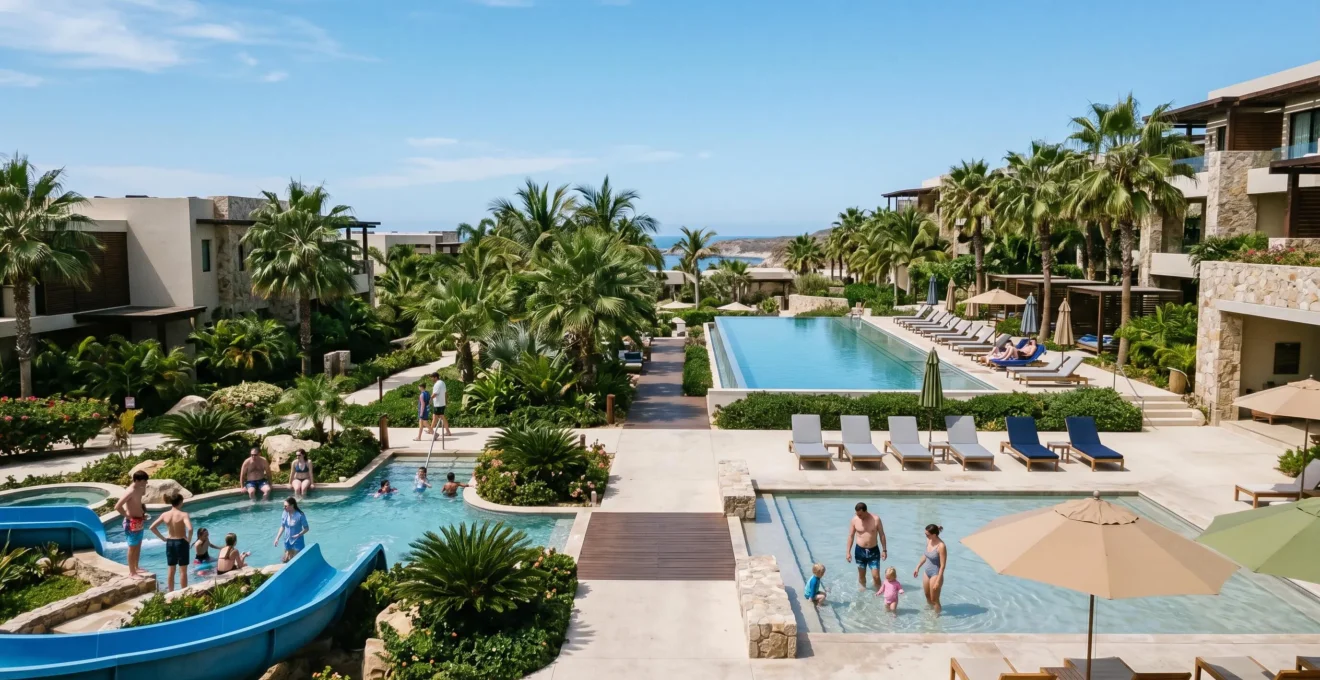
The secret to a perfect family pool holiday isn’t more features, but a resort’s deliberate strategy of creating separate ‘aquatic zones’ for different age groups.
- Truly family-centric resorts offer a portfolio of pools, separating high-energy splash areas from quiet relaxation zones.
- Decoding facility descriptions is key: verify pool depths, entry styles, and the true scale of features like lazy rivers or slides.
Recommendation: Prioritize resorts that describe their pool areas as a collection of distinct experiences, not just a list of amenities, to ensure harmony for your mixed-age group.
The idyllic image of a family enjoying a resort pool often clashes with a messy reality. For families with children of varying ages, a single body of water is rarely a one-size-fits-all solution. The shallow end that delights a toddler is a zone of profound boredom for a teenager, while the deep end perfect for a tween’s cannonball is a source of anxiety for parents of young swimmers. This fundamental conflict can turn a much-anticipated day of relaxation into a stressful juggling act of supervision and entertainment management.
Conventional wisdom advises looking for a “kids’ pool” or a waterslide, but this feature-checklist approach is often too simplistic. It fails to address the core needs of a generationally diverse family. A single slide may be too intimidating for a 5-year-old and underwhelming for a 15-year-old, leaving everyone unsatisfied. The real challenge isn’t just finding amenities, but finding a cohesive aquatic environment where every family member feels engaged, safe, and catered to.
But what if the solution lies not in the features themselves, but in the resort’s architectural philosophy? The most successful family resorts have moved beyond the single-pool model. They strategically design a portfolio of aquatic experiences, creating distinct zones tailored to the unique needs of different age groups. This guide will teach you how to look past the marketing brochures and decode a resort’s pool facilities. We will explore how to identify these “zoned aquatic experiences,” evaluate crucial factors like temperature and depth, and ultimately select a property that delivers a genuinely harmonious holiday for everyone, from toddler to teen.
This article provides a comprehensive framework for evaluating resort pool facilities to meet the needs of every family member. Follow our guide to understand the key differentiators that create a truly successful aquatic experience for all ages.
Summary: Choosing the Ideal Resort Pool Complex for Your Family
- Why Do Resorts With 3+ Pools Outperform Single-Pool Properties for Families?
- How to Decode Resort Pool Descriptions to Find the Perfect Fit?
- Heated Pool vs Natural Temperature: Which Matters for Spring and Autumn Breaks?
- The Pool Depth Mistake That Disappoints Families With Young Swimmers
- How to Secure Poolside Spots at Busy Resorts Without Waking at Dawn?
- Pacuare vs Reventazón: Which Costa Rican River for Families With Teens?
- Hotel Rink vs Natural Lake vs Ice Trail: Which Skating Experience for Families?
- How Do All-Inclusive Resorts Eliminate Hidden Costs for Family Holidays?
Why Do Resorts With 3+ Pools Outperform Single-Pool Properties for Families?
The superiority of a multi-pool resort isn’t just about offering more water; it’s about providing a strategic separation of experiences. A resort with a diverse aquatic portfolio demonstrates a deep understanding of family dynamics. While a single, large pool forces toddlers, teens, and adults to coexist in a chaotic environment, multiple pools allow for the creation of dedicated zones. For instance, Grand Wailea Resort in Maui features 9 pools, waterfalls, and a lazy river, a scale that inherently allows for this crucial separation.
This “zoning” strategy is the cornerstone of a harmonious family vacation. It allows for a high-energy splash zone for children and tweens, a tranquil, shallow area for toddlers and their parents, and often a serene, adults-only pool for quiet retreat. This separation minimizes conflict and maximizes enjoyment. Teenagers can socialize and listen to music without disturbing families with sleeping infants, while parents of young children can relax knowing their little ones are in a safer, purpose-built environment. This architectural choice transforms the pool area from a potential source of stress into a versatile and relaxing amenity for everyone.
Case Study: The Multi-Pool Advantage at Dreams Playa Esmeralda
The Dreams Playa Esmeralda resort in the Dominican Republic perfectly illustrates the power of a multi-pool strategy. By offering an infinity pool, an activity pool, a dedicated children’s pool, a private club pool, and a full waterpark, it achieves successful age-group separation. Younger children can safely enjoy the Explorer’s Club pool, while teenagers have their own spaces at the Core Zone Teens Club. This allows adults to move freely between the spa, various dining venues, and quieter pool areas, preventing the friction that often arises when all age groups are forced to share a single space.
Ultimately, a resort with three or more pools isn’t a luxury; it’s a clear indicator that the management has invested in a design that respects the different needs of a mixed-age family. It’s a commitment to providing a better, more peaceful experience for all guests.
How to Decode Resort Pool Descriptions to Find the Perfect Fit?
A resort’s website may boast of “lagoon-style pools” and “exciting water features,” but these marketing terms can be vague and even misleading. To find the perfect fit for your family, you must become an expert in pool feature decoding—looking beyond the glossy photos to understand the practical reality of the amenities. This means scrutinizing the details to ensure they align with the needs of your specific age groups.
For example, a “lazy river” can be a major draw, but its impact varies wildly with its scale. A short, decorative channel under 500 feet will quickly bore active kids, whereas a top-tier resort might feature a river over 1,000 feet long, offering a genuine attraction. Similarly, “waterslides” must be evaluated for their height and age restrictions. A resort truly catering to families will offer multiple slides designed for different thrill levels, ensuring both a timid 6-year-old and an adventurous 16-year-old have an option.
Learning to spot these nuances is critical. The presence of a “zero-entry” feature is a gold standard for toddlers, offering a beach-like gentle slope into the water that is far safer and more accessible than standard pool steps. Here are key features to look for and the questions you should ask:
- Zero-entry pool: Is it a true, gradual slope? This is the best option for toddlers and makes supervision much easier than lagoon pools with irregular, hard-to-monitor edges.
- Lazy river length: Ask for the actual length. Anything over 1,100 feet is a sign of a significant attraction, while shorter versions are often just decorative.
- Waterslide specifications: Always verify height requirements and age restrictions. A resort with multiple slide types is a strong indicator of a family-first design.
- Cabana availability: Are they complimentary or for rent? Daily rental fees can range from $50 to over $200, so confirm this to avoid unexpected costs.
- Pool zone designation: Does the resort explicitly mention an “adults-only pool”? This is a positive sign, as it guarantees a quiet retreat option and shows the resort is actively managing its spaces.
By asking these targeted questions, you transform from a passive tourist into an informed consumer, capable of selecting a resort whose aquatic facilities will genuinely delight every member of your family.
Heated Pool vs Natural Temperature: Which Matters for Spring and Autumn Breaks?
For families traveling during the shoulder seasons of spring and autumn, or to destinations with cooler evenings, the question of a heated pool is not a luxury—it’s a necessity. While a refreshing dip in a cool pool is welcome on a scorching summer day, unheated water can be uncomfortably cold for the most vulnerable family members, namely young children and seniors. An unheated pool can effectively render the resort’s main attraction useless for a significant portion of your group.
The science of comfort is clear. According to pool temperature safety guidelines, young children require pool temperatures between 84-86°F (29-30°C) to swim comfortably and safely without risking a rapid drop in body temperature. Seniors, who often have poorer circulation, need even warmer water, ideally between 86-90°F (30-32°C). A resort that invests in heating its pools demonstrates an awareness of these needs and a commitment to year-round guest comfort. It ensures that the pool remains an accessible and enjoyable feature, regardless of a cool morning breeze or a dip in the evening air temperature.
This detail is especially crucial for families with infants and toddlers, who lose body heat much faster than adults. A heated pool allows for extended, happy splash time. For a multi-generational family traveling with grandparents, it means everyone can comfortably participate in water activities together.
As you can see, the visual cues of warmth—like gentle steam and soft, inviting light—translate to tangible comfort. When booking a trip outside of peak summer months, you should actively verify that at least one of the family pools is heated. Don’t rely on vague descriptions like “temperature-controlled.” Seek explicit confirmation to guarantee this essential amenity will be available for your family’s enjoyment.
The Pool Depth Mistake That Disappoints Families With Young Swimmers
One of the most common and disappointing design flaws in resort pools is a uniform depth. A pool that is a standard 4-5 feet deep everywhere might seem like a good compromise, but in reality, it pleases no one in a mixed-age family. For parents with toddlers, this depth creates constant safety anxiety, forcing them to hold their child at all times. For tweens and teens who are competent swimmers, this same depth is too shallow for satisfying jumps or dives, leading to boredom. This single-depth approach is a classic mistake that fails to create a truly functional family space.
The solution is graduated and varied depths across the aquatic complex. Safety experts are clear on what young children need: toddler wading pools should have a maximum depth of 2 feet (0.6m), while the ideal depth for children learning to swim is a reassuring 3-4 feet. A resort that understands family needs will incorporate these specific depths into its design. The gold standard is a “zero-entry” or “beach-entry” pool that gradually slopes from zero depth to 2-3 feet, perfectly mimicking a natural shoreline and allowing toddlers to play safely at the water’s edge.
Case Study: Optimal Depth Variation at Hammock Beach Resort
The 91,000-square-foot pool complex at Hammock Beach Golf Resort & Spa in Florida is a masterclass in depth variation. It features a zero-entry pool with a sandy beach area perfect for toddlers, creating a safe and engaging play space. It then offers intermediate depth zones ideal for tweens to practice their swimming skills. Finally, deeper sections support a massive three-story water slide, providing the thrill that teenagers crave. This graduated depth approach masterfully prevents both the safety concerns of parents and the boredom of older kids.
When researching resorts, look for explicit mentions of “zero-entry,” “wading pool,” or “varied depths.” The absence of these terms may indicate a single-depth design that could disappoint your family. A thoughtfully designed pool complex with multiple depth zones is a hallmark of a truly family-focused property.
How to Secure Poolside Spots at Busy Resorts Without Waking at Dawn?
The infamous “towel game”—waking at sunrise to claim poolside loungers—is a dreaded ritual at many busy resorts. However, with a bit of strategic thinking, your family can secure prime spots without sacrificing precious vacation sleep. The key is to work smarter, not earlier, by understanding the natural ebb and flow of resort crowds. Forget the dawn patrol; a few clever tactics can make all the difference.
Instead of competing with the early risers, target the mid-day transition period. Many families who arrive at the pool first thing in the morning head off for lunch or naps between 1 PM and 2 PM. This window represents a golden opportunity to find newly vacated chairs, often in prime locations. Another effective strategy is to explore the resort’s peripheral pools. While the main “action” pool may be packed, secondary “quiet” pools or even adults-only areas (during designated family swim times, if offered) often remain underutilized, even at peak occupancy.
For guaranteed comfort, consider pre-booking a cabana. While it comes at a cost, reframing it as a “sanity investment” rather than a luxury expense can be a game-changer. A cabana provides a guaranteed home base, shade, and a bit of privacy, which can be invaluable for families with young children who need to nap. Here are some actionable tactics:
- Time the Mid-Day Transition: Arrive at the pools between 1-2 PM to catch the wave of families leaving for lunch.
- Explore Peripheral Pools: Scout the entire property. The quietest pools are often the furthest from the main building.
- Book Cabanas Strategically: Reserve a cabana for a half-day block during the busiest times, securing your family’s comfort.
- Choose Multi-Pool Resorts: Properties with 3+ pools naturally distribute crowds, increasing your chances of finding an open spot.
- Leverage the Weekday Advantage: If possible, book mid-week stays. Resort data shows pool areas can be 30-40% less crowded on a Tuesday than on a Saturday.
By applying these strategies, you can bypass the poolside stress and ensure your family has a comfortable and relaxing home base for their day of fun in the sun.
Pacuare vs Reventazón: Which Costa Rican River for Families With Teens?
When choosing a whitewater rafting adventure in Costa Rica for a family with teenagers, the decision often comes down to two legendary rivers: the Pacuare and the Reventazón. While both offer world-class rapids, they provide distinctly different experiences, and the best choice depends on your family’s appetite for adventure and immersion.
The Pacuare River is often hailed as one of the most beautiful rafting destinations in the world. Its appeal lies not just in its challenging Class III-IV rapids, but in the pristine, untouched rainforest that surrounds it. A trip on the Pacuare is an immersive journey, typically spanning one or two days with an overnight stay at a remote jungle lodge. This is the choice for the adventurous family with teens who crave a true expedition. The thrill of the rapids is matched by the experience of waking up to the sounds of the jungle, spotting toucans and monkeys, and feeling completely disconnected from the outside world. It’s more than just rafting; it’s a comprehensive nature adventure.
The Reventazón River, by contrast, offers more power and accessibility. It features more challenging sections, including some formidable Class V rapids (which are typically reserved for experienced rafters), but it also has long stretches of exhilarating Class II-III rapids that are perfect for a robust family day trip. Because of its proximity to major hubs, the Reventazón is ideal for families looking for a high-intensity, single-day adventure without the commitment of an overnight stay. It delivers a massive dose of adrenaline and spectacular canyon scenery in a more concentrated package.
In short, for the family with teens seeking an epic, multi-day jungle immersion with a blend of nature and excitement, the Pacuare is unparalleled. For the family wanting the most intense whitewater thrill that can be packed into a single, accessible day, the Reventazón is the superior choice.
Hotel Rink vs Natural Lake vs Ice Trail: Which Skating Experience for Families?
A winter family vacation often includes the classic activity of ice skating, but the venue can dramatically shape the experience. The choice between a controlled hotel rink, a vast natural lake, or a winding ice trail depends entirely on your family’s skill level, desire for adventure, and priorities.
The hotel rink is the epitome of convenience and safety. It’s typically small, well-maintained, and located just steps from your room. The ice is smooth, rentals are on-site, and the environment is controlled, making it the perfect setting for beginners and families with very young children. It offers a low-stress, predictable way to enjoy an hour or two on the ice, often with festive music and hot chocolate nearby. Its limitation is its lack of scale and sense of discovery.
Skating on a natural frozen lake offers the complete opposite experience. It is an adventure defined by epic scale and a profound sense of freedom. Gliding across a vast expanse of ice surrounded by snow-covered mountains and trees is a truly memorable and wild experience. However, this comes with inherent risks. Safety is paramount and depends entirely on verified ice thickness and local conditions. It’s best suited for confident skaters and families who prioritize natural beauty and adventure over predictability.
This is where the natural beauty of the experience truly shines, offering a backdrop that no artificial rink can replicate.
The ice trail offers a brilliant compromise between the two. These are purpose-built skating paths that wind through forests or parks, offering the scenic beauty of a natural setting with the safety and maintenance of a rink. They provide a sense of journey and exploration that a simple rink cannot, while eliminating the safety concerns of a frozen lake. For a family of mixed skill levels, an ice trail is often the perfect solution, providing a safe but adventurous experience for everyone.
Key Takeaways
- True family-friendly resorts use a “portfolio” of pools to create distinct zones for different age groups, rather than relying on one large, chaotic pool.
- Decode marketing terms by verifying crucial details: confirm pool depths, look for “zero-entry” features for toddlers, and ask for the actual length of lazy rivers.
- For off-season travel, a heated pool is a non-negotiable feature for the comfort and safety of young children and seniors.
How Do All-Inclusive Resorts Eliminate Hidden Costs for Family Holidays?
The primary appeal of an all-inclusive resort is the promise of budget predictability—a single upfront price for lodging, meals, drinks, and activities. For families, this can seem like the perfect way to eliminate financial stress and avoid constant “can we get this?” negotiations. However, the reality is that not all “all-inclusive” packages are created equal. The average all-inclusive vacation costs thousands, yet hidden fees for everything from resort services to premium dining can quickly inflate the final bill, undermining the very premise of the concept.
The spectrum of inclusions is vast, ranging from truly comprehensive packages to more basic offerings where many amenities carry a surcharge. A “premium” all-inclusive might cover top-shelf liquor, à la carte dining, and non-motorized water sports, while a “basic” tier may limit you to buffet meals, house-brand drinks, and charge extra for everything else. Understanding this difference is crucial to avoiding disappointment and unexpected expenses.
This table highlights the common differences between a basic and premium all-inclusive offering, revealing where hidden costs often lie.
| Feature Category | Basic All-Inclusive | Premium All-Inclusive | Hidden Cost Risk |
|---|---|---|---|
| Dining Options | Buffet meals, limited hours | Buffet + à la carte restaurants, 24-hour dining | Low (Premium) / High (Basic) |
| Alcoholic Beverages | House brands, limited selection | Top-shelf liquor, premium wines, craft cocktails | Medium (Premium) / High (Basic) |
| Water Sports | Kayaks, paddleboards (non-motorized only) | Includes snorkel gear, Hobie Cats, sailing lessons | Medium (both tiers) |
| Kids Activities | Basic kids club (limited hours) | Full-day kids club, teens club, nanny services included | High (Basic) / Low (Premium) |
| Entertainment | Evening shows, pool games | Shows + cooking classes, fitness classes, cultural activities | Low (Premium) / Medium (Basic) |
| Gratuities | Varies by resort policy | Typically fully included | High (Basic) / Low (Premium) |
| Airport Transfer | Often not included | Roundtrip transfers included | High (Basic) / Low (Premium) |
| Resort Fees | $20-50 per night common | Usually waived or included | High (Basic) / Low (Premium) |
To truly benefit from an all-inclusive model, you must perform due diligence before booking. This means asking specific questions to verify exactly what is covered and what is not.
Action Plan: Verifying Your All-Inclusive Package
- Points of Contact: List all advertised inclusions. Query the specifics of dining (buffets vs. à la carte), beverages (house vs. premium brands), and activities (which water sports are free vs. paid?).
- Collect Evidence: Scour the resort’s website for kids’ club fee schedules, spa service menus, and brochures for off-property excursions to inventory all potential extra costs.
- Check for Coherence: Confront the resort’s marketing claims with its fine print. Does “tips included” really mean no tipping is expected? Are mandatory “resort fees” added at checkout?
- Assess True Value: Evaluate the feel of the package. Does it feel generous and liberating (e.g., access to multiple specialty restaurants) or restrictive and designed to upsell you at every turn?
- Build a Realistic Budget: Based on your findings, create a separate budget for all the identified extras—like spa treatments, guided tours, or premium dining—to calculate the true total cost of your vacation.
By conducting this audit, you can ensure the all-inclusive resort you choose genuinely delivers on its promise of a worry-free, financially predictable family holiday.
Start planning your next family vacation with confidence. By using this guide to decode resort facilities and verify inclusions, you are empowered to ask the right questions and choose a destination that truly caters to the safety, comfort, and enjoyment of every single family member.