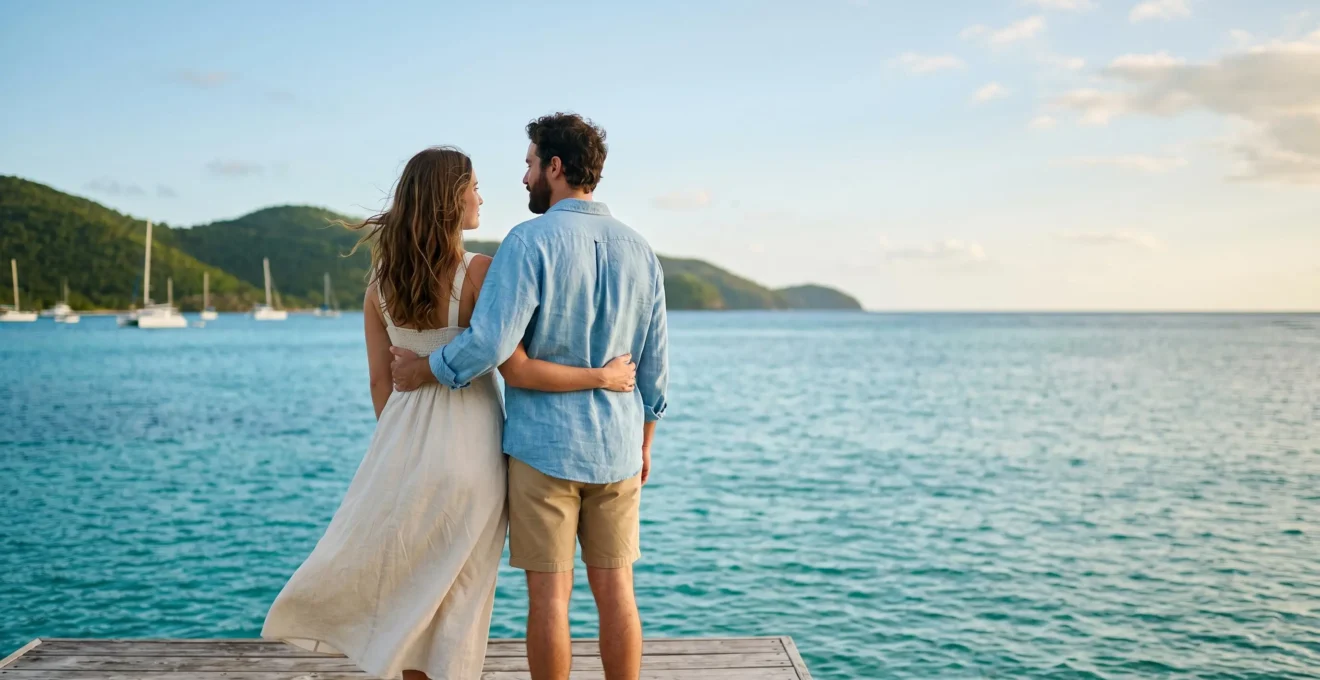
The single greatest cause of honeymoon disappointment isn’t the destination, but the mismatch between the island’s reality and a couple’s unspoken travel preferences.
- Success lies in first decoding your “Couple Travel DNA”—your shared priorities for adventure, relaxation, and culture.
- Logistical blind spots, like seaweed season and hurricane risk, can ruin an otherwise perfect trip if not strategically planned for.
Recommendation: Before looking at a single brochure, complete a joint priority assessment to create a personalized island shortlist that guarantees compatibility.
The fantasy is a familiar one: pristine white sands, turquoise waters, and two people celebrating the start of a new life together. The Caribbean has long been the gold standard for romantic escapes, yet this paradise of choice presents its own paradox. With over 30 distinct islands, each offering a seemingly identical slice of heaven, how do you choose the one that’s truly right for you? Many couples dive into planning by asking “Which island is best?” when the far more important question is “Which island is best for *us*?”
The typical advice often involves overwhelming lists of “best for beaches” or “best for nightlife,” pushing couples toward a decision based on isolated features rather than a holistic vision. This approach ignores the most critical factor: the compatibility between a destination’s inherent rhythm and a couple’s unique travel style. The truth is, a couple who thrives on spontaneous adventure might feel stifled at a structured all-inclusive resort, just as a pair seeking tranquil seclusion could be unnerved by a vibrant, bustling port town. This disconnect is a primary driver of post-honeymoon dissatisfaction.
This guide offers a different path. Instead of providing another exhaustive list, we’ll equip you with a strategic framework. You’ll learn to decode your “Couple Travel DNA,” understanding the fundamental preferences that define your ideal getaway. We’ll explore how to mitigate common but devastating timing mistakes and how to analyze accommodation not just as a place to sleep, but as the philosophical core of your honeymoon experience. By the end, you won’t just have a list of islands; you’ll have the confidence to select the one destination that feels like it was made just for you.
To help you navigate this important decision, this article breaks down the essential steps and considerations for finding your perfect Caribbean match. From understanding the roots of honeymoon regret to mastering the art of timing and choosing your travel style, here is your roadmap to a flawless romantic escape.
Summary: A Strategic Guide to Your Perfect Caribbean Honeymoon
- Why Do 60% of Honeymooners Regret Choosing the Wrong Caribbean Island?
- How to Shortlist the Perfect Caribbean Island Based on Your Couple Profile?
- Barbados vs Saint Lucia: Which Caribbean Island for Adventurous Couples?
- The Timing Mistake That Ruins Caribbean Honeymoons for Beach Lovers
- When to Visit the Caribbean to Avoid Hurricanes Yet Save 40% on Costs?
- Luxury Expedition vs Adventure-Focused: Which Ship Style for Antarctic First-Timers?
- Why Do Genuine Historic Chalets Offer Atmosphere Modern Builds Can’t Replicate?
- How Do Modern Ocean Liners Compare to Floating Resort Hotels?
Why Do 60% of Honeymooners Regret Choosing the Wrong Caribbean Island?
While the 60% figure might feel specific, the underlying sentiment is alarmingly common. The real story is that travel regret is a widespread phenomenon, especially for a high-stakes trip like a honeymoon. In fact, an astonishing 97% of travelers regret at least one trip taken, and a key reason often lies in a fundamental mismatch of expectations. For honeymooners, this disappointment stems from two primary sources: the influence of social media and a failure to align on travel styles before booking.
The modern planning process is often hijacked by perfectly curated Instagram feeds. Research reveals that an overwhelming 80% of couples used social media to help pick their honeymoon destination, creating a significant “expectation-reality gap.” A destination chosen for its “Instagrammability” may not align with a couple’s actual desire for privacy, adventure, or authentic culture. That picture-perfect overwater bungalow might be on an island with little to do outside the resort, leaving an adventurous couple feeling trapped in paradise.
Even more crucial is the internal dynamic. As the Travel Guard Research Team points out, regret often comes from the people we travel with when interests diverge. One partner may envision days spent trekking to hidden waterfalls, while the other dreams of uninterrupted hours on a sun lounger with a book. When a couple hasn’t defined and harmonized their individual priorities—their “Couple Travel DNA”—they risk choosing an island that caters to one person’s dream at the expense of the other’s, leading to friction and disappointment.
How to Shortlist the Perfect Caribbean Island Based on Your Couple Profile?
The antidote to choice paralysis and potential regret is a structured, introspective process. Before you even look at a map, you must first look inward and define your “Couple Profile” or what we call your Couple Travel DNA. This is your unique blend of interests, energy levels, and desires for the trip. Instead of a vague notion of “fun,” you need to get specific. Are you adventurers, relaxationists, culture seekers, luxury connoisseurs, or a mix of everything?
A practical way to do this is to sit down together and rank your priorities. On a scale of 1 to 10, how important is gourmet dining? Seclusion and privacy? A vibrant nightlife? High-adrenaline activities? By scoring these elements, your ideal island profile will begin to emerge. This self-assessment turns a list of 30 islands into a manageable shortlist of two or three strong contenders that genuinely match your shared vision. This process also forces a healthy conversation, ensuring both partners’ expectations are heard and aligned.
Once you understand your core priorities, you can consider the structure of your trip. Do you prefer the effortless, everything-handled nature of an all-inclusive resort, or does the freedom of a private villa or boutique hotel appeal more to your sense of spontaneity? This choice will dramatically narrow down which islands are best suited for you. For example, some islands specialize in mega-resorts, while others are known for their intimate, independent properties. The goal is to build a trip that feels authentic to you, not one that fits a generic honeymoon template.
As the image suggests, some couples might even find their perfect match by splitting their time between two different environments—perhaps starting with adventure and ending with relaxation. This “best of both worlds” strategy is only possible once you’ve clearly defined what those worlds look like for you.
Barbados vs Saint Lucia: Which Caribbean Island for Adventurous Couples?
Putting the “Couple Profile” theory into practice, let’s consider a common query: the adventurous couple. Both Barbados and Saint Lucia are famed for adventure, but they offer vastly different “destination rhythms” and experiences. Choosing between them perfectly illustrates how two seemingly similar islands can cater to very different types of adventurers.
Saint Lucia is the queen of dramatic, rugged adventure. Its identity is defined by the iconic Pitons—two volcanic spires that offer challenging hikes and breathtaking views. The island’s interior is a playground of dense rainforests, ziplining courses, hidden waterfalls, and the unique “drive-in” volcano at Sulphur Springs. Adventure here is immersive and vertical, requiring a bit more planning and travel time between sites due to mountainous terrain. It’s the ideal choice for nature lovers and hikers who want to feel fully enveloped by a wild, untamed landscape.
Barbados, by contrast, offers a more accessible, water-centric adventure. As a flatter, coral-limestone island, it’s easier to navigate. Its adventurous spirit is found along its coasts. The east coast is home to the legendary surf spot, Bathsheba, while the calm west coast is a hub for catamaran trips, jet-skiing, and world-class snorkeling. Inland adventures include exploring the vast Harrison’s Cave system or off-roading with an ATV tour. Adventure in Barbados is convenient and varied, perfect for couples who want a mix of high-energy activities and relaxed beach time without long drives.
This side-by-side comparison shows why a deep dive is necessary. Both are great for “adventure,” but the texture of that adventure is completely different. And this trend is growing, with emerging Caribbean destinations like St. Vincent recording a 25% growth in visitors, further expanding the options for specialized travel.
To help clarify the choice, this table breaks down the key differences for an adventurous couple.
| Adventure Aspect | Barbados | Saint Lucia |
|---|---|---|
| Terrain Type | Flat coral-limestone island, easy navigation | Volcanic mountains, dramatic elevation changes |
| High-Adrenaline Activities | Surfing (Bathsheba), catamaran snorkel trips, ATV tours, coasteering on east coast | Ziplining through rainforest, Piton hiking (Gros Piton climb), scuba diving volcanic reefs |
| Exploratory Adventure | Harrison’s Cave underground tunnel system, wildlife reserve with green monkeys, rum distillery tours | Sulphur Springs volcanic area, hidden waterfalls in interior, fishing village immersion (Soufrière) |
| Beach Adventure | White sand beaches with calm west coast waters, excellent for water sports and swimming | Volcanic black/grey sand beaches, dramatic coves framed by Pitons, snorkeling at Anse Cochon |
| Accessibility | Walkable from resorts, excellent roads, easy beach-hopping, short travel times | Requires more planning, mountainous roads, longer drives but rewarding scenic routes |
| Best For | Beach adventurers, water sports enthusiasts, couples wanting variety with convenience | Hikers, nature lovers, couples seeking dramatic scenery and outdoor immersion |
The Timing Mistake That Ruins Caribbean Honeymoons for Beach Lovers
For many, the quintessential Caribbean honeymoon is defined by one thing: flawless beaches. You imagine pristine, seaweed-free shores and crystal-clear water. However, a critical timing mistake can turn this dream into a frustrating reality. The single biggest culprit in recent years is sargassum, a type of floating seaweed that can accumulate in massive quantities on beaches, particularly from April to August.
This is not a minor inconvenience. Large sargassum blooms can cover entire beaches, making swimming unpleasant or impossible and releasing a pungent odor as they decay. This natural phenomenon has become more pronounced, with scientists using satellite data to predict record-high bloom levels in recent years. Arriving on your long-awaited honeymoon to find your resort’s beachfront unusable is a devastating and entirely avoidable mistake. It underscores the importance of researching not just the place, but the *time* you visit.
Planning around sargassum involves a two-pronged strategy: choosing the right location and the right time. Some islands are geographically less affected. The southern Caribbean islands like Aruba, Bonaire, and Curaçao are typically outside the main sargassum belt. Additionally, booking on an island’s western-facing coast can reduce risk, as the seaweed is often carried by Atlantic currents that impact eastern shores more directly. Finally, traveling during the peak dry season from December to early April generally lowers the risk, though it comes at a higher price.
Action Plan: Your Sargassum Risk Mitigation Checklist
- Pre-booking Check: Review NOAA’s sargassum risk index and historical data for your target islands and dates.
- Geographic Targeting: Prioritize southern Caribbean islands (Aruba, Bonaire, Curaçao) or west-facing coasts which historically see less impact.
- Real-time Monitoring: In the weeks before departure, monitor the University of South Florida’s Sargassum Watch System (SaWS) for current bloom tracking.
- Resort Policy Inquiry: Ask potential hotels about their sargassum cleanup protocols and whether they have protected coves or alternative beach access.
- Insurance Review: Consider “cancel for any reason” travel insurance if booking during high-risk months (May-August) for ultimate flexibility.
When to Visit the Caribbean to Avoid Hurricanes Yet Save 40% on Costs?
The two biggest concerns for many couples planning a Caribbean honeymoon are budget and weather, specifically hurricanes. The good news is that it’s entirely possible to find a sweet spot that delivers fantastic weather and significant savings. The key is to understand the nuances of the region’s “shoulder seasons” and geography.
The Caribbean peak season runs from December to April, offering the best weather but the highest prices. The official hurricane season runs from June to November, peaking from August to October. Many travelers avoid this period entirely, but that’s a missed opportunity. The shoulder seasons—specifically late April to June and again in November—often provide a perfect balance. During these months, the peak season crowds have dissipated, and travel experts confirm you can find significantly lower rates, often 30-40% less on accommodation and flights, while the hurricane risk is still very low.
For those willing to travel during the traditional low season (July to October) to maximize savings, the secret is geography. The southernmost Caribbean islands, often called the “ABC Islands”—Aruba, Bonaire, and Curaçao—lie below the primary hurricane belt. This strategic positioning makes them a reliably safe and sunny choice year-round. Resorts in this region actively market this advantage, attracting savvy honeymooners who want luxury for less. For example, a property like Sandals Royal Curaçao is promoted as an ideal hurricane-free escape during these months, allowing couples to enjoy low-season pricing without the associated weather anxiety.
Case Study: The ABC Islands Budget Strategy
Unforgettable Honeymoons highlights how the ABC islands (Aruba, Bonaire, Curaçao) leverage their position below the hurricane belt. By booking a luxury resort in Curaçao in September, a couple can access the same amenities as a peak-season traveler but at a fraction of the cost. They benefit from shoulder-season savings of up to 40% without the weather risk plaguing islands further north, demonstrating how geographic knowledge can unlock significant value.
Luxury Expedition vs Adventure-Focused: Which Ship Style for Antarctic First-Timers?
While Antarctica may seem worlds away from the Caribbean, the decision-making process for choosing a cruise there offers a powerful analogy for your honeymoon accommodation. The choice between a “Luxury Expedition” ship and an “Adventure-Focused” vessel in Antarctica is fundamentally about your travel philosophy. This same choice exists in the Caribbean: do you want a curated, all-inclusive “luxury expedition,” or a flexible, exploratory “adventure-focused” basecamp?
The Luxury Expedition model, whether a ship in Antarctica or an all-inclusive resort in the Caribbean, prioritizes seamless comfort and curated experiences. As Shakespeare Agency Travel Specialists note about their high-end planning, the goal is to “handle every element: the right hotel for your romantic vision, the experiences that create the moments you’ll talk about for years.” This is for the couple who wants to arrive and have every detail—from gourmet dining to daily activities—beautifully orchestrated for them. The resort or ship *is* the destination, providing a predictable, high-quality environment with minimal planning required from the couple.
Conversely, the Adventure-Focused style prioritizes flexibility, authenticity, and self-directed exploration. This is akin to choosing a boutique hotel, a private villa, or an eco-lodge as your “basecamp.” From this home base, you decide your own itinerary, eat at local restaurants, and immerse yourself in the island’s culture on your own terms. It requires more planning and a willingness to embrace the unpredictable, but the reward is a deeper, more personal connection to the destination. Understanding this core difference in travel style is critical before you even begin looking at properties.
The Basecamp Theory in Caribbean Honeymoons
Travel advisors increasingly apply the “Basecamp Theory” to match couples with the right accommodation. The all-inclusive resort serves as a “luxury expedition” base, offering a polished, predictable itinerary with premium amenities—perfect for couples who value effortless service. In contrast, a boutique eco-lodge acts as an “adventure-focused” base, providing the flexibility for local immersion and spontaneous discovery. The key is aligning the accommodation’s philosophy with the couple’s travel values, a principle that travel professionals say is essential for success on nearly every island.
Why Do Genuine Historic Chalets Offer Atmosphere Modern Builds Can’t Replicate?
Just as a ship style reflects a travel philosophy, the character of your accommodation sets the entire tone for your honeymoon. The debate between historic properties and modern builds in the Caribbean is another powerful lens through which to examine your “Couple Travel DNA.” Are you drawn to the story and soul of a place, or do you prioritize flawless, cutting-edge convenience?
Genuine historic properties—like the charming plantation inns of Nevis or the colonial guesthouses of Jamaica—offer what designers call unreplicable “soul.” This atmosphere isn’t just about antique furniture; it’s woven into the very fabric of the building. It’s in the patina of a weathered stone wall, the creak of original hardwood floors, and the family stories that span generations. These properties have a narrative depth that a new build, no matter how luxurious, simply cannot manufacture. Choosing to stay in a place with a rich history connects you to the island’s story in an intimate, tangible way.
Of course, this “soul” often comes with quirks: perhaps fewer electrical outlets, vintage plumbing, or a layout that favors character over modern open-plan design. This is the trade-off. Modern minimalist villas, particularly on islands like St. Barts or Turks & Caicos, offer the opposite: sterile perfection. They deliver state-of-the-art amenities, seamless technology, and pristine aesthetics. The experience is one of effortless luxury and comfort, but it can sometimes lack a distinct sense of place. The experience is flawless but can feel generic.
The Soul Factor: Historic Plantation Inns vs. Modern Villas
With over 30 years of experience, Unforgettable Honeymoons has observed this divide clearly. They note that couples seeking a “story-rich atmosphere” consistently prefer historic properties like the Montpelier Plantation & Beach on Nevis. These couples willingly accept the authentic quirks of an 18th-century estate in exchange for the genuine “soul” that is impossible to find in a brand-new building. The choice reveals a couple’s core values: do they prioritize narrative and atmosphere, or seamless, modern convenience?
Key Takeaways
- Your perfect honeymoon is found not by choosing the “best” island, but the island that is the best “match” for your shared travel personality.
- The most successful travel planning moves from the abstract to the concrete: first define your style, then find the destination and accommodation that embodies it.
- Every choice, from timing your visit to the style of your hotel, is an expression of your travel philosophy and contributes to the overall narrative of your trip.
How Do Modern Ocean Liners Compare to Floating Resort Hotels?
The comparison is not just a clever turn of phrase; it’s a reality. Today’s modern ocean liners operating in the Caribbean are, for all intents and purposes, floating all-inclusive resorts. This presents a final, fundamental choice in your honeymoon planning: do you want your resort to be stationary on land, or do you want it to move from port to port? With the Caribbean Tourism Organization reporting an estimated 33.7 million cruise visits in 2024, it’s clear this is a popular and relevant option to consider.
Choosing a cruise-based honeymoon offers unparalleled variety. You can wake up in a different country almost every day, sampling a taste of multiple islands without the logistical hassle of packing, unpacking, and booking inter-island flights. It’s the ultimate “sampler platter” of the Caribbean. The ship itself provides the consistent “basecamp,” with all your dining, entertainment, and accommodation needs met in one place. This is ideal for couples who are indecisive about which island to choose or who value seeing multiple destinations with maximum efficiency.
Conversely, a land-based resort honeymoon offers depth over breadth. By staying on one island, you have the time to truly immerse yourself in its culture, explore its hidden gems, and experience its rhythm beyond the few hours a cruise ship is in port. You can linger over a sunset at a local beach bar, take a multi-day hiking trip, or simply enjoy the peace of not having to be back on board by a specific time. This option is for couples who prefer to form a deeper connection with a single place rather than getting a fleeting glimpse of many.
Ultimately, the choice reflects the core principles we’ve discussed. A cruise is the epitome of the “Luxury Expedition” style—a curated, multi-destination journey. A land-based stay allows for a more “Adventure-Focused” or immersive experience. Neither is superior; they are simply different architectures for a honeymoon, each catering to a different kind of Couple Travel DNA.
Now that you are equipped with this strategic framework, you can move from dreaming to planning. The next step is to sit down with your partner and begin the exciting process of discovering your shared travel vision and building the unforgettable honeymoon that is waiting for you.