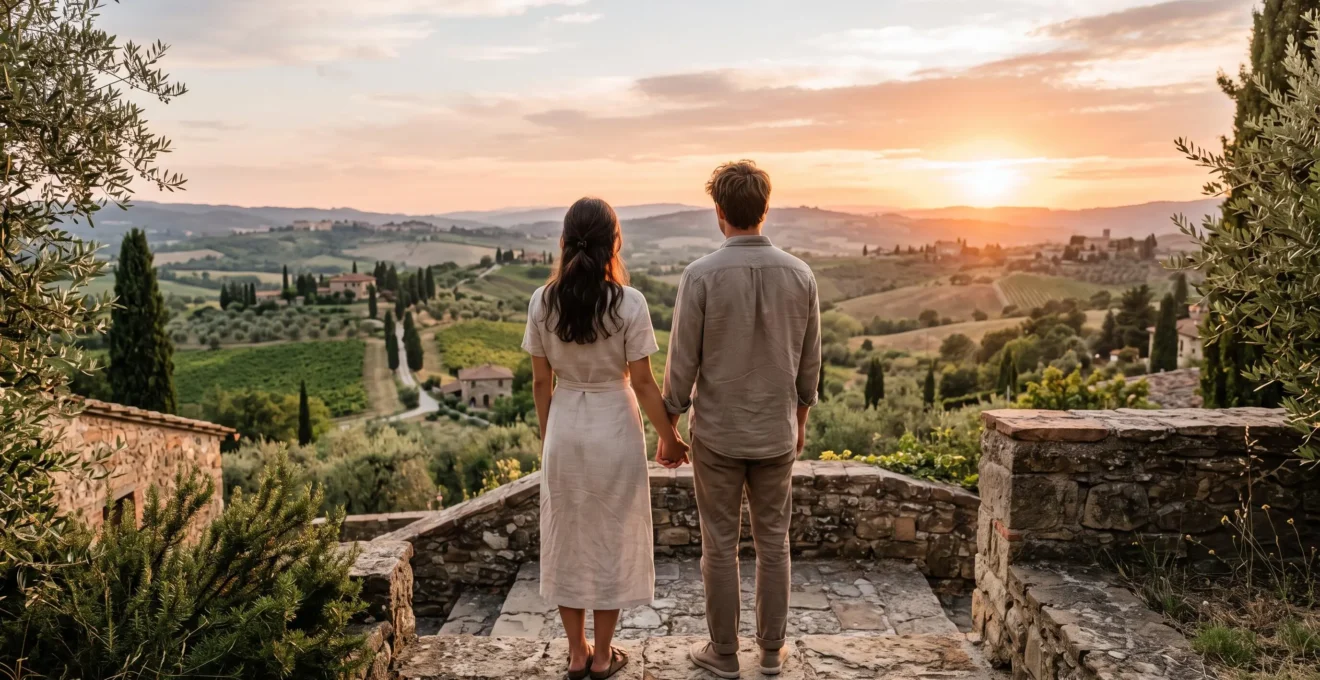
This guide flips the script. You’ll discover why a hop-on-hop-off bus pass isn’t a budget compromise — it’s the smartest romantic choice for exploring Florence, Siena, Pisa, Lucca, and San Gimignano without the headaches that come with four wheels and a steering wheel pointed the wrong direction.
Your Tuscany Honeymoon Snapshot: Why the Bus Pass Wins
- Visit 5 iconic cities — Florence, Siena, Pisa, Lucca, San Gimignano — without driving stress or parking nightmares
- Save significant costs versus car rental when factoring in fuel, insurance, and potential traffic fines
- Enjoy romantic spontaneity with hop-on-hop-off flexibility, WiFi, and multilingual AI assistant
- Focus on your partner, not GPS — proven itinerary covers top sites in 5 relaxed days
The Hidden Cost of ‘Freedom’: Why Renting a Car Can Ruin Your Tuscan Romance
Let’s talk about what most honeymoon blogs won’t tell you. That rental car advertised as your ticket to Tuscan freedom? It comes with invisible costs that surface weeks after you’ve returned home, when a surprise charge hits your credit card from an automated camera you never saw.
Take the classic scenario: a couple arrives in Florence, picks up their rental, and drives into the historic center to find their hotel. Seems logical, right? Except they’ve just entered a ZTL zone — Zona a Traffico Limitato — a restricted traffic area protected by cameras that silently photograph every license plate. The fine arrives 3 weeks later: often exceeding 100 €, sometimes reaching €200, plus the rental company’s processing fee. And if you crossed multiple ZTL boundaries in one day? Multiple fines stack up fast.
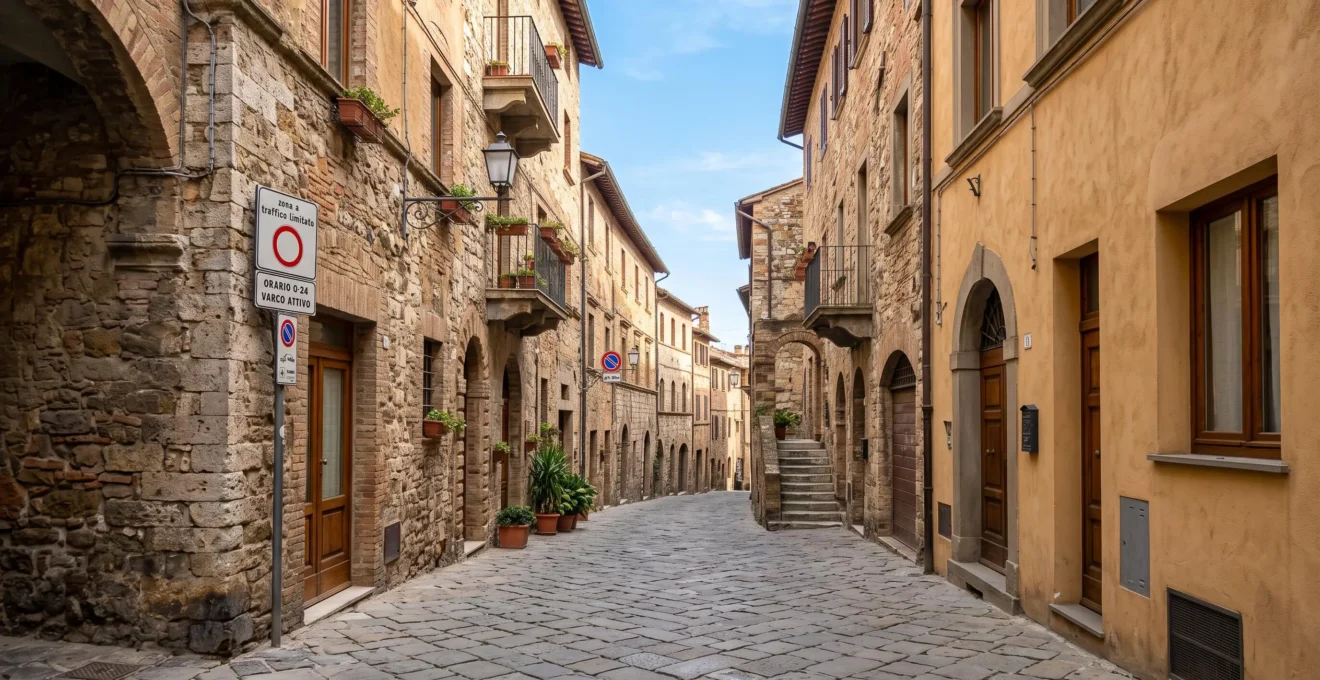
The ZTL Fine That Arrives Weeks Later: ZTL cameras are invisible and automated. You won’t know you’ve been fined until a charge appears on your statement 2 to 8 weeks after your honeymoon ends — often with rental company admin fees added on top. In cities like Florence and Siena, fines can exceed €100 per violation, and crossing multiple camera zones means multiple penalties.
But wait, there’s more. Parking in Tuscan city centers is both scarce and expensive, often requiring 30-plus-minute hunts that eat into your precious honeymoon hours. And let’s not even start on the stress of navigating roundabouts, deciphering Italian road signs at speed, or the fact that many non-European visitors forget they need an International Driving Permit until the rental counter turns them away.
The reality on the ground is this: couples who rent cars spend a disproportionate amount of their romantic getaway feeling anxious, lost, or financially ambushed. One partner navigates while the other white-knuckles the steering wheel through streets built for horses. Not exactly the relaxed dolce vita you imagined.
How a Multi-Day Bus Pass Transforms Stress into Spontaneity
Now imagine a different arrival. You land in Florence, grab an espresso, and board a comfortable, air-conditioned coach with panoramic windows, free WiFi, and USB-C charging ports. No insurance upsells. No fumbling with unfamiliar gear shifts. Just you, your partner, and the Tuscan hills rolling past while you plan your next move on the integrated travel app — available in over 50 languages, so the Italian language barrier vanishes entirely.
This is the promise of a multi-day Tuscany bus pass. The regional bus pass service operates two main routes across the region: the Green Line connects Florence, Pisa, and Lucca, while the Terracotta Line reaches Siena and San Gimignano. Together, they cover every essential honeymoon destination without requiring you to touch a steering wheel or decode a parking meter. You can explore detailed Tuscany travel pass options including multi-day pricing, route maps, and booking processes to find the perfect fit for your itinerary.
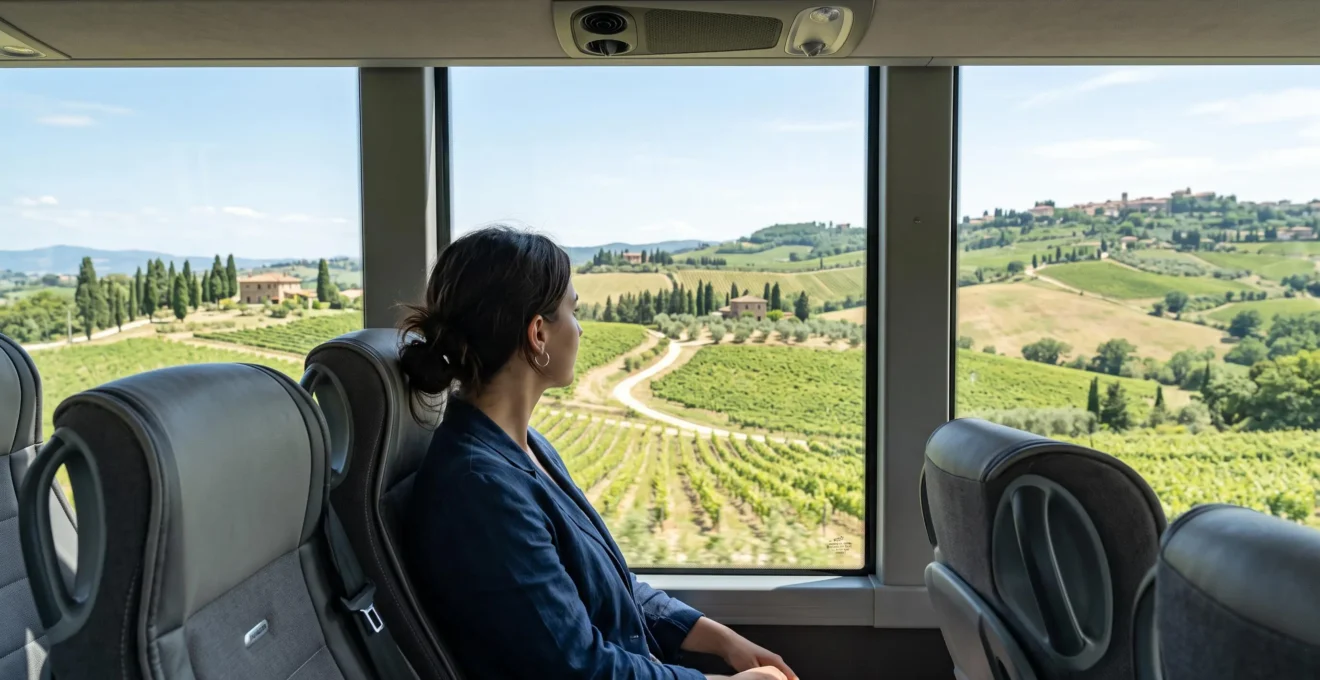
Here’s the contrast most guides miss: choosing a bus pass over a car rental isn’t settling for less — it’s actively choosing more connection and less friction. While car-rental couples argue over missed turns, bus-pass couples hold hands and watch the sunset paint the Val d’Orcia gold. The underrated advantage here is that hop-on-hop-off flexibility gives you spontaneity without consequences. Fell in love with a tiny vineyard en route? Hop off, spend two hours, catch the next bus. No parking tickets. No stress.
Meet Your Digital Guide: Your Multilingual Tuscany Companion
The app acts as your personal Tuscany expert in 50-plus languages. Ask it anything from “Where’s the best sunset viewpoint in Siena?” to “Show me hidden vineyards near San Gimignano.” No Italian required, no awkward phrasebook moments — just seamless exploration that lets you focus on each other.
Let’s break down the real comparison across what actually matters on a honeymoon:
| Criteria | Multi-Day Bus Pass | Car Rental | Private Guided Tours |
|---|---|---|---|
| Cost (5 days) | Competitive multi-day rate | €350-500+ (rental, fuel, insurance, parking) | €800-1500+ |
| Stress Level | Minimal (sit back, relax) | High (ZTL zones, parking, navigation) | Low (but rigid schedule) |
| Flexibility | High (hop on/off anytime) | Medium (parking limits city exploration) | Low (fixed itinerary) |
| Romance Factor | High (hold hands, enjoy views together) | Low (one person always drives/navigates) | Medium (shared experience with strangers) |
| Eco-Impact | Low (shared transport) | High (individual vehicle) | Medium (depends on group size) |
According to The Florentine’s February 2026 report on Tuscany wedding tourism, more than 65% of destination weddings now take place in villages, castles, and rural villas — precisely the locations where driving becomes most stressful and bus routes offer the most relief. The data shows wedding tourism revenue surpassed €213 million in 2025, with projections indicating a further 5.3% increase for 2026 driven by couples seeking intimate, stress-free experiences.
Your 5-Day Romantic Itinerary: Florence to San Gimignano Without a Single Parking Ticket
Five UNESCO World Heritage sites, zero driving stress, one simple pass. Here’s how to structure your Tuscan honeymoon using the bus network to its full romantic potential:
- Day 1: Florence — Arrival and Renaissance immersion
Land in Florence, activate your pass, and orient yourself with the Green Line network. Spend the afternoon at the Duomo, the Uffizi at sunset, and Ponte Vecchio for your first Tuscan aperitivo. Skip the Uffizi queue crowds by booking a sunset time slot — the golden-hour light on Renaissance masterpieces is unmatched, and you’ll avoid the midday tourist crush entirely.
- Day 2: Siena — Medieval magic without the parking hunt
Take the Green Line to Siena, a journey of approximately 90 minutes through vineyard-striped hills. Explore Piazza del Campo (the shell-shaped square locals call the city’s living room), climb Torre del Mangia for panoramic views, and visit the black-and-white striped Duomo di Siena. Grab gelato and settle into the Campo — this is where you linger, not rush. The entire historic center is pedestrian-only, so a car would strand you outside the walls anyway.
- Day 3: San Gimignano — Towers, wine, and twilight solitude
Connect via the Terracotta Line to San Gimignano, the “medieval Manhattan” famous for its stone towers. This hilltop town is notoriously difficult to reach by car (narrow access roads, limited parking far below the town). Spend the day tasting Vernaccia wine, wandering cobblestone alleys, and walking the ancient walls. Here’s the secret: the town empties completely around 6pm when day-trippers leave. If you stay for twilight, you’ll own the magic entirely — just you, your partner, and the Tuscan sunset turning the towers to gold.
- Day 4: Pisa and Lucca — Iconic photo op meets hidden gem
The Green Line makes a Pisa-Lucca double feature effortless. Arrive in Pisa early for your Leaning Tower photo before the crowds, then continue 30 minutes further to Lucca. This walled Renaissance city is Tuscany’s most underrated romantic stop: rent bikes and ride the 4km loop atop the perfectly intact city walls, shaded by ancient trees, with views over terracotta rooftops and the Apuan Alps beyond. Locals consider this the most romantic ride in Italy, and you’ll understand why within the first kilometer.
- Day 5: Florence finale — Gardens, artisans, and farewell views
Return to Florence for your final day. Explore the Boboli Gardens in the morning coolness, wander the artisan workshops of Oltrarno (the “other side” of the Arno River, far from tourist traps), and finish at Piazzale Michelangelo for the panoramic sunset that started it all. This is the view that launched a thousand honeymoons — and you experienced every corner of it without a single moment of driving anxiety.
This itinerary proves what car-centric guides miss: you can cover Tuscany’s greatest hits in five relaxed days without ever hunting for parking or decoding a GPS instruction in Italian. The bus routes are designed precisely for this kind of comprehensive exploration, and the flexibility means if you fall in love with Siena and want to stay an extra night, your pass adjusts with you.
Smart Booking Tips and What to Know Before You Go
You’re convinced the bus pass makes sense. Now let’s make sure you book smart and avoid the rookie mistakes that can trip up even the most prepared couples.
First, timing matters. Tuscany’s peak season runs May through September, with June and September offering the sweet spot of warm weather and slightly fewer crowds. Book your pass at least 2 weeks in advance during high season to guarantee availability, though last-minute bookings are often possible in shoulder months like April or October.
- Confirm your travel dates and choose 3-day or 5-day pass duration based on your itinerary
- Download the travel companion app and create account before departure (works offline after initial setup)
- Check official bus schedules for your priority cities (Green versus Terracotta lines)
- Screenshot or print your digital pass confirmation (WiFi can be spotty in small Tuscan towns)
- Pack light — you’ll be hopping on and off buses, not hauling luggage through parking lots
A common question: should you base yourself in one city and day-trip, or move hotels? For maximum romance and minimum logistics, most couples choose Florence as their home base for 4 nights, then add 1-2 nights in a countryside agriturismo near Siena or San Gimignano. This strategy means you only pack and unpack once, while still experiencing both urban Renaissance splendor and rural Tuscan tranquility.
Here’s what most guides won’t tell you: skip the car rental insurance upsell entirely, and invest those euros in an extra wine tasting or a sunset dinner overlooking the Chianti vineyards instead. The money you save on rental fees, fuel, parking, and potential fines often covers an entire extra day of experiences — and you’ll arrive home relaxed instead of exhausted from navigation stress.
Can we bring luggage on the buses?
Yes, but travel light. There’s storage space for small-to-medium bags, but if you’re moving hotels daily, consider a home-base strategy (stay in Florence, day-trip to other cities). Most honeymooners keep one base and explore without luggage, which maximizes both comfort and spontaneity.
What if we want to stay overnight in Siena or San Gimignano?
Absolutely doable — your multi-day pass works across all days of validity, not consecutive trips. Stay wherever romance strikes, resume your pass the next morning. The flexibility is the entire point, allowing you to follow your instincts rather than a rigid schedule.
Are the buses actually comfortable enough for a honeymoon?
These aren’t public city buses — The touring coaches feature air conditioning, reclining seats, panoramic windows, free WiFi, and USB-C charging ports. Think comfortable touring coach designed for international travelers, not crowded commuter transport. Many couples report the journey itself becomes a romantic highlight, not just a means to an end.
Do we need to speak Italian?
Not at all. The digital assistant works in 50-plus languages, bus announcements are multilingual, and drivers expect international tourists. You’ll navigate Tuscany easier than ordering coffee in some countries — the language barrier effectively disappears with the right tools.
How does this compare to renting a car for freedom?
Define freedom: is it stressing over ZTL cameras and parking, or holding hands while Tuscan hills roll by? The pass gives you access to the same iconic towns without the logistical anxiety. You gain freedom from worry, not freedom to navigate traffic. In practice, couples find that removing the driving variable dramatically increases the quality of time spent together.
One final piece of advice: download offline maps of Florence, Siena, and San Gimignano before you leave home. While the Tootie app handles most navigation, having a backup ensures you never feel lost, even in the rare WiFi dead zones of rural Tuscany. And bring a portable charger — your phone will work overtime capturing every golden-hour sunset and medieval tower silhouette.
- Book your multi-day pass at least 2 weeks before peak season departure
- Reserve Florence accommodation as your home base, plus one rural agriturismo night
- Download offline maps and the Tootie app before your flight
- Pack a portable charger and comfortable walking shoes for cobblestone exploration
- Leave room in your schedule for spontaneous detours — the best memories aren’t planned
The choice between a rental car and a bus pass isn’t really about transportation at all. It’s about deciding what kind of honeymoon you want to remember: one spent navigating logistics, or one spent navigating nothing but the taste of Chianti and the warmth of your partner’s hand in yours as Tuscany unfolds exactly as it should — effortlessly, romantically, and without a single parking ticket to ruin the postcard-perfect memory.